
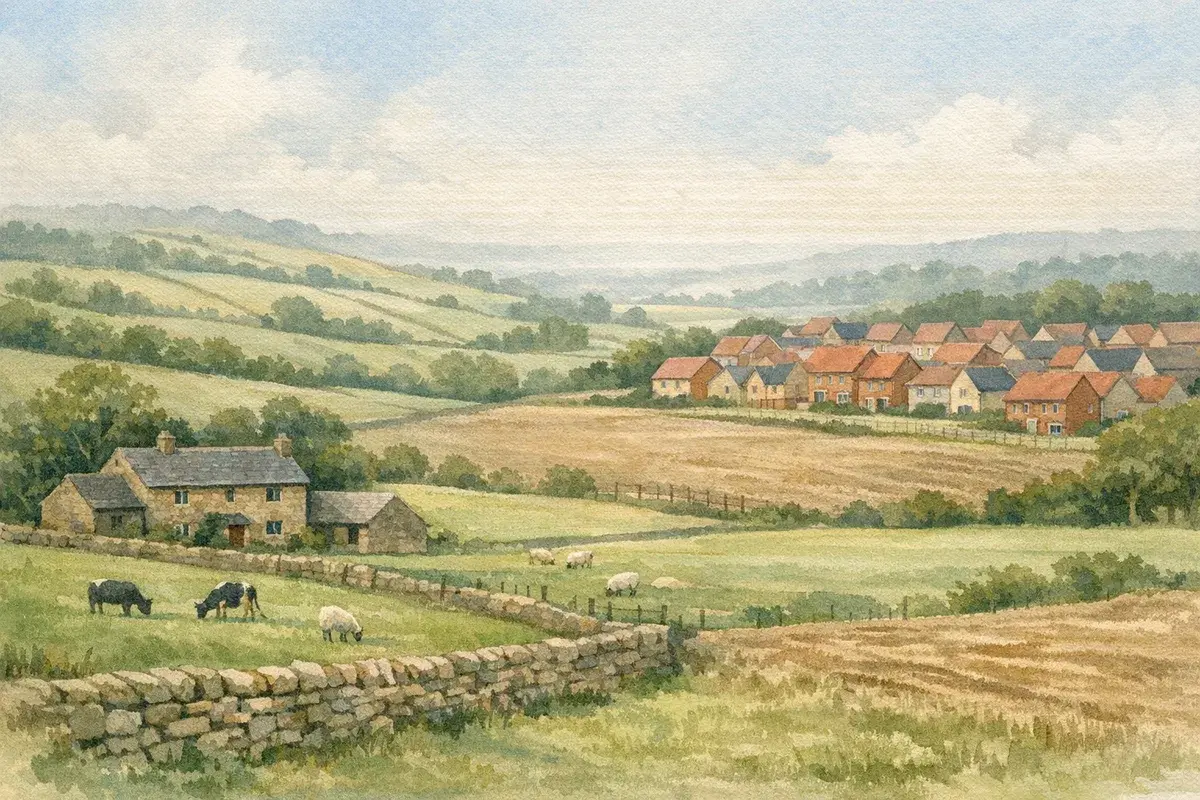
The first time a developer phones you about a field, it can feel like you've been handed a golden ticket.
And sometimes you have. But just as often, what you've actually got is interest, not value. In the UK, development value is created (or destroyed) by planning policy, constraints, access, servicing, and deal structure. Miss one moving part and you can lose years, spend a fortune, or sign away upside you didn't even realise existed.
This guide is written for you as the landowner: practical, UK‑specific, and focused on how deals really get done, what's realistic, what to prepare, which route to market fits your risk appetite, and how to negotiate so you capture value rather than leak it.
Start With The Right Question: Is Development Value Actually Realistic?
If you only take one idea away, make it this: developers don't buy land, they buy planning outcomes. Your job is to work out whether your land can credibly move from "nice idea" to "deliverable site" in the eyes of a planning officer, a highways engineer, and (crucially) a funder.
A quick sanity check early on saves months of noise.
How Developers Assess A Site's Potential
Developers will usually do an initial "desktop" appraisal in days, then a deeper look if the basics stack up. They're typically scanning for:
- Policy direction: Is your land allocated in the Local Plan, or at least in an area where growth is being pushed? If it's not allocated, is there a plausible route via a review, windfall policy, or appeal?
- Deliverability: Can homes actually be built and sold there at a pace that makes sense, access, gradients, services, drainage, and buildability all matter.
- Constraints profile: Some constraints add cost: others make consent very unlikely.
- Comparable precedents: Planning history nearby is a strong signal. If similar edge‑of‑settlement sites have been approved recently, interest becomes more serious.
- Control: Developers prefer clean title, clear access, and a landowner who can make decisions. Complexity doesn't kill every deal, but it affects price and terms.
One practical move: before you get too far down the track, get a realistic view of value as it stands today versus value with consent. We often see landowners anchor to a "per acre" figure they've heard at the pub, when what really matters is the planning pathway and the eventual gross development value. If you want a structured way to think about pricing inputs and assumptions, our guide on how a proper land valuation is put together is a good place to start.
Red Flags That Kill Deals Early
Developers are ruthless at filtering. The following tend to stop a deal before it starts (or push it into a long‑shot "option at a peppercorn" category):
- No credible access: A site that can't achieve safe, adoptable access (or can only do so by paying a neighbour for a strip of land) quickly becomes uneconomic.
- Ransom strips and third‑party control: A tiny sliver of land in someone else's ownership can hold the whole scheme hostage.
- Severe policy constraints: Green Belt isn't automatically impossible, but it's an uphill route. AONB, SSSI, and heritage designations can be equally tough depending on harm and mitigation.
- Flood risk and drainage reality: Flood Zone 3 isn't always dead, but it requires robust evidence and can reduce developable area.
- Unclear occupancy/tenancy position: If a tenant has rights that prevent vacant possession when needed, developers either walk away or demand a structure that pushes risk onto you.
- "We'll sort planning later" optimism: If the pitch is vague, no planning strategy, no constraint response, no timeline, treat it as a red flag.
If you're still at the stage of testing the waters, it can help to step back and understand the broader rules around planning on agricultural land so you know what's a genuine opportunity versus wishful thinking. (We'll go deeper in the next section.)
Planning Reality Check: Policy, Constraints, And Strategy
In the UK, the planning system is the gatekeeper. Land can sit beside a village for generations and still never be "right" for housing if policy and constraints are against it.
Before you negotiate price, you need to understand what sort of planning fight you're signing up for, and who's paying for it.
Local Plan, Housing Land Supply, And The "Planning Window"
Most development value is unlocked when your land is either:
- Allocated (or proposed for allocation) in the Local Plan, or
- A credible windfall site in a location planners can defend, or
- In a moment of policy vulnerability, for example when the council can't demonstrate a robust housing land supply.
The "window" is real. There are periods when local authorities are updating plans, running "call for sites", or facing pressure on housing delivery. That's when well‑presented land with a strong planning case can move quickly.
If you're not confident where your land sits, start with the fundamentals: what permission is required, what's possible under permitted development, and what absolutely isn't. Our explainer on planning rules for agricultural land in the UK lays out the basics plainly, without the usual jargon soup.
Key Constraints: Green Belt, AONB, SSSI, Flood Risk, Highways, And Services
Constraints aren't all equal. Some are "hard stops", some are "expensive but solvable", and some are simply a case of presenting evidence.
- Green Belt: Development is generally inappropriate unless very special circumstances apply. Developers may still pursue it where councils are under pressure, but you should expect a longer timeline and higher risk.
- AONB / National Landscapes: Expect landscape‑led design, reduced density, and heavy scrutiny. Value can still be strong, but only if the scheme can show exceptional quality and minimal harm.
- SSSI / designated habitats: You can be into complex ecology and potentially "no go" outcomes depending on impact.
- Flood risk and drainage: Developers will look for sequentially preferable land, then mitigation. Sustainable drainage is now a core design issue, not an afterthought.
- Highways: If visibility splays, junction capacity, or pedestrian safety can't be solved without third‑party land or major off‑site works, your value can collapse fast.
- Services: Power, water, and foul drainage capacity can be a nasty surprise. "Close to houses" doesn't mean "easy to connect".
A useful mindset: planning is rarely a single yes/no question. It's a negotiation between policy, evidence, and impact mitigation, then economics.
Pre-Application, Promotion, And Appeal: Common Routes To Consent
Most landowners encounter three broad pathways:
- Pre‑application discussions: You (or your team) test the principle with the local authority before submitting. It can flush out showstoppers early, but it doesn't guarantee success.
- Promotion: A promoter funds and manages the planning process, then markets the land once consent is secured, taking an agreed fee from sale proceeds.
- Appeal: If planning is refused, a robust appeal may succeed, but it's expensive, slow, and outcome‑uncertain.
The right route depends on your appetite for time and risk, and whether you want to stay hands‑on. For many landowners, the key is not to "wing it" based on a developer's enthusiasm. You want a strategy that's defensible on paper and costed properly.
Getting The Land Ready: Evidence, Title, And Practical Due Diligence
Selling agricultural land to developers isn't like selling a block of pasture to a neighbour. Once development is in the conversation, the buyer's solicitor, funder, and technical team will pick the site apart.
Your leverage increases dramatically when you've already done the unglamorous groundwork.
Title, Easements, Ransom Strips, And Access Rights
Developers prize certainty. Before you get too far into negotiations, make sure you can answer:
- Do you have registered title with clear boundaries?
- Are there rights of way across the land (public footpaths, bridleways)? Can they be diverted, and at what cost/time?
- Is access owned by you, or do you rely on third‑party rights?
- Are there restrictive covenants (e.g., "no building", "agricultural use only") that could complicate the planning and legal route?
- Is there any historic "ransom" position, someone owning a strip between your land and the adopted highway?
If you're considering carving out a development parcel while retaining the rest of the farm, treat boundaries, access, and service corridors as a design exercise, not a red line on a map. This is where it's worth reading up on the practicalities of selling off a portion of a holding, done well, it protects the retained land and reduces future disputes.
Tenancies, Grazing Licences, And Vacant Possession
Occupation is one of the most common "it seemed fine until the lawyers got involved" issues.
Developers often want vacant possession on completion, or at least a clear, timed route to it. If the land is occupied, you need clarity on:
- What agreement is in place (FBT, AHA 1986 tenancy, grazing licence, informal arrangement)?
- What notices are required and whether termination is actually achievable.
- Who owns crops, improvements, and entitlements.
- Whether the occupier has any renewal rights or compensation claims.
If you're dealing with an occupier, don't assume it's "simple" because it's your neighbour or a handshake arrangement from years ago. Start here: our guide to selling land where there's a tenant in place covers the issues that typically matter in a development‑led sale.
Surveys And Reports Developers Will Expect
Even at heads of terms stage, expect a serious buyer to ask for (or commission) a suite of technical work. The most common includes:
- Topographical survey (levels, features)
- Phase 1 desktop environmental (contamination risk)
- Ecology (protected species, habitats, biodiversity net gain considerations)
- Flood risk assessment and drainage strategy (often including infiltration testing)
- Transport statement / highways appraisal
- Utilities searches (capacity and routes)
- Ground investigation (later stage, but it affects foundations and cost)
You don't necessarily need to commission everything upfront. But you do want to know what the likely findings are, because unpleasant surprises late in a negotiation usually translate to price chips or more onerous contract terms.
If you're at the "getting your ducks in a row" stage generally, it's worth running through a proper preparation checklist. We've put one together on how to get agricultural land ready for sale, much of it applies even when development is only a possibility.
Choosing Your Route To Market: Sell Now, Promote, Or Option?
How you sell is often more important than who you sell to.
The structure determines who pays for planning, who controls the process, how long you're tied in, and how much upside you keep if the site takes off.
Outright Sale Vs Conditional Contract Vs Option Agreement
Three common deal shapes come up in UK land-to-developer conversations:
- Outright sale (unconditional): Fast and simple. But unless you already have strong planning prospects (or consent), you may be selling at agricultural/"hope value" levels and leaving a lot on the table.
- Conditional contract: The buyer agrees to purchase if certain conditions are met, typically planning permission by a longstop date. You often get a deposit and a defined price mechanism. Done well, it balances certainty and upside.
- Option agreement: The developer pays for the right (not obligation) to buy the land at a future point, usually triggered by planning. Options can be sensible, but they can also be landowner‑unfriendly if the term is long, the option price formula is weak, or the buyer can "land bank" without meaningful effort.
The detail that really matters isn't the label, it's the obligations: What must the buyer do? By when? At whose cost? With what planning strategy?
Promotion Agreement: When It Works Well (And When It Doesn't)
A promotion agreement can be a strong fit when:
- The planning route requires persistence and expertise.
- You want competitive tension once consent is achieved (promoter markets the land to multiple bidders).
- You're comfortable sharing proceeds via a promoter's fee (often a percentage of sale price).
But it can disappoint when:
- The promoter's incentives don't fully align with your priorities (e.g., speed vs maximising value vs protecting retained land).
- The agreement gives too much discretion over planning strategy, or too little transparency on costs.
- There are disputes later about what counts as "market value" or "best price reasonably achievable".
A pragmatic tip: insist on clear reporting, agreed consultant appointments, and a tight definition of recoverable costs, otherwise the final net figure can feel like it's been nibbled away.
Joint Ventures And Overage In Principle
Sometimes the right answer isn't selling immediately at all. You may explore:
- Joint ventures where you contribute land and share profit with a developer.
- Overage (clawback) where you sell now but retain a right to additional payment if planning is improved later.
Both can help you capture upside. Both can also create years of admin and dispute risk if drafted loosely.
At this stage, it helps to step back and make sure you're comparing routes like-for-like (risk, timing, tax, control), not just chasing the highest headline number.
Price, Terms, And Value Capture: Negotiating Like A Landowner
Developers negotiate for a living. Many landowners don't. That doesn't mean you're at a disadvantage, your leverage is the asset and the ability to say "no", but you do need a framework.
Benchmarking Value: Hope Value Vs Consent Value
You'll hear two phrases thrown around constantly:
- Hope value: what someone will pay for land with a chance of planning, reflecting risk and time.
- Consent value: what land is worth with a deliverable planning permission in place.
The gap between them can be enormous. So when a developer offers "a premium over agricultural value", ask yourself: premium over what? A decent offer for a low-probability site might still be far below what you could achieve under promotion or a conditional contract.
A useful approach is to separate:
- Planning probability (what are the real odds, not the sales pitch?),
- Time to consent (months vs years), and
- Net land receipt after abnormal costs, contributions, and fees.
If you're serious about taking the market's temperature, don't rely on one inbound call. Put the site in front of the right buyers, properly presented, and create competition. Our guide to marketing rural and agricultural land effectively is aimed at straight sales, but the principles, information pack quality, targeting, and competitive tension, apply just as much to development land.
Overage (Clawback): Triggers, Time Limits, And Anti-Avoidance
Overage can protect you if you sell before the full potential is realised. But it only works if it's drafted with real‑world behaviour in mind.
Key elements to get right:
- Trigger events: common triggers include the grant of planning permission, implementation, sale of the site, or sale of dwellings. Each has pros/cons.
- Time period: too short and it's meaningless: too long and it can blight the buyer's ability to finance or sell on. Many deals land somewhere in the 10–25 year range, depending on strategy.
- Calculation method: is overage a percentage of uplift in land value, a per‑plot payment, or a share of profit? Clarity reduces disputes.
- Anti‑avoidance: buyers can structure around weak overage (e.g., transferring shares in a company rather than selling land, or securing permissions in phases). Your solicitor needs to anticipate this.
- Security: a restriction on title, legal charge, or escrow arrangements can be essential, overage without enforcement is just a polite request.
Overage discussions can feel adversarial. They don't have to be. The best deals are the ones where both parties know what success looks like and the paperwork makes it hard to play games.
Costs, Exclusivity, And Timetables: What To Push Back On
Watch for "death by a thousand cuts" in heads of terms:
- Exclusivity: if a developer wants you tied in, they should commit to a timetable, milestones, and meaningful cost coverage.
- Abnormal costs: ground conditions, drainage, ecology, utilities, make sure assumptions are evidenced, not speculative.
- Planning obligations: the developer will factor in CIL (where applicable) and Section 106 contributions. You don't need to be a planner, but you do need transparency on what's being deducted in valuation models.
- Longstop dates: without them, you can be stuck for years with no progress.
A small but important reality: the cleanest headline price is not always the best deal. Certainty of completion, enforceable obligations, and downside protection matter, especially if you're planning retirement, succession, or reinvestment.
Tax, Structuring, And Cashflow: Avoid Expensive Surprises
Tax can turn a "great" development deal into a disappointing one, particularly if you commit to a structure early, then discover you've triggered an avoidable charge or lost a relief.
You don't need to become a tax technician. But you do need to know where the cliff edges are, and get advice before you sign anything binding.
Capital Gains Tax, Corporation Tax, And The Trading Vs Investment Line
For individuals and trusts, selling land will often sit in Capital Gains Tax (CGT) territory. But development activity can muddy the water.
Where land is bought (or held) with a view to profit from development, or where you take an active role that looks more like a trade, HMRC may argue income treatment rather than capital. That can mean higher tax rates and National Insurance implications.
If you're operating through a company, Corporation Tax will typically apply, but again the detail depends on what you're doing and why.
The message we hear repeatedly from advisers we work with: get input early, because the "trading vs investment" analysis is fact‑sensitive, and your paper trail (board minutes, business plans, historic use) can matter.
Reliefs To Explore: BADR, Rollover Relief, Hold-Over Relief, IHT APR And BPR
Depending on your circumstances, there may be reliefs worth exploring with a specialist rural tax adviser:
- Business Asset Disposal Relief (BADR) (formerly Entrepreneurs' Relief): potentially reduces CGT on qualifying disposals, but the conditions are specific.
- Rollover Relief: may apply if you reinvest gains into qualifying business assets within the permitted timeframe.
- Hold‑Over Relief: can apply to certain gifts/transfers, often relevant in succession planning.
- Inheritance Tax (IHT) reliefs: Agricultural Property Relief (APR) and Business Property Relief (BPR) can be crucial for family farms, but development arrangements can affect availability.
A common pitfall: entering into development arrangements (options, promotions, joint ventures) without considering how they may alter the character of the asset for IHT or push you into a less favourable position.
VAT, SDLT, And The Option To Tax
VAT is often overlooked until late in the day.
- Bare land is often VAT exempt, but elections like the option to tax (for commercial property/land) can change treatment.
- Developers may prefer certain VAT positions depending on their ability to recover input VAT.
- SDLT is the buyer's issue in principle, but it affects what they can pay and how they structure.
This is an area where "rule of thumb" advice can be dangerously wrong. If VAT is in play, involve a VAT specialist, especially where there are buildings, mixed use, or you're granting rights rather than selling freehold.
Professional Team, Process, And Pitfalls To Avoid
A strong team pays for itself in this world. You're making a one‑off, high‑stakes transaction: the other side will do ten of these a year.
Who You Need And When: Agent, Solicitor, Planner, Surveyors, And Tax Adviser
For most landowners selling agricultural land to developers, you'll want:
- A specialist rural/strategic land agent: not just to "find a buyer", but to run competitive tension, sanity‑check appraisals, and negotiate heads of terms.
- A solicitor experienced in development land: options, promotions, overage, and title risks are a different discipline from straightforward farm sales.
- A planning consultant: to assess policy, constraints, and the realistic route to consent.
- Surveyors/technical consultants as needed: ecology, highways, drainage, utilities.
- A tax adviser with rural/development experience: to protect reliefs and structure the transaction sensibly.
If you're also considering a simpler sale route (without a development angle), it's still worth understanding the standard process end‑to‑end. Our step-by-step on how to sell agricultural land in the UK helps you map what happens when, from title and access to negotiation and completion, so you're not blindsided when things speed up.
Heads Of Terms, Confidentiality, And Data Rooms
Developers often want momentum: "Let's agree heads of terms quickly." That's fine, if heads of terms capture the commercial deal properly.
Practical tips:
- Don't treat heads of terms as disposable. They're not legally binding in most respects, but they set the tone and become the template for legal documents.
- Use confidentiality agreements where appropriate, especially if you're sharing farming accounts, tenancy details, or technical reports.
- Build a simple data room early: title documents, plan, wayleaves, utility info, tenancy agreements, basic constraints maps, and any surveys you already have. Being organised signals seriousness and reduces delays.
Common Deal Breakers: Promotion Conflicts, Uplift Disputes, And Enforcement Risk
The issues that most often derail (or poison) development deals include:
- Misaligned incentives in promotion arrangements: for example, disputes over strategy, density, or when to sell.
- Uplift and overage arguments: vague drafting leads to years of wrangling. Define assumptions and scenarios upfront.
- Enforcement risk: if there's been unauthorised use, unauthorised access works, or historic breaches, resolve them before they're weaponised in negotiations.
- Third‑party leverage: neighbours controlling access, service routes, or visibility splays can extract value late in the process.
One "quiet" pitfall: letting a developer control the narrative with their appraisal model. You want your adviser to interrogate the inputs, sales values, build costs, planning obligations, abnormal costs, so you know whether a discount is real or just convenient.
If you're actively looking to test developer appetite, AgLand shows you how many registered buyers already match your land before you pay anything, then lets you advertise straight to them for one flat fee, with no commission and no board at the gate. Your outcome still depends on planning and deal structure, but being visible to the right market is part of keeping leverage.
Conclusion
Selling agricultural land to developers can be transformative, financially and for your long‑term plans. But in the UK it's rarely a simple "field equals housing" equation. The money arrives when policy lines up, constraints are understood, access and title are clean, and the deal structure keeps your interests protected.
If you're considering a developer approach, treat the early stage like a triage: reality‑check planning prospects, get your paperwork and occupation position straight, and choose a route (sale, option, conditional, promotion) that matches your appetite for time, risk, and control. Then negotiate terms that are enforceable, not just optimistic.
Disclaimer: AgLand.co.uk is a UK agricultural land and rural property matching service, where buyers register what they are looking for and owners advertise directly to the buyers who match, and a rural resource hub. Nothing in this text is intended as legal, financial, tax, or investment advice. You should carry out your own due diligence and take advice from appropriately qualified professionals (for example, a solicitor, chartered surveyor/land agent, planner, and tax adviser) before making decisions or entering into any transaction.