
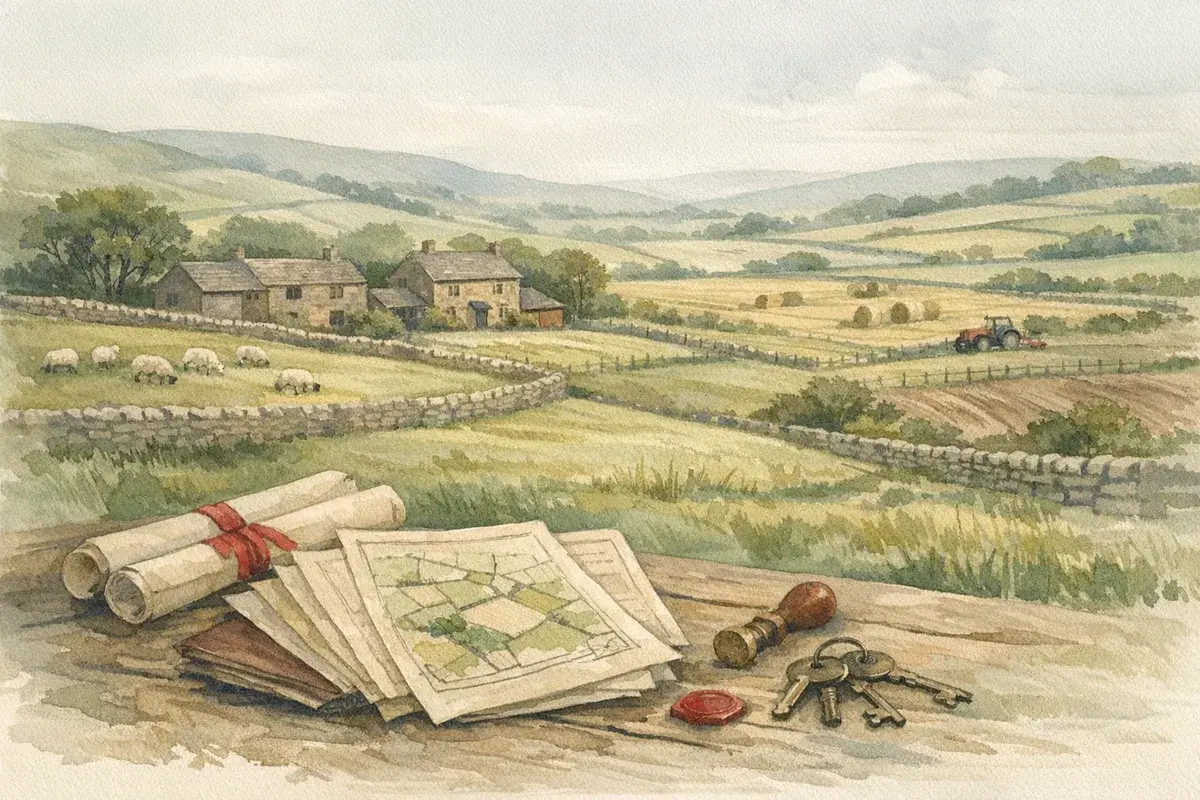
You've found the right block of ground. The soil's decent, the yard's workable, and the price feels… almost believable. Then someone says, "Have you checked the title deeds?"
In UK rural property, that one question can be the difference between a straightforward purchase and a slow-motion headache involving missing strips of access, old covenants no one remembers signing, or a neighbour who's quietly used your track for 30 years.
This guide cuts through what an agricultural land title deed actually is in 2026 (spoiler: it's usually not a dusty bundle of parchment), what it proves, what it doesn't, and how you use it, properly, when you're buying, refinancing, claiming grants, or sorting out family land that's been "always ours".
What A Title Deed Actually Is (And What It Is Not)
If you're used to the phrase "title deeds", you might picture a big envelope of original documents kept in a solicitor's strongroom. That still exists sometimes, particularly with older rural holdings, but in most day-to-day UK transactions the practical reality is simpler:
For registered land, your "title deed" is effectively the HM Land Registry title (the title register and title plan), plus any documents referred to on it.
What it proves (most of the time):
- Who owns the land (the registered proprietor)
- What land is included (by reference to a plan)
- What rights benefit the land (e.g., rights of way)
- What burdens affect it (e.g., restrictive covenants, charges)
What it does not automatically prove:
- That every boundary line on the ground is correct to the centimetre
- That access is practical, usable, and dispute-free
- That there aren't occupiers, informal arrangements, or third-party rights not obvious at first glance
- That the holding works for your intended use (planning, grant compliance, development potential)
Registered Title Vs Unregistered Title
Most rural property in England and Wales is now registered, but pockets of unregistered agricultural land still exist, often because it's been in the same family for generations and hasn't triggered compulsory registration (for example, by sale or mortgage).
- Registered title: HM Land Registry holds the definitive record. You rely on official copies of the register and plan.
- Unregistered title: Ownership is proved by a chain of historic deeds (conveyances, mortgages, assent documents, etc.). Your solicitor will want to see an unbroken chain, typically at least 15 years, showing good root of title.
If you're unsure where to start, it helps to understand how rural titles are handled in practice by HM Land Registry and what the common pitfalls are. AgLand's explainer on how the Land Registry treats agricultural land in real transactions is a useful companion when you're getting your head around the basics.
Title Register, Title Plan, And Supporting Deeds
For registered land you'll usually deal with:
- Title Register (the written record): split into Property / Proprietorship / Charges.
- Title Plan (the mapped extent): the land edged in red, often with notes.
- Supporting deeds: referenced documents, older conveyances, deeds of grant, transfers, deeds of easement, or agreements, often where the detail lives.
A very common rural mistake is treating the register and plan as "the whole story". In reality, the register is the index and the detail is sometimes sitting behind a referenced deed. If the register says "copy filed" or refers to a dated deed, you need to read it, not assume it's harmless boilerplate.
Why Rural Property Is Often More Complex Than It Looks On Paper
Rural property isn't just a red line on a plan. It's access routes, drainage ditches, water supplies, third-party apparatus, and long-running "handshake" arrangements that worked fine, until someone tries to sell or borrow against the land.
In towns, titles can be complicated too, but agricultural land tends to stack up issues because it's worked, crossed, shared, and altered over decades. And the paperwork often lags behind the practical reality.
Boundaries, Hedgelines, Ditches, And The Limits Of The Title Plan
HM Land Registry title plans are prepared using Ordnance Survey mapping and operate under the general boundaries rule. In plain English:
- The red edging shows the general position of the boundary, not the exact legal line.
- Thick lines on OS mapping can cover a surprising width on the ground (a hedge, bank, ditch, fence, and a bit of "no man's land" can all sit inside that thickness).
This matters because rural boundaries are rarely neat:
- Hedgelines get laid, flailed, moved, or replaced.
- Ditches can indicate a boundary, but ownership can depend on which side the ditch sits and historic practice.
- Banks, walls, and fences are not always on the legal boundary.
- Watercourses can move gradually over time.
If a boundary is genuinely contentious, or the exact line is vital for value (say, a yard edge, a building plot, or a ransom strip scenario), you may need a measured survey and possibly an agreed boundary or determined boundary application. Don't assume the title plan will settle an argument at the gate.
Rights And Burdens: Easements, Wayleaves, Covenants, And Ransom Strips
Most rural deals hinge on rights and burdens:
- Easements: rights of way, rights to run services, rights to take water.
- Wayleaves: often for electricity apparatus: sometimes contractual rather than permanent rights.
- Restrictive covenants: limits on use, e.g., "no buildings", "agricultural use only", or restrictions tied to an old estate sale.
- Ransom strips / retained strips: a sliver of land retained to control access or extract value.
It's common to find an old covenant that looks irrelevant, until you want to put up a grain store, diversify, or split off a paddock. If you're regularly dealing with these, it's worth reading up on how they bite in practice: AgLand's guide to rural restrictive covenants and how they can affect land use goes deeper into the typical wording and what to do about it.
A practical rule we've seen hold up well: if a right is critical to the farm's operation (access, water, drainage, services), it should be explicitly documented and you should be able to point to where it appears on the register/plan or in the supporting deed.
How To Get A Copy Of An Agricultural Land Title Deed
When someone asks you to "send the title deeds", what they usually mean is:
- the official copy of the title register, and
- the official copy of the title plan,
…plus any documents referred to.
Downloading Official Copies From HM Land Registry
If the land is registered, you can usually obtain official copies online through HM Land Registry's digital services. For due diligence, the key is to make sure you're pulling:
- The correct title number (rural holdings can have multiple titles)
- The title plan for each title
- Any filed deeds or documents referred to in the register (not always automatically included)
Also, pay attention to whether you're looking at the title for:
- Freehold land
- Leasehold parts (yes, rural land can have leasehold interests)
- Separate titles for tracks, verges, or yard areas
If you're doing this because you're preparing a sale, refinancing, or trying to tidy up the paperwork on family land, the wider context of registration matters. AgLand's practical overview on agricultural land registration in the UK explains when registration is triggered and why getting it right early saves pain later.
What To Do If The Land Is Unregistered Or Deeds Are Missing
Unregistered land isn't automatically "dodgy". But it does raise the stakes because your proof of ownership depends on physical documents.
If deeds are missing, or the chain of ownership is incomplete, your solicitor may discuss:
- Reconstructing title from copies held by lenders, previous solicitors, or estate papers
- Statutory declarations / statements of truth to evidence long possession and use
- Title insurance (sometimes suggested, but it's not a magic wand)
- Applying for first registration based on available evidence
If you've inherited land, or you're looking at a block that's never been registered, you'll want a clear process for bringing it onto the register. AgLand has a step-by-step piece on registering unregistered agricultural land that's particularly relevant where deeds are incomplete or historic boundaries are fuzzy.
One more nuance: where the evidence isn't perfect, HM Land Registry may register you with a lesser class of title (for example, possessory). That can be workable, but it has implications for value, lending, and resale.
How To Read The Title Register Like A Pro
The title register is short, but it's dense. Rural buyers sometimes skim it, see the seller's name, and move on. The better approach is to read it like you're looking for failure points.
A registered title in England and Wales is typically divided into three sections.
Property Register: What You're Buying (And What's Included)
This section describes the land and may refer to:
- The tenure (freehold/leasehold)
- The location and any postal address (often vague for fields)
- Rights that benefit the land (e.g., "together with a right of way…")
- Land that has been removed from the title (transfers out)
What to watch for:
- "Except and reserved" rights: these can carve out surprising controls for someone else.
- Multiple parcels: one "farm" may sit across several title numbers.
- Rights granted but not wide enough: e.g., a right of way "on foot" where you need tractors and artics.
If you're buying, align this with your operational needs: can you get modern machinery in? Can a milk tanker or muck lorry legally use that track? If the wording is silent on vehicles, don't assume.
Proprietorship Register: Ownership, Restrictions, And Buying Entities
This is where you'll see:
- The registered proprietor(s)
- The class of title (absolute, possessory, qualified, etc.)
- Price paid data (often, but not always)
- Restrictions, these are big in rural deals
Restrictions are instructions to HM Land Registry, e.g. requiring:
- Consent of a lender (if there's a charge)
- Two trustees for a trust sale
- Compliance with a deed (sometimes used where overage or estate controls exist)
If you're buying through a company, partnership, or with family members, restrictions can affect how quickly you can complete and what evidence your solicitor must provide.
Charges Register: Mortgages, Notices, And Third-Party Rights
This section records:
- Legal charges (mortgages)
- Notices protecting third-party rights
- Restrictive covenants and other burdens
Two practical tips here:
- Read the dates. A 1920s covenant can still bind land today.
- Chase referenced documents. "A conveyance dated…" can contain the detail that makes or breaks your intended use.
And if you're regularly handling rural transactions, it helps to know the standard "agricultural notes" and flags that often appear on Land Registry records. AgLand's overview of Land Registry notes that commonly crop up on agricultural titles is useful for decoding the less obvious entries.
What To Check On The Title Plan (And What Else You Must Cross-Reference)
The title plan is where many rural assumptions go to die.
Yes, it shows the land edged red. But your job is to test whether the plan matches reality, and whether reality is legally supported.
Is The Access Legally Documented From Public Highway To Field Gate?
You're looking for an unbroken chain of lawful access:
- From the public highway
- Along the route you'll actually drive
- To the field gate / yard entrance
Questions to ask yourself:
- Is the track included in the red edging, or is it outside the title?
- If it's outside, is there an express right of way in the register (and is it wide enough for agricultural use)?
- Does the plan show the route clearly, or is it described only in an old deed?
In practice, we see deals wobble because access is "always been used" rather than legally documented. Lenders care. Future buyers care. And neighbours care, especially when traffic increases.
If you're at the stage of evaluating a purchase, it's worth following a structured process so title checks aren't done in isolation from planning, access, and occupation. AgLand's step-by-step guide to buying agricultural land in the UK is built around that reality.
Are All Parcels Included, Or Are There Exclusions And Retained Strips?
Rural titles are often messy around edges:
- A verge or ditch might be excluded.
- A strip along a boundary may have been retained years ago.
- A yard corner may sit on a different title.
What to do:
- Compare the title plan with what you see on the ground and on mapping.
- Ask for the seller's plan used for cropping, stewardship, or farm assurance, then cross-check against the registered extent.
- Look for "T marks", colouring references, and notations on the plan (and in filed deeds) that show shared structures or maintenance obligations.
Remember: the title plan is not a full operational map. It doesn't show everything you'll care about (drains, water pipes, cabling, informal turning areas). Treat it as a legal starting point and cross-reference hard.
Common Agricultural Title Issues That Delay Or Derail Deals
If rural transactions had a top ten list of deal-killers, most would be "title-adjacent": not necessarily fraud or drama, just unresolved practical reality.
Gaps In Title, Possessory Title, And Adverse Possession Risks
A few recurring scenarios:
- Gaps in the deed chain (unregistered land): missing conveyance, lost mortgage release, unclear transfer on death.
- Possessory title (registered): the owner is registered, but the evidence wasn't strong enough for absolute title at first registration.
- Adverse possession risk: a neighbour (or the public) has used land in a way that might support a claim over time.
Possessory title isn't automatically a problem, but it can:
- Make some lenders cautious
- Trigger extra legal enquiries
- Complicate resale if the buyer's solicitor is risk-averse
Where you're starting from a weaker class of title, there are sometimes routes to improve it over time with evidence and the right application. AgLand's guide to upgrading an agricultural title where the class of title isn't ideal is worth reading if you're trying to "clean up" a holding for sale or refinance.
Occupiers, Grazing Licences, Farm Business Tenancies, And Sporting Rights
One of the most common surprises: someone else is using the land, and it's not always clear on the title register.
In rural property, occupation can come from:
- Grazing licences (short-term, but sometimes poorly documented)
- Farm Business Tenancies (FBTs) under the Agricultural Tenancies Act 1995
- Older agricultural tenancies (potentially more protected)
- Informal arrangements (the dangerous "he's always had that field" situation)
Your due diligence needs to confirm:
- Who is in occupation on completion day
- What rights they have to stay
- Whether any notices have been served properly
And don't forget sporting rights. Sometimes they're retained or leased separately, meaning you might buy the land but not control shooting rights, which can affect insurance, access, and neighbour relations.
Minerals, Manorial Rights, And Overages: The Clauses Buyers Miss
This is where rural titles get properly specialist.
- Mineral reservations: someone else may own or have rights to mines and minerals, sometimes with rights of entry. This can matter for development, quarrying interest, or infrastructure.
- Manorial rights: these exist historically and can still appear as notices on titles (often low day-to-day impact, but they spook buyers if not explained).
- Overage / clawback: the seller (or historic estate) takes a share of uplift if you get planning permission or change use.
Overage is a classic "looks fine until you run the numbers" clause. If you're buying with any hope of diversification, equestrian use, solar, or development, overage wording and triggers need to be understood early, ideally before you spend heavily on surveys and applications.
At this point, bringing in the right solicitor and (often) a land agent to sanity-check how the holding works in reality pays for itself.
Using Title Deeds In Real Decisions: Finance, Grants, Planning, And Tax
Title deeds aren't just a box-ticking exercise for conveyancing. They show up in practical decisions you'll make over the next decade.
Lenders, Security, And Why Clean Title Matters For Borrowing
Lenders want certainty. Clean title helps because it reduces the risk that:
- The land can't be accessed legally
- Part of the land isn't actually included
- Third-party rights reduce value
- Restrictions prevent registration of the lender's charge
If you're refinancing, splitting titles, or borrowing against only part of a holding, small errors become expensive. We've seen lenders pause offers simply because the "security" land on their plan doesn't match the registered title extent.
Subsidies And Schemes: Mapping Parcels, Control, And Consents
While payment schemes and eligibility rules evolve, one constant remains: you'll need accurate parcel mapping and clear control of land.
Title documents help you evidence:
- What land is included within your holding
- Whether you have rights necessary to manage it (access, water)
- Whether there are third-party constraints (easements, wayleaves) that affect what you can do on certain areas
If you're entering land into environmental management or capital works, you may also need consents where other parties have rights.
Farmhouses, Dwellings, And Agricultural Occupancy Conditions
Title issues often surface when a dwelling is involved:
- Is the farmhouse within the same title as the land, or split?
- Are there restrictions or covenants affecting residential use?
- Is there an agricultural occupancy condition (AOC) or tie (usually a planning condition, but it can interact with value and mortgageability)?
A title deed won't tell you the whole planning story, but it can hint at constraints, especially where covenants or overage are used to control residential separation.
If you're even considering a farmhouse purchase, a proposed dwelling, or converting buildings, it's sensible to treat title review and planning review as one joined-up task, not separate checklists.
A Practical Due Diligence Checklist Before You Make An Offer
You don't need to be a solicitor to do sensible early-stage due diligence. You just need a disciplined list, and the humility to assume something will be slightly off.
Documents To Request Beyond The Land Registry Title
Beyond the official register and plan, ask for:
- Copies of all filed deeds referenced on the register
- Any rights of way agreements (and plans showing routes)
- Wayleave agreements and details of apparatus (electricity, telecoms, pipelines)
- Drainage / water agreements (private supplies, easements, discharge consents where relevant)
- Details of occupiers: licences, FBTs, service occupancy, or informal arrangements (get them in writing)
- Sporting rights details (owned, leased, reserved?)
- A plan showing what the seller believes they're selling (and any excluded areas)
If the land is unregistered, you'll want the full deed bundle, plus any statutory declarations that support long use, access, or boundaries.
When To Bring In A Land Agent, Solicitor, Surveyor, Or Rights Specialist
This is where being pragmatic saves money.
Bring in specialist help early if any of the following are true:
- Access isn't clearly within the title or granted by deed
- The land is split across multiple titles (or doesn't match the seller's plan)
- There are covenants, restrictions, overage, or unusual third-party notices
- You suspect boundary drift, encroachment, or neighbour disputes
- The land includes buildings, yards, dwellings, or development potential
- You'll need lending and the lender is likely to be cautious
A good agricultural solicitor doesn't just "do the paperwork": they spot rural-specific risks and know what to press on. If you're choosing one (or trying to understand what you're paying for), AgLand's guide on what an agricultural land solicitor actually does in a rural purchase is a solid benchmark.
Land agents and surveyors can be equally important when the issue is practical, how the farm functions, where the boundary likely sits, whether access works for modern kit, and how to negotiate a fix (a deed of grant, a title adjustment, a retention, or a price chip) without derailing goodwill.
One final, slightly unromantic point: don't make your offer the moment you fall in love with a view. Make it when you can see the legal and practical shape of what you're buying.
Conclusion
An agricultural land title deed in the UK is less about tradition and more about certainty: what you own, how you reach it, what you can do with it, and what might stop you.
If you take one habit from this guide, make it this: always cross-reference the register, plan, and the on-the-ground reality before you commit serious money. Rural property rewards careful buyers, and it punishes assumptions.
Disclaimer: AgLand.co.uk is a UK agricultural land and rural property matching service, where buyers register what they are looking for and owners advertise directly to the buyers who match, and a rural resource hub. Nothing in this text is intended as legal, financial, or investment advice. You should do your own due diligence and seek help from appropriate professionals (such as an agricultural solicitor, chartered surveyor, land agent, tax adviser, or planning consultant) before making decisions or entering into transactions.