
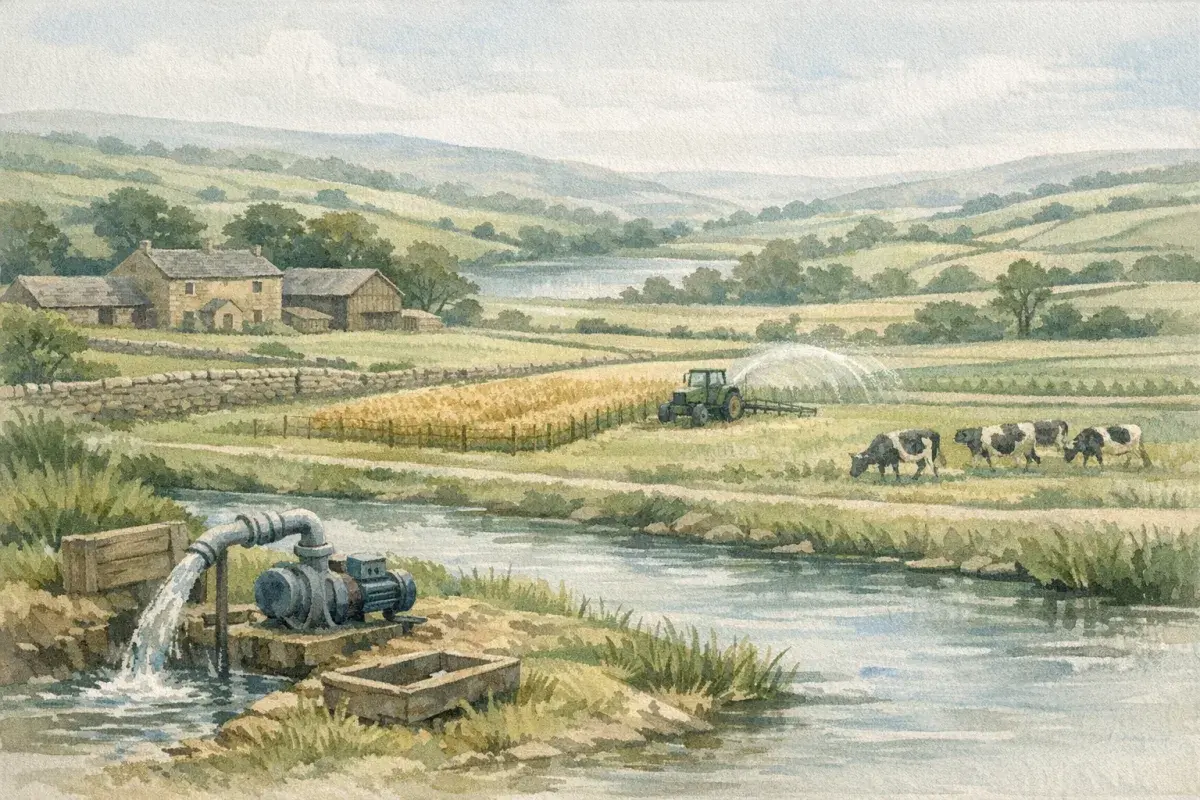
If you're farming in the UK, water is rarely "just water". The moment you take it from a river, stream, borehole, spring, lake, or even an old quarry pond, you can wander into a world of licences, hands-off flow conditions, metering, annual returns, and, yes, water abstraction charges.
And it matters more than it used to. Hotter summers, tighter catchment availability, and tougher scrutiny mean abstraction is now a cost line and a compliance risk you can't treat as an afterthought. The upside? Once you understand how the charging framework works, and where genuine exemptions sit, you can plan, budget, and invest with confidence instead of crossing your fingers every season.
This guide cuts through how UK farm abstraction is defined, how you're charged (and by whom), what drives the price up, where exemptions genuinely apply, and how to reduce your bill without creating new enforcement headaches.
What Counts As Water Abstraction In Farming
Water abstraction is, in plain terms, taking water from the environment. For farming, that can be as routine as filling a sprayer bowser, or as strategic as running an irrigation ring main all summer.
It's easy to assume abstraction only means big irrigation pumps. In practice, regulators look at where the water comes from, how much you take, what you use it for, and whether it affects other users or the environment.
Common On-Farm Abstraction Scenarios
Here are the on-farm situations that commonly fall into abstraction territory (and hence may trigger licensing/charging requirements):
- Irrigation for potatoes, veg, soft fruit, salads, or turf, usually the biggest driver of authorised volumes and charges.
- Livestock watering from boreholes, springs, or surface intakes (often lower volume than irrigation, but still regulated depending on thresholds and local rules).
- Crop spraying / washdown / yard use supplied from a borehole rather than mains.
- Filling storage reservoirs or lagoons from a river or borehole.
- Aquaculture and fisheries (flow-through systems can involve significant volumes).
- Dewatering during construction or drainage works (temporary, but still can require permissions).
A practical way to think about it: if you're using a pump, siphon, pipe intake, or borehole to move water from a natural source into your system, you should assume abstraction rules might apply until you've confirmed otherwise.
Surface Water Vs Groundwater: Why The Source Matters
Your water source changes both risk and cost.
- Surface water (rivers, streams, lakes) is often more environmentally sensitive because flows vary day-to-day. Licences can include hands-off flow conditions, meaning you must stop abstracting when river flows drop below a trigger level.
- Groundwater (boreholes, wells, springs) can be more stable but is tightly managed where aquifers are under pressure. Regulators pay close attention to cumulative impacts and nearby dependent habitats.
From a charging perspective, the source can affect the likelihood of seasonal restrictions, and the long-term reliability of your supply. For property and tenancy decisions, understanding your source isn't a "nice to have", it feeds directly into cropping options, capital investment, and resilience planning.
If you're trying to get your head around what you can use, store, or need permission for on a specific holding, it's worth reading AgLand's deeper explainer on what to check around water rights on agricultural land (note: it's not a substitute for bespoke advice, but it'll help you ask better questions).
How Water Abstraction Licensing And Charging Works
In the UK, abstraction is governed by a mix of primary legislation - in England and Wales, the Water Resources Act 1991 - regulatory guidance, and local catchment rules. The headline is simple: if you need a licence, you'll normally pay charges, and you'll have reporting duties. But the detail, who you deal with and how your licence conditions bite, depends on where in the UK the abstraction happens.
Who Regulates And Bills You In England, Wales, Scotland, And Northern Ireland
Regulation is devolved, so don't assume your neighbour across a border is playing by identical rules:
- England: Environment Agency (EA)
- Wales: Natural Resources Wales (NRW)
- Scotland: Scottish Environment Protection Agency (SEPA)
- Northern Ireland: Northern Ireland Environment Agency (NIEA) (with related responsibilities across departments depending on context)
These bodies manage licensing, monitor compliance, and issue abstraction-related charges/fees. The charging structures and terminology can differ, but the core principle is the same: authorised abstraction is a managed privilege tied to environmental capacity.
If you're reviewing the broader compliance picture around on-farm water systems, especially where private supplies, distribution, and quality overlap, this resource on agricultural water supply regulations is a helpful companion piece.
Licences, Authorised Volumes, And Hands-Off Flow Conditions
A typical abstraction licence sets out:
- Authorised volume (often an annual total, sometimes with daily/weekly limits)
- Abstraction point (exact location/source)
- Purpose of use (e.g., spray irrigation, trickle irrigation, livestock)
- Seasonality (summer-only, winter-only, all-year)
- Hands-off flow/level (HOF/HOL) conditions (mainly for surface water)
- Time limits / expiry and conditions for renewal or variation
The key operational reality: your licence might allow a high annual volume on paper, but hands-off flow can reduce real-world availability in dry spells, exactly when you want the water most. That mismatch is one of the biggest planning traps in horticulture and irrigated arable.
Metering, Returns, And The Difference Between Charges And Enforcement
Two separate but linked obligations catch people out:
- Charging/fees – what you pay for authorised abstraction (and sometimes application/variation work).
- Compliance/enforcement – what happens if you breach licence conditions, fail to submit returns, abstract without a licence, or ignore hands-off flow.
Most abstractors must keep accurate measurement (often via a meter) and submit returns (typically annually) showing actual volumes abstracted, as set out in the government's abstraction licensing guidance.
Important nuance: you may be charged based on authorised quantities or a charging formula that doesn't perfectly track your actual usage. So even if you barely used the pump in a wet year, your bill might not fall in line with that reality. If you irrigate and have an approved meter, you can ask for a two-part tariff: half the charge is based on your authorised volume and half on what you actually take. That's why licence design, authorised volumes, seasonality, and purpose codes, matters as much as day-to-day pumping discipline.
And enforcement isn't theoretical. Regulators can investigate based on complaints, routine audits, low-flow events, remote sensing, or inconsistencies in returns. Penalties and remediation can be far more painful than the original charge line, particularly if abstraction is linked to environmental harm or persistent non-compliance.
How Abstraction Charges Are Calculated
Abstraction charging is designed to reflect environmental pressure and administrative cost, so it's not a flat "pence per cubic metre" across the board. Two farms taking the same volume can face very different bills depending on timing and location.
Key Charge Components: Volume, Season, Source, And Location
While each regulator has its own charging scheme, the calculation commonly turns on factors like:
- Authorised volume: how much you're allowed to abstract (often a major driver).
- Season of abstraction: summer abstraction is typically priced higher than winter.
- Source type: tidal sources are charged less than rivers and groundwater, and some supported sources cost more.
- Catchment availability / local pressure: areas classed as water-stressed, or with low availability, can cost more.
- Purpose of use: uses that lose more water, such as irrigation, are charged at a higher rate than low-loss uses such as cooling. A winter-only licence cuts the annual charge in England by half.
In plain English: abstraction is priced to discourage taking scarce water at the scarcest time, in the scarcest places.
Why Summer And Low-Availability Catchments Cost More
Summer water is expensive for a reason. In many catchments, ecological flow needs and competing demand (public supply, industry, other abstractors) collide right when rainfall is least reliable.
If you're abstracting for irrigation in July/August, regulators are trying to manage two risks at once:
- Low flows and habitat stress (fish, invertebrates, wetland systems)
- User conflict (other abstractors downstream, navigation interests, angling, and public perception during drought)
That's why licences and charging schemes tend to reward farmers who can do one of the following:
- Abstract in winter (when water is more available), and store it
- Reduce peak summer demand (efficient application, better scheduling)
- Demonstrate low environmental impact (depending on local rules and licence conditions)
Worked Examples For Typical Farm Uses
Charges vary so much by regulator, year, and catchment that publishing "you'll pay £X" is rarely honest. But examples help illustrate what moves the needle.
Example 1: Seasonal spray irrigation (high sensitivity)
You're growing potatoes and veg and rely on summer abstraction for a few intense months.
- Authorised volume is sized for the "bad year", not the average year.
- Summer season weighting applies.
- Catchment is classed as low availability in dry periods.
What tends to happen: even if your actual pumping varies year to year, your cost base can remain stubborn because the licence is built around peak demand and peak environmental pressure.
Example 2: Winter abstraction to fill storage (planning-heavy, often cheaper per unit)
You invest in a reservoir and take water in winter to supply summer irrigation.
- Abstraction season shifts to winter.
- Storage helps you avoid summer hands-off flow restrictions (because you're not abstracting then).
- You still need robust measurement and a licence that matches the operational plan.
What tends to happen: you may improve supply reliability and potentially reduce unit costs, but you've swapped variable summer risk for capital cost, planning constraints, and ongoing inspection/maintenance.
Example 3: Borehole for yard/livestock (lower volumes, but don't assume exempt)
You use a borehole for parlour washdown and livestock water.
- Volumes can be modest compared to irrigation.
- Groundwater management may be strict if the aquifer is pressured.
What tends to happen: charges might be lower, but compliance still matters, particularly if you expand the enterprise and quietly creep into higher daily volumes.
If you want the most accurate forecast, the right approach is to treat abstraction costs like any other farm input: model it. Start with authorised volumes and seasons, overlay likely hands-off flow downtime, and then stress-test your cropping plan against a dry year.
Exemptions, Low-Risk Activities, And When You Still Need To Notify
Exemptions exist, but they're often narrower than people expect, and the wording matters. A common (and expensive) mistake is assuming an activity is exempt because it feels small-scale or "normal farming".
The Main Exemptions Farmers Rely On (And Their Limits)
Across the UK, you'll come across situations where abstraction may be exempt from licensing and/or charging, often tied to very small volumes, specific activities, or temporary works.
Typical examples that sometimes fall into exempt/low-risk territory include:
- Very small abstractions below a daily threshold (thresholds and rules vary by nation and can change, always confirm locally).
- Some emergency uses (rarely a routine operating strategy).
- Certain land drainage-related activities in tightly defined circumstances.
The limits are the point. Even where licensing is not required, regulators can still expect you to:
- avoid environmental harm
- comply with other environmental permitting rules
- keep evidence that your abstraction genuinely sits within an exemption
If you're unsure, treat "exempt" as a hypothesis you need to prove, not a comfort blanket.
Trickle Irrigation, Storage Reservoirs, And On-Farm Transfers
Efficient irrigation (like trickle/drip) is often a smart agronomic move and can reduce overall abstraction volumes. But efficiency doesn't automatically mean fewer regulatory obligations.
- Trickle irrigation may reduce peak demand and total volumes, but you're still abstracting.
- Storage reservoirs can be a major resilience win, but they introduce new layers: planning considerations, engineering assurance, and, crucially, licence terms that match how you fill and use the store.
- On-farm transfers (moving water around a holding, or between parcels) can involve rights-of-way, easements, and third-party consents if pipes or access cross boundaries.
A quick reality check: the best designed water strategy is the one you can defend on paper. If an inspector asks "Where does this water come from, and under what authority?", you want a clean answer in under a minute.
Dewatering, Construction, And Temporary Abstractions On Rural Sites
Rural properties aren't just farms. You might have barn conversions, new livestock buildings, track upgrades, or development of rural commercial units. Temporary works can trigger abstraction rules too.
Common triggers:
- Dewatering excavations (foundations, drains, utilities)
- Temporary pumping to manage high groundwater during construction
- Site works near watercourses where pumping could affect flows or sediment
Even if the abstraction is short-lived, you may still need to notify or seek permission depending on your location and volumes. If you're letting land to contractors or developers, don't assume they've handled it, your ownership and reputation can still be part of the story if something goes wrong.
Reducing Your Bill Without Increasing Risk
There's a "cheap" way to cut water costs, ignore paperwork and hope nobody notices. That's also the route to sleepless nights, awkward lender questions, and potentially serious penalties.
The sensible way is to reduce abstraction pressure while strengthening your evidence trail.
Improve Measurement: Meters, Telemetry, And Audit Trails
If you can't measure it, you can't manage it, and you can't credibly defend your compliance.
Practical steps that tend to pay back:
- Install and maintain accurate meters at abstraction points and key distribution nodes.
- Use telemetry where abstraction is material to the business (alerts for unusual flows, early warnings during peak use).
- Create an audit trail: pumping logs, maintenance records, calibration notes, photos of meter readings during critical periods.
This isn't bureaucracy for its own sake. A strong record can protect you if there's a dispute over volumes, a suspected breach of hands-off flow, or a historic compliance question during a sale.
Shift Demand: Storage, Winter Abstraction, And Operational Scheduling
Most farms can't control rainfall, but you can control when and how you use what you're allowed to take.
Options to explore:
- Increase storage so you're not forced into the most expensive/restricted abstraction window.
- Switch to winter fill where feasible (subject to licensing conditions and hydrology).
- Schedule irrigation smarter: soil moisture monitoring, night-time application to reduce evaporation, crop prioritisation in drought.
- Fix losses: leaky pipework, poorly maintained hydrants, over-pressurised systems.
The goal is to reduce the "panic pumping" that happens when you're chasing crop stress in a dry spell. Those are the weeks when restrictions bite and mistakes happen.
Collaborate: Shared Infrastructure, Bulk Licences, And Water Trading
In some areas, collaboration is the only realistic way to build resilience without each farm duplicating infrastructure.
Depending on local rules and what regulators will support, you may see opportunities around:
- Shared reservoirs or transfer mains (spreading capital cost)
- Bulk arrangements (where a central abstraction and distribution model is workable)
- Licence trading/variation (in areas where it's permitted and carefully managed)
This is where you want a land agent, water consultant, and solicitor who've done it before. Collaboration can be brilliant, until it's governed by a vague handshake and nobody's clear on maintenance, access, and what happens when one party expands their cropping.
If you're already thinking about resilience investments, remember lenders and buyers increasingly ask how water risk is managed. Done properly, a robust water strategy can support value: done casually, it can spook a deal.
Buying, Selling, Or Letting Land With Abstraction: Due Diligence For Rural Property
Abstraction isn't just an operational issue, it's a property issue. Licences, infrastructure, and compliance history can materially affect value, lending, and the types of enterprises a holding can support.
If you're buying, selling, or letting, treat water like you'd treat access, drainage, and tenure: verify it, document it, and assume someone will ask hard questions.
What To Check In The Legal Pack: Licences, Variations, And Historic Returns
When abstraction is involved, you want to see evidence, not assurances.
Key items to request and review:
- Current abstraction licence(s), including all conditions and authorised quantities
- Any variations (and whether they were properly approved)
- Recent abstraction returns and proof they were submitted
- Correspondence with the regulator (especially around restrictions, compliance queries, or proposed changes)
- Maps and plans showing the abstraction point, pipes, and storage
If you're purchasing farmland, this kind of diligence should sit alongside your wider investigation of rights and constraints. AgLand's guide on water rights during a farmland purchase is a useful starting point for building your checklist before solicitors start firing enquiries.
Irrigation Infrastructure, Easements, And Rights Over Third-Party Land
A licence is only one part of "having water". The other part is whether you can physically access and move it.
Check:
- Pump stations: ownership, condition, power supply, access rights.
- Pipelines and ring mains: who owns them, where they run, and whether they cross third-party land.
- Easements/wayleaves: formal rights for pipes, access for repairs, and power cables.
- Reservoir safety and engineering: age, lining, embankments, overflow arrangements, inspection history.
A surprisingly common rural problem: the abstraction works fine, but the intake is on someone else's land and the agreement is informal or outdated. That's not just inconvenient, it can be value-eroding.
Valuation And Deal Risks: Over-Abstraction, Non-Compliance, And Lender Scrutiny
From a valuation standpoint, abstraction can add value if it's reliable and transferable in practice. But there are deal risks that can cut the other way:
- Non-compliance history (or missing records) can lead to renegotiation, retention clauses, or a buyer walking away.
- Over-abstraction risk can create future restrictions and reputational issues.
- Licence fragility: if the licence is time-limited, under review, or subject to conditions that make summer abstraction unreliable.
- Lender concerns: banks and valuers increasingly ask about climate resilience and regulatory exposure.
If you're letting land, it's also worth being explicit in agreements: who is responsible for compliance, metering, reporting, maintenance, and what happens if the tenant's cropping pushes demand beyond what the licence can support. Vague clauses invite disputes later, often at the worst time of year.
Practical Next Steps: Getting Advice And Keeping Records Tight
You don't need to become a water lawyer to run a compliant farm. But you do need a system, and you need to know when to pull in specialists.
When To Speak To A Land Agent, Water Consultant, Or Environmental Lawyer
Get professional input early if any of the following apply:
- You're applying for a new abstraction licence or a significant variation.
- You're planning storage (reservoirs, lagoons) with planning/environmental angles.
- Your catchment is heavily constrained and you're trying to secure reliability.
- You're buying/selling land where the water supply is material to value.
- You've had any hint of regulatory concern, missed returns, unclear conditions, or a neighbour dispute.
In our experience, the best outcomes come when your land agent and technical advisers work together: the agent understands the commercial reality and deal structure: the consultant/lawyer makes sure the water position stands up to scrutiny.
A Simple Annual Compliance Checklist For Farm Businesses
Use this as a practical, repeatable routine (and keep it somewhere your team can actually find it):
- Confirm what you're authorised to do: volumes, seasons, purposes, and abstraction points.
- Check hands-off flow/level requirements and how you'll monitor them.
- Inspect and test meters: record maintenance and calibration where relevant.
- Log abstraction regularly during the season (not three months later from memory).
- Reconcile logs vs returns before submission.
- Review actual usage vs cropping plan: are you drifting towards a breach risk?
- Document abnormal events: pump failures, emergency use, drought restrictions.
- File everything: licences, returns, emails, maps, photos, one folder, one naming convention.
If you do nothing else: make your records boringly good. It's one of the few admin habits that consistently reduces both cost surprises and compliance stress.
Conclusion
Water abstraction charges in UK farming aren't just another utility bill, they're a signal of how scarce water is in your area, in that season, for that source. If you treat abstraction as a strategic input (measured, planned, and properly licensed), you'll make better decisions on crops, infrastructure, and land deals.
The farms that stay ahead tend to do three things well: they know exactly what their licences allow, they can prove what they've abstracted, and they design operations around reliability, not best-case rainfall. That's where compliance stops feeling like a threat and starts feeling like control.
Disclaimer: AgLand.co.uk is a UK agricultural land and rural property matching service, where buyers register what they are looking for and owners advertise directly to the buyers who match, and a rural resource hub. Nothing in this text is intended as legal, financial, or investment advice. You should carry out your own due diligence and seek guidance from appropriate professionals (for example, a solicitor, land agent, water consultant, accountant, or environmental lawyer) for your specific circumstances.