
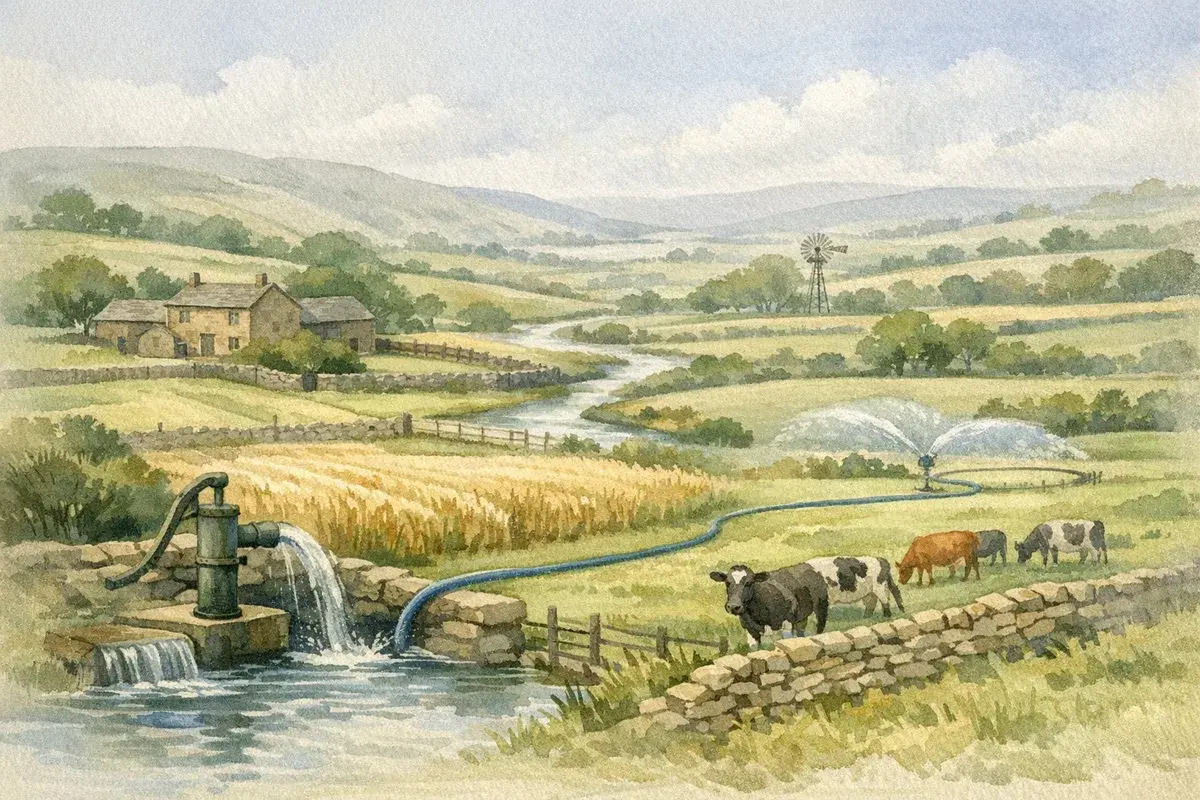
If you farm in the UK, water is no longer a "nice to have" input you sort out on the fly. Between hotter summers, tighter catchment limits, and more eyes on environmental flows, the question isn't just "can I get water?", it's "am I allowed to take it, at that time, at that rate, from that source, for that use?"
An abstraction licence in agriculture sits right at that intersection of operational reality and regulation. Get it right and you can plan cropping, livestock and infrastructure with confidence. Get it wrong and you're exposed, commercially (no water when you need it) and legally (enforcement, reputational fallout, and expensive fixes).
This guide cuts through what an abstraction licence is, when you need one, how to apply, and, just as importantly, how to keep your farm compliant once you've got it.
What An Abstraction Licence Is (And Why Agriculture Is Under Tighter Scrutiny)
At its simplest, an abstraction licence is formal permission to take water from a source, usually a river, stream, lake, canal, spring or borehole, at specified quantities and under specified conditions.
In agriculture, that "specified conditions" part matters. Regulators aren't only looking at your total volume: they're looking at when you take it (seasonality), how quickly you take it (daily/hourly rates), and what the environment can spare (flows, groundwater levels, protected habitats).
Why the tighter scrutiny now?
- More frequent dry spells mean environmental flows are under pressure exactly when agriculture needs water most.
- Catchment-based management is becoming more conservative in many places: you may be in a "water-stressed" area even if it doesn't feel like it on your farm.
- Better monitoring and enforcement tools (remote monitoring, improved telemetry, stronger incident reporting) make "informal" arrangements riskier.
Key Terms: Abstraction, Impoundment, Transfer, And Hands-Off Flows
You'll hear a few terms repeatedly in licensing conversations:
- Abstraction: taking water from a source into your control, pumping from a river, drawing from a borehole, or diverting from a stream.
- Impoundment: holding back water (for example, a weir or dam structure) which can change flows. Impoundment can require separate permissions.
- Transfer: moving water from one place to another without intervening use (e.g., moving raw water to a storage reservoir). Some transfers have different rules or charges.
- Hands-off flow (HOF): a trigger point, typically a river flow threshold, below which you must reduce or stop abstraction. Think of it as an environmental "stop/go" rule written into your licence.
Who Regulates What Across The UK: England, Wales, Scotland, And Northern Ireland
Water regulation is devolved, and the detail varies:
- England: the Environment Agency (EA) administers abstraction licensing and compliance.
- Wales: Natural Resources Wales (NRW) is the licensing authority.
- Scotland: the Scottish Environment Protection Agency (SEPA) regulates abstractions under the Environmental Authorisations (Scotland) Regulations 2018, which replaced the CAR regime in November 2025.
- Northern Ireland: the Northern Ireland Environment Agency (NIEA) licenses abstraction. Taking between 10 and 20 cubic metres a day must be notified, and taking more than 20 cubic metres a day needs a licence.
The practical takeaway: if your farm footprint crosses borders, or you're buying land near them, don't assume the same thresholds, charges or application routes apply everywhere.
When You Need An Abstraction Licence For Farming Activities
Most farm businesses don't set out to "become regulated". They just need water for crops, stock, washdown, or a new horticulture enterprise. But licensing isn't tied to how reasonable your need feels, it's tied to what you do, where you do it, and how much you take.
If you're planning irrigation, it's worth reading a dedicated guide to getting an irrigation licence set up properly because irrigation is one of the most scrutinised uses in dry catchments.
Typical Farm Uses That Trigger Licensing: Irrigation, Livestock, Washdown, And Horticulture
Common licensable uses include:
- Field-scale irrigation (potatoes, veg, salads, soft fruit, maize in some systems). Regulators pay close attention to summer peak demand.
- Horticulture and protected cropping (polytunnels, glasshouses) where demand can be high and consistent.
- Livestock water supply when sourced directly from a river/stream or a high-yield borehole rather than a mains connection.
- Washdown and yard use, dairy parlours, packhouses, sprayer filling areas, especially where volumes are larger or continuous.
- On-farm processing (washing, chilling, and other water-dependent steps) that scales beyond "incidental" use.
A key point: "agricultural" doesn't automatically mean "easier". In some catchments, agricultural abstraction competes with public supply, fisheries, and protected habitat requirements.
Low-Risk Exceptions And Grey Areas: Small Abstractions, Emergency Use, And Temporary Set-Ups
There are limited situations that can feel like exceptions, small-scale use, short-term setups, or emergency arrangements, but the devil is in the detail.
- Small abstractions: some low-volume activities may fall below licensing thresholds or qualify for simpler permissions, depending on jurisdiction and source. Don't assume, confirm with your regulator.
- Temporary pumps and bowsers: "It's only for this season" is exactly the kind of reasoning that causes problems if you're still taking licensable volumes.
- Emergency use (e.g., animal welfare): regulators will often expect you to have planned contingencies rather than improvising abstraction that breaches conditions.
If you're not sure where your activity sits, treat it as a compliance question early, before you've invested in pumps, mains, reservoirs, or crop contracts.
How To Check Whether Your Water Source And Set-Up Are Licensable
A surprising number of problems start with a simple mismatch: the farm thinks it has "a water source", but the regulator sees a specific abstraction point, from a specific body of water, with a measurable effect on flows or groundwater.
If you're exploring a new supply, the starting point is being clear on what you're taking from and how. For groundwater options, it can be helpful to understand what's involved in developing a borehole on agricultural land, not just drilling, but yield testing, protection zones, and ongoing monitoring.
Surface Water Vs Groundwater: Rivers, Streams, Lakes, Boreholes, And Springs
Broadly:
- Surface water includes rivers, streams, drains, canals, and lakes. Licensing is often sensitive to hands-off flows and seasonal restrictions.
- Groundwater includes boreholes, wells and springs (depending on how they're captured). Groundwater licensing often focuses on aquifer sustainability, nearby abstractions, and potential impacts on dependent wetlands and watercourses.
Also watch out for "in-between" setups:
- Field drains and grips: abstracting from a drain that's hydrologically connected to a river can still be treated as surface water abstraction.
- Spring capture: a spring feeding a watercourse may be regulated in ways you don't expect.
- Storage reservoirs: filling a reservoir from a river is abstraction: using stored water later might not be, depending on how it's supplied and recorded.
Measuring Volumes And Rates: What Regulators Expect You To Record
Even if you're at an early planning stage, you should think like an auditor for a moment:
- Volume (e.g., cubic metres per day or per year) is what your licence will typically limit.
- Rate (how quickly you abstract) can matter just as much as annual volume, especially for surface water.
- Timing (months, seasons, hours of operation) is frequently constrained.
In practice, regulators commonly expect:
- A calibrated meter on the abstraction point (or an approved alternative method).
- A log of daily/weekly volumes and relevant conditions (river levels/flows where applicable).
- Evidence your system can physically comply, pump capacity, pipe sizes, and control valves should match the licensed limits.
If you're inheriting an existing system, don't take old paperwork at face value, verify that what's installed on the ground aligns with what's authorised.
Applying For An Abstraction Licence: A Step-By-Step Process
An abstraction licence application is closer to a mini business case than a simple form. You're demonstrating that your need is legitimate, your proposal is technically sound, and the environment can tolerate it, now and under stress.
And yes, money matters too. Abstraction isn't just a capex issue: it can create ongoing costs. If you want to avoid nasty surprises, get familiar with how water abstraction charges affect farming before you lock your budgets and cropping margins.
Pre-Application Assignments: Catchment Constraints, Drought Plans, And Protected Sites
Before you spend heavily on reports, do the practical checks:
- Catchment status: some catchments are effectively "closed" or heavily constrained at certain times of year. That can mean tighter hands-off flows, shorter seasons, or lower volumes.
- Drought planning reality: if your business model only works when you can abstract during dry periods, pressure-test that assumption. In dry years, restrictions bite.
- Protected sites: Special Areas of Conservation (SACs), Sites of Special Scientific Interest (SSSIs), Ramsar sites, and other designations can increase scrutiny and evidence requirements.
A quiet but important point: if you're also altering watercourses, drainage, or outfalls, the permissions landscape can expand. On mixed projects (irrigation plus drainage or watercourse works), it helps to understand how agricultural drainage rights interact with wider environmental controls.
What Your Application Must Include: Locations, Purpose, Volumes, Timing, And Infrastructure
Expect to provide (in some form):
- Exact abstraction point (grid reference, maps, site plans).
- Source type (surface water/groundwater) and how it's accessed.
- Purpose/use (irrigation, livestock, washdown, processing, etc.). Be specific, "farm use" is rarely enough.
- Volumes and rates (daily, annual, and peak rates), plus seasonality.
- Operating pattern (e.g., summer-only, night pumping, batch filling of a reservoir).
- Infrastructure detail: pumps, intakes, screens, pipework, storage reservoir specs, and metering.
- Evidence: depending on risk, you may need hydrological/hydrogeological assessments, modelling, and environmental appraisal.
One of the fastest ways to stall an application is to submit a "best guess" volume. Regulators will ask: why that number, and what data supports it?
Timescales, Costs, And Common Reasons Applications Stall
Timescales vary by regulator, catchment pressure, and application complexity, and the Environment Agency sets out the current route for applying in England. Straightforward, low-risk applications can be quicker: higher-risk ones (or those near protected sites) can take significantly longer.
Common stall points we see in the real world:
- Unclear demand case: no cropping plan, no irrigation scheduling, no stocking assumptions, just a desired volume.
- Mismatch between licence request and infrastructure: pump sized to exceed requested limits, no control method, or no feasible metering.
- Catchment reality check: the requested volume is technically possible but environmentally unacceptable at low flows.
- Incomplete land control: you don't have rights over access routes, intake location, or pipe easements.
The pragmatic move is to build the application around what you can defend, technically, operationally and environmentally, rather than what you'd ideally like on paper.
Licence Conditions You’ll Need To Operate Within
A licence isn't a trophy: it's a rulebook. And on farm, the day-to-day pressures (weather windows, staff availability, crop stress, breakdowns) are exactly what make condition breaches more likely.
Two broad categories of conditions matter most: (1) how much/when you can abstract, and (2) how you prove you've complied.
Seasonality, Maximum Daily Rates, And Hands-Off Flow Triggers
You may face any combination of:
- Seasonal windows (e.g., winter storage filling periods vs summer direct abstraction restrictions).
- Maximum daily/hourly rates that control how fast you can take water.
- Annual caps that affect whole-season planning.
- Hands-off flows or levels where abstraction must reduce or stop.
If you're relying on surface water in summer, treat hands-off flow triggers as a core business risk, not a footnote. In a dry year, you can be "licensed" but still unable to abstract.
Metering, Record-Keeping, Reporting, And Site Inspections
This is where many otherwise careful businesses slip.
What good looks like:
- A meter you trust, installed correctly, maintained, and readable.
- A simple log routine (daily during abstraction periods is common), with clear responsibility.
- Documented calibration/maintenance records.
- A system for exceedance prevention: pump controls, alarms, or operational SOPs that stop "just one more hour."
Inspections aren't only about catching bad actors. They're also about verifying the scheme is understood and controlled. If your team can't explain the conditions, or the records don't match the physical system, you'll feel the heat.
Transfers, Shared Supplies, And Trading Water Between Holdings
Farms increasingly share infrastructure: a shared reservoir, a transfer pipe, a jointly funded pump station, or a neighbour-to-neighbour arrangement in dry spells.
Be careful here:
- Licence conditions may be site-specific: moving the abstraction point or changing the end user can be a variation, not a casual agreement.
- Transfers can introduce new constraints: especially if water is moved across land where you don't have robust rights.
This is where land documentation matters. If pipes, access tracks, or intake structures sit on or cross someone else's land, you'll want those rights pinned down properly via agricultural land easements rather than relying on a handshake that won't survive a sale, probate, or a tenant change.
Buying, Renting, Or Financing Land With Abstraction In Mind
Water can quietly be the difference between "average land" and "strategic land". But it can also be the difference between a bankable farm plan and a spreadsheet fantasy.
If you're buying or taking a tenancy with an abstraction licence attached, your due diligence needs to go beyond "there's a licence number". You're checking whether the right is real, transferable, compliant, and usable in the way you intend.
Due Diligence Checklist: Licence Validity, Compliance History, And Actual Yield
A practical checklist to run (ideally before heads of terms):
- Confirm what's actually licensed: source, abstraction point, purpose, volumes, rates, seasons.
- Check status and expiry/variations: is it time-limited, recently amended, or subject to review?
- Ask for abstraction records: do the logs exist, and do they show consistent compliance?
- Validate yield: especially for groundwater, borehole yield can be very different from what someone "remembers" in a wet year.
- Look for physical alignment: does the installed pump/meter/intake match the licence?
Don't skip the paperwork that underpins land control. For example, if you're confirming boundaries, access and rights, the Land Registry and title documents matter, this guide to Land Registry checks for agricultural land is a useful refresher when you're verifying what you're actually acquiring.
How Abstraction Affects Farm Value, Tenancies, Cropping Plans, And Lender Requirements
From a value perspective, abstraction can:
- Increase resilience and cropping optionality (higher-value crops, more reliable yields, better contract performance).
- Change the "best use" of the holding (irrigated veg vs grass, horticulture vs combinables, finishing vs store systems).
- Influence tenancy negotiations: who maintains the licence, who pays charges, who owns/maintains pumps and meters, and what happens on assignment.
- Matter to lenders: banks and specialist rural finance providers increasingly look for evidence that the water plan is robust and compliant, not just aspirational.
But be honest about constraints. A tightly conditioned summer licence with restrictive hands-off flows may add less practical value than a winter storage strategy, depending on your catchment.
What Changes Need Consent: New Points, Higher Volumes, Different Uses, Or New Irrigation Tech
You can't assume the licence is "elastic". Changes that often need approval (or at least formal discussion) include:
- Moving the abstraction point even within the same river reach.
- Increasing volumes or rates to meet expansion.
- Changing the purpose (e.g., from general irrigation to a new processing use).
- Adding new infrastructure (bigger pumps, new reservoirs, different intake structures).
- Rolling out new irrigation tech that changes abstraction patterns (higher peak rates, different timing).
Also watch legal constraints sitting alongside water rights. A restrictive covenant or title condition can limit what you can build or where you can run pipes, even if the abstraction itself is licensable. If that's on your radar, this explainer on restrictive covenants on agricultural land can help you spot issues early rather than when contractors are on site.
Enforcement, Penalties, And How To Reduce Risk In Dry Years
Nobody plans to breach a licence. It usually happens through a chain of very normal farm decisions: a hot week, a crop under stress, a pump running an extra night, a missing log entry, a new staff member who doesn't know the conditions.
Unfortunately, regulators don't assess breaches on vibes, they look at facts, records, and impacts.
What Happens If You Abstract Without A Licence Or Breach Conditions
Potential consequences can include:
- Investigations and formal warnings
- Requirements to stop abstraction immediately (which is operationally brutal mid-season)
- Enforcement action and penalties, which can escalate depending on severity, intent, and environmental harm
- Licence review/variation pressure, if confidence is lost, future flexibility can get harder
Just as damaging can be the commercial knock-on: buyers, processors, insurers and lenders don't love compliance uncertainty.
Practical Compliance Systems: Meters, Logs, Contingency Supplies, And Staff Training
If you want a system that stands up in a dry year, build it like you'd build biosecurity: simple, habitual, documented.
Practical measures that work on real farms:
- Make the licence conditions readable: a one-page SOP in the pump house (volumes, rates, hands-off triggers, who to call).
- Meter discipline: photograph readings, use telemetry where justified, and check meters haven't failed silently.
- Keep a living abstraction log: not a spreadsheet you "catch up" later.
- Contingency options: stored winter water, alternative licensed sources, mains connection as fallback for welfare-critical uses, or crop plan flexibility.
- Train more than one person: compliance can't sit with a single operator who might be off sick in July.
In other words: treat compliance as an operational system, not an admin task.
Working With Advisers And Agents To Get It Right
There's a point where DIY becomes false economy, especially when you're investing in infrastructure, negotiating tenancies, or buying land where water is part of the value.
The trick is using the right expert at the right time, with a brief tight enough that you don't commission the same report twice.
When To Involve A Land Agent, Hydrologist, Planning Consultant, Or Environmental Lawyer
In practice:
- A specialist land agent helps you translate water rights into deal terms: what's included, what's assigned, what's conditional, and how that affects value.
- A hydrologist/hydrogeologist is often essential for higher-risk abstractions, yield testing, modelling, and environmental assessment.
- A planning consultant becomes relevant when abstraction is tied to development (reservoirs, buildings, on-farm diversification) and you're navigating multiple regimes.
- An environmental lawyer is most useful when there's enforcement history, complex transfers, third-party objections, or you're negotiating tight conditions.
If your project involves rights across multiple parcels, get your legal foundations straight early. Reviewing the agricultural land title deed can reveal gaps, like missing rights to lay a pipe, unclear maintenance responsibilities, or legacy clauses that complicate compliance.
How To Brief Professionals So You Don't Pay Twice For Reports
A strong brief usually includes:
- Your actual farming plan (cropping, irrigation scheduling, livestock numbers, washdown/process needs).
- The physical layout (maps, proposed intake points, pipe routes, reservoir sites, power supply).
- What you already know (existing licence documents, past abstraction logs, borehole tests, previous correspondence).
- Your decision deadlines (tenancy start dates, contract cropping commitments, finance milestones).
And set one key rule: every report must answer a decision. "Interesting" doesn't pay the drilling contractor, or satisfy the regulator.
As a portal, we've seen the best outcomes where land agents, technical specialists and lawyers collaborate early, rather than arriving in sequence after something has already gone off track.
Conclusion
If you take one thing from all this, let it be this: an abstraction licence isn't just a regulatory hurdle, it's a working constraint that should shape your cropping, infrastructure, staffing and even your purchase decisions.
So before you bank on water, pressure-test the basics. What's the source? What's the licensed rate and season? What happens in a dry year when hands-off flows kick in? And do you have the records and systems to prove you stayed within the rules?
If you're buying, renting, or expanding, treat abstraction as part of core due diligence, not an afterthought once the deal is done. The farms that do this well are the ones still in control when the weather stops cooperating.
Disclaimer: AgLand.co.uk is a UK agricultural land and rural property matching service, where buyers register what they are looking for and owners advertise directly to the buyers who match, and a rural resource hub. Nothing in this text is intended as legal, financial, or investment advice. You should carry out your own due diligence and seek guidance from appropriately qualified professionals (e.g., land agents, solicitors, accountants, hydrologists, and environmental consultants) before making decisions or taking action.