
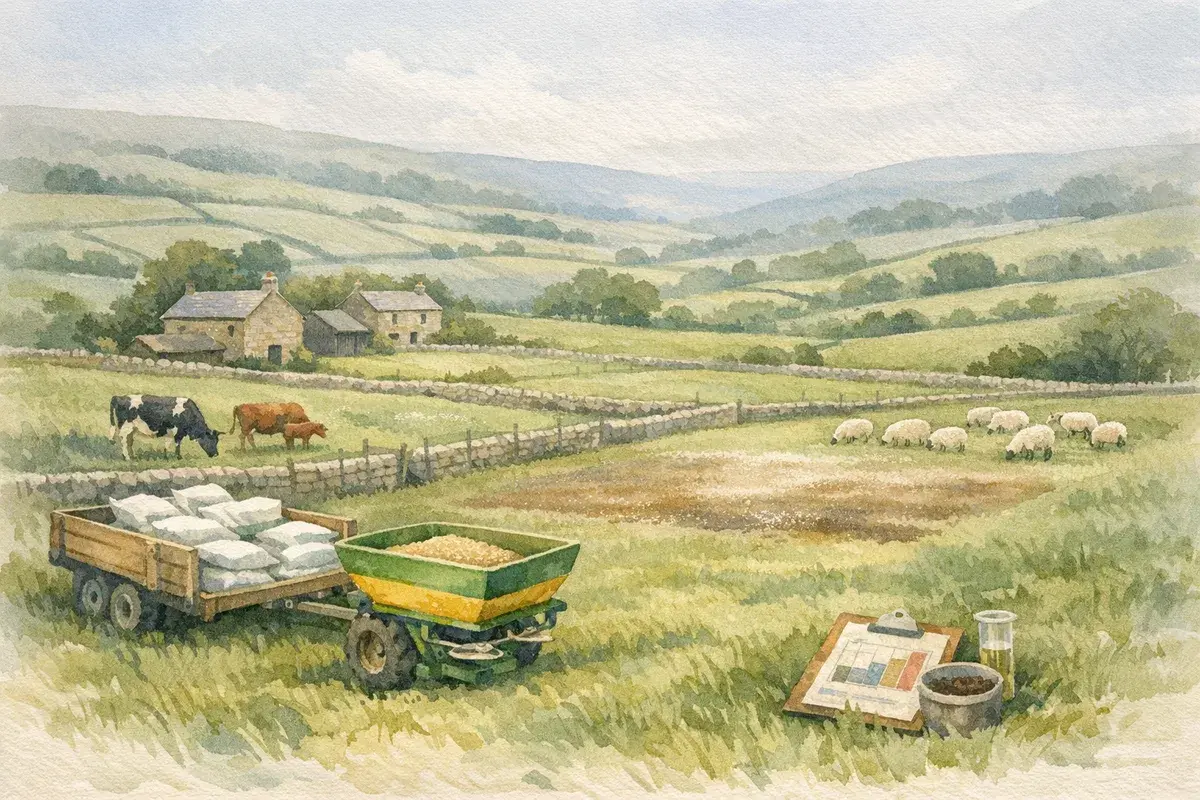
Pasture fertiliser is one of those topics where "a bit of 20-10-10 in spring" can look like a plan, right up until grass growth stalls, clover disappears, or the silage analysis comes back underwhelming.
In the UK, pasture fertiliser requirements aren't about chasing the biggest nitrogen number you can afford. They're about matching nutrients to what your fields are actually trying to produce (grazing or silage), what the soil can supply, and what you can justify in records, especially if you're in an NVZ, under assurance, or preparing a farm for rent, sale, or refinance.
This guide walks you through a practical, evidence-led way to plan fertiliser for pasture: start with your system, test properly, prioritise the nutrients that actually move the dial, and apply them when the grass can use them. The goal is simple: more usable grass per hectare, fewer wasted inputs, and results you can explain to an auditor, or a buyer, without bluffing.
Start With The Basics: What Your Pasture Is Trying To Do
Your pasture doesn't have one universal "requirement". It has a job.
A tightly grazed beef and sheep platform has different nutrient drawdown and different timing pressures compared to a dairy block chasing early cuts and high protein silage. So before you talk products, rates, or prices, you need to pin down what success looks like field-by-field.
Grazing Vs Silage: Different Nutrient Demand Profiles
Grazing is lots of small removals, with a big chunk of nutrients returned in dung and urine, just not evenly. You'll see:
- Patchy nutrient distribution (hotspots around troughs, gateways, loafing areas)
- A stronger case for maintenance P and K, and for correcting pH so you're not wasting N
- A bigger management win from better utilisation (rotation, rest periods) than from pushing high N
Silage, on the other hand, physically exports nutrients off the field. Every cut takes a meaningful amount of potash (K) in particular, and repeated cutting can mine P and K quickly if you're not replacing them. If you're taking first-cut and second-cut silage from the same ground, fertiliser planning stops being "seasonal" and becomes "nutrient accounting".
A quick reality check: many UK silage fields that look "tired" aren't short of nitrogen first, they're short of potassium, suffering from low pH, compacted, or too wet to grow well.
Sward Type, Stocking Rate, And Yield Targets
A ryegrass-dominant reseed with a bit of white clover will respond differently to N than an older permanent pasture with bent grasses and a thin base. And it's not just botany: it's how hard you're asking the field to work.
Ask yourself (and be honest):
- Stocking rate pressure: are you routinely grazing too tight, too early, or too late?
- Output target: are you aiming for "keep cattle moving" or "drive milk from forage"?
- Sward quality: do you have productive species, or are you feeding inputs to low-yield grasses?
If the sward is underperforming structurally, fertiliser becomes a sticking plaster. In that situation, it's often worth stepping back into wider pasture land management basics, grazing discipline, pH, drainage, and reseed decisions, because they change how efficiently every kilo of nutrient turns into grass.
And if you're viewing fields as a landlord, incoming tenant, or buyer, this "what is the pasture trying to do?" question is gold. It helps you evaluate whether past performance was limited by nutrients, or by management and infrastructure.
Get The Evidence Right: Soil, Manure, And Sward Testing
In UK grassland, the most expensive fertiliser plan is the one built on assumptions.
Soil analysis isn't glamorous, but it's where you find the hidden handbrake: low pH locking up nutrients, phosphate indices drifting down, or potassium being stripped by silage.
Soil Sampling Frequency, Depth, And Field Zoning
For most UK pasture, a sensible baseline is:
- Every 3–5 years soil testing on each field (more often if you're changing management, cutting heavily for silage, or correcting pH)
- Sampling depth typically 7.5–10 cm for grassland (consistency matters more than perfection)
- Avoid contamination: keep away from dung pats, gateways, troughs, headlands, old muck heaps, and burn sites
Field zoning is where you can get sharper without overcomplicating things. If a "field" is really two different soils (ridge and hollow, light sand and heavier clay), treat it like two management zones. You'll stop over-liming one half and under-feeding the other.
Drainage also matters here: chronically wet areas will distort performance and nutrient use, so it's worth tying your fertility plan into practical pasture land drainage decisions. A field that can't carry machinery at the right time will make even the best fertiliser schedule look bad.
Reading Results: pH, P, K, Mg, And Indices
Most UK soil reports give you indices (commonly 0–4) for P, K, and Mg.
- pH drives availability: if pH is off, you pay for nutrients you can't access.
- Phosphate (P) supports root growth and energy transfer, especially important for early spring growth and reseeds.
- Potash (K) is huge for grass yield, drought tolerance, and silage production: it's also linked with animal health issues when excessive (more on that later).
- Magnesium (Mg) matters for both plant function and livestock risk management.
As a practical rule, you generally aim to build low indices up to a workable target and then maintain, because pushing high indices indefinitely is rarely cost-effective and can carry environmental risk.
When To Use Grass Tissue Tests And What They Actually Tell You
Tissue testing can be useful, but only when you're clear on the question.
Use it when:
- You've corrected pH and P/K on paper, but performance still lags
- You suspect sulphur shortage, or a trace element issue affecting growth
- You're comparing management zones within a field
What it tells you: what the plant has taken up recently, not what the soil contains overall. Timing is everything, sample at a similar growth stage, and don't interpret a result in isolation. A low nutrient in tissue might be caused by waterlogging, compaction, cold soils, or drought limiting uptake.
If you're making big changes, switching from arable into grass, for example, testing becomes even more valuable because the nutrient dynamics change quickly in the first couple of seasons after converting arable to pasture (especially around pH and potash reserves).
Nutrients That Drive Pasture Performance
There's a temptation to treat fertiliser as "nitrogen plus a bit of P and K". In reality, UK pasture response is usually limited by whichever factor is most restrictive at that moment, pH, moisture, sward density, and then nutrients.
Here's how the main nutrients behave in practical pasture systems.
Nitrogen: Response Curves, Timing, And Realistic Expectations
Nitrogen (N) is the headline act because it gives visible response, when conditions are right.
Key points for UK pasture:
- Response isn't linear: the first kilograms of N typically give the best return: higher rates can still add yield but with diminishing efficiency.
- Timing beats brute force: N applied when soils are cold, saturated, or the sward is stressed will leak away (volatilisation, leaching, denitrification) rather than growing grass.
- System matters: a grazing platform with decent clover and good utilisation may need less bagged N than a silage-only block.
Be wary of "paper yield targets" that ignore real constraints. If you can't graze at the right cover, or you can't travel to spread after rain, you won't realise the theoretical response.
Also, if you're reseeding or introducing clover, heavy N early on can backfire, fast grass can smother seedlings, and you end up paying for a thinner, less stable sward.
Phosphate And Potash: Building Vs Maintenance Applications
Think of P and K as your pasture's reserves account.
- Building applications make sense when indices are low and the soil can't supply enough to meet demand.
- Maintenance applications replace what you remove, especially in silage systems.
For silage ground, potash is often the quiet limiter. If your K index is slipping and you keep applying N, you can get greener grass that simply can't build bulk properly.
Practical warning: very high potash in forage can be a risk factor for metabolic issues in dry cows (because it can interfere with magnesium uptake). That doesn't mean "don't apply K": it means apply it with a plan, ideally using soil indices, crop removal, and stock class to guide where the highest K goes.
Sulphur, Magnesium, And Sodium: The Common UK Shortfalls
These are the nutrients that often explain the "we've done everything and it's still flat" feeling.
- Sulphur (S): UK reductions in atmospheric sulphur deposition over recent decades mean many areas now see sulphur shortage, particularly on lighter soils and higher rainfall zones. Symptoms can mimic low N (pale growth), but adding more N won't fix it.
- Magnesium (Mg): important for chlorophyll and animal health risk management. Soil Mg index and pH both affect availability.
- Sodium (Na): not essential for plant growth in the same way, but can improve palatability and may support clover in some situations, often most relevant on inland, low-Na soils.
You don't need to chase every micro-nutrient on a spreadsheet. But if you're serious about pasture fertiliser requirements, you do need to understand which "secondary" nutrients are most likely to be limiting in your region and soil type.
Lime And pH: The Cheapest “Fertiliser” You’ll Ever Buy
If you only fix one thing on UK grassland, fix pH.
Low pH reduces nutrient availability and biological activity. That means you can apply nitrogen, phosphate, potash, then watch response disappoint because the plant can't access what you've paid for.
Target pH Ranges For Productive Grass And Clover
As a general guide:
- Productive grass swards typically perform best around pH 6.0–6.5 (soil type dependent)
- Clover generally prefers a slightly higher pH than grass: if you want clover to persist, you'll rarely regret getting pH into the right band
The key is consistency. A field at pH 5.4 might still grow something, but you're farming with the handbrake on, especially for P availability.
Choosing Lime Types And Planning Split Applications
Your lime choice and application strategy should match your soil and your operational reality.
- Ground limestone is the standard workhorse: it's about neutralising value and even spreading.
- Dolomitic lime can be useful where magnesium is low (but don't treat it as a universal Mg fix, soil indices matter).
- Split applications often make sense when the required rate is high or when you're trying to avoid shocking sward/soil biology.
Plan it like a job, not an afterthought:
- Don't apply lime and then immediately apply certain fertilisers without thinking about timing and interactions.
- Prioritise fields where you'll get the fastest return: silage ground, reseeds, and high-output grazing blocks.
If your pasture is thin, open, or dominated by low-value species, correcting pH is also one of the foundations of successful pasture improvement techniques, because better fertility is what allows improved species to compete and persist.
Fertiliser Planning Through The Season
Good pasture fertiliser planning in the UK is less about one big decision and more about a chain of smaller calls: is the soil warm enough, can you travel, what's the growth rate doing, and what's coming off the field (grazed or cut)?
Spring Kick-Off: Soil Temperature, Trafficability, And First N
Spring is where you either set the season up, or spend the rest of the year trying to catch up.
Before your first N goes on, check:
- Soil temperature and growth: grass needs to be actively growing to use N efficiently.
- Trafficability: compaction from "just getting on" can cost you more yield than the fertiliser will ever repay.
- Sward cover: thin swards respond differently: sometimes the priority is to thicken the base via grazing management rather than push N.
A practical approach is to start modestly, assess response, then build as conditions stabilise.
In-Season Strategy: Grazing Rotations, After-Cut, And Topping
In-season fertiliser isn't separate from grazing, it's tied to it.
- On grazing blocks, tighter rotation and better residual control can increase utilisation, which effectively reduces the N you need per tonne of eaten grass.
- After silage cuts, nutrient replacement (especially K) becomes critical if you want rapid regrowth.
- Topping can help reset quality, but it's not a substitute for getting grazing pressure right.
When you're planning for multiple cuts, it's worth treating each field like a production unit: what did it export, what did it receive (including slurry/FYM), and what's the next job?
Autumn Decisions: Extending Grazing Without Wasting N
Autumn fertiliser decisions are where money is often burned quietly.
Late-season N can make sense in some systems, but the risk increases as:
- growth rates fall,
- soils get wetter,
- and uptake becomes less reliable.
If your aim is to extend grazing, the bigger wins are often:
- managing covers earlier,
- protecting soil structure,
- and using fields with better drainage and access.
In other words: you can't fertilise your way out of poor autumn grazing infrastructure. And if you're assessing new land (to rent or buy), you should look at gateways, tracks, and wet corners as much as you look at fertiliser history, because they dictate how much of your "planned growth" you can actually harvest with stock.
Making Best Use Of Manures And Slurries
Organic manures are often the most under-accounted nutrient source on UK livestock farms. The nutrients are valuable. The variability is the catch.
If you want a fertiliser plan that's both cost-effective and defensible, you need to treat manures and slurries like inputs with a range, not like "free fertiliser".
Nutrient Supply From FYM, Slurry, Digestate, And Poultry Manure
Different materials behave very differently:
- FYM tends to be slower-release, supporting soil organic matter and longer-term fertility.
- Cattle slurry supplies readily available N and K, but the N portion is prone to loss if handled poorly.
- Pig slurry (where relevant) can be higher in readily available N.
- Digestate can be a useful nutrient source but varies by feedstock and processing.
- Poultry manure is typically more nutrient dense: it can be very effective but needs careful planning to avoid oversupply and runoff risk.
The best practice is to use analysis where possible (especially for slurry/digestate) rather than relying purely on book values.
Spreading Methods, Losses, And Where Precision Pays
How you spread can matter as much as what you spread.
- Splash-plate spreading can lead to higher ammonia losses in some conditions.
- Lower-emission application methods (such as trailing shoe) can improve nitrogen capture and reduce smell and drift, particularly useful near sensitive receptors.
Precision pays most where:
- you're applying to silage ground (high offtake),
- you're near watercourses,
- or you have limited windows to travel.
Integrating Organic Nutrients Into The Fertiliser Plan
The practical approach is:
- Map where manures go (not just "the near field every year").
- Credit the nutrients realistically, especially available N.
- Top up with bagged fertiliser only where the evidence says you need it.
Done well, this is how you cut spend without cutting yield. Done badly, it's how you end up with high P in the wrong place, low K where you cut silage, and records you can't defend.
If you're reworking a tired permanent pasture and considering a reseed, remember that manure strategy should be aligned with establishment needs. There's more detail on timing and preparation in our guide to reseeding permanent pasture, because early nutrient and pH decisions can make or break the first year.
Clover And Multi-Species Swards: Reducing Bagged Nitrogen
With fertiliser prices still fresh in everyone's mind, clover and multi-species swards have moved from "nice idea" to "serious strategy". But they don't remove the need for nutrient planning: they change it.
Establishment And Reseed Nutrition: Avoiding Early Setbacks
Young leys are vulnerable. Common causes of early disappointment include:
- pH not corrected before sowing
- potash or phosphate being limiting during establishment
- heavy N that drives grass dominance and shades clover
Establishment nutrition should support root development and even competition, not just top growth.
Managing Nitrogen To Protect Clover And Fix More N Naturally
Clover will fix nitrogen from the air, but only when:
- soil pH and P/K are adequate,
- the sward isn't being blasted with N,
- and grazing management encourages light and leaf area at the right times.
In practice, you're usually aiming to use enough N to keep grass moving when needed, but not so much that clover gives up (because plants are efficient: if free N is raining down, clover has no reason to work).
Multi-species mixes add other benefits, root diversity, drought resilience, and potentially improved soil structure, but they can complicate fertiliser decisions because different species have different sensitivities. That's not a reason to avoid them: it's a reason to test, monitor, and adjust rather than running on habit.
One pragmatic point: if your base pasture is fundamentally weak (poor drainage, low pH, compacted), adding clover or herbs won't magically compensate. Sort the basics first, then let the biology do its job.
Trace Elements And Animal Health Links In Pasture Systems
Trace elements are where pasture nutrition and animal health start to overlap, and where it's easy to make costly mistakes.
In the UK, the right approach is cautious: diagnose properly, supplement appropriately (often via animals rather than soil), and avoid blanket applications "just in case".
When Copper, Cobalt, Selenium, And Iodine Become A Pasture Issue
You typically consider trace elements when you see:
- consistent performance issues that don't match energy/protein supply
- vet-advised concerns (fertility, growth rates, immunity)
- known local soil-related risks (for example, some areas with higher molybdenum affecting copper availability)
Important nuance: a deficiency in the animal doesn't always mean a deficiency in the soil. Availability, antagonists, and intake patterns matter.
Avoiding Over-Application And Interactions With Soil pH
Trace elements can be toxic in excess and may persist in soils.
- Raising pH (via liming) can change availability of some elements.
- High iron or molybdenum can interfere with copper utilisation.
So, if you're tempted by a "trace element blend" as part of pasture fertiliser requirements, slow down and get evidence first, soil/tissue where appropriate, but also animal blood/liver tests under veterinary guidance.
For many farms, the lowest-risk route is targeted animal supplementation (boluses, minerals, feed) rather than broadcasting trace elements onto pasture without a clear deficiency diagnosis.
Compliance, Environmental Risk, And Record-Keeping In The UK
Pasture fertiliser decisions sit in a compliance landscape, especially where there's slurry, NVZ rules, or proximity to water.
And if you ever plan to rent out land, renew a tenancy, sell a block, or attract investment, good nutrient records stop being "admin" and start being part of the asset story.
NVZ Rules, N Max Limits, And Closed Period Logic
If you're in a Nitrate Vulnerable Zone (NVZ), you'll be used to tighter rules around nitrogen applications, storage capacity, and closed periods for certain organic manures.
The logic is straightforward: reduce nitrate loss risk when crops can't take up nutrients (cold/wet seasons) and when runoff risk is high.
Because requirements can depend on:
- land use (grass vs arable),
- soil type,
- livestock category,
- and specific dates,
…you should keep your plan current and, where needed, confirm details with a suitably qualified advisor.
Water Protection: Buffers, Slope Risk, And Runoff Prevention
Even outside NVZs, UK regulators and assurance schemes expect sensible risk control.
Practical steps that actually prevent problems:
- leave appropriate buffer areas near watercourses
- avoid spreading before heavy rain or on saturated/frozen ground
- prioritise fields with better infiltration and access in risky periods
- manage gateways, tracks, and compacted headlands (runoff often starts there)
Practical Records: What To Keep For Assurance, Tenancies, And Buyers
A strong record system isn't complicated. It's consistent.
Keep:
- soil test results and dates
- lime applications (product, rate, field, date)
- fertiliser applications (product, rate, field, date, weather notes)
- manure/slurry applications (type, estimated/analysed nutrients, method, field, date)
- silage cuts and approximate yields (even rough data is useful)
If you're a tenant, these records help protect you in end-of-tenancy discussions. If you're a buyer, they help you judge whether the pasture is being maintained or quietly mined.
Whichever side you're on. Buyers tell AgLand what they're looking for and hear the moment something fits. Owners advertise straight to the buyers who already match, for one flat fee and no commission. Register as a buyer or check your matches.
Costs, Purchasing, And Application Practicalities
Even the best nutrient plan can be undone by poor purchasing decisions or sloppy application. Stripey fields, missed bouts, and inconsistent spreading don't just look bad, they create uneven utilisation, uneven regrowth, and uneven performance.
Comparing Straight Fertilisers, Compounds, And Protected Urea
In practice, your choice comes down to what problem you're solving:
- Straight fertilisers give flexibility (useful when soil indices vary by field).
- Compounds/blends simplify operations and can be effective when you need balanced nutrients in one pass.
- Protected urea can reduce ammonia losses compared with standard urea in suitable conditions, which can improve N efficiency.
Your decision should consider:
- nutrient price per kg (not just per tonne)
- how many passes you can realistically do
- sulphur need (often overlooked)
- storage and handling
Buying well is partly market timing, but it's mostly about not buying the wrong nutrient in the wrong format for your soils.
Spreader Calibration, Bout Marking, And Avoiding Stripey Fields
Calibration is dull, until you realise it's one of the fastest ways to "find" 5–10% performance.
Focus on:
- tray testing/spreader checks where possible
- matching bout widths to your fertiliser and machine setup
- consistent forward speed
- headland management (many stripes start there)
If you're applying manures, precision matters too: the right method, the right field, the right day.
One last practical note: if you're assessing land for purchase or rent, ask how fertiliser is applied and what kit is used. The difference between careful application and "it'll do" often shows up in sward evenness and long-term soil condition, things you'll inherit.
If you're currently looking for UK pasture, grazing land, or mixed farms with grass at their core, register your requirements with AgLand and you'll hear the moment matching land is advertised - then judge it on the fundamentals (soil, access, drainage, field layout), not just the acreage figure.
Conclusion
Pasture fertiliser requirements in the UK are simplest when you treat them as a system: define the pasture's job, test and interpret evidence properly, fix pH early, credit manures honestly, and then use bagged fertiliser to fill the gaps, at the right time, on the right fields.
Do that, and you're not just spending less (though you often will). You're building a pasture platform you can rely on: more consistent covers, better regrowth after grazing or cutting, and a paper trail that stands up to scrutiny.
Disclaimer: AgLand.co.uk is a UK agricultural land and rural property matching service, where buyers register what they are looking for and owners advertise directly to the buyers who match, and a rural resource hub. Nothing in this text is intended as legal, financial, or investment advice. You should carry out your own due diligence and seek advice from appropriately qualified professionals (for example, an agronomist, chartered surveyor, accountant, solicitor, or planning consultant) before making decisions.