
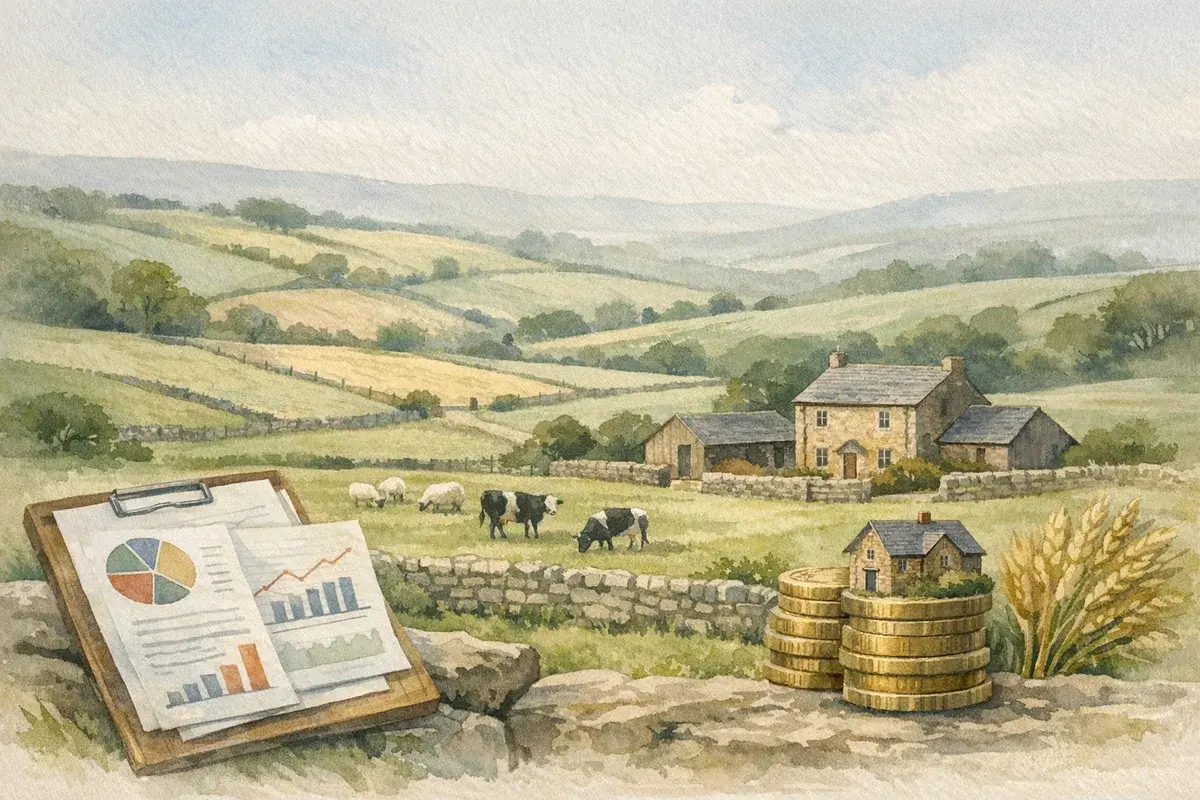
UK farmland has a habit of looking boring, until you put it next to the rest of your portfolio.
On paper it's "just land". In practice it's a finite asset tied to food production, energy transition, environmental policy, and (in some cases) long‑dated development value. That mix is exactly why farmland investment funds UK investors are increasingly discussing have moved from niche to mainstream conversation.
But funds aren't magic. They're wrappers around real fields with real tenants, drainage problems, access issues, planning constraints, and changing subsidy rules. If you're considering a farmland fund, whether you're a farmer diversifying, a landowner thinking about pooling capital, or an investor looking for inflation‑resilience, this guide cuts through how these vehicles actually work, what returns really come from, where the risks hide, and how to choose one that fits your goals.
Why UK Farmland Funds Are Gaining Attention
UK farmland has been attracting capital for decades, but the type of capital and the reasons behind it have shifted. Today it's not just about "land always goes up". It's about how land behaves when inflation bites, when policy pivots, and when investors want tangible assets with optionality.
The Core Drivers: Inflation Hedging, Scarcity, And Food Security
A few practical realities underpin the current interest:
- Scarcity is real. The UK isn't making more agricultural land, and the best blocks are rarely "on the open market" for long. Even when values pause, good land tends to stay tightly held.
- Inflation linkage (imperfect, but meaningful). Rents, commodity dynamics, and replacement costs (buildings, inputs, labour) feed into land values over time. Land doesn't track CPI neatly month‑to‑month, but it has historically behaved differently from equities and conventional property.
- Food security is back in the conversation. Supply chain shocks and geopolitics have made productive capacity feel strategic rather than quaint.
And there's a behavioural angle too: if you've watched commercial property reprice quickly with interest rates, or you've felt the volatility of equities, "real assets you can walk on" suddenly feel comforting.
How Policy And Environmental Markets Are Changing The Investment Case
Post‑Brexit agricultural support has moved from area-based payments towards "public money for public goods". For funds, that changes the playbook:
- Environmental schemes and natural capital can create new income lines (or at least cost support) on suitable land, but the paperwork, eligibility, and long-term obligations matter.
- Carbon, biodiversity net gain (BNG) demand, and corporate nature targets have created interest in land as a platform for environmental outcomes. This can lift competition for certain land types, peat, uplands, habitats, while also introducing long commitments that can reduce flexibility.
- Renewables and grid infrastructure (solar, battery storage, wind, and the cables/substations that come with them) can be value‑moving where planning and grid access line up.
So yes, farmland investment funds UK managers run today often pitch a broader "land use" thesis. The smart question is whether the fund has the capability, and governance, to execute it without boxing you into unfavourable long-term constraints.
In the background, it's worth grounding yourself in the fundamentals of UK land as an asset class before you judge any fund wrapper. If you want a solid baseline on what makes land investable (and what can go wrong), AgLand's guide to agricultural land investment is a useful reference point for the UK specifics.
What A Farmland Investment Fund Actually Is
A farmland investment fund is simply pooled capital buying exposure to farmland (and sometimes farm businesses), run by a professional manager. You're not buying a field: you're buying units/shares/participations in a vehicle that owns (or lends against) land.
That sounds straightforward, until you look at structure, fees, borrowing, valuation, and what the fund is allowed to do.
Fund Structures You'll See In The UK (Open-Ended, Closed-Ended, Trusts, Partnerships)
In the UK market you'll commonly come across:
- Open‑ended funds: the fund can issue/redeem units as investors enter/exit. Because land is illiquid, these often come with notice periods, dealing windows, and "gating" powers (restrictions on withdrawals) to protect remaining investors.
- Closed‑ended funds: a fixed pool of capital for a set term, with exits at the end (or via a secondary market). These can be cleaner for illiquid assets because the manager isn't forced to sell land at awkward moments just to meet redemptions.
- Listed investment trusts/companies: you buy shares like other listed equities. Liquidity is better, but the share price can trade at a discount/premium to NAV, adding another layer of volatility.
- Partnership or club structures (often for larger tickets): fewer investors, more tailored terms, sometimes with tax and governance nuances.
What matters for you is not the label, it's how and when you can get your money back, what the manager can change, and what happens in stress scenarios.
How Investors Make Money: Income, Capital Growth, And Value-Add
Returns in farmland funds usually come from three buckets:
- Income: farm rents (often via Farm Business Tenancies), grazing licences, wayleaves, telecoms masts, renewables leases, storage yards, plus sometimes environmental scheme payments.
- Capital growth: underlying land value appreciation over time.
- Value-add: improving drainage, re-parcelling awkward blocks, upgrading buildings (where justified), securing planning permissions, or repositioning land use (e.g., suitable habitat creation) to lift value.
If you're comparing fund literature, check whether it's truly "passive" exposure or whether the manager is effectively running a development and land‑use change programme.
For context on the more hands‑off end of the spectrum, AgLand's explainer on passive farmland investment sets out what "passive" realistically means in UK farmland (spoiler: someone is always doing the work, either a tenant or an operator).
Farmland Fund Strategies: Passive, Regenerative, And Development-Led
Not all farmland investment funds UK investors encounter are chasing the same thing. Strategy drives risk, return pattern, and the "headline story" you'll hear.
Let-To-Farm Versus Operated Models (And Why It Matters)
Most funds sit somewhere on a spectrum:
- Let‑to‑farm (tenanted) model: the fund owns land and lets it to farmers. You're relying on rent for income and land appreciation for growth. Operational risk is largely with the tenant (though landlord responsibilities still exist).
- Operated (in‑hand) model: the fund (or its contractor) runs farming operations directly. That can unlock more upside, cropping decisions, direct scheme participation, regenerative transitions, but it also introduces execution risk, input cost volatility, staffing/contracting risk, and sometimes reputational risk.
If you're looking for something closer to "inflation‑resilient real asset exposure", a tenanted approach often reads cleaner. If you're seeking higher target returns, you'll usually be taking more operational complexity.
Natural Capital And Diversification: Woodland, Peat, Renewables, And Grazing Licences
Funds increasingly talk about diversification within land:
- Woodland creation and management: can be part of long-term strategy, but it's not a quick liquid trade and it can come with long obligations.
- Peatland restoration: highly policy‑driven and site‑specific. Great in the right place: complicated in the wrong one.
- Renewables: solar and wind can materially change income profiles, but planning risk, grid constraints, and community acceptance are real. Also, the lease terms can constrain future land flexibility.
- Grazing licences and short lets: useful for flexibility, but income can be less predictable.
The best managers treat these as site-led opportunities, not a template they force across every holding.
Conservation Covenants, SFI/CS, And Long-Term Land Use Constraints
Here's the part that can catch investors out: some "green" income is tied to long-term land-use commitments.
- SFI and Countryside Stewardship (and their successors/updates) can provide support, but agreements have rules, inspections, and the risk of change in scheme terms over time.
- Conservation covenants and certain habitat creation projects can limit future options, sometimes for decades.
- BNG-style projects (where relevant) can create long-duration management obligations that may affect valuation and future saleability.
That doesn't make them bad. It just means you should treat "natural capital" as a land use strategy with trade-offs, not free money.
If tax is part of your decision-making (and it usually is), you'll want to understand how different land uses and holding structures can interact with reliefs and liabilities. The UK-focused overview on tax efficient farmland investment is a sensible starting point before you assume any relief applies automatically.
Returns And Performance: What To Expect (And What To Question)
The phrase "target return" does a lot of heavy lifting in fund marketing. Your job is to separate return sources (rent, growth, development) from return presentation (valuation smoothing, leverage, fee netting).
Key Return Drivers: Rent, Commodity Exposure, Interest Rates, And Land Supply
In broad terms, UK farmland fund performance tends to be driven by:
- Rental yield: often modest, sometimes stabilising. Rents depend on local demand, farm profitability, and tenancy terms.
- Land value movements: sensitive to interest rates (the "discount rate" effect), investor demand, and constrained supply of quality blocks.
- Commodity exposure (direct or indirect): in a tenanted model, the landlord may be less directly exposed, but the tenant's ability to pay rent still relates to farm economics.
- Non-farming income: renewables, telecoms, diversification leases, and environmental scheme receipts can become meaningful.
If you want a UK-specific breakdown of where returns actually come from (and what tends to be cyclical), AgLand's piece on agricultural land investment returns goes into the drivers in plain English.
Fees, Leverage, And Valuations: Where Reported Returns Can Mislead
Two funds can own similar land and report very different "performance". Common reasons:
- Fees: management fees, performance fees, acquisition fees, operating costs, always look at returns net of all fees.
- Leverage: borrowing can boost returns in good times and magnify pain in bad times. Check loan-to-value limits, covenant triggers, and refinancing risk.
- Valuation policy: farmland is typically valued periodically, not continuously. That can smooth volatility. Ask how often valuations occur, who signs them off, and what comparable evidence is used.
- Transaction timing: a fund that revalues after a strong quarter or before a rate shift can look better (temporarily) than peers.
A practical tip: whenever you see a steady upward line, ask yourself whether it reflects genuine market movements, or simply the rhythm of valuation events.
Benchmarks And Data Sources: RICS, CAAV, Defra, And Farmland Indices
In the UK, you'll often see farmland performance referenced against:
- RICS: sentiment and market commentary through rural surveyor networks.
- CAAV: tenancy and rural professional insight, often highlighting how rents and agreements are behaving.
- Defra: structural data, land use, and industry economics.
- Farmland indices: useful, but methodologies vary, check what they include (bare land vs equipped farms, geography, deal sizes).
Benchmarks are helpful for triangulation, not as a promise. A fund can outperform an index by taking more risk, development exposure, leverage, concentrated geographies, or by simply being early in a rising market.
If you're at the stage of judging whether farmland belongs in your wider plan at all, the broader question is still worth asking: is farmland a good investment for your objectives, timeframe, and appetite for illiquidity?
The Risks: Practical, Legal, And Political
Farmland isn't a ticker symbol. Even in a fund, you're exposed to physical assets, UK regulation, and political choices. The upside of that tangibility is resilience: the downside is that problems are rarely solved with a click.
Liquidity And Exit Risk: Gating, Lock-Ups, And Secondary Sales
This is the risk most investors underestimate.
- Open‑ended funds can gate redemptions if too many people want out at once. That's not necessarily "bad behaviour", it's often the only way to avoid forced land sales at poor prices.
- Lock‑ups and notice periods matter more than the headline return. A 9% target return is less attractive if you can't access capital when your circumstances change.
- Secondary sales (selling your position to someone else) may be possible in some structures, but pricing can be opportunistic.
If you need high liquidity, a farmland fund may simply be the wrong tool, or you'll need a listed structure and accept share price volatility.
Tenant, Operational, And Biosecurity Risks (From Dilapidations To BPS Transition)
Even "passive" farmland comes with hands-on realities:
- Tenant risk: rent arrears, covenant strength, disputes over repairs, end-of-tenancy dilapidations, and compliance with tenancy terms.
- Biosecurity and disease: impacts can be indirect (tenant profitability) or direct (movement restrictions, reputational concerns in operated models).
- The ongoing transition away from legacy support mechanisms has changed farm economics: some businesses have adapted well, others are still under pressure. A fund's tenant selection and rent-setting discipline becomes crucial.
A good manager has robust rural management capability, ideally with deep local agent networks and a track record of handling the awkward conversations.
Planning, Subsidy, And Tax Change Risk (Including APR/BPR Uncertainty)
Three UK-specific areas deserve blunt attention:
- Planning risk: development-led funds live and die by planning outcomes, and UK planning is slow, political, and locally variable.
- Subsidy/scheme change risk: environmental schemes can evolve, pause, or be replaced. Don't underwrite long-term returns on today's scheme rules without sensitivity testing.
- Tax change risk: reliefs and thresholds can change, and eligibility depends on facts (use, occupation, tenancy type, trading status, and more). APR/BPR are frequently debated in the rural press and policy circles: uncertainty itself is a risk.
If a manager is selling "guaranteed tax efficiency", treat that as a yellow flag. In UK land, the detail is everything.
Due Diligence Checklist Before You Invest
If you only do one thing before committing to a farmland fund, do this: assume the brochure is the best-case narrative and build your own "stress-tested" version.
What To Read: Prospectus, KID/KIID, Valuation Policy, And ESG Claims
Your minimum reading list should include:
- Prospectus/Information Memorandum: what the fund can invest in, concentration limits, borrowing permissions, and exit mechanics.
- KID/KIID (where applicable): risk indicators, costs, and scenarios (often simplified, but still useful).
- Valuation policy: frequency, independence, methodology, and how "material events" are handled.
- ESG / sustainability reports: look for measurable outcomes and governance, not just nice photography and vague language.
Pay attention to definitions. "Regenerative" can mean anything from genuine soil-first rotations to a marketing label stapled onto business-as-usual.
Questions To Ask The Manager: Track Record, Pipeline, Conflicts, And Governance
You're not just buying land exposure, you're buying manager judgement. Ask:
- What's your realised track record (not just paper returns)?
- How do you source deals, off-market networks, agent relationships, auctions, and how competitive is your pipeline?
- Are there conflicts of interest (e.g., related-party transactions, affiliated contractors, internal brokerage)? How are they managed?
- Who is on the investment committee, and what rural expertise do they actually have?
- What happens when something goes wrong, flooding, tenant failure, planning refusal?
A manager who answers crisply (and admits what they can't control) is usually a safer bet than one who promises smooth sailing.
Asset-Level Details That Matter: Soil, Water, Access, Rights, And Covenants
Even in a fund, the underlying asset quality drives outcomes. You want to understand how the manager diligences:
- Soils and capability (indices, drainage, compaction risk, cropping flexibility)
- Water (abstraction licences, water scarcity risk, irrigation infrastructure)
- Access and layout (road frontage, rights of way, ransom strips, sporting rights)
- Title constraints (restrictive covenants, easements, wayleaves, overage/clawback)
- Environmental designations (SSSIs, protected habitats) and how they affect management
This is also where you'll spot strategy drift: if a "prime arable" fund is quietly buying compromised parcels because it can't win the best blocks, the risk profile changes.
If you're newer to land investing and want a practical grounding before evaluating a fund's detail, the guide on investing in farmland for beginners will help you sharpen the questions you bring to managers and advisers.
How To Choose The Right Fund For Your Goals
Choosing between farmland investment funds UK investors can access is less about finding "the best" and more about finding "the best fit". Start with your constraints, not the fund's pitch deck.
Matching Time Horizon, Liquidity Needs, And Risk Tolerance
Be honest about three things:
- Time horizon: farmland is a long game. If your horizon is under five years, you're leaning heavily on market timing.
- Liquidity needs: can you tolerate lock-ups, notice periods, and the possibility of gating?
- Risk tolerance: are you comfortable with operated farming, development exposure, leverage, and concentrated geography, or do you want simpler tenanted exposure?
A good rule of thumb: the more a fund promises "extra return" through activity, the more you should interrogate execution capability.
Retail Versus Professional Access: Minimums, Platforms, And Eligibility
Access in the UK can vary widely:
- Some vehicles are structured for professional or sophisticated investors with higher minimum tickets.
- Others may be available through mainstream investment platforms (depending on classification and regulatory permissions).
- Listed structures can be accessible with smaller amounts, but remember you're then taking stock market pricing dynamics on top of land exposure.
Don't force yourself into an unsuitable product just because it's easy to buy.
Alternatives To Funds: Direct Ownership, Joint Ventures, And Farm Business Tenancies
A fund isn't the only route. Depending on your capital, expertise, and appetite for involvement, you might consider:
- Direct ownership: more control, but you take on sourcing, management, and concentrated risk. If you want a practical UK buying plan (what to check, who to involve, and how to avoid expensive mistakes), see AgLand's guide to buying agricultural land as an investment.
- Joint ventures: partner with an operator or landowner, align incentives, and share upside/effort, great when structured well, painful when governance is vague.
- Tenancies (FBTs) and structured agreements: if you're on the farming side, the right tenancy structure can be a strategic tool: if you're investing, tenancy terms define your real risk/return.
And if you're specifically thinking about long-term wealth planning, retirement wrappers, or how farmland sits alongside pensions, you'll want specialist advice, plus a clear understanding of what is and isn't feasible. AgLand's overview of buying farmland as a pension investment explains the UK considerations and common misconceptions.
Eventually, the "right" choice is the one whose liquidity terms you can live with, whose strategy you genuinely understand, and whose manager you'd trust to handle a bad year, not just a good one.
Conclusion
Farmland investment funds in the UK can make sense when you want diversified exposure to land without buying and running a farm yourself. They can also be a frustrating fit if you need quick access to capital, or if you're seduced by headline targets without reading the plumbing, fees, leverage, valuations, and exit terms.
The best way to approach the category is simple: treat it like buying a farm from behind a curtain. You can't walk the fields yourself, so you compensate by getting forensic on the documents, the manager's governance, and the asset-level constraints they're willing to accept. If the story is "stable, uncorrelated, and green", push for specifics. What land, what agreements, what obligations, what price, and what happens when conditions change?
Disclaimer: AgLand.co.uk is a UK agricultural land and rural property matching service, where buyers register what they are looking for and owners advertise directly to the buyers who match, and a rural resource hub. Nothing in this text is intended as legal, financial, tax, or investment advice. You should do your own due diligence and take advice from appropriately qualified professionals (for example, FCA-authorised advisers, rural chartered surveyors, solicitors, and tax specialists) before making any investment or property decision.