
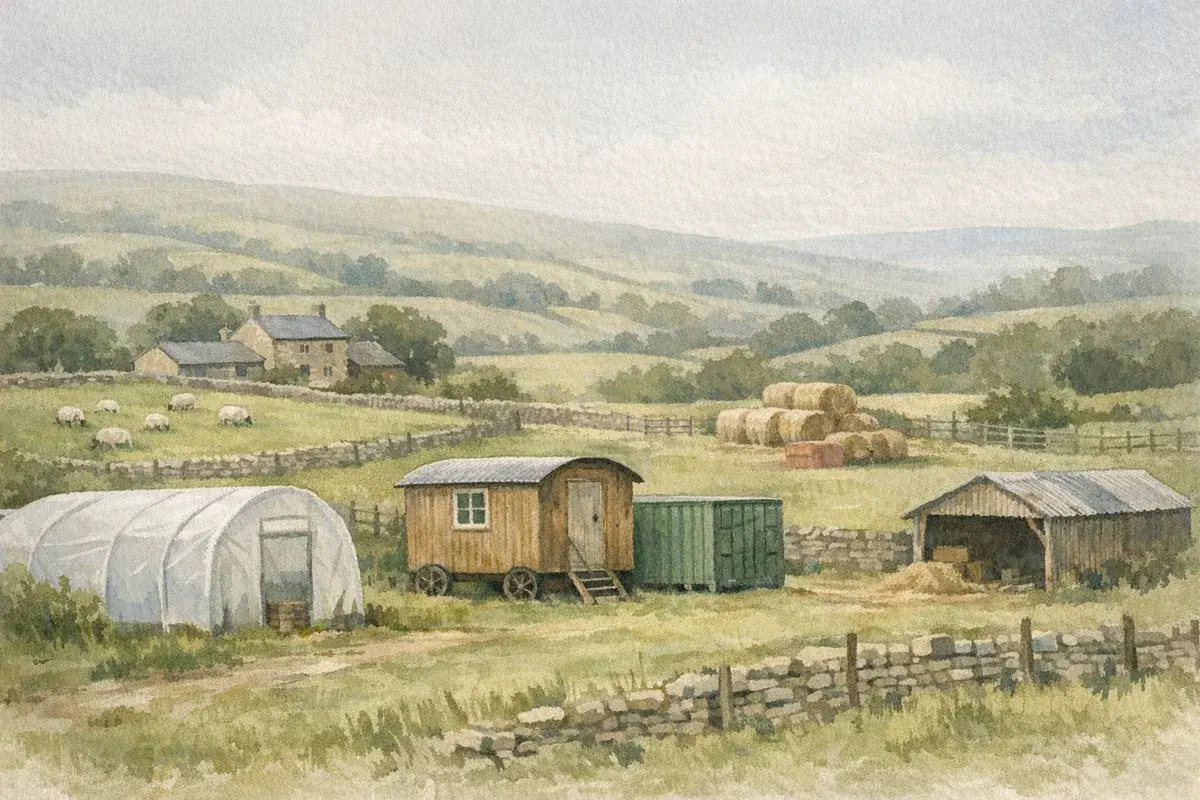
You can put up a "temporary" structure on your land in an afternoon. The planning consequences can last for years.
In UK rural property, that mismatch causes more headaches than almost anything else we see: a container that quietly turns into a workshop, a field shelter that slowly grows a permanent pad, a caravan that becomes "just for lambing" in March… and is still there in December.
This guide cuts through the grey areas. You'll learn what counts as a temporary structure (and what doesn't), how permitted development rights and prior approval really work in practice, and where farmers and rural businesses most often get caught out, so you can make a plan that stands up to scrutiny, not just to the wind.
What Counts As A Temporary Structure (And Why The Label Matters)
"Temporary" isn't a magic word in planning. In most disputes, the question isn't what you call it, it's what you've actually done on the ground.
In UK planning terms, the key triggers are usually:
- Is it development? (i.e., an "operation" or a material change of use.)
- How long is it there for? Duration matters, but it's not the only test.
- How is it fixed or serviced? Foundations, hardstanding, drainage, utilities and access works often tip something into operational development.
- What's it used for? Agricultural use is treated differently from residential, equestrian, commercial or mixed uses.
Temporary Vs Portable Vs Mobile: How Planners Typically View Each
You'll hear these terms used interchangeably on farms. Planners don't.
- Portable usually means you can move it, but it might still be treated as a building if it's effectively stationed in one place. A "portable cabin" with steps, a deck, mains power and a drainage connection doesn't feel very portable in planning reality.
- Mobile (caravans, mobile homes, some field shelters) often attracts even more attention because mobility is sometimes used as a workaround for residential or commercial uses.
- Temporary is about intention and effect: are you using it for a limited, defined period, and will the land be returned to its former condition?
A good rule of thumb: if removal would leave behind meaningful infrastructure (pads, bases, trenches, permanent access), you should assume planners may see the overall arrangement as development, even if the unit itself has wheels.
When A "Temporary" Building Becomes Operational Development
A structure can start "light touch" and end up looking permanent. Typical tripwires include:
- Concrete pads or hardcore bases laid "just to keep it level"
- Hardstanding creep, track widening, extra parking, turning areas
- Services (water, power, drainage) installed in a way that implies permanence
- Re-siting (moving it around the holding can be fine: leaving it in the same spot year after year is what raises eyebrows)
What planners often look at is the planning unit: the land and the activities as a whole. If the unit starts functioning like a yard, a depot, or a dwelling, calling the structure temporary won't rescue you.
Agricultural Use, Ancillary Use, And Change Of Use: Getting The Basics Right
Many "temporary structure" problems are actually use problems.
- Agricultural use (as defined in planning) broadly covers farming and land-based operations. This is where permitted development rights tend to be strongest.
- Ancillary use is secondary to the primary use. For example, a small welfare cabin genuinely ancillary to a farm operation can sometimes be approached differently to a standalone commercial unit.
- Change of use is where you slide out of agriculture, often without noticing. Equestrian/livery, storage for non-farm businesses, a farm shop, or a contractors' yard can all trigger a different planning regime.
If you suspect your "temporary" plan is actually part of a wider shift in how the land is used, it's worth reading up on what counts as a change of use, because the structure is only half the story. (Our deeper guide to change of use on agricultural land is designed for exactly this situation.)
The UK Planning Framework You Need To Navigate
Planning for temporary structures sits at the intersection of three things:
- Full planning permission (application, decision notice, conditions)
- Permitted development rights (PDR) (development allowed by national rules, subject to limits)
- Prior approval / prior notification (a middle ground: you may have a right in principle, but you must notify and sometimes wait for approval on specific details)
The frustrating bit is that the same physical thing, say, a container, can be fine in one scenario and an enforcement magnet in another depending on use, siting, and whether you've created operational development around it.
Planning Permission Vs Permitted Development Rights Vs Prior Approval
In England, most farm-related PDR for buildings and operations are set out under the Town and Country Planning (General Permitted Development) (England) Order 2015 (the GPDO), particularly Part 6 for agricultural buildings and operations.
- Full planning permission is the safe route when your proposal is outside PDR, is sensitive (e.g., near neighbours), or involves non-agricultural use.
- Permitted development can cover certain agricultural buildings and works, often with size thresholds and conditions.
- Prior notification / prior approval commonly applies where the LPA (local planning authority) is given the chance to assess siting, design and external appearance, and sometimes highway impacts.
If you want the PDR landscape in one place before you invest in anything, it's worth cross-checking against AgLand's guide to permitted development rights for agricultural buildings, then treat it as the start of your due diligence, not the finish.
Key Definitions And Tests: Curtilage, Unit, Holding, And Reasonably Necessary
These words pop up in officer reports and appeal decisions for a reason.
- Planning unit: the land and buildings functioning as a single unit. If you've got multiple uses on a holding (agriculture + storage + livery), the unit analysis matters.
- Curtilage: roughly, the area of land immediately associated with a building. This becomes important when you start adding cabins, containers or "temporary" welfare space near a farmhouse or yard.
- Agricultural unit / holding: PDR often turns on whether land is part of an established agricultural unit and its size.
- Reasonably necessary for agriculture: a frequent test. You should be able to explain, with evidence, why the structure is needed for the agricultural enterprise, not merely convenient.
That last point is where many applications win or lose. "It makes life easier" is humanly true, but planning tends to reward "it's necessary for animal welfare, biosecurity, crop handling, or compliance, and here's the operational reason."
National Parks, AONBs, SSSIs, Listed Buildings, And Article 4 Directions
Constraints don't automatically mean "no", but they do change the risk profile.
- National Parks and AONBs: greater scrutiny on landscape and visual impact. Temporary structures that read as "clutter" can be challenged.
- SSSIs and protected habitats: ecology can become the gating item, even for short-duration proposals.
- Listed buildings and their settings: even a container can be an issue if it harms setting.
- Article 4 Directions: can remove certain permitted development rights in a defined area.
If you're in a sensitive designation, assume you'll need better siting, more screening, and a stronger written case. Also assume timescales will be longer.
Temporary Structures That Often Work Under Permitted Development (And The Usual Conditions)
There are plenty of scenarios where temporary structures on agricultural land are straightforward, particularly when they're clearly tied to farming, sited sensibly, and genuinely temporary.
But here's the catch: the conditions and limits matter more than the structure itself. The same polytunnel can be "obviously agricultural" on one site and "a visual intrusion" on another.
Agricultural Polytunnels And Crop Protection Structures
Polytunnels, crop covers and similar structures are a classic example: sometimes treated as plant/temporary equipment, sometimes treated as development depending on scale, fixings, and visual effects.
Factors that influence how an LPA views polytunnels include:
- Degree of permanence (are groundworks substantial? Is it up year-round?)
- Scale and number (one tunnel versus a complex)
- Location (near a road, on a ridge, close to housing)
- Ancillary infrastructure (hardstanding, water tanks, lighting, fencing)
If polytunnels are part of your plan, don't rely on hearsay, check the specifics and keep a paper trail. We've set out the planning angles in our guide to planning rules for agricultural polytunnels.
Temporary Livestock Shelters, Field Shelters, And Mobile Housing
Livestock shelters are where "temporary" language is most commonly used, and where small siting decisions make a big difference.
What tends to work better:
- Siting near existing agricultural activity (but not so close to neighbours that odour/noise becomes the story)
- Avoiding engineered bases where possible
- Moving shelters (where genuinely practical) to demonstrate non-permanence
- Clear agricultural justification tied to welfare (lambing/calving, weather exposure, quarantine)
What tends to cause trouble:
- Field shelters that become a de facto stable block for leisure horses
- A shelter plus a tack room plus a feed store plus a menage… and suddenly you've built a livery yard in all but name
Short-Term Storage, Containerised Units, And Yard-Based Shelters
Containers and demountable units are popular because they're quick and relatively affordable. They're also a common source of enforcement cases because they can drift into non-agricultural storage, workshops, retail prep, or even accommodation.
To keep risk down, treat containers like any other development proposal:
- Put them where they're screened and logically linked to the farmstead
- Avoid "temporary" add-ons that look permanent (paletised decking, canopies, bunded fuel tanks without thought, fixed signage)
- Be precise about what's stored and who uses it
If your broader aim is to understand what might be possible without a full application (and where the lines usually are), you'll get value from this UK guide to what you can build without planning permission, just remember the details always turn on your site.
Common High-Risk Uses: “Temporary” Doesn’t Mean Low-Risk
If you want a quick way to triage risk, focus less on materials and more on use.
A temporary structure used for core agriculture is often defensible. The same structure used for residential, leisure equestrian, or commercial purposes is where planning risk spikes.
Residential And Welfare Uses: Caravans, Mobile Homes, And On-Site Staff Needs
This is the big one. LPAs are understandably alert to "temporary" accommodation becoming a permanent dwelling by default.
Common scenarios include:
- A caravan "for lambing" that becomes year-round staff accommodation
- A mobile home for a new entrant or family member without an established functional need
- A welfare unit that quietly becomes an office/overnight stay
There are legitimate routes for agricultural workers' accommodation, but they're evidence-heavy and often condition-led. If you're exploring caravans or mobile homes as part of the plan, read this alongside our specific piece on mobile homes and planning on agricultural land and take proper professional advice before you spend money.
Practical point: even where something is allowed temporarily, you may be looking at conditions limiting occupation, requiring removal by a set date, and restricting domestic paraphernalia (fencing, gardens, patios). That's where people get caught, because the lived reality of staying somewhere doesn't match the planning condition.
Equestrian Uses And Livery: When You Slide From Agriculture Into Planning Trouble
Equestrian is often the stealth change-of-use. Grazing horses can, in some circumstances, look like agriculture from a distance, but leisure equestrian, livery and associated infrastructure rarely are.
Red flags LPAs look for:
- Multiple stables/field shelters in prominent locations
- Separate access and parking for clients
- Lighting, arena surfacing, jumps storage
- Frequent vehicle movements (trailers, liveries)
If your "temporary shelter" is really part of an equestrian set-up, treat it as a planning project, not a quick fix.
Commercial, Events, And Diversification Uses: Farm Shops, Pop-Ups, And Seasonal Trading
Farm diversification is a fact of life now, but temporary structures used for commercial activity raise different issues:
- Highways (parking, turning, visibility)
- Noise and hours (especially events)
- Signage and lighting
- Food hygiene / waste storage (if relevant)
A container café, a seasonal retail unit, or an events marquee might look "temporary", but it can still be development and can still be refused if impacts aren't managed.
If you're thinking about a temporary structure because you see wider upside in the site (future yard expansion, conversion potential, diversification), it's worth stepping back and assessing the development potential of agricultural land so you're not making piecemeal decisions that undermine the longer-term play.
Siting, Design, And Environmental Constraints That Decide Outcomes
When applications (or prior notifications) fail, it's often not because the idea is outrageous, it's because the siting is lazy.
Move the structure 50 metres, drop the ridge height, swap bright cladding for darker materials, screen with a hedge, avoid the floodplain… and you change the whole conversation.
Access, Highways Safety, Visibility Splays, And HGV Movements
Highways is a frequent veto point.
Even a "temporary" structure can trigger highways objections if it:
- Creates a new access or intensifies an unsafe one
- Requires HGVs to reverse on the highway
- Adds customer traffic (commercial/equestrian)
- Reduces visibility splays due to fencing, bunding, or stored materials
If the structure implies a new use (storage business, farm shop, livery), expect a sharper focus on traffic generation and parking layout.
Drainage, Flood Risk, Groundworks, And Hardstanding Creep
You can unintentionally build a permanent development out of "temporary" components by changing the landform.
Watch for:
- Hardstanding that expands year on year
- Raised bases that alter runoff patterns
- Drainage outfalls into ditches/watercourses without thought
- Flood zones where even short-term siting can be contentious
A surprisingly common issue is installing hardcore "temporarily" and then finding it's effectively impossible (or financially painful) to remove fully. From an enforcement perspective, that's not a great position.
Landscape, Ecology, And Neighbours: Lighting, Noise, Odour, And Screening
In rural planning, neighbours don't need to be next door to be affected.
- Lighting travels. Downlighting, timers, PIR sensitivity, and warm colour temperatures matter.
- Noise from generators, compressors, refrigeration units, livestock handling, or late-night movements can be the issue, not the structure itself.
- Odour and flies can escalate quickly if the structure changes where you handle waste, feed or muck.
- Ecology: hedgerows, trees, and field margins can be sensitive, and works can trigger survey seasons and method statements.
If you can show you've designed impacts out from the start, screening, setbacks, muted materials, limited hours, you give officers reasons to support you.
How To Stay Compliant: A Step-By-Step Approach Before You Install Anything
If you want the "boring" approach that saves money, it's this: decide your planning pathway first, then buy/install second.
Here's a step-by-step process we see good operators follow.
Document The Agricultural Need And The Proposed Duration
Write it down before anyone asks.
At minimum, capture:
- What the structure is for (be specific: lambing shelter for X ewes: chemical store to meet assurance requirements: crop handling during harvest window)
- Why it's reasonably necessary (welfare, compliance, biosecurity, operational efficiency)
- Why it's temporary (start date, end date, seasonal duration, decommissioning plan)
- Why the siting is chosen (access to water, proximity to yard, distance from dwellings)
Photos, simple sketch plans, and a short operational note can be enough to transform a "maybe" into an easier conversation.
Check Title, Tenancy, Easements, And Scheme Obligations (Including ELM/Stewardship)
Planning isn't your only constraint.
Before you place anything, check:
- Land Registry title (boundaries, restrictive covenants)
- Tenancy terms (do you need landlord consent? are there restrictions on structures?)
- Easements and wayleaves (rights of way, utility routes)
- Public rights of way crossing the field
- Scheme obligations (e.g., Countryside Stewardship or ELM agreements) that may limit ground disturbance, siting or access
If you're buying new land and planning to add temporary infrastructure quickly, build this into your acquisition due diligence. It's part of the wider discipline of owning rural land well, which we cover in our practical overview of buying and managing agricultural land in England.
Use Pre-Application Advice, Prior Notification, And Written Confirmation Where Possible
Where risk is moderate to high, a short, well-aimed interaction with the LPA can save you months.
Options include:
- Pre-application advice: you pay a fee, but you get written feedback you can act on.
- Prior notification / prior approval routes: if your proposal falls under PDR with prior approval, do it properly, plans, elevations, siting, materials, and supporting need.
- Lawful development certificate (LDC): not always applicable to new structures, but where it is, it can provide valuable certainty.
You're trying to avoid the worst position in planning: spending money first and then looking for a legal argument after.
Enforcement, Removal, And Exit Planning
Temporary structures fail in two ways:
- you shouldn't have installed them in the first place, or
- you could have, but you didn't manage the aftercare, duration, use, and removal.
Either way, enforcement is stressful and time-consuming, and it can complicate refinancing, sales, or future applications.
Typical Enforcement Triggers And Evidence Planners Rely On
Enforcement action is commonly triggered by:
- Neighbour complaints (visual impact, traffic, noise, smells)
- Visible change from roads/footpaths (new access tracks, lighting, containers)
- Online advertising (events, storage, livery vacancies)
- Repeat siting (the "temporary" unit is there every year, in the same place)
Evidence can be surprisingly simple: dated photos, site visits, historic aerial imagery, screenshots, and records of service connections.
Time Limits, Conditions, And Proving You Removed It Properly
If you do have consent (or a temporary permission), treat the condition wording like a contract.
- Diary the removal date early.
- Keep before-and-after photos.
- Remove not just the unit, but associated works, bases, pads, access spurs, service connections, if required.
If you're planning something short-term, design it for clean removal from day one. The exit plan is part of the permission in spirit, even when it's not explicitly written.
What To Do If You Receive A Planning Contravention Notice Or Enforcement Notice
Don't ignore it, and don't rely on pub-law.
- A Planning Contravention Notice (PCN) is information-gathering. You must respond accurately within the deadline.
- An Enforcement Notice is more serious and will specify alleged breaches and required steps.
At this stage, get your paperwork together (photos, dates, invoices, tenancy documents, any prior advice) and speak to an appropriately qualified planning consultant or surveyor. There may be options, retrospective permission, modification, relocation, or a compliance plan, but the best route depends entirely on the facts.
Conclusion
Temporary structures on agricultural land can be completely sensible, sometimes essential. But the safest wins usually come from a simple mindset shift: treat "temporary" as a planning strategy you can evidence, not a label you can rely on.
If you document the agricultural need, choose your siting with care, avoid accidental permanence (bases, services, hardstanding creep), and use the right process, prior notification, pre-app advice, or a full application when needed, you'll stay in control.
Disclaimer: AgLand.co.uk is a UK agricultural land and rural property matching service, where buyers register what they are looking for and owners advertise directly to the buyers who match, and a rural resource hub. Nothing in this text is intended as legal, financial, or investment advice. You should carry out your own due diligence and seek advice from suitably qualified professionals (for example, planning consultants, rural surveyors, solicitors, and tax advisers) before taking action.