
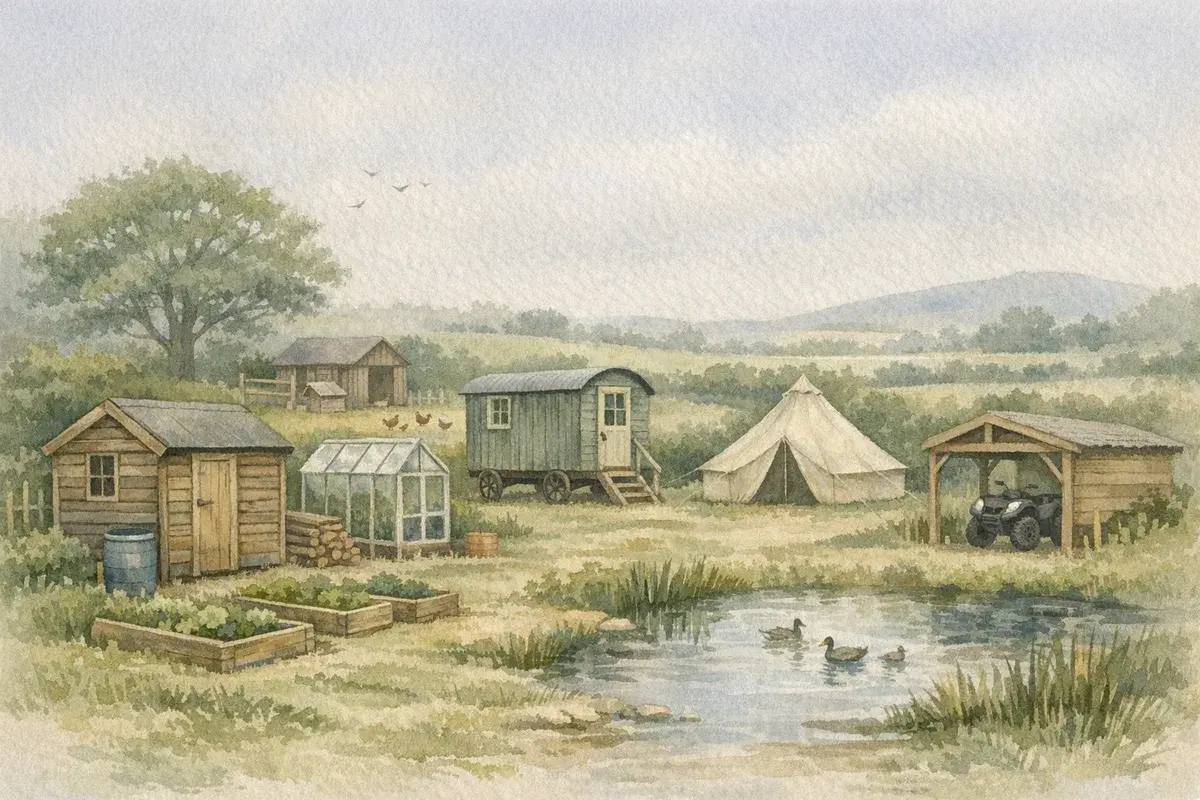
If youare asking what can you build on land without planning permission uk, the short answer is: less than many people hope, but more than you might think. Some agricultural structures, temporary works, and certain permitted development items can go ahead without a full planning application, provided they meet strict conditions.
The catch is that land use matters. What is acceptable on a working farm in Cumbria or Lincolnshire may be treated very differently on amenity land in Surrey or a smallholding in Devon, especially where the land is not genuinely in agricultural use.
That is why getting the basics right early can save a great deal of time and money. We'd argue that most disputes happen not because people build the wrong thing, but because they assume a shed, track, or shelter is automatically exempt (it usually isn't).
What Counts As Permitted Development On Rural Land
Permitted development rights allow certain works without a full planning application, but they are tightly defined. In the countryside, the biggest misconception is that any structure on open land is fine if it is small enough. Size helps, but purpose, use, siting, and permanence matter just as much.
For farms, many common items fall under agricultural permitted development, subject to conditions and prior notification in some cases. For non-agricultural land, the options are narrower, and Class B or general development rights may be restricted by planning conditions, Article 4 directions, conservation constraints, or designated landscapes.
Agricultural Permitted Development
If the land is in bona fide agricultural use, the list broadens. Basic structures such as lambing shelters, machinery stores, and certain livestock buildings may be possible without a full permission, although less than 5 hectares of land often triggers tighter rules and prior approval requirements.
The key test is whether the building is reasonably necessary for agriculture. A hobby shed for horses on a grazing paddock is not the same as a building needed for an established sheep enterprise. One is far more likely to face scrutiny.
Temporary And Movable Structures
Temporary structures can sometimes be erected without planning permission if they are genuinely temporary and easily removable. Think sheep handling pens, moveable field shelters, or lightweight polytunnels used seasonally. But if it looks permanent, foundations and all, planners may treat it as development.
- Field shelters: Often possible on agricultural land, but location and use are crucial.
- Polytunnels: Can be acceptable for horticulture, though scale and visual impact matter.
- Static cabins: Usually treated more like buildings than temporary items.
- Fencing: Much more flexible, yet still sensitive near highways, heritage assets, or protected habitats.
Buildings You Can Often Erect Without A Full Application
Once you move beyond the general principle, the practical question is what the market actually sees on the ground. In our view, the most common lawful without-full-permission additions on rural land are agricultural sheds, livestock accommodation, fencing, hard standings, and small ancillary structures tied directly to the holding's use.
That said, the grey areas are where buyers, sellers, and agents get caught out. A structure can be physically small but still require permission if it changes the character of the land, serves a non-agricultural use, or involves material changes to access or drainage.
Sheds, Stores, And Livestock Buildings
A typical farm shed may be acceptable under agricultural permitted development, especially where it supports an active enterprise. A straw store, feed store, or implement shed is often more defensible than a building intended for general storage or future residential conversion.
In Gloucestershire, Shropshire, and parts of Yorkshire, we often see agricultural buyers asking whether a modest shed can be added before completion. The answer usually depends on whether the land already functions as part of a farm business and whether prior notification has been satisfied.
Fencing, Gates, And Boundaries
Fencing is one of the easiest forms of development to misunderstand. Many boundary fences can be installed without planning permission, but visibility, height, location, and rights of way can all change the picture. If the fence affects a public footpath in Somerset or borders a highway in Norfolk, extra care is sensible.
Gates and stock fencing usually sit in a more straightforward category than substantial walls or close-boarded screens. Still, in sensitive settings, even a simple boundary treatment can attract attention if it alters views or raises safety concerns.
Tracks, Yards, And Hard Standings
Farm tracks and hard standings are often essential, especially in wetter counties such as Lancashire, Cumbria, or parts of Wales. However, surfacing works can be classed as development if they materially alter the land. The bigger the area and the more engineered the finish, the greater the planning risk.
A compacted stone track serving a field gate is not the same as a wide concreted yard with drainage channels. The former may be easier to justify as part of normal agricultural operations. The latter can start to look like a commercial yard and trigger closer assessment.
What You Can Build On Farm And Smallholding Land
The line between a working farm and a lifestyle holding is often decisive. Agricultural use remains the strongest route to building without full planning permission, while equestrian, storage, leisure, and mixed-use sites tend to face much tighter controls. That matters because land values and demand vary sharply by county and by use class.
As of May/2026, well-bred pasture in parts of the South West and Midlands still commands a premium when it offers genuine agricultural utility, while land marketed mainly for amenity or equestrian use may attract buyers hoping for buildings that planning will not support. Those expectations can be expensive if they are wrong.
| Typical Rural Item | Likely Position | Main Risk | County Example |
|---|---|---|---|
| Livestock shelter | Often possible on farm land | Appears permanent or non-agricultural | Devon |
| Machinery shed | Often possible with proper use | Size, siting, and prior approval | Lincolnshire |
| Field fencing | Usually straightforward | Highway, heritage, or rights of way issues | North Yorkshire |
| Polytunnel | Possible for horticulture | Visual impact and land use change | Kent |
For smallholdings, the question is often whether the land is being farmed in any meaningful sense at all. A few ponies and a mower command do not usually amount to agriculture. By contrast, a holding producing crops, poultry, or livestock for sale may have a stronger basis for agricultural structures.
Buyers should also be wary of inherited structures. Just because a previous owner put something up does not mean it is lawful. If there's no planning record, no evidence of permitted development compliance, and no sign of agricultural use at the relevant time, caution is wise.
Common Exemptions, Limits, And Hidden Traps
The planning system is full of traps for the unwary. Landowners often assume that small scale means safe, or that temporary means exempt. Those assumptions can be wrong, particularly where the land sits near a settlement, in a conservation area, or on the edge of a National Park or Area of Outstanding Natural Beauty, now often referred to locally as National Landscapes.
Some of the toughest issues are not the building itself, but what comes with it. Access creation, drainage alterations, lighting, hard surfacing, spoil storage, and changes in use can all turn a simple project into something requiring approval.
Size Limits And Siting Constraints
Even when a structure is allowed, it must usually sit well within the relevant dimensions and distances. Proximity to roads, boundaries, and existing buildings can matter, as can whether the proposal is visible from neighbouring land or public viewpoints.
Perhaps the biggest practical rule is this: if a scheme feels like it is stretching the agricultural label, it probably is. A large timber barn used mainly for storage of caravans, building materials, or unrelated commercial goods will attract attention quickly.
Protected Land And Special Designations
Land in or near a conservation area, listed curtilage, Scheduled Monument setting, flood zone, or protected landscape may have fewer rights. Even where a small building might normally be acceptable, design quality and visibility become much more important.
In parts of the Lake District, Northumberland, the Cotswolds, and Dartmoor, local planning policies can be stricter than many owners expect. The same is true in villages across Kent, Oxfordshire, and East Sussex where countryside views are fiercely protected (for sound reasons).
- Conservation areas: Extra sensitivity to appearance and materials.
- Listed buildings: Curtilage and setting can restrict works nearby.
- National Landscapes: Greater emphasis on minimising visual impact.
- Flood risk land: Hard surfaces and buildings may face drainage scrutiny.
How To Check Before You Build
If you want certainty, start with the land's lawful use and planning history. Is it genuinely agricultural? Has anything similar been built before? Is there a planning condition removing permitted development rights? These are the questions that matter before a post is dug or a base is poured.
It is sensible to review title documents, past permissions, enforcement letters, and any agricultural occupancy clauses. An agricultural occupancy clause can limit who lives in a dwelling, but it can also hint at the land's planning background and any associated development restrictions.
Where the project sits in a grey area, a lawful development certificate or pre-application discussion may be worth considering. A certificate does not create permission, but it can provide formal confirmation that the work is lawful if the facts stack up. That can be valuable when selling land or borrowing against it.
From a market perspective, clear planning status adds confidence. Buyers pay closer attention to land with documented rights, especially in counties where mixed-use opportunities are priced aggressively. Rural assets with uncertain legality often trade at a discount because the risk follows the title.
So, before building, ask three simple questions. What is the land's real use? What is the structure for? And can you prove it if challenged? If you can answer those cleanly, you are in much safer territory.
Conclusion
So, what can you build on land without planning permission uk? In practice, it is usually limited to genuinely agricultural structures, certain temporary items, and low-risk boundary or access works, all subject to strict conditions. The more permanent, commercial, or residential the proposal looks, the more likely permission will be needed.
For farmers, landowners, and investors, the safest approach is to test the use, the location, and the paper trail before starting work. A small mistake on rural land can become a costly enforcement issue, especially where the land's value depends on future development potential.
Disclaimer: AgLand.co.uk is a UK agricultural land and rural property matching service, where buyers register what they are looking for and owners advertise directly to the buyers who match, and a rural resource hub. Nothing in this text is intended as legal, financial, or investment advice. You should carry out your own due diligence and seek guidance from appropriately qualified professionals (for example, solicitors, land agents, surveyors, and financial advisors) for your specific circumstances.