
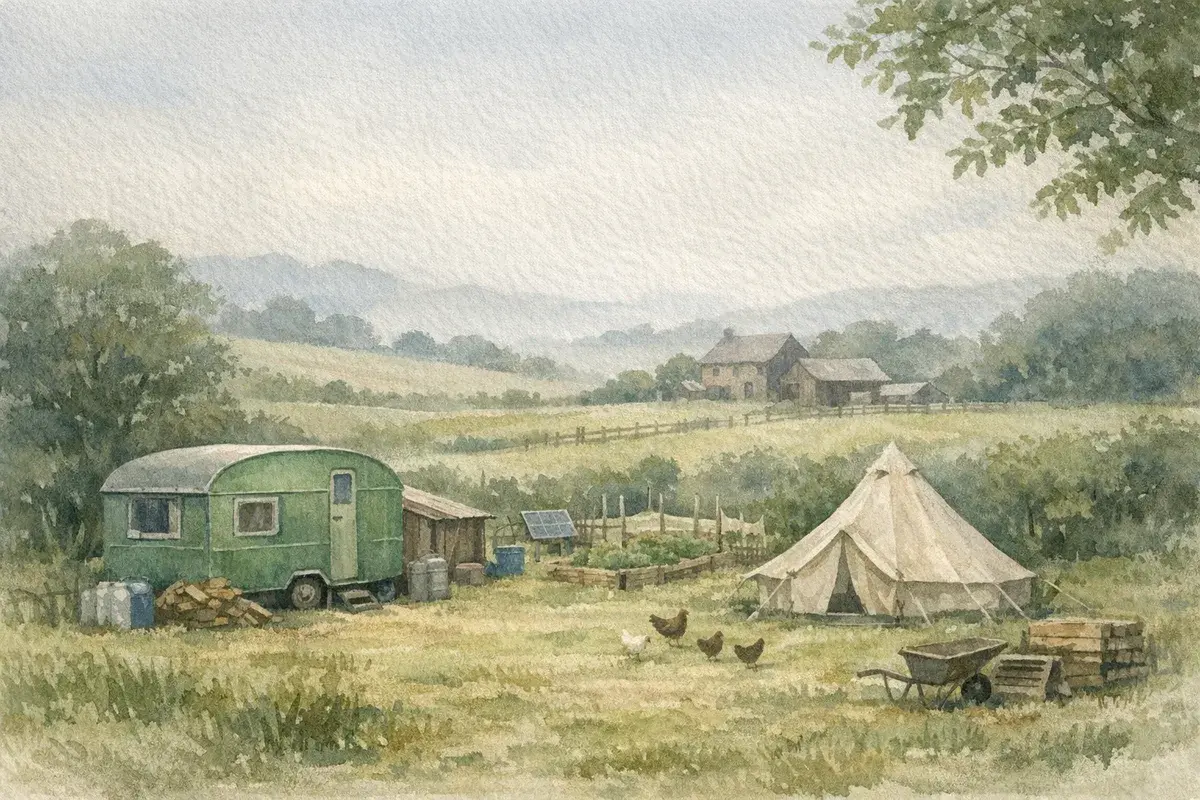
Living on agricultural land without planning permission is a common question, but the answer is rarely as simple as yes or no. In most cases, you cannot make a permanent home on agricultural land unless the right planning consent, lawful change of use, or a very specific permitted development route applies.
The crucial issue is not the field itself. It is the use of the land and whether the accommodation is truly tied to a genuine agricultural operation, or whether it amounts to open countryside living without consent.
If you are a farmer, landowner, or purchaser considering a roadside plot, pony paddock, or a small acreage somewhere in Devon, Lincolnshire, Yorkshire, or Carmarthenshire, you need to be clear on the rules before spending money. We'd argue that a surprising number of disputes arise because people confuse temporary shelter with lawful residential occupation.
What Planning Law Actually Says
In England and Wales, residential use on agricultural land usually needs planning permission unless it falls within an exception. The starting point is simple: agricultural use and residential use are not the same thing, even if they happen on the same holding.
Planning authorities look at what is happening on the land in practice. A field with a caravan, cabin, shepherd's hut, or converted store may still count as unauthorised development if it is used as a permanent home without consent. That applies whether the site is in Somerset, Shropshire, Norfolk, or the Borders.
Why Agricultural Use Does Not Automatically Mean Residential Use
Agricultural land is land used for agriculture, which can include crops, grazing, horticulture, and associated buildings. But sleeping on the land does not magically make it residential. The council will ask whether the main use has changed.
The test often comes down to permanence, facilities, and intention. A seasonal hut for lambing may be one thing, but a year-round kitchen, bathroom, post, bins, and council tax registration points towards a dwelling. That's where problems start.
- Residential use: living there as your home, usually requiring planning permission.
- Ancillary use: accommodation supporting farming activity, such as a worker's unit tied to the business.
- Temporary use: short-term occupation that may be acceptable for limited periods, depending on the facts.
- Material change of use: a planning term meaning the land's use has changed enough to need consent.
The Role Of Permitted Development
Some farm buildings can, in limited circumstances, be converted under permitted development rights, subject to prior approval or specific conditions. But permitted development is often misunderstood, and it is not a free pass to create a home wherever you like.
For example, converting a redundant barn in Gloucestershire may be possible in principle, while pitching a static caravan beside a barn usually is not the same thing at all. Councils will also scrutinise access, design, amenity, drainage, and whether the site is genuinely suitable.
When Living On Agricultural Land Can Be Lawful
There are lawful routes to living on agricultural land, but they are narrower than many buyers expect. The key is to match the type of accommodation to the planning route, and to prove the need if the law requires it.
A classic example is an agricultural workers dwelling. This is a home allowed because someone needs to live on site to run a viable farm unit or deal with livestock, security, or crop management at odd hours. Even then, the case has to be evidenced properly.
Agricultural Occupancy Conditions
Some homes on agricultural holdings carry an agricultural occupancy condition. That means the property can only be occupied by a person employed, or last employed, in agriculture or forestry, or by a dependant of such a person. These homes appear across counties such as Herefordshire, Cheshire, Kent, and Suffolk.
These conditions can help farmers and rural workers, but they also restrict future resale. Buyers often underestimate how much an occupancy tie affects marketability and finance options. We'd argue it should always be checked early, not after a sale is agreed.
Temporary And Seasonal Accommodation
Short-term accommodation can sometimes be tolerated where it is genuinely temporary and tied to an agricultural need. Think of lambing season, fruit picking, or close supervision during a specific project. However, a temporary structure that becomes a long-term home may quickly cross the line.
The distinction matters because councils assess facts, not labels. Calling a unit a hut, cabin, or mobile home does not make it temporary if it is installed, serviced, and lived in like a dwelling.
Lawful Development Certificates
If a use has continued long enough, with the right evidence, a Lawful Development Certificate may be available. In planning, this is a formal confirmation that a use or development is lawful because the necessary time period has passed without enforcement.
In many cases, that means years of open, continuous, and demonstrable residential occupation. The evidence burden is high, so utility bills, council tax records, photographs, witness statements, and tenancy papers all matter.
The Risks Of Living There Without Permission
Trying to live on agricultural land without planning permission carries real risk. Some people think councils will not notice. In practice, complaints, aerial imagery, utility applications, and enforcement inspections can all trigger action.
Once a council decides there has been a breach, it can issue an enforcement notice. That may require the residential use to stop, the structure to be removed, or the land to be restored. Ignoring the notice can lead to prosecution, costs, and a great deal of stress.
| Issue | Typical Risk | What It Means In Practice | Date Reference |
|---|---|---|---|
| Unauthorised dwelling | High | May require removal or cessation of residential use | As of June 2026 |
| Occupancy tie breach | Medium to High | Can affect resale and mortgageability | As of June 2026 |
| Temporary structure treated as a home | High | Can be judged a material change of use | As of June 2026 |
| Established use over time | Medium | May support a lawful certificate if evidence is strong | As of June 2026 |
There are also practical consequences. Insurers may refuse cover, mortgage lenders may decline the security, and a sale can stall when solicitors spot an unresolved planning issue. On small holdings in Cornwall, Lancashire, or Powys, that can wipe out the value of a site that looked cheap on paper.
How Councils Assess Agricultural Land Homes
Planning officers take a fairly pragmatic line. They want to know what the land is used for, why someone needs to live there, and whether the claimed occupation is credible. The more permanent and domestic the setup, the harder it is to argue that no permission is needed.
They also look at the wider pattern of use. A site with a water supply, sewage treatment plant, hardstanding, internet, postal delivery, and regular visitors is much more likely to be viewed as a dwelling than a simple farm shelter.
Evidence Councils Usually Expect
If you are seeking permission, or defending an alleged breach, evidence matters more than opinion. Councils and planning consultants will usually look for the full picture rather than one isolated document.
Typical evidence can include business accounts, stock numbers, labour records, tenancy agreements, land maps, and photographs showing where the person lives in relation to the farming enterprise. The stronger the link between the dwelling and the agricultural operation, the better.
- Business need: proof that someone must live on the holding for effective farm management.
- Continuity: records showing how long the occupation has been happening.
- Physical works: services, foundations, access tracks, or other signs of permanence.
- Practical alternative: whether nearby housing could reasonably meet the need.
Regional practice can vary a bit. Rural districts in North Yorkshire or Shropshire may deal with more farm-worker dwelling applications than urban fringe authorities, but the underlying policy tests remain broadly similar.
Why Location Still Matters
Location affects both the planning case and the market value. A unit near an established farmstead in Suffolk will often be easier to justify than a lone cabin in an isolated field in Surrey, where the residential character may stand out more sharply.
Access, visibility, and relationship to existing buildings all matter. If the accommodation looks and functions like a small house rather than farm accommodation, planners will usually notice.
Practical Options If You Want To Live On The Land
If you want to live on agricultural land, there are usually four realistic routes. None is perfect, but each can be lawful if handled properly and backed by evidence.
The best route depends on whether you already own the land, whether there is an existing building, and whether the need is tied to actual agricultural activity. A planning consultant or rural surveyor will often start by asking exactly that.
Apply For Planning Permission
This is the cleanest route if you want a permanent dwelling. A fresh application can succeed where there is a strong business case, a viable farm, or a replacement dwelling on a rural site.
Applications can be stronger where the holding is active in livestock, horticulture, or intensive crop management. A dairying unit in Pembrokeshire or an equine enterprise in Essex may justify a different approach from a hobby holding with a few ponies.
Use An Existing Building Lawfully
Sometimes the site already contains a barn or outbuilding that may have conversion potential. The key question is whether it qualifies under the relevant planning rules and whether the structure is suitable for habitation.
Older stone barns in Derbyshire or brick buildings in East Anglia may offer better conversion prospects than flimsy modern sheds. But even then, the local authority will want to see that the proposal works in planning terms, not just from a building perspective.
Regularise An Existing Occupation
If someone is already living on the land without permission, regularisation should be considered quickly. That might mean a retrospective application, a lawful use case, or in some circumstances ceasing occupation and removing the structure.
The worst approach is to do nothing and hope the issue disappears. Time can help in some legal scenarios, but only with proper evidence and only if the relevant planning periods have been met.
What Buyers, Sellers, And Estate Agents Should Check
For buyers, the big question is whether the land can really support lawful residential use. For sellers, it is whether the marketing information matches the planning status. For agents, it is whether the asset has been described accurately enough to avoid trouble later.
In the current countryside market, some land parcels are advertised as lifestyle plots or smallholdings when the planning reality is much stricter. As of June 2026, buyers remain cautious, especially where financing is involved and the site has no clear consent for living accommodation.
If you are valuing a holding in Cumbria, Wales, or the South West, check the title, planning history, occupancy conditions, and any enforcement correspondence. That extra due diligence can prevent a nasty surprise after exchange.
Conclusion
Living on agricultural land without planning permission is usually risky and often unlawful unless a very specific exception applies. The real answer depends on the land use, the type of accommodation, the strength of any agricultural need, and the history of occupation.
If you remember one thing, make it this: a field is not a home just because someone sleeps in it. For anyone dealing with living on agricultural land without planning permission, the safest route is to check the planning position early, evidence the facts properly, and avoid assuming that rural character alone creates a right to live there.
Disclaimer: AgLand.co.uk is a UK agricultural land and rural property matching service, where buyers register what they are looking for and owners advertise directly to the buyers who match, and a rural resource hub. Nothing in this text is intended as legal, financial, or investment advice. You should carry out your own due diligence and seek guidance from appropriately qualified professionals (for example, solicitors, land agents, surveyors, and financial advisors) for your specific circumstances.