
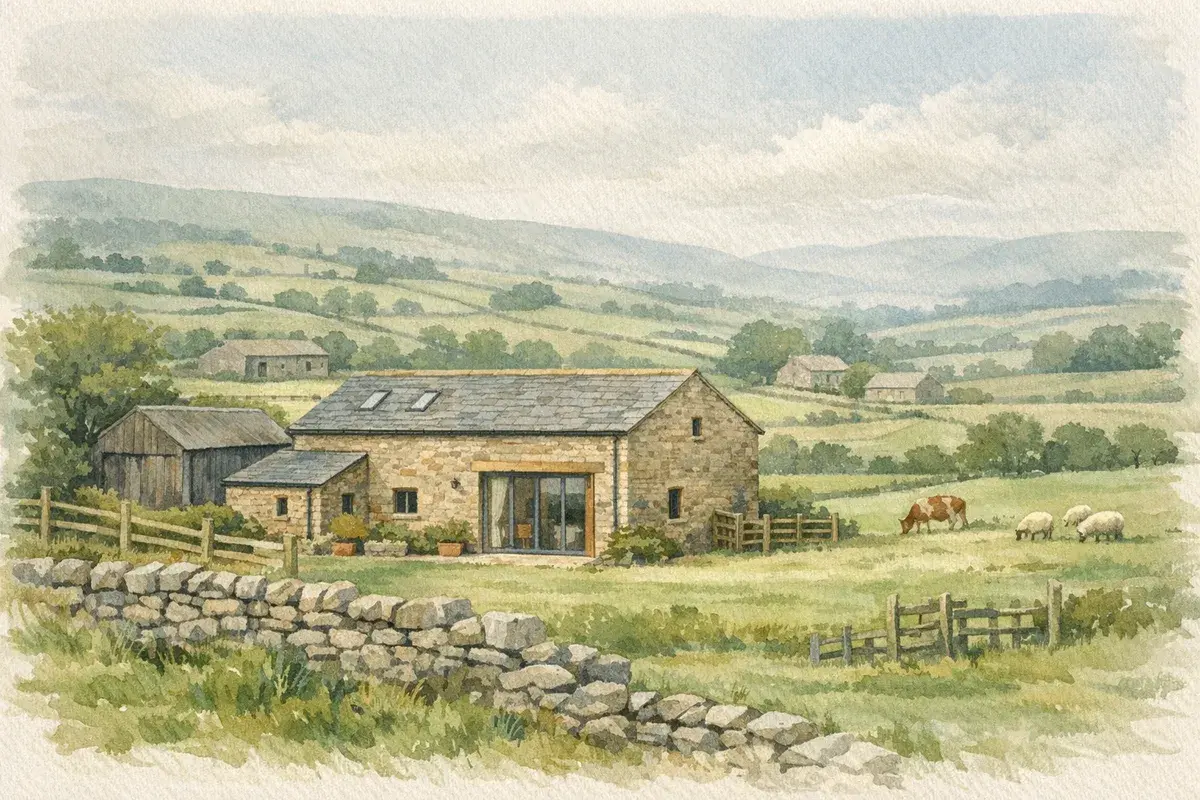
You've found a barn with "potential", great frame, decent access, maybe even a view you can't buy in most postcodes. Then you spot it in the paperwork: agricultural tie (also called an agricultural occupancy condition, or AOC).
That one line can change everything: what you can convert, who can live there, how lenders view it, and what you can sell it for later. And it's not just a planning detail. An agricultural tie can become a compliance issue if you get the sequence wrong (or assume the council won't notice).
This guide is built for UK farmers, landowners, and rural buyers who want to approach an agricultural tie barn conversion with eyes open. We'll cover the main conversion routes, when (and how) ties can be varied or removed, the financial reality, enforcement risks, and a due diligence checklist you'll be glad you used before spending money on drawings.
Understand The Agricultural Tie: What It Is And Why It Matters For Barn Conversions
An agricultural tie is a planning condition (or legal obligation) that restricts who can live in a dwelling, usually to someone employed, last employed, or otherwise working in agriculture (sometimes forestry or other rural enterprises too). It's typically imposed because the planning authority accepted that a home in the countryside was justified only by a genuine functional need for a rural worker to live close to the enterprise.
So when you talk about an agricultural tie barn conversion, you're not just asking "can I make this building into a home?" You're also asking "who is allowed to occupy it once it becomes a home?" Those are separate questions, and councils treat them separately. That second question rests on the same functional need test that governs any new countryside dwelling, and what it actually takes to live on farmland you have bought shows why owning the acres never grants the right to occupy them.
How Agricultural Occupancy Conditions Work In Practice
In practice, the tie sits on the planning permission for the dwelling and binds future owners and occupiers. It doesn't "expire" when the farm changes hands. It doesn't drop off because nobody's checked it for years. And it can still bite even if the original farm business has evolved, merged, been rented out, or diversified.
Typical real-world impacts include:
- Resale friction: fewer buyers qualify, and many buyers can't get comfortable with the risk (or can't get a mortgage).
- Letting constraints: you can't simply let it to "anyone reliable": you need an occupier who fits the condition.
- Refinancing limits: lenders may treat a tied dwelling as non-standard security.
- Enforcement exposure: if the council believes the tie is breached, you can face enforcement action, difficulty selling, or a forced change in occupation.
If your end goal is a standard open-market home, you'll often need a strategy that addresses the tie head-on, not as an afterthought.
Common Wording Variations And Why They Change The Outcome
Not all ties are created equal. Small changes in wording can swing the outcome.
Common variations you'll see in UK decision notices include:
- "Solely or mainly employed" in agriculture locally (tighter).
- "Employed or last employed" (gives some flexibility if someone has recently left the sector).
- Including "dependants" (broadens who can live there, but only alongside a qualifying person).
- Linking to a named holding or unit (can be restrictive, but sometimes gives you a clearer evidence path).
- Broader rural enterprise ties (occasionally includes forestry, equestrian, or other land-based businesses).
Why it matters: if you're trying to prove compliance, arrange a letting, or argue the tie is no longer necessary, the council will read the condition literally. The precise words determine what evidence you need and how hard it will be to satisfy the requirement.
If you're considering changing the wording, or removing it entirely, AgLand's guide on the routes and evidence for removing an agricultural occupancy condition is worth having in your toolkit.
Who Typically Qualifies: Worker Tests, Dependants, And Edge Cases
At a high level, the qualifying person is usually:
- A worker in agriculture (employed or self-employed) where the role is genuine and ongoing, and
- In many cases, the work is connected to the holding or to agriculture in the locality.
Edge cases are where people come unstuck:
- Retired workers: if the condition includes "last employed", retirees may qualify: if not, they may not.
- Part-time roles: councils may question whether the agricultural element is substantial enough to meet "mainly employed".
- Contractors: a contractor can qualify, but you may need clear evidence of the agricultural work being the core occupation.
- Farm managers on multiple units: possible, but the "locality" element can become contentious.
- Dependants and separated households: the tie typically expects the dwelling to be occupied as a household connected to the qualifying person: informal arrangements can create risk.
The practical point: before you design a conversion around your "ideal end user", sanity-check whether they can actually occupy the dwelling under the wording you've got. If they can't, you're designing a problem.
Barn Conversion Routes: Permitted Development Vs Full Planning
Most barn conversion conversations in the UK quickly turn into a single question: "Is it Class Q?" That's understandable, permitted development can be faster and less contentious. But with an agricultural tie in the mix, you need to be careful not to mash two issues together: the route to create a dwelling and the occupancy restriction on that dwelling.
Class Q (England): When It Applies And The Main Limitations
In England, Class Q (Part 3, Schedule 2 of the GPDO) can allow change of use of an agricultural building to a dwellinghouse, subject to prior approval and a list of limitations.
Key points buyers often miss:
- Class Q is about change of use + limited building operations. If the structure needs substantial rebuilding, Class Q can fall over.
- There are caps and conditions (including limits on what buildings qualify, where, and how many dwellings can be created), and the prior approval process tests things like transport, noise, contamination, flooding, and design.
- Class Q doesn't automatically make the dwelling "normal" from a planning history perspective. It's still a countryside dwelling, often scrutinised for sustainability, access, and impacts.
For a deeper run-through of the criteria and tripwires, see our dedicated explainer on Class Q barn conversion.
When Full Planning Is The Safer Route (Or The Only Route)
Full planning is often the safer path when:
- The building isn't eligible under Class Q (or you can't prove lawful agricultural use/history).
- The works required go beyond what Class Q tolerates (e.g., major structural intervention).
- You want a design outcome that Class Q's limitations can't accommodate.
- The site has constraints where you'll need a more holistic planning case (heritage setting, landscape sensitivity, access upgrades, biodiversity issues).
With an agricultural tie scenario, full planning can also be useful if you're seeking a permission that explicitly varies, replaces, or reimposes an occupancy condition in a way that fits your business plan (for example, tying the dwelling to a wider rural enterprise rather than a narrow agricultural definition, where policy allows).
If you're comparing routes, AgLand's guide to agricultural to residential planning permission lays out the practical differences between permitted development and full planning, including common pitfalls.
Scotland, Wales, And Northern Ireland: Key Differences To Watch
Class Q is an England-specific permitted development right under the GPDO. If your barn is in:
- Wales: permitted development rules differ, and the Welsh planning system has its own framework and guidance. Don't assume an "English Class Q playbook" will translate.
- Scotland: the permitted development regime and planning policy context are different again, with distinct pathways and terminology.
- Northern Ireland: planning is a devolved system: processes, permitted development rules, and rural housing policy can be materially different.
The key takeaway: in devolved nations, you need advice anchored in that country's legislation and policy, and you should expect different evidence standards and different attitudes to countryside housing. If you're buying across borders, budget for that learning curve early.
Can You Remove Or Vary The Agricultural Tie As Part Of A Conversion?
Sometimes the tie is the whole point: you want a home for a worker, succession housing, or an on-site manager. But if your end goal is open-market residential value, you'll inevitably ask: can you remove or vary the agricultural tie as part of a conversion?
Possibly, but it's rarely a "tick box" exercise. Councils imposed the tie for a reason, and they'll want to see that the reason no longer applies.
Proving The Tie Is No Longer Necessary: Evidence Councils Expect
Local planning authorities typically look for evidence that:
- There is no longer a functional need for an on-site agricultural worker's dwelling, and
- That need is unlikely to reappear in a realistic way.
Evidence that can matter includes:
- A clear description of the holding and business model (including tenancies, contracting arrangements, livestock numbers, cropping, labour requirements).
- Accounts or business summaries that show the scale and nature of activity.
- Operational rationale: why on-site presence is not required (or can be met without a tied dwelling).
- If the original enterprise has ended, evidence of what replaced it and why that change is durable.
Be careful with "paper arguments" that look tidy but don't match reality on the ground. Councils (and neighbours) often know the local picture.
Marketing Requirements: Demonstrating A Genuine Lack Of Demand
Even where need is disputed, councils frequently expect you to demonstrate that the property has been properly marketed as a tied dwelling and that there's no realistic demand from qualifying occupiers.
Marketing evidence often includes:
- A reasonable marketing period (commonly around 12 months, but it varies by authority and circumstance).
- Marketing at a realistic price that reflects the tie (not an open-market benchmark).
- Use of appropriate channels and agents who understand rural restrictions.
- A schedule of enquiries and viewings, and why applicants didn't proceed.
This is one of the most common failure points: sellers try to "prove" no demand while quietly setting the property up to fail. That tends to backfire.
Alternative Outcomes: Variation, Replacement Dwellings, Or Mixed Permissions
If outright removal is unlikely, you may still have workable options:
- Varying the wording so it fits the modern reality of the business (for example, aligning to a broader rural enterprise where policy supports it).
- Replacement dwelling strategies (where an existing dwelling is replaced with a new one, potentially with conditions carried over).
- Mixed outcomes where part of the scheme is residential, part remains tied, or the tie is reattached to a different unit on the holding.
The important bit: treat the tie as a strategic planning constraint, not an annoyance. The right route depends on your holding structure, the local policy stance, and what you can evidence.
If you want the detailed routes (including common applications like Section 73, Section 106 changes, and lawful development approaches where relevant), read our guide to agricultural occupancy condition removal.
Valuation, Mortgages, And Resale: The Financial Reality Of A Tied Conversion
A tied barn conversion can be a brilliant asset, especially if it supports the farm business. But financially, it behaves differently from a "normal" rural home.
How A Tie Affects Value, Rentability, And Buyer Pool
In straightforward terms, an agricultural tie usually:
- Reduces market value compared to an unrestricted dwelling (sometimes significantly), because your buyer pool is smaller.
- Narrows letting options, because you can't simply pick the best tenant: you need a qualifying occupier.
- Adds transaction friction, because buyers' solicitors (and lenders) will ask tougher questions about compliance history.
That doesn't mean it's "bad value". For the right buyer, someone who qualifies and genuinely needs to be on-site, it can be a cost-effective way to secure a rural home.
But you need to be honest about your exit options. If your future plan assumes an open-market resale price, you must align that plan with the realistic prospects of varying/removing the tie.
Mortgage And Lending Constraints (And How Buyers De-Risk Them)
Lending on tied dwellings is often possible, but it can be slower and more conditional.
Expect a lender (and valuer) to focus on:
- The exact wording of the occupancy condition and how restrictive it is.
- Evidence of compliance (or at least no obvious breach).
- Marketability: how quickly it would sell if the lender had to repossess.
- Any planning risk tied to the conversion route.
How you de-risk it:
- Get the planning paper trail tidy: decision notices, approved plans, discharge of conditions, prior approval documents.
- Document occupancy carefully (who lives there, why they qualify, and since when).
- Use a solicitor who understands rural restrictive conditions, this isn't the time for "template conveyancing".
And if you're still deciding on the route, understanding the broader process of converting a barn to residential use will help you anticipate what lenders and valuers will ask later. Construction method feeds into that too, since SIPs panels, timber frame cassettes and bathroom pods can shorten site time but raise warranty and non-standard construction questions, which our guide to modern methods in barn conversion works through.
Overage, Clawback, And Title Restrictions To Check Early
Barn conversions, especially those with any residential "uplift", often come with extra strings:
- Overage/clawback: the seller (or former owner) takes a slice of the uplift if you obtain residential consent or remove the tie.
- Restrictive covenants: limits on use, additional dwellings, or subdivision.
- Access and service rights: private tracks, shared yards, easements for drains and water.
You want these reviewed before you commission architects or submit planning. Overage clauses in particular can be drafted broadly, and the trigger events can catch you out (for example, a "change of use" even without a sale).
A good rural solicitor and an experienced land agent are worth their fees here, because once you've triggered an overage event, you can't un-trigger it.
Compliance And Enforcement: Avoiding The Classic Barn Conversion Pitfalls
If there's one theme we see repeatedly, it's this: people don't get into trouble for trying to do things properly, they get into trouble for assuming "it'll probably be fine". With a tied dwelling, that assumption can get expensive.
Lawful Use, Breach Of Condition, And Certificate Options
A tied dwelling can be breached if it's occupied by someone who doesn't meet the condition. That may sound simple, but real life gets messy: job changes, retirement, short-term lets, relationship breakdowns, "temporary" arrangements that become permanent.
There are legal tools that can sometimes help clarify position, like lawful development certificates in certain circumstances, but they're evidence-driven and not a magic eraser. If you suspect historic non-compliance, get proper advice before you start writing casual explanations in emails that later become disclosure documents.
It's also worth being crystal clear on the planning route you're using. Permitted development is not a loophole: it's a defined right with a defined process. If you're tempted by the idea of a barn conversion without planning permission, read the fine print first, because "no planning" in rural conversions often really means "planning exists somewhere in the background, and you still have conditions to satisfy".
Council Enforcement Triggers: Neighbours, Listings, And Council Tax Flags
Enforcement isn't always a planning officer driving past and spotting a new kitchen window.
Common triggers include:
- Neighbour complaints (parking, noise, lights, new domestic activity on a yard).
- Online marketing that suggests unrestricted residential occupation.
- Council Tax and electoral roll signals where a property is clearly being used as a standard dwelling.
- Utility connections and building control trails that don't align with what's been permitted.
You don't need to be paranoid. But you do need to be consistent: if the dwelling is tied, don't advertise it like it isn't.
Record-Keeping That Protects You If The Tie Is Challenged
Good record-keeping is boring right up until it saves you.
Practical records to keep include:
- Proof of the occupier's qualifying employment/self-employment (contracts, accounts, invoices, CIS statements where relevant).
- A short written occupancy statement explaining how the condition is met.
- Planning approvals, discharge of conditions, and any correspondence confirming interpretation.
- If the dwelling is linked to a holding, evidence of the enterprise and the worker's role in it.
If you're a landowner providing housing for staff, create a simple internal process, annual check-ins, basic documentation, and a clear understanding of what changes must be flagged.
And don't forget: compliance isn't just planning. A conversion also has to meet the technical standards expected of a dwelling. If you're scoping works, our guide to barn conversion building regulations can help you understand what building control will focus on (structure, fire safety, insulation, drainage, and more).
Due Diligence Checklist Before You Spend Money On Designs
Before you pay for measured surveys, designs, ecology reports, and planning statements, you want a quick but serious "go/no-go" check. Here's a pragmatic checklist we'd recommend you run through.
Planning Constraints: AONB, Green Belt, SSSI, Heritage, And Access
Start with constraints that can block or reshape a scheme:
- AONB / National Landscape: not a ban, but scrutiny is higher and design expectations tighten.
- Green Belt: barn conversions can be possible, but the policy tests are specific and mistakes are costly.
- SSSI / protected habitats: ecology can become the critical path.
- Listed buildings / conservation areas: you may need listed building consent and a conservation-led approach.
- Highway access: visibility splays, passing places, and safe access can decide the application.
- Flood risk: even if the building is existing, changing to a dwelling can bring a tougher flood risk position.
If you're weighing up routes and likely sticking points, our in-depth guide to barn conversion planning rules goes into the practical deal-breakers (access, flood, ecology, and the "how much rebuilding is too much?" question).
Building Reality Check: Structural Surveys, Services, And Biodiversity
Barns look robust, until you price the fix.
Before you get emotionally attached to a layout, check:
- Structure: frame integrity, foundations, roof condition, signs of movement. A chartered building surveyor can quickly tell you whether it's conversion-friendly or effectively a rebuild.
- Services: water supply, power capacity, drainage, and telecoms. Private drainage can be a whole mini-project.
- Contamination: former fuel tanks, chemicals, or agricultural waste areas may need investigation.
- Biodiversity: bats and nesting birds are common in barns. Surveys are seasonal, and mitigation can change design and cost.
One small but telling indicator: if the "cheap win" relies on extensive new steelwork and wholesale rebuilding, you may be drifting away from the assumptions that underpin permitted development routes.
Professional Team: Land Agent, Planner, Surveyor, And Tax Adviser Roles
The best outcomes usually come from getting the right people in early, before positions harden.
- Land agent: reality-checks value, demand for tied occupation locally, and marketing evidence if removal/variation is a future aim.
- Planning consultant: maps the strategy, prior approval vs full planning, how to position the tie, and what the local authority is likely to push back on.
- Surveyor/engineer: confirms whether the building can be converted in the way you're imagining.
- Tax adviser/accountant: stress-tests VAT, CGT, IHT reliefs, and the impact of letting.
If you want a simple rule: spend a little on advice to avoid spending a lot on the wrong design.
And if you're leaning towards permitted development, it's worth reading up on what councils can, and can't, query during a permitted development barn conversion prior approval process.
Tax, Business Structure, And Reliefs: Don’t Let The Conversion Create A Surprise Bill
Planning risk is only half the story. A barn conversion can also reshape your tax position, sometimes in ways that only become obvious when you come to sell, restructure, or pass assets to the next generation.
You should get bespoke advice for your circumstances, but here are the UK tax themes that commonly matter with an agricultural tie barn conversion.
VAT And Construction Treatment For Conversions
VAT on conversion work can be nuanced. The rate and recoverability can depend on:
- Whether the building is being converted into a dwelling versus adapted for another use.
- Whether it has been residential before.
- How contractors invoice and how the works are structured.
It's also common to see VAT questions crop up around enabling works (access tracks, service connections) and whether they're considered part of the qualifying works.
If VAT recovery is part of your budget maths, don't rely on "what a mate did on his conversion". Get it confirmed in writing by a tax adviser who's comfortable with property and rural businesses.
Capital Gains, IHT, And The Risk Of Losing APR Or BPR
For farmers and landowners, the big strategic risk is accidentally harming inheritance tax reliefs.
Depending on how the asset is held and used, you'll want to consider:
- Agricultural Property Relief (APR): often linked to agricultural use/value: moving property into residential use can reduce the agricultural element.
- Business Property Relief (BPR): can be sensitive to the nature of the business (trading vs investment) and how property is used.
- Capital Gains Tax (CGT): can arise on sale, transfer, or sometimes on restructuring: the "uplift" from residential consent can change the numbers dramatically.
A tied dwelling can feel "part of the farm", but HMRC doesn't run on vibes. The specifics of occupation, use, and business structure matter.
Letting, Holiday Use, And Furnished Holiday Letting Changes To Consider
If you're thinking about letting the converted barn (tied or otherwise), consider:
- Whether the occupancy condition allows the intended type of letting.
- The difference between a straightforward AST-type arrangement and short-term holiday use.
- The changing UK landscape around furnished holiday letting treatment and what that means for reliefs and reporting.
Also, if your longer-term plan is to run it as a diversified income stream, make sure the planning permission matches that reality. "Residential use" and "holiday accommodation" aren't always treated the same way in planning terms, and conditions can be drafted to restrict what you can do.
This is one area where you're best served by joined-up advice: planner + tax adviser + solicitor, all looking at the same intended outcome.
Conclusion
An agricultural tie barn conversion can be a smart, farm-serving move, or a slow-burn headache that shows up when you try to refinance or sell. The difference usually comes down to whether you treated the tie as the core constraint from day one.
If you want the practical approach: get the wording, planning route, and end user aligned early: document everything: and don't spend serious money on designs until you've stress-tested planning, buildability, and tax. When it works, a tied conversion can deliver exactly what rural businesses often need most: the right person living in the right place, for the right reason.
Disclaimer: AgLand.co.uk is a UK agricultural land and rural property matching service, where buyers register what they are looking for and owners advertise directly to the buyers who match, and a rural resource hub. Nothing in this text is intended as legal, financial, tax, or investment advice. You should carry out your own due diligence and take independent professional advice (for example from a planning consultant, rural surveyor, solicitor, mortgage adviser, and tax adviser) before acting on any information above.