
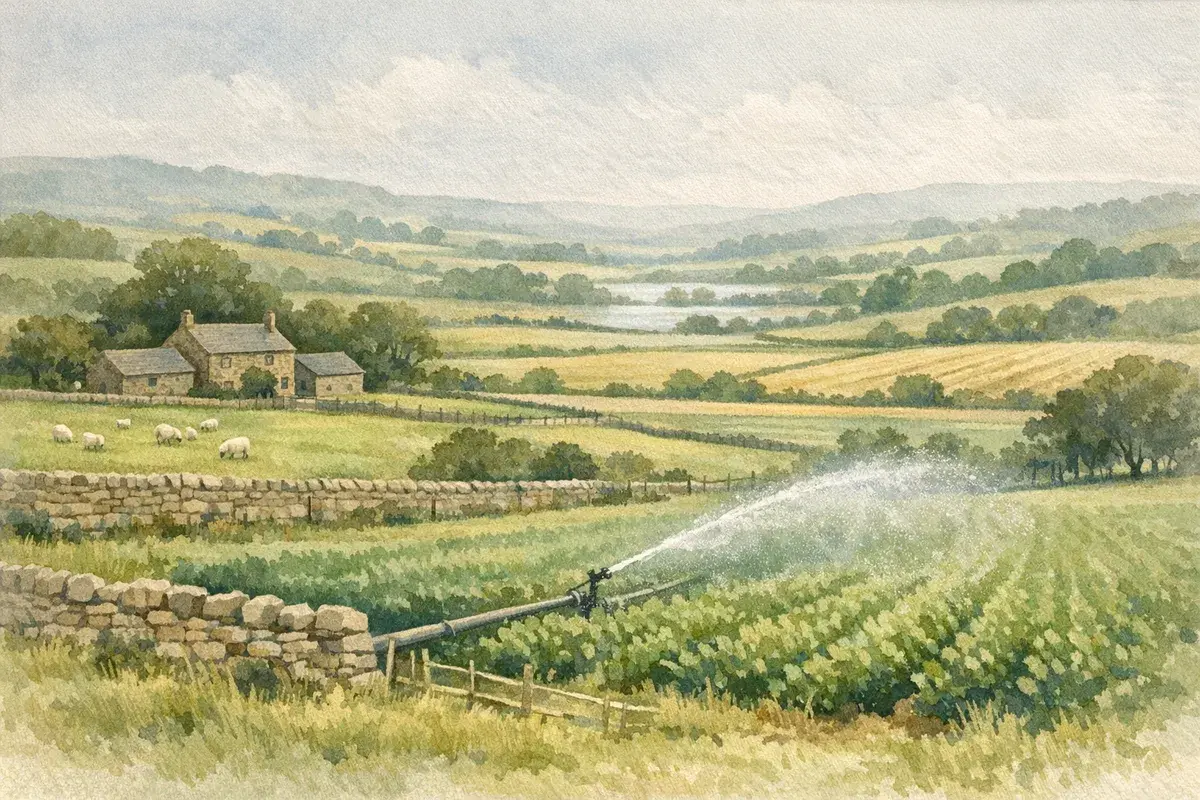
There's arable land… and then there's arable land that can keep producing when the rain doesn't turn up.
If you're looking at irrigated arable land for sale in the UK, you're probably thinking beyond "nice soils" and into reliability: consistent crop quality, flexibility to chase higher-value rotations, and a practical hedge against dry springs and hot summers. But irrigation also drags in extra moving parts, abstraction licences, storage, pumps, power, maintenance, compliance, and the occasional nasty surprise buried in the small print.
This guide cuts through the noise. You'll learn what "irrigated" really means in listings, where it tends to come to market, what you must verify on water rights, and how to price the land, the kit, and the water separately, so you can buy with your eyes open.
What Counts As Irrigated Arable Land (And Why It Commands A Premium)
In UK terms, "irrigated arable land" should mean more than a field that could take a rain gun. Properly irrigated land is land where you can apply water when the crop needs it, at volumes that make a material difference to yield and quality, backed by lawful abstraction, workable infrastructure, and a system that actually reaches the cropping area.
That's why it commands a premium. In the right place, irrigation can:
- Stabilise output and quality (especially for veg, potatoes, sugar beet, seed crops, and some high-performing combinable rotations)
- Reduce your downside risk in dry seasons
- Increase rental and contracting attractiveness
- Support a more responsive agronomy plan (timely drilling, establishment, and crop stress management)
The catch? Not all "irrigated" claims are equal. You're buying a capability, and you need to prove it exists.
Irrigation Setups You'll See In UK Listings
Most listings you'll come across fall into a few practical categories:
- Hose reel / rain gun systems: Common, flexible, and relatively movable. They can be effective but are labour- and diesel/power-hungry, and performance depends on pressure and wind.
- Boom irrigators: Often used on potatoes and some veg: can give more uniform application than a gun, but still needs solid pressure and a sensible layout.
- Drip irrigation: Less common in broad-acre arable, more common in horticulture and certain specialist setups. Great efficiency potential, but design, filtration, and management matter.
- Fixed mains with hydrants: A big value signal. A well-laid underground main with hydrants (and decent mapping) can reduce set-up time and improve usability across multiple fields.
- Reservoir-fed systems: Storage changes everything. A workable reservoir (and licence conditions that allow filling when water is available) can turn a marginal setup into a robust one.
And don't ignore the "boring" bits: filtration, meters, backflow prevention, control panels, telemetry, and power, these decide whether the system is a joy or a constant headache.
The Difference Between "Irrigation Potential" And "Irrigation In Place"
You'll see both phrases used loosely, so you have to pin down what's actually being sold.
- Irrigation potential usually means there's a conceivable route to irrigation: nearby water source, historically irrigated, a reservoir footprint, or a licence on a different holding in the area. Potential can be valuable, but it's not the same as a working system.
- Irrigation in place should mean the core components already exist and are used: lawful abstraction or stored supply, pumps, mains/hydrants, and serviceable application kit.
If you're comparing irrigated arable land for sale with non-irrigated blocks, say, when reading up on arable land or weighing up whether a simpler purchase like bare fields could be upgraded, treat "potential" as a development project. Cost it like one.
Key Drivers Of Value: Water, Soils, Cropping, And Infrastructure
Irrigated land is often priced like a bundle of separate assets. The premium typically sits on four pillars:
- Water reliability
- Is the water lawful and dependable in practice (not just on paper)?
- Are there hands-off flow conditions that bite in dry weather?
- Is there storage to bridge restrictions?
- Soils and rooting depth
- Irrigation lifts performance most when soils can actually hold and deliver moisture to the crop.
- Cropping opportunity
- The closer you are to proven markets and logistics (processors, packers, storage, labour), the more the water is "worth".
- Infrastructure completeness
- A tidy system with mapped mains, maintained pumps, compliant meters, and sensible hydrant spacing is a different proposition to "there's an old pump house somewhere".
Think of it this way: you're not buying rain insurance. You're buying a production system.
Where Irrigated Arable Land Comes To Market In The UK
Irrigated blocks don't come up evenly across the UK. They tend to cluster where water sources, soils, and cropping infrastructure align, and where there's a history of irrigated production.
Regional Hotspots And Cropping Patterns
While opportunities can appear anywhere, irrigated arable land for sale is more commonly associated with:
- Eastern England (East Anglia and parts of Lincolnshire/Cambridgeshire/Norfolk/Suffolk): strong vegetable, potato, and high-output arable systems: lighter land often benefits from irrigation and storage.
- The Midlands: pockets of irrigated capability supporting potatoes, veg, and specialist crops, depending on local water availability.
- The South and South East: mixed opportunities, often shaped by abstraction constraints and competition for water.
Cropping patterns matter because they signal whether irrigation is commercially integrated (and hence maintained and managed) versus a legacy setup rarely used.
If your search is wider, say you're comparing general UK agricultural land buying with more targeted irrigated arable, keep a note of what local rotations "want" from water. A licence that supports occasional drought support for cereals is one thing: a system sized for potatoes and veg is another.
On-Market Versus Off-Market Opportunities
Irrigated farms can sell in a few different ways:
- Open market listings: Best for transparency and comparability. You can sanity-check guide prices against recent local activity and the obvious spec of the system.
- Tender / informal tender: Common for higher-quality arable units. Be ready to move quickly and present your position clearly.
- Private/off-market approaches: These exist because owners of well-equipped irrigated units often prefer discretion (or already have a list of likely buyers).
If you're serious, it helps to build relationships with specialist land agents, contractors, and neighbouring businesses, because irrigation assets tend to be locally known.
How To Make Sure The Right Irrigated Blocks Reach You
You can waste months scrolling broad rural property feeds that don't distinguish "irrigated and operational" from "might take a pump". Your best move is to state exactly what you're after, agriculture-first, and then interrogate water specifics early.
On AgLand, you register the requirement instead: arable, plus location, acreage, tenure, and whether you're chasing add-on blocks or full units. It's free, and you're alerted the moment an owner advertises something that matches. If you're hunting for a bigger, integrated operation (where irrigation is more likely to be complete, storage, mains, staff knowledge, records), it's worth reading up on larger arable units as well as smaller field blocks before you set your requirement.
Two practical tips that save time:
- Write your requirement with "must-haves" and "nice-to-haves". Must-haves might be storage + transferable licence: nice-to-haves could be hydrants installed, three-phase power, or telemetry.
- Ask for the water pack up front (licence summary, abstraction points, meter history, reservoir consents, irrigation plan/maps). If the seller can't produce basics, assume you'll spend time, and money, making the situation clear.
The aim is simple: qualify water and infrastructure before you fall in love with the soil.
Water Rights And Abstraction Licensing: What You Must Verify
In the UK, irrigation value lives or dies on lawful access to water. You're not just checking that a licence exists, you're checking that it's usable, transferable, and fit for your intended cropping.
In England, most abstraction licensing is handled by the Environment Agency: in Wales, by Natural Resources Wales: in Scotland, water abstractions are regulated through SEPA authorisations. Rules and local pressures differ, so treat this as an area where specialist advice pays for itself.
Abstraction Licences, Volumes, And Hands-Off Flow Conditions
Start with the licence itself and build a clear picture:
- Authorised quantities: Daily and annual volumes. A headline annual volume can look generous until you realise the daily limit caps your ability to irrigate at peak demand.
- Abstraction point(s): River, borehole, reservoir fill point, etc. The physical location matters for engineering feasibility and ongoing running costs.
- Time-limited periods: Many licences have dates/seasonal windows. Make sure the abstraction period aligns with your crop water demand.
- Hands-off flow (HOF) conditions: These can restrict abstraction when river levels/flows fall below a trigger. In dry spells, HOF conditions may bite exactly when you want water most.
- Metering and reporting: You'll need to understand the compliance obligations and whether records are in good order.
If the seller says, "We've never had a problem," ask: never had a problem when, and under what cropping? A licence that supports occasional irrigation for establishment isn't the same as one that supports a reliable vegetable programme.
Licence Transfers, Variations, And Timescales
A crucial point for buyers: a licence isn't always a simple "handover". You need clarity on whether it can transfer with the land, whether you need a variation, and what the regulator's timescales look like.
Key checks include:
- Is the licence tied to the land parcel being sold? If the abstraction point or use area sits partly outside the title, you may need easements or a restructure of the arrangement.
- Is the purpose/use authorised for your crops? If it's licensed for "spray irrigation" that might be fine, but always confirm the authorised purpose and any constraints.
- Is there a history of variations, partial revocations, or reductions? That can indicate catchment pressure.
Plan around timing. If you need a variation to match your intended use, you might not have it in place for the first season, so your business plan should be robust without "perfect water" from day one.
Drought Planning, Restrictions, And Compliance Risk
Even with a solid licence, drought years can bring restrictions, voluntary reduction requests, or enforcement focus. This is where storage can be a strategic advantage, if you can lawfully fill it when conditions allow.
To manage compliance risk, you want:
- Clear records of abstraction and irrigation use
- Understanding of local drought plans and historic restriction patterns
- A system that's maintained well enough to avoid leaks, failures, and panic abstractions
If you're buying into a catchment under pressure, treat irrigation as a privilege, not an automatic right. And build a margin into your appraisal for "bad years".
Infrastructure Due Diligence: What To Inspect Before You Offer
Irrigation infrastructure is one of those things that looks fine in a brochure… until you're standing in a pump house at dusk wondering why the pressure won't hold.
Before you offer, you're trying to answer two questions:
- Does the system do what the listing implies?
- What will it cost you, realistically, to run and renew?
Reservoirs, Lined Lagoons, And Storage Capacity
Storage can be a major chunk of the premium, so inspect it properly:
- Capacity versus demand: Is storage sized for the cropped area and typical peak requirements, or is it "nice to have" but undersized?
- Lining and integrity: Look for signs of damage, repairs, slumping banks, burrowing, or vegetation that suggests neglect.
- Consents and documentation: Confirm what permissions were obtained and whether there are ongoing conditions.
- Inlets/outlets and safety: Condition of pipework, screens, valves, and access. A reservoir you can't operate safely becomes a liability.
If you're viewing land that's also positioned as top-end arable, storage tends to go hand-in-hand with better overall infrastructure and management. It's part of why buyers chasing higher-grade ground often care as much about "system completeness" as the soil map.
Pumps, Mains, Hydrants, And Power Supply
Pumps and power are where hidden costs like to live.
Check:
- Pump specification: Duty point (flow/pressure), age, service history, and whether spares/support are readily available.
- Power supply: Single-phase vs three-phase, capacity, and reliability. If it's generator-driven, cost the fuel and maintenance properly.
- Mains layout: Is it underground? What material? Any history of leaks? Are maps accurate?
- Hydrants/standpipes: Spacing, condition, compatibility with your kit, and whether they're where you'd actually want them.
It's also worth asking about electricity costs and any operational tricks the seller uses (night-time pumping, pressure management, staged irrigation) because that tells you how tight the system runs.
Reels, Booms, Drip, And Telemetry: Condition And Replacement Costs
Application kit can be a bargain, or a money pit.
- Hose reels: Look at hose condition, turbine/drive, pressure requirements, and whether the reel matches field lengths.
- Booms: Check nozzles, joints, calibration, and whether it's been stored properly.
- Drip: Ask about filtration, flushing, water quality, and blockages. Drip is brilliant when it's engineered well and managed tightly.
- Telemetry/control: Useful, but only if it's supported and the seller can hand over logins, manuals, and a working setup.
A practical approach: treat irrigation kit like a fleet. Some of it will be end-of-life sooner than you'd like, so price in a replacement schedule rather than hoping it lasts forever.
Soils, Drainage, And Agronomy: Proving The Land Will Perform
Water on its own doesn't make a field valuable. The land has to use that water efficiently, support traffic, and keep performing year after year.
Soil Type, Depth, And Available Water Holding Capacity
Two neighbouring fields can both be "irrigated" and yet respond completely differently.
You're looking for:
- Rooting depth and structure: Deeper, well-structured profiles tend to convert irrigation into yield and quality more reliably.
- Texture and stone content: Very light sands may need frequent smaller applications: stony soils can complicate uniformity and crop performance.
- Available Water Holding Capacity (AWHC): This is the practical bridge between "we can irrigate" and "we can maintain crop growth through stress periods."
If you're buying, insist on decent evidence: soil analyses, historic maps, and honest commentary about how the land behaves in a dry May or a wet October.
Compaction, Drainage Status, And Field Access
Irrigated systems often mean more passes, more kit moving, more pressure on headlands, more chance of creating compaction.
So you should check:
- Drainage condition: Are underdrains present and functioning? Any known wet holes? Any maintenance records?
- Compaction risk areas: Gateways, headlands, tramlines. A quick spade test during viewing can tell you a lot.
- Access and load-bearing: Can you get reels/booms in and out without destroying margins and gateways? Is there room for turning and parking?
And yes, it matters for value: land that can be irrigated but is awkward to travel or constantly damaged at access points loses practical "irrigated" benefit fast.
Cropping History, Yields, And Rotational Constraints
Ask for evidence, not vibes.
Useful information includes:
- Cropping history and rotations (ideally 5–7+ years)
- Yield and quality data (where available)
- Weed, pest, and disease pressure: black-grass risk, nematodes (particularly in potato areas), resistant issues
- Scheme constraints: Any agri-environment options that restrict cultivation timing or water use in practice
If you're purchasing irrigated arable land for sale as part of a broader portfolio, especially if you're comparing it to general arable farmland opportunities, this is where you separate "great on paper" from "quietly brilliant". Good irrigated ground usually has a story: consistent performance, tidy records, and a rotation that makes commercial sense locally.
Pricing And Appraisal: How Irrigation Changes What You Pay
Irrigation can raise value substantially, but only when you can quantify what you're paying for.
A common buyer mistake is to pay a single blended premium for "irrigated", without separating:
- the land value,
- the water right/licence value,
- and the physical infrastructure value.
That's how you end up overpaying for a system that's partially constrained, ageing, or not actually transferable.
Valuing The Licence, The Kit, And The Storage Separately
A practical appraisal approach is to split the asset into components:
- Base land value (what the land would be worth without irrigation)
- Licence/value of lawful abstraction (insofar as it is transferable and usable)
- Storage (reservoir/lagoons, plus consents and remaining life)
- Distribution (mains, hydrants, pumps, power)
- Application kit (reels/booms/drip)
Then you stress-test each element:
- What's the remaining useful life?
- What's the replacement cost?
- What's the operational cost per hectare?
- Where are the single points of failure?
If you're earlier in your buying journey, it's worth reading up on the broader mechanics of buying arable land to crop because irrigation decisions don't sit in isolation, they affect cropping choices, labour, machinery strategy, and your long-term management plan.
Calculating The Uplift For Higher-Value Crops And Reliability
The premium usually comes from two places:
- Access to higher-margin crops: If irrigation enables you to grow crops with better gross margins (and you have the contracts/market routes), the land can justify more value.
- Reduced variability: Even without changing the crop mix, irrigation can protect establishment and quality, and reduce the "disaster year" impact.
Be disciplined here. Don't just model a best-case rotation. Run three scenarios:
- Normal year (average rainfall/conditions)
- Dry year with restrictions (HOF hits / drought measures)
- Wet year where irrigation adds little but you still carry the fixed cost
If the deal only works in the best case, it's not a premium asset, it's a gamble.
Common Price Traps: Over-Optimistic Water Assumptions
A few traps come up repeatedly in UK irrigated transactions:
- Assuming the full licensed annual volume is always available (ignoring daily caps, HOF, and drought restrictions)
- Treating a reservoir as "guaranteed water" without checking how and when it can be filled
- Underestimating renewal and compliance costs (meters, maintenance, electrical upgrades, leak repairs)
- Overestimating irrigable area due to field shape, access, and mains layout
One blunt rule of thumb: if the seller can't show you clean paperwork and a coherent operating setup, price it as "irrigation project" not "irrigated farm".
Legal, Tax, And Transaction Mechanics For Buyers
Irrigated arable purchases have all the usual rural conveyancing complexity, plus extra layers around water infrastructure, third-party rights, and plant.
Title Checks: Easements, Wayleaves, Access, And Rights Of Way
Your solicitor (ideally with rural/agricultural experience) should be checking title with irrigation in mind:
- Easements for pipe runs: If mains cross neighbouring land, you need legally enforceable rights, not informal arrangements.
- Wayleaves and power: Pumps and control systems often rely on power lines, cabinets, and agreements that must be properly documented.
- Access for maintenance: You may need rights to access abstraction points, pump houses, or reservoir banks.
- Public rights of way: Not a deal-breaker, but they can affect working practices and biosecurity when high-value crops are in.
Don't treat these as paperwork details. If you can't legally maintain or operate the system, it's not a system.
Tenure And Possession: Farm Business Tenancies And Contract Farming
You need clarity on what you're buying and when you can use it.
Common scenarios include:
- Vacant possession: Cleanest for irrigated operations because you control water use and compliance immediately.
- Farm Business Tenancy (FBT): Check who controls the licence use, who maintains kit, and how costs are split. Also confirm what happens to irrigation kit at end of term.
- Contract farming / share arrangements: These can work well for high-output irrigated land where specialist knowledge matters, but document responsibilities carefully.
Where irrigation is involved, ambiguity becomes expensive quickly. You don't want a dispute over who exceeded volumes or who pays for a failed pump mid-season.
Tax Points To Flag Early: APR, IHT, And Capital Allowances On Plant
Tax is highly fact-specific, so take advice early, before you structure the deal.
That said, three areas are routinely relevant:
- Agricultural Property Relief (APR) and Inheritance Tax (IHT): How the land is occupied and used can affect reliefs.
- Capital allowances: Certain plant and machinery (pumps, pipes, some fixed equipment) may qualify, potentially valuable in an irrigated purchase where infrastructure is significant.
- VAT and structuring: Depending on what's included (land, equipment, reservoirs), VAT treatment can be complex.
A good rule: get your accountant and solicitor talking to each other early, especially if the irrigation kit is material to the price.
Closing The Deal And Managing The First Season
The most successful irrigated purchases are the ones where the buyer treats "handover" like a technical transition, not just a keys-and-contracts moment.
Your Offer Strategy And What To Put In Heads Of Terms
When you make an offer on irrigated arable land for sale, your Heads of Terms should do more than state a price.
Consider including:
- A clear list of what's included (licence(s), pumps, mains, hydrants, reels/booms, telemetry, spares)
- A requirement for the seller to provide licence documents, abstraction records, meter history, and any correspondence that indicates restrictions or issues
- Provisions for access to inspect and test the system (including pumping tests where appropriate)
- A timetable that reflects regulatory realities if a transfer/variation is required
You're not being awkward, you're being commercial. Irrigation value depends on evidence.
Surveys And Specialist Advisors To Instruct
You'll usually need a slightly wider advisory team than for a straightforward arable block:
- Rural solicitor: Title, rights, wayleaves, contract terms.
- Water/irrigation consultant or engineer: System condition, capacity checks, replacement cost estimates.
- Land agent/valuer: Comparable evidence, negotiation, and practical risk assessment.
- Agronomist (if you're changing system/cropping): To sense-check rotations, soil capability, and risk.
If you're still mapping out your buying approach more broadly, region, due diligence order, and how to compare different parcels, the wider framework in this England-focused land guide can help you avoid missing basics while you go deep on irrigation-specific checks.
Handover Checklist: Records, Maintenance Logs, And Compliance Files
Your first season will go smoother if you insist on a proper handover pack.
Ask for:
- Licence copies, abstraction point details, authorised volumes, conditions, and transfer paperwork
- Meter calibration/installation records (where relevant) and abstraction logs
- Reservoir plans/consents, inspection notes, and any maintenance history
- Pump servicing history, manuals, parts lists, control panel diagrams
- Mains/hydrant maps (accurate, ideally GPS-marked)
- Irrigation scheduling notes and any telemetry logins
And one small but telling request: ask the seller to walk you through a "typical irrigation day" on that holding, what breaks, what they watch, what they avoid. You'll learn more in 20 minutes of lived experience than in a stack of PDFs.
Get this right, and you don't just buy irrigated land, you inherit a working operation.
Conclusion
Buying irrigated arable land for sale in the UK can be a genuinely strategic move, but only if you treat water as an asset you must verify, not a promise you assume. The best purchases are the ones where the paperwork is clean, the system is maintainable, and the land's soils and access make irrigation worthwhile year after year.
Be methodical. Separate the land from the water from the kit. Stress-test the "dry year" scenario. And don't be shy about using specialists, irrigation is one of those areas where a modest upfront spend can save you a painful (and expensive) first season.
Disclaimer: AgLand.co.uk is a UK agricultural land and rural property matching service, where buyers register what they are looking for and owners advertise directly to the buyers who match, and a rural resource hub. Nothing in this text is intended as legal, financial, or investment advice. You should carry out your own due diligence and seek guidance from appropriately qualified professionals (for example, a rural solicitor, chartered surveyor/valuer, accountant, and water or irrigation specialist) before making decisions or entering into any transaction.