
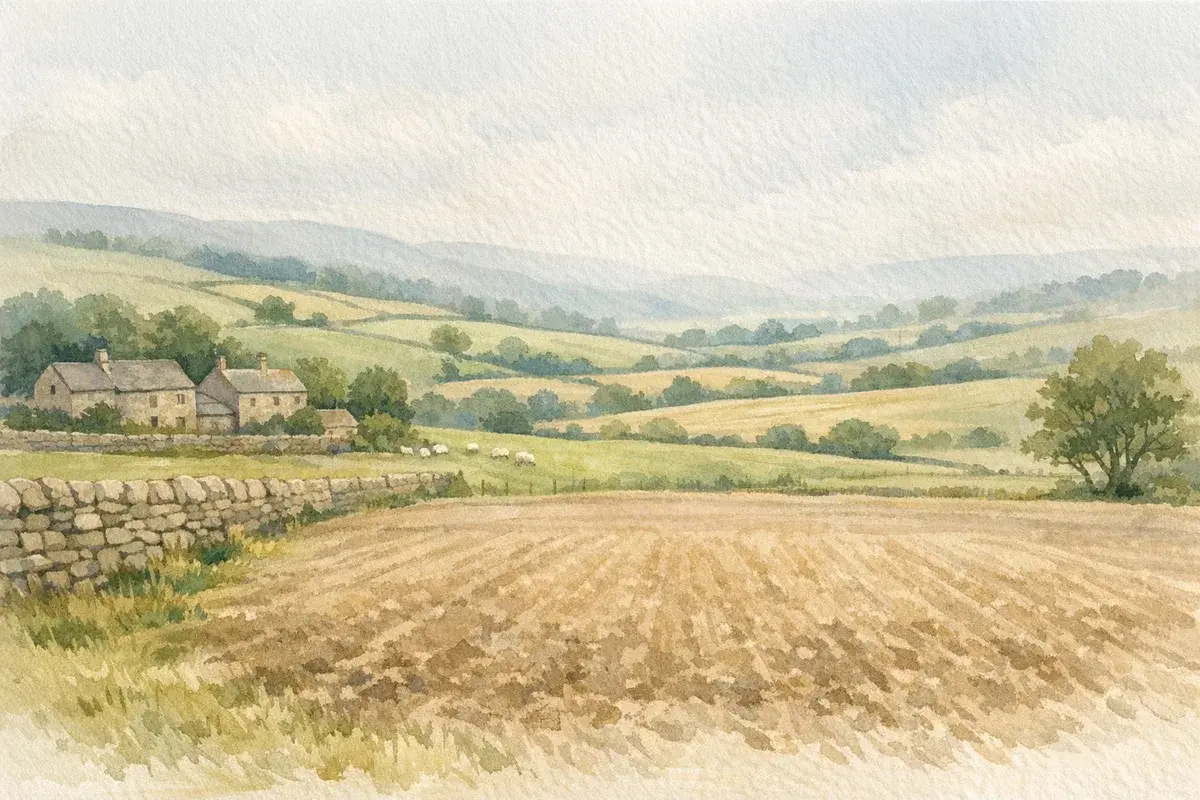
Bare arable land for sale can look deceptively simple on particulars: a red line, a acreage figure, maybe a flattering drone shot at golden hour. But the value of an arable field in the UK is rarely "just" its hectares. It's access. It's drainage you can't see from the road. It's whether the boundaries are where you think they are. It's whether you'll be battling black-grass for the next decade, or sitting on beautiful, resilient soil that does what you ask of it.
If you're buying bare arable land, whether to farm, invest, expand a contracting round, or future-proof a family business, this guide walks you through what actually moves the needle: how to search, what to inspect, and what to get checked before you commit serious money.
What Counts As Bare Arable Land (And Why It Matters For Value)
"Bare arable land" sounds straightforward, but in practice it's a useful label for a specific kind of asset: farmland sold without a farmhouse, buildings, livestock kit, grain stores, or a working yard attached. You're buying productive acreage and the rights that come with it, nothing more, nothing less.
That matters because the moment a property includes residential elements, extensive buildings, or diversified income streams, you're no longer valuing a field on farming fundamentals alone. You're valuing lifestyle, planning risk, replacement cost, and sometimes pure scarcity.
Bare Land Vs Residential, Farmsteads, And Equipped Units
Bare arable land tends to be priced and negotiated differently from:
- Residential smallholdings and farmhouses with land (where the house can dominate the price)
- Farmsteads/equipped units (where buildings, hardstanding, and infrastructure add utility and complexity)
- Let, contract-farmed, or diversified holdings (where income streams, leases, and business structures come into play)
If you're focused on bare arable land for sale, it's usually because you want:
- Operational simplicity (fewer buildings to repair, insure, or bring up to spec)
- Flexibility (cropping, stewardship, grazing, or natural capital options)
- Cleaner valuation (soil, access, and location do the heavy lifting)
And yes, bare land can still come with hidden baggage: wayleaves, rights of way, uncertain boundaries, drainage liabilities, or an awkward ransom strip you only discover when you try to widen a gateway.
Arable Land Grades, Cropping History, And Rotation Potential
In the UK, land quality is often discussed using the Agricultural Land Classification (ALC) system (Grades 1 to 5). While it's not the only determinant of performance, it's a quick shorthand for versatility and yield potential.
- Grade 1–2: typically the most versatile, often commanding a premium in certain regions.
- Grade 3: a wide spectrum, from excellent 3a to more marginal 3b.
- Grades 4–5: increasingly limited options, more weather-sensitive and management-intensive.
If you're actively hunting higher-quality ground, it's worth reading up on what tends to drive premiums for Grade 1 arable land, but don't buy the grade alone. A "good" grade can still be compromised by compaction, poor drainage, difficult access, or persistent weeds.
Cropping history matters just as much. Before you get carried away by a tidy standing crop, ask yourself:
- What's the weed burden (black-grass, brome, ryegrass, charlock)?
- Has it been min-tilled/direct drilled, or regularly deep cultivated?
- Any known history of clubroot (if OSR is in the picture) or other crop limitations?
- Are you inheriting a soil that's been mined (low organic matter, poor structure), or one that's been built?
Rotation potential is basically your "risk spread". A field that can sensibly alternate between winter and spring crops, include break crops, and cope in wet harvests without becoming a rutting disaster is typically worth more to a working buyer, because it behaves when the weather doesn't.
Key Drivers Of Price And Demand In The UK Arable Market
UK arable land values don't move on one lever. They move on a bundle of practical details that affect how profitably (and how painlessly) you can farm the ground, and how attractive it will look to the next buyer.
You'll often hear generalisations like "good land always sells" or "it's all about location". True-ish. But when you're deciding whether a field is worth fighting for, get specific.
Soils, Drainage, Topography, And Field Shape
If you only do one thing before viewing, do this: look at the soil and water story.
- Soil type and structure: Loams that carry machinery without smearing tend to outperform heavy clays in awkward seasons. Light sands can be brilliant with the right moisture management, and brutal without it.
- Drainage: Old clay tiles, unknown outfalls, or ditches that back up can turn "nice arable" into a winter headache.
- Topography: Slopes affect erosion, cultivations, and working windows. North-facing banks can be colder and later.
- Field shape: A neat 20-acre block can be more valuable (to a farmer) than a 25-acre jigsaw with awkward corners, because you lose less time and less crop to headlands.
In other words, you're not just buying hectares, you're buying work rate.
Access, Road Frontage, And Working Distances
Access is where arable economics becomes very real, very quickly.
Ask:
- Can you get modern kit in and out, legally and safely?
- Is there good road frontage, or a long private track you'll be maintaining?
- Are there pinch points (villages, weight limits, tight bridges) between the field and your yard?
- What's the working distance from your base? A few extra miles per trip becomes expensive when it's drills, sprayers, fertiliser, grain, straw… the lot.
A field that looks cheap but sits 35 minutes from everything can quietly cost you more than it saves.
Location Factors: Local Competition, Nearby Uses, And Long-Term Prospects
Location isn't just county or postcode, it's the micro-market.
- Local competition: In some areas, neighbouring farmers (or well-capitalised investors) are consistently active, and that supports a firmer price.
- Nearby uses: Adjacent poultry, AD plants, equestrian, solar, or industrial neighbours can affect nuisance risk, biosecurity, access, and perceptions.
- Long-term prospects: You should be cautious about "hope value" (we'll come to that), but it's fair to consider infrastructure projects, settlement edges, and strategic land interest.
If you're trying to benchmark what you're seeing, our deeper guide on arable land for sale is useful for understanding what typically drives UK pricing beyond the headline acreage.
Where To Find Bare Arable Land For Sale (On-Market And Off-Market)
Finding the right field is often less about luck and more about running a disciplined search, especially if you're looking for a specific size, soil type, or location.
Specialist Portals, Land Agents, And Estate Sales
For most buyers, the most efficient approach is:
- Start with specialist agricultural listings (where the filters actually reflect rural reality)
- Build relationships with land agents who handle farms and estates in your target patch
- Keep an eye on estate sales (often larger blocks, sometimes with tender processes)
If you want a structured overview of sourcing routes, including what tends to appear where, see where to find agricultural land for sale and use it as a checklist against your own search.
And because you're specifically targeting bare arable land for sale, it's worth using search tools that let you screen by:
- land type (arable vs pasture vs mixed)
- acreage bands
- proximity to your base
- features like road access, water, and potential constraints
Tenders, Informal Bids, And Auctions: What To Expect
In the UK, bare land is commonly sold via:
- Private treaty: negotiated sale, often with flexibility on timing and terms.
- Formal or informal tender: competitive, deadline-driven, usually "best and final" style.
- Auction: speed and certainty, but you need your assignments done early.
A few practical realities:
- Tender packs can be thin on detail. Treat them as an invitation to investigate, not a full report.
- Auction lots can be excellent, especially for smaller parcels, but the legal pack is everything. If you're not comfortable reviewing it with a rural solicitor quickly, it's easy to get burned.
- Informal bids can feel murky. They're not automatically unfair, but you should be clear on what the selling agent is asking for: proof of funds, conditions, proposed completion date, and whether the vendor will entertain offers "subject to".
Building A Search System: Alerts, Mapping, And Shortlisting
Most buyers waste time in two places: chasing unsuitable listings and viewing too early.
A simple system that works:
- Set tight criteria (max travel time, minimum gateway width, desired soils/grades, target size).
- Use alerts so you're not relying on memory.
- Map your shortlist: look for blocks that adjoin your existing land or sit near your haul routes.
- Do a first-pass ‘desk due diligence': title hints, access, public footpaths, watercourses, nearby development.
If you're expanding a cropping operation, it's also worth reading our practical notes on buying arable land for cropping, not because it's complicated, but because the small checks (workability, rotations, travel, weed history) are exactly where expensive mistakes hide.
Due Diligence Checklist Before You Offer
When you're buying bare arable land, due diligence isn't bureaucracy, it's how you avoid paying full price for someone else's problem.
Below is a UK-focused checklist you can use before you offer (and then again before exchange), ideally with input from a rural solicitor and an experienced land agent/surveyor.
Title, Boundaries, And Rights Over The Land
Start with the basics, but do them properly:
- Title and plan: confirm the land is registered, check the title number, and scrutinise the plan for odd exclusions.
- Boundaries: hedges and fences aren't always the legal boundary. If the seller's plan is vague, consider a measured boundary plan.
- Access rights: is access direct from the highway, or reliant on a right of way over someone else's track?
- Rights of way: public footpaths/bridleways crossing the field affect biosecurity, cropping choices, and practical management.
- Sporting, mineral, and timber rights: what's included, what's reserved, and does it matter for your intended use?
If there's anything unusual, unadopted tracks, shared gateways, historic "handshake" arrangements, get it written down and checked.
Tenancies, Grazing Licences, Cropping Agreements, And Vacant Possession
"Vacant possession" isn't a vibe: it's a legal and practical state.
You need to establish:
- Is the land let under an Agricultural Holdings Act 1986 tenancy, or a Farm Business Tenancy (FBT) under the Agricultural Tenancies Act 1995?
- Are there grazing licences or short-term arrangements in place?
- Any contract farming or cropping agreements that give third parties rights or expectations?
- What exactly is being sold: the freehold interest alone, or freehold with occupational arrangements?
Timings matter. If you're buying to farm immediately, you want clarity on entry, crop in the ground, and who carries which costs (sprays, fertiliser, seed) if completion lands mid-season.
Environmental Constraints And Designations (SSSI, AONB, NVZ, Flood Risk)
Environmental constraints don't necessarily stop arable use, but they can limit what you can do and add ongoing obligations.
Consider:
- SSSI (Site of Special Scientific Interest): may restrict operations and require consents for certain activities.
- AONB / National Park: not a ban on farming, but development and changes can face higher scrutiny.
- NVZ (Nitrate Vulnerable Zone): affects nutrient management rules and record-keeping.
- Flood risk: river floodplains and surface water risk can influence workable days, crop choices, and insurability.
- Historic environment constraints: scheduled monuments or archaeology sensitivity can affect cultivations.
The key is matching the land to your intent. If your plan involves drainage work, new tracks, or field reconfiguration, constraints become more than a footnote.
Utilities, Wayleaves, Easements, And Third-Party Infrastructure
Bare land can still be "busy" with third-party rights.
Look for:
- Overhead lines and pylons: affect spray drift, access, and sometimes development potential.
- Pipelines (gas, fuel, water): usually carry easements with restrictions on planting, excavations, and building.
- Telecoms apparatus: masts, cabinets, underground cables.
- Wayleaves vs easements: a wayleave can be temporary/terminable: an easement is usually permanent. Your solicitor should confirm what's on title and what isn't.
If there's infrastructure, don't just accept "there's a payment." Confirm the amount, who receives it, whether it transfers, and what rights the operator has to access your field (and when).
Practical Field Assessment: What To Inspect On The Ground
A viewing from the gate tells you almost nothing. You want boots-on, ideally after rain (or at least not during a perfect dry spell that flatters everything).
Drainage Condition, Compaction, Weeds, And Headlands
This is where you find the truth.
- Drainage: look for wet seams, rushes, standing water in hollows, or tell-tale crop colour changes. Ask where ditches outfall and who maintains them.
- Compaction: check headlands and tramlines. If the top is capped and hard, you may be inheriting a restructuring job.
- Weeds: walk more than one transect. Black-grass patches are often localised and easy to miss from a vehicle.
- Headlands and corners: these show management standards. If the headlands are thin, rutted, and full of docks, it's a clue about traffic, drainage, and attention.
A useful mindset: you're not inspecting the crop, you're inspecting the soil's ability to deliver crops reliably.
Water Availability, Irrigation Potential, And Abstraction Considerations
Water is increasingly a value driver, but in the UK it's also a regulatory and practical maze.
If you're looking at high-value cropping, vegetables, or seed production, you'll be thinking about irrigation early. In that case, it's worth digging into the realities of irrigated arable land, because "there's a river nearby" isn't the same as "you can legally and reliably abstract water when you need it".
On the ground, check:
- existing mains water connections (rare for fields, but possible)
- reservoirs, boreholes, or historic abstraction infrastructure
- signs of past irrigation (standpipes, hydrants, reels in photos, reinforced gateways)
Then confirm, with professional help:
- abstraction licensing position and transferability (where relevant)
- any historic restrictions or hands-off flow conditions
- practicalities of pumping, storage, and seasonal reliability
Access Points, Gateways, Tracks, And Biosecurity Risks
Access is both a value factor and an ongoing operating cost.
Inspect:
- Gate width and swing: can a drill or a beet harvester physically enter without eating the hedge?
- Sight lines onto the road: is it safe to move machinery?
- Track condition: ruts, stone depth, drainage, and who maintains it.
- Public access: if there's a footpath, think about gates, signage, dogs in crops, and practical separation.
Biosecurity isn't just a livestock thing. Mud on kit, visitors on footpaths, and neighbouring uses can all increase weed spread and disease risk. A field that sits next to a busy dog-walking route may still be a great buy, but you should price in the management reality.
Planning, Permitted Development, And “Future Hope Value” Risks
Planning is the area where buyers most often get carried away, especially if you're told, with a wink, that the land is "strategic".
The good news? Agricultural land in active use has a clear baseline purpose.
But here's the catch: turning that baseline into something else is rarely quick, certain, or cheap.
Agricultural Use Rights Vs Change Of Use Reality Checks
Buying bare arable land for sale with an idea of "maybe one day" can be sensible, as long as you're honest about probabilities.
Reality checks to run:
- Agricultural use: arable cultivation is typically straightforward from a planning perspective.
- Operational development: certain agricultural buildings and tracks may be possible under permitted development in England (with prior notification processes), but it's not automatic and it's fact-specific.
- Change of use: moving to equestrian, storage, commercial uses, or residential development is a different world, local plan policies, access, landscape impact, ecology, and highways all matter.
In Wales, Scotland, and Northern Ireland, the frameworks and permitted development rules differ, so don't assume an "England answer" applies UK-wide.
Overage, Options, And Ransom Strips: Clauses That Can Bite
If there's even a whiff of development potential, expect the paperwork to become more interesting.
Common issues:
- Overage (clawback): you pay the seller a percentage uplift if the land gets planning or sells at a higher value within a defined period.
- Options and promotion agreements: someone may already hold rights to pursue planning, affecting your control.
- Ransom strips: a narrow piece of land retained to control access, small on a plan, huge in leverage.
None of these are automatically deal-breakers. But they change what you're buying. Your solicitor should explain, in plain English, what triggers payments, what permissions are caught, and how long you're tied in.
Stewardship And Natural Capital: Opportunities And Obligations
Post-BPS, environmental land management and private natural capital deals have become a serious part of the arable landscape.
Opportunities might include:
- stewardship options that fit awkward corners, wet patches, or steep banks
- biodiversity net gain (BNG) interest in certain contexts
- soil carbon and regenerative agriculture frameworks (variable by buyer and scheme)
Obligations and risks include:
- existing stewardship agreements transferring with the land
- management prescriptions that limit cultivation timings or inputs
- long-term commitments that may affect resale flexibility
If you're assessing a bigger block, these considerations sit alongside scale economies and operational efficiency. For context on how larger holdings tend to be marketed and structured, see our notes on large arable farms, even if you're only buying a field or two, the "big farm" issues (infrastructure, environmental schemes, clauses) can still appear in miniature.
Funding The Purchase And Structuring Ownership
With bare arable land, funding is often less about fancy finance and more about preparation: knowing what lenders ask for, how quickly you can move, and how ownership will sit alongside the rest of your business.
Cash, Bridging, And Agricultural Lending: Typical Requirements
Your main routes are:
- Cash purchase: fastest, strongest negotiating position.
- Agricultural lending: common for expansion: expect valuation, affordability, and security discussions.
- Bridging: sometimes used to secure land quickly (for example, where you need to sell another asset first), but it's usually more expensive and needs an exit plan.
In practice, lenders and valuers will focus on:
- purchase price vs valuation
- your farming accounts/cashflow and existing borrowings
- the land's marketability (access, rights, any title oddities)
- any income streams (licences, stewardship) and whether they're secure
If you're buying at tender, proof of funds and speed matter. Being "able to proceed" can beat a marginally higher offer that looks wobbly.
Joint Ventures, Partnerships, And Family Ownership Structures
Ownership structure is one of those things that's easy to postpone, and annoying to unpick later.
Common structures include:
- personal ownership (simpler, but may not fit succession goals)
- farming partnership ownership
- limited company ownership
- joint ventures with neighbours, contractors, or investors
Each has different implications for control, profit extraction, borrowing, succession, and tax. The right answer depends on what you're trying to achieve: expanding a trading farm, holding a long-term asset, or bringing in the next generation.
Tax And Reliefs To Discuss Early (With Specialist Advice)
Tax is not a "later" problem on land purchases. Discuss it early with a UK tax adviser who understands rural property.
Topics to raise include:
- Stamp Duty Land Tax (SDLT) in England and Northern Ireland (and LTT in Wales / LBTT in Scotland)
- VAT position (often not applicable to bare land, but watch for opted-to-tax arrangements or commercial elements)
- Capital Gains Tax planning if you're selling other assets to fund the purchase
- Inheritance Tax considerations (e.g., APR/BPR, where relevant to your circumstances)
This is also where "bare arable land" can differ from mixed property. Add a farmhouse or commercial storage and the tax picture can change quickly.
If you want wider context on buying farmland generally (beyond arable-only), our guide to agricultural land for sale in the UK is a solid companion piece, particularly for understanding the due diligence items lenders and professional advisers tend to focus on.
Making An Offer And Getting To Completion
Once you've found a field worth pursuing, the aim is simple: make an offer that's attractive to the seller but still protects you from nasty surprises.
Negotiation Points: Entry, Crop Status, Fixtures, And Holdbacks
Bare land still has moving parts. Key points to negotiate include:
- Entry date and completion timing: line it up with cropping reality if you can.
- Crop status: who owns the growing crop at completion? If the vendor has already spent on fertiliser and sprays, what's being reimbursed?
- Residual value and cultivations: if land is left in a state that needs remedial work, price it.
- Holdbacks/retentions: occasionally used where there's uncertainty over something specific (for example, a disputed boundary or an unresolved wayleave issue), though vendors may resist.
Don't be shy about asking the agent direct questions. A good one will prefer a well-informed buyer to a chaotic negotiation later.
What Your Solicitor And Surveyor Should Verify
Your rural solicitor should be all over:
- title, restrictive covenants, and easements
- access rights (and adoption status of roads/tracks)
- any tenancy/licence arrangements and how they end
- overage and option clauses
- completion undertakings and apportionments (including any rents/licence fees)
A surveyor/land agent can add value by:
- sanity-checking price against comparable local evidence
- inspecting boundaries and access on the ground
- spotting practical constraints you might miss (awkward gate geometry, field efficiency, drainage patterns)
If you're buying more than one parcel, make sure everyone is clear on whether you're buying "as a whole" or "in lots", and what happens if one lot has an issue.
Completion Day, Handover, And First-Season Priorities
Completion isn't the finish line: it's the point you start carrying risk.
On or immediately after handover:
- walk the boundaries and photograph condition (quietly useful if disputes arise)
- confirm you've received any keys, gate codes, and wayleave contact details
- inform your insurer and lender (if applicable)
- update your farm maps, nutrient plan records, and contractor instructions
First-season priorities tend to be unglamorous but high-impact:
- tackle compaction and drainage early if needed
- set a weed plan based on what you actually find (not what you hope)
- make access safer and more efficient (gateways, hardstanding, track repairs)
Do those well and you'll feel, within a season or two, whether you bought a headache, or a field that will quietly earn its keep for decades.
Conclusion
Buying bare arable land for sale in the UK rewards the buyer who stays slightly sceptical. Not cynical, just thorough. The best fields are rarely perfect on paper: they're simply the ones where the risks are understood, priced, and manageable.
If you treat every listing as a starting point (not the full story), walk the land properly, and get the legal and practical checks done before you commit, you'll put yourself in a strong position, whether your goal is expanding a farming business, securing long-term productive acreage, or building a resilient rural portfolio.
Disclaimer: AgLand.co.uk is a UK agricultural land and rural property matching service, where buyers register what they are looking for and owners advertise directly to the buyers who match, and a rural resource hub. Nothing in this text is intended as legal, financial, or investment advice. You should carry out your own due diligence and seek guidance from appropriately qualified professionals (such as rural solicitors, chartered surveyors, land agents, tax advisers, and planning consultants) before making decisions or transactions.