
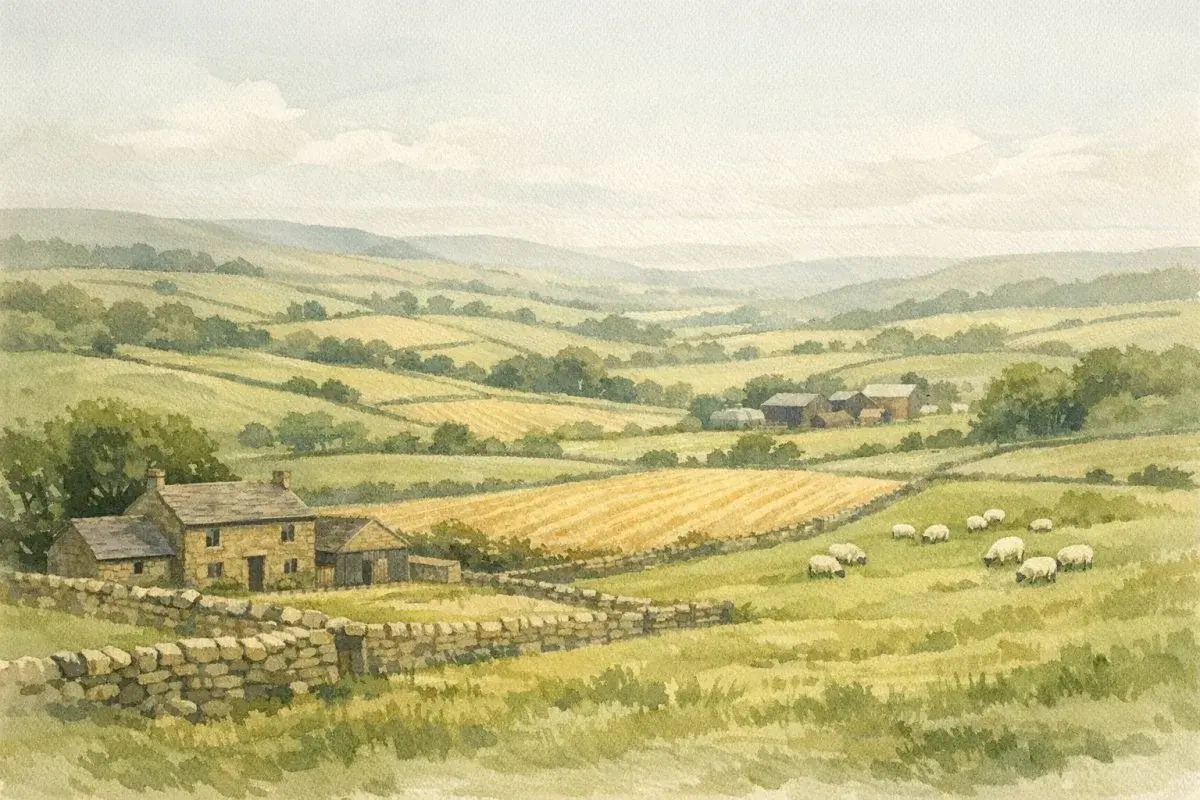
A large arable farm purchase isn't just "buying more acres". It's taking on a whole operating system: soils, water, access, staff, kit, compliance, and a set of constraints (and opportunities) that only really show themselves at scale.
And that's why the search for large arable farms for sale can feel oddly frustrating. The best holdings don't always sit on the most obvious listings for long, the headline acreage rarely tells the full story, and the difference between a good farm and a great one is often hidden in boring details, drainage outfalls, water abstraction history, a ransom strip on an access track, or a stewardship agreement you didn't spot.
This guide cuts through the noise. You'll learn what "large" means in today's UK market, why big arable farms come up for sale, where to find them (including off‑market routes), and how to appraise land and deal structure like someone who's bought at this level before.
What Counts As A “Large” Arable Farm In Today’s UK Market
"Large" is a moving target. Twenty years ago, 500 acres could feel substantial in many counties. Today, large arable units are often discussed in the context of machinery capacity, labour efficiency, and the ability to carry overheads through volatile grain prices, rather than acreage alone.
A useful way to think about it: large is the point where your decision-making becomes system design. You're no longer just choosing varieties and drilling dates, you're designing logistics, storage, traffic management, rotation resilience, and risk controls.
Typical Size Bands And Enterprise Models
In practice, UK buyers and agents tend to bucket "large arable" holdings into a few broad bands:
- Circa 500–1,000 acres (200–400 ha): Often the threshold where dedicated grain storage, a fuller machinery fleet, and employed staff become more common. Still potentially manageable as a single core block if you're lucky.
- 1,000–2,500 acres (400–1,000 ha): Usually a multi‑block reality. You start caring a lot about road miles, field size, turning areas, and whether the farm is "kit‑efficient". Contract farming agreements (CFAs) and joint ventures become more attractive.
- 2,500 acres+ (1,000 ha+): You're into estate-scale operational planning. The holding may include multiple yards, cottages, telehandler routes, HGV access, and a compliance burden (NVZ rules, water, stewardship) that needs proper management time.
Enterprise models you'll commonly see at the large end:
- In-hand arable with employed team (often where there's strong storage/drying and a coherent block).
- Contract farming where the landowner wants to keep "trading status" and control, but outsource operations.
- Farm business tenancies (FBTs) or older tenancies where the "farm" is effectively an investment and income stream.
- Hybrid models: an in-hand "home farm" plus outlying blocks let on FBTs, grazed on licence, or used for environmental schemes.
Key Regional Differences Across England, Scotland, Wales, And Northern Ireland
If you're searching UK‑wide, you'll quickly notice that "large arable" looks different depending on where you are.
- England: The biggest concentration of high-performing arable is in the East and East Midlands, with strong markets for combinable crops and often better road/processing infrastructure. In places like East Anglia, scale can mean very large fields, long histories of arable, and intense competition for the best land. If that's your focus, it's worth reading up on regional dynamics like East Anglia's arable market because local demand patterns matter.
- Scotland: Larger blocks can be found, but soil/climate variability is sharper across short distances. Rotation choices and harvest risk can shift your appraisal of "productive potential" more than it might in parts of eastern England.
- Wales: Large pure arable is less common than mixed units. Where you do find it, you'll want to be extra precise about access, field shape, and whether the holding has constraints that push you toward mixed farming or environmental income.
- Northern Ireland: Tenure patterns, field sizes, and local markets can feel very different again. Availability of genuinely large, arable-dominant holdings may be more limited, so off-market channels and agent relationships often carry more weight.
The big takeaway: don't define "large" as acres alone. Define it as how reliably the holding can turn acres into margin, given its soils, layout, and constraints.
Why Large Arable Farms Come To Market (And What That Signals)
Large farms don't appear for sale every day, and when they do, there's usually a reason. Your job isn't to judge the reason, it's to interpret what it might mean for vacant possession timing, investment needs, and negotiation leverage.
Vacant Possession Vs Tenanted Land And Succession Planning Context
A significant share of big arable sales have a family and succession backdrop. Sometimes the next generation isn't taking it on: sometimes the farm is being split: sometimes a wider estate is rationalising.
What this can signal for you:
- Vacant possession (VP) sales can be operationally attractive, but watch the practicalities. "VP on completion" is straightforward: "VP after harvest" or "VP subject to notice" introduces timing and risk.
- Tenanted land can still be a strong buy, but it changes your objective. Are you buying income and long-term upside, or are you buying to farm? If you need to take land in-hand, the route (and timescale) matters.
- Genuine sale motivations can make vendors open to sensible structures, overage, delayed completion, or a phased handover, if it helps them achieve certainty.
At scale, succession also affects the paperwork quality. Some farms are impeccably documented: others have "it's always been that way" boundaries, informal access arrangements, and missing wayleave paperwork. That doesn't kill a deal, but it should change your diligence intensity.
Strategic Sales: Debt Restructures, Estate Break-Ups, And Portfolio Rebalancing
Not every sale is sentimental. Large arable farms also come to market due to:
- Debt restructuring after a period of heavy capex, changing interest rates, or business consolidation.
- Estate break-ups where land is sold to fund inheritance tax planning, diversification elsewhere, or to simplify management.
- Portfolio rebalancing by investors, selling arable to buy commercial, forestry, or alternative rural assets.
As a buyer, treat the "why" as a clue to the deal shape:
- If the vendor prioritises speed and certainty, you may win by being the cleanest bidder rather than the highest.
- If the vendor prioritises headline price, expect best-and-final offers and tighter conditions.
- If the sale is part of a bigger restructure, ask early whether parcels can be split (or must be sold as a whole), and whether there are rights retained (sporting, minerals, access routes) that could affect how you farm it.
One practical tip: when you see a large unit marketed, also search for the smaller "bolt-on" lots that sometimes get listed separately. That's often where the best value (or the biggest operational headache) hides.
How To Find Large Arable Farms For Sale (Beyond The Obvious Listings)
The obvious listings are only part of the picture. Large arable holdings can be marketed quietly, offered to pre-qualified buyers first, or released in stages.
Using Specialist Portals, Agent Networks, And Off-Market Channels
At this end of the market, you want three channels working together:
- Specialist portals that actually understand agricultural detail. On AgLand, you can start broad by browsing what's currently available for sale and then narrow your search based on the criteria that genuinely affect performance (not just "farm for sale").
- Agent networks (and the sub-networks behind them). The best land agents keep lists of buyers who can move, have funding lined up, and won't waste a vendor's time.
- Off-market intelligence: neighbours, contractors, agronomists, land drainage firms, grain store engineers. If you're serious, quietly letting a few trusted people know what you're looking for can surface opportunities before they become public.
A note on approach: if you're relying on off-market, be crisp about your brief. "Large arable farm anywhere" is forgettable. "1,200+ acres predominantly Grade 2/3, workable block, irrigation a bonus, within X minutes of a main A-road" is the sort of brief that gets remembered.
Filtering For The Details That Matter: Soil, Blocks, Access, And Water
The fastest way to waste months is filtering on acreage and postcode alone. For large arable farms, your early-stage filters should reflect operating reality:
- Soil capability and consistency: If your target is high-output combinable cropping, you'll want to understand what's driving yield stability. Start by looking at the nature of the land being offered, e.g., whether you're mainly looking at Grade 1-quality arable ground or more variable land where cropping strategy must be different.
- Blockiness: Is it one coherent block or five satellites? Satellites aren't automatically bad, but they change staffing, machinery, and haulage costs.
- Access: Not just "has road frontage", but: are gateways wide enough, are there pinch points through villages, can artics get to the yard, is there any reliance on third-party tracks?
- Water: For some enterprises, water is the difference between a "nice farm" and a "serious farm". If irrigation is central to your margin (veg, seed, potatoes, high-value rotations), specifically seek out irrigated arable opportunities and then interrogate abstraction/licensing details later in diligence.
You'll also come across offerings described as "farm" that are essentially land-only, with limited buildings or none at all. That can be ideal if you already have infrastructure nearby or you're building a portfolio of blocks. If that's your angle, it's worth understanding the pros and cons of bare arable land purchases, because your bottleneck won't be soil, it'll be logistics.
One last filtering reality check: you're not trying to find the "perfect" farm online. You're trying to find the right shortlist, then do serious appraisal quickly, before someone else does.
How To Appraise A Large Arable Farm: Land, Soils, And Productive Potential
When you move beyond 500 acres, appraisal becomes less about "is this a good field?" and more about "does this holding behave like a coherent production unit?" The economics are shaped by stability: consistent workability, reliable access, and infrastructure that doesn't force you into expensive compromises.
Soil Type, Drainage, Indices, And Historic Cropping Data
Start with what you can't change easily.
- Soil type and workability: Heavy clays can produce very strong yields in the right hands, but they'll punish you on timeliness. Light land can be a dream to travel, but may rely more on moisture management, organic matter, and (sometimes) irrigation to stabilise output.
- Drainage condition: Don't accept "well drained" as a description, look for evidence. On large arable farms, a tired drainage system isn't a minor cost: it's a multi-year capex programme and a yield drag. Ask about:
- date and extent of tile drainage
- outfalls and maintenance responsibility
- any history of waterlogging or silted ditches
- Soil indices and nutrient history: You're looking for patterns across the holding. A farm with big swings in P/K/Mg indices will often require a deliberate rebalancing plan, and budget.
- Cropping records: Historic rotations can hint at blackgrass pressure, take-all risk, compaction history, and how intensively the farm has been pushed.
In reality, you'll rarely get a full "pretty" dataset up front. But you should be able to build a working picture from: previous cropping, stewardship maps, soil sampling summaries, and what you can see on the ground (structure, earthworm activity, headland compaction, tramline ruts, etc.).
If you want a more field-by-field approach to buying, including the sort of checks that stop nasty surprises after exchange, it's worth revisiting a practical guide to buying arable land for cropping, the principles scale up, but the consequences get bigger.
Field Layout, Farm Infrastructure, And Operational Efficiency At Scale
This is where large farms are won or lost.
Consider appraisal in three layers:
- Field geometry and traffic flow
- Average field size and shape: long, awkward fields can slow every pass.
- Headlands: large headlands can be helpful for turning: tiny headlands can be a daily irritation.
- Tramline direction: sometimes legacy layouts force inefficient patterns.
- Yard, storage, and drying
- Is there sufficient grain storage for the acreage and likely yield range?
- What's the drying capacity and energy setup (and condition)?
- Can you segregate crops/qualities without chaos?
- People and machinery reality
- Where do staff live, and is there housing included?
- Is the machinery policy realistic for the land (or have they been "getting away with it")?
- What's the true travel time between blocks during peak periods?
A quick mental test that's surprisingly revealing: imagine a wet October followed by a narrow drilling window. Can the holding physically get drilled without wrecking itself? If the answer depends on "well, we usually…" rather than hard capability, price the risk in.
Also watch for hidden positives. Two farms with similar acreage can perform very differently if one has well-positioned internal tracks, wide gates, and sensible field clusters. Those boring details don't just save diesel, they save decision fatigue. They also set the ceiling on machinery, because large-scale kit earns its keep through timeliness rather than acreage and a wide drill is worth little if the gateways, headlands and yard turning space cannot take it.
Planning, Regulation, And Land Designations That Can Make Or Break Value
With large arable farms, the planning and regulatory layer can move value more than many buyers expect. It's not just about whether you can put up a shed, it's about whether the holding can evolve without triggering enforcement risk or costly redesign.
Basic Planning Constraints: GPDO, Prior Notifications, And Change Of Use Risks
Most buyers will have heard of permitted development rights (PDR), but the detail matters.
- GPDO and agricultural PDR: In England (and with different rules/thresholds across the devolved nations), certain agricultural buildings and operations can be carried out under permitted development, often subject to prior notification rather than full planning. But it's not automatic, and you'll need to check what's already been used on the unit.
- "Reasonably necessary" tests: Agricultural development under PDR is typically tied to agricultural need. If you're planning significant new infrastructure, you'll want a strategy that can be defended.
- Change of use risks: If part of the yard has been used for non-agricultural activities (storage, contracting, commercial lets), it can complicate your planning position and may attract business rates or other compliance needs.
At scale, it's also common to encounter older buildings, slurry/diesel storage areas, or legacy yard layouts that have never been "regularised". That doesn't mean you walk away, it means you cost the work and confirm what's required to bring things up to standard.
Environmental And Legal Constraints: SSSI, NVZ, Stewardship, And Rights Of Way
Constraints aren't always bad. Some are manageable: some can materially limit your flexibility.
Key ones to identify early:
- SSSI (Sites of Special Scientific Interest): If parcels fall within an SSSI, operations may be restricted and consents required for certain works. It can affect ditching, drainage, cultivation depth, and timing.
- NVZ (Nitrate Vulnerable Zone) rules: NVZ compliance changes nutrient planning, storage requirements, and record-keeping. Even outside NVZs, wider farming rules and water regulations still apply, but NVZ status can increase management load.
- Stewardship agreements: Whether it's Countryside Stewardship (and its successors) or bespoke options, you need to know what's committed, what's paid, and what happens on transfer. Schemes can enhance income, but they can also restrict cropping flexibility.
- Public rights of way: Footpaths, bridleways, byways and permissive routes can influence biosecurity, access, and day-to-day operations (especially if they run through the yard or across key field entrances).
A pragmatic way to think about designations: separate constraints on farming from constraints on development. A strip of environmental land might be fine if it's already awkward to farm. The same strip might be a big issue if it blocks yard expansion or access improvements.
If you're building a shortlist of properties, it can help to compare what's being offered across the broader market of arable farmland in the UK so you get a feel for how common (or rare) certain constraints are in your target regions.
Tenure, Tax, And Structuring The Purchase
Large arable acquisitions aren't just land deals, they're legal structures with long tails. Get the structure wrong and you can end up with operational restrictions, unexpected costs, or a resale headache.
Understanding Title, Easements, Sporting And Mineral Rights, And Overage
Your solicitor will run the formal checks, but you should understand what you're looking for so you ask the right questions early.
- Title and boundaries: On large holdings, boundary issues often hide in plain sight: a track used "since forever" that isn't in the title, a farmyard edge that doesn't match the red line, or a missing strip between highway and field.
- Easements and wayleaves: Electricity lines, telecoms, water mains, private drainage, and access rights can all sit across the holding. Some are benign: some affect where you can build or how you can cultivate.
- Sporting rights: If sporting is retained or leased, it can affect shoot days, crop damage responsibilities, and access by third parties.
- Mineral and timber rights: Less common to bite day-to-day, but they can matter for development value and negotiation.
- Overage/clawback: Large arable farms sometimes come with overage provisions tied to future development or change of use. These can be commercially reasonable, but the drafting matters hugely, duration, triggers, and what counts as "development value".
A small but real-world point: at scale, you'll often be buying a mix of land types, core arable, odd corners, woodland, tracks, maybe even redundant buildings. Make sure the contract and plan treat these areas properly. A "minor" exclusion can turn into a major operational nuisance.
Tax Considerations: SDLT, APR/BPR, CGT, And Relief Planning (Get Advice Early)
Tax is where you can't afford DIY assumptions. The right answer depends on your structure (individual, partnership, company), your intended use (investment vs trading), and what's included in the sale (residential, commercial lets, solar leases, etc.).
Key UK tax topics that often come up with large arable farms:
- Stamp Duty Land Tax (SDLT): Rates and treatment vary depending on whether land is purely agricultural, mixed with residential, or includes commercial elements.
- APR/BPR (inheritance tax reliefs): Agricultural Property Relief and Business Property Relief can be central to long-term planning, but eligibility depends on occupation, use, and how the business is run.
- Capital Gains Tax (CGT): Relevant both for the vendor (which can shape negotiation) and for your future planning, particularly if you might sell parcels or pursue development.
- Relief planning: Hold-over relief, rollover relief, and other reliefs may be relevant depending on circumstances.
The practical advice is simple: get specialist tax advice early, before you're emotionally committed to a deal structure. At this scale, small misunderstandings become five-figure mistakes.
If you're still at the stage of narrowing what type of holding you want, rather than a specific farm, AgLand's broader explainer on arable land for sale in the UK is a useful grounding for the drivers of value you'll keep bumping into (soils, access, drainage, and the less-glamorous parts of title).
Financing And Deal Process For Big Ticket Arable Acquisitions
For big-ticket arable, the deal process is often less about "can you buy it?" and more about "can you buy it cleanly?" Vendors and their agents typically prefer buyers who can demonstrate funding, move quickly, and won't reopen the price over foreseeable issues.
Funding Routes: Agricultural Mortgages, Private Finance, And Vendor Options
Common funding routes in the UK include:
- Agricultural mortgages (bank lending): Often the backbone of funding. Expect lenders to focus on serviceability, valuation, tenancy status, and your operating plan. Large, coherent blocks with good access and dependable productivity usually finance better than awkward, fragmented holdings.
- Private finance: Sometimes used for speed or flexibility, particularly when you need to move before refinancing onto longer-term lending.
- Vendor options / deferred consideration: In some situations, a vendor may accept staged payments, delayed completion, or other mechanisms to help a deal, especially where tax or succession planning is a factor.
Your credibility with funding isn't just about having a decision in principle. It's about showing you understand the asset: your cropping plan, capex priorities, and risk management.
Due Diligence Checklist And Timeline: From Offer To Completion
A clean process is typically built around a disciplined checklist. You'll adapt this to each holding, but at a minimum, expect to cover:
- Heads of terms: price, lots, timing, inclusions (grain in store, machinery, entitlements if applicable), access arrangements, and any overage.
- Title review: boundaries, rights of way, easements, wayleaves, restrictive covenants.
- Occupational position: VP vs tenancies, grazing licences, contract farming agreements.
- Planning and compliance: building consents, PDR usage, environmental permits, any notices or enforcement history.
- Environmental constraints: designations, stewardship commitments, NVZ status and nutrient management requirements.
- Operational reality checks: condition of tracks, gateways, drainage, grain store, driers, electrical capacity, water systems.
- Insurance and risk: flooding history, public access routes, and any third-party liabilities.
Timeline-wise, larger rural deals can take longer than buyers expect, simply because there's more to check and more parties involved. The quickest way to keep momentum is to line up your team early: solicitor experienced in agricultural property, a land agent or rural surveyor, and (where needed) planning and tax specialists.
One more thing: don't underestimate the value of a pre-offer site walk with the right people. A drainage contractor and an agronomist can sometimes spot issues in 30 minutes that a thick pack of papers won't reveal for weeks.
Post-Purchase Strategy: Making The Farm Pay In Year One And Beyond
Completion day is satisfying. Then the real work starts.
Your first year sets the tone: you're either stabilising the asset and building momentum, or you're firefighting inherited problems while trying to run a cropping programme.
Cropping And Contracting Choices: In-Hand, Contract Farming, Or Joint Ventures
The right operating model is the one that matches your management capacity and risk appetite.
- In-hand farming: You control decisions and capture upside, but you also carry labour, machinery, and execution risk. It can work brilliantly where the unit is coherent and you have (or can recruit) the right team.
- Contract farming: Often a strong fit if you want to keep strategic control and longer-term flexibility, but outsource operations to a capable contractor with the right kit.
- Joint ventures / share farming: Can unlock expertise, spread risk, and make best use of infrastructure, particularly when the farm has specialist potential (seed, roots, veg) or when you're integrating it into an existing operation.
In year one, prioritise stability over perfection:
- Create a realistic rotation that respects blackgrass pressure and soil condition.
- Fix "silent" yield thieves (drainage pinch points, compaction, poor gateways).
- Get a proper baseline of indices and soil health metrics so you're not guessing.
Diversification And Natural Capital: What Stacks Up Without Derailing Core Arable
Diversification can be value-adding, but large arable farms can also be ruined by distractions. The best approach is to treat diversification as a portfolio of options, then stress-test each one against your core arable system.
Paths that sometimes stack up (depending on location and constraints):
- Letting redundant buildings (where lawful use and access are clear) without creating planning headaches.
- Environmental income via stewardship-style options that complement awkward corners, wet spots, or hard-to-farm headlands.
- Woodland creation or agroforestry elements in areas that genuinely underperform in arable.
What to be cautious about:
- Anything that complicates access and traffic flow during harvest.
- Uses that change the planning "character" of the yard without a clear compliance plan.
- Agreements that tie your hands for decades without appropriately pricing the opportunity cost.
A good discipline is to write a one-page "farm design" plan: what must stay true (core arable performance, operational efficiency, compliance) and what can flex (contracting, storage upgrades, scheme participation). If a diversification idea breaks the must-haves, it's probably not worth the hassle, at least not early on.
If you're still searching, keep your criteria grounded in operational reality. It's easy to drift into browsing mode at this end of the market. Define your non-negotiables, get your funding and advisory team aligned, and move decisively when the right holding appears.
Conclusion
Buying a large arable farm in the UK is one of those decisions that rewards calm, slightly obsessive diligence. Acreage gets the headlines, but it's soil consistency, drainage, access, water, and clean legal structure that decide whether the holding feels like a joy, or a constant drag on time and cash.
If you take one mindset into your search, make it this: you're not just buying land, you're buying a production system with constraints. Get clear on what "large" means for your enterprise, filter hard for the details that matter, and don't be shy about building a professional team early. The best buyers aren't the ones who never find problems: they're the ones who find them early, price them correctly, and still have a workable plan on day one.
Disclaimer: AgLand.co.uk is a UK agricultural land and rural property matching service, where buyers register what they are looking for and owners advertise directly to the buyers who match, and a rural resource hub. Nothing in this text is intended as legal, financial, or investment advice. You should carry out your own due diligence and seek advice from suitably qualified professionals (for example, solicitors, chartered surveyors, tax advisers, and planning consultants) before making decisions or entering into transactions.