
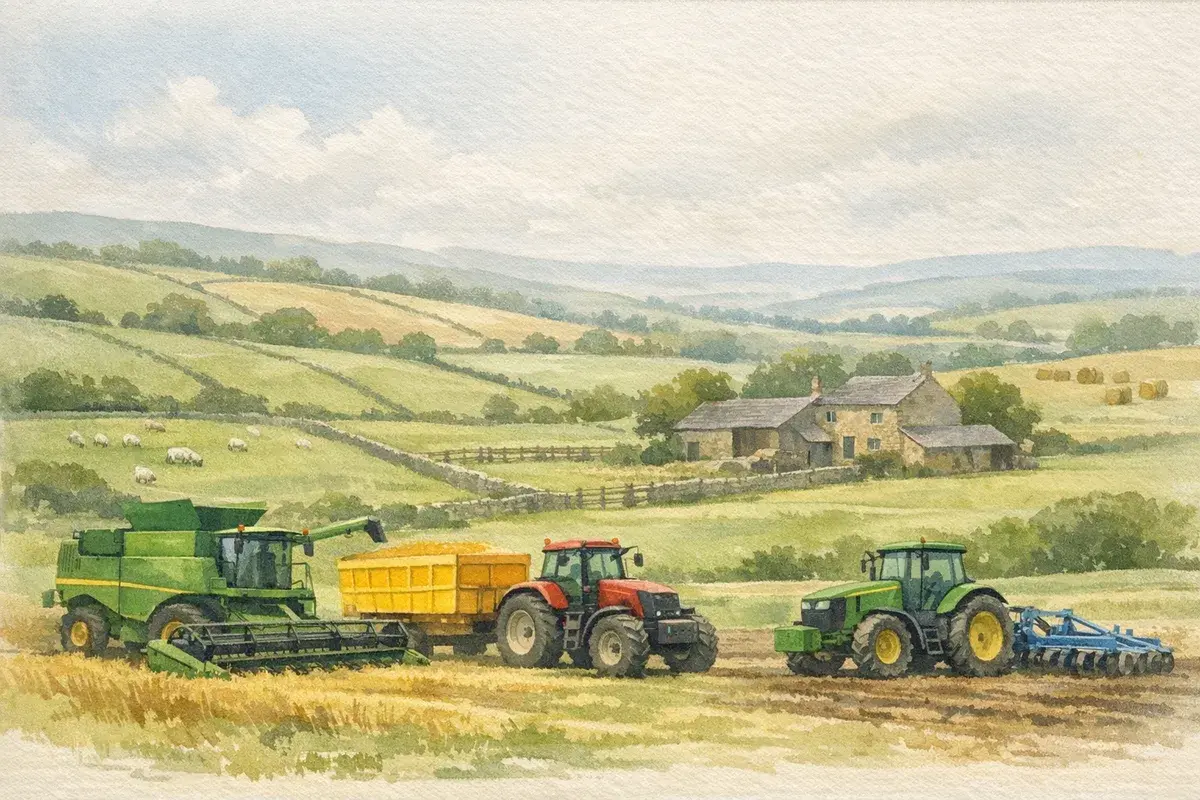
The first time you run the numbers on "going bigger" with machinery, it's rarely the headline price that makes you pause. It's everything wrapped around it: whether your fields are actually set up for 12-metre kit, whether your yard can turn an articulated lorry, whether your team can run two shifts safely during harvest, and whether the extra output will land inside the weather window you've really got.
Large-scale farming equipment can transform timeliness and margins on the right UK farm. On the wrong one, it can lock you into high fixed costs, soil damage, and a shed full of steel that doesn't earn its keep. This guide is designed to help you think like an operator and an owner: what counts as large-scale kit, how to spec it properly, which buying routes work in the UK, and how to connect machinery decisions to your land strategy.
What Counts As Large-Scale Farming Equipment (And When You Actually Need It)
Large-scale farming equipment isn't just "big tractors and big bills". In practice, it's any machine (or system) that materially shifts your cost per hectare/tonne by increasing work rate, reducing labour per unit output, or improving timeliness across a short operating window.
On UK farms, "large-scale" usually shows up when you're:
- Trying to cover a lot of ground in tight weather windows (late drilling, catch crops, second cut silage, harvest pressure)
- Consolidating operations across blocks of land, contract-farming agreements, or multiple holdings
- Dealing with labour constraints (fewer skilled operators available when you need them)
- Running higher output systems that punish delays (e.g., forage quality, grain drying costs, slurry compliance)
The trick is recognising the point where bigger kit becomes a system change, not a like-for-like upgrade.
Output, Acreage, And Timeliness: The Real Drivers Of Scale
If you're honest, scale on many UK farms is driven by timeliness, not acreage.
- Heavy land in the East or North can give you a brutally narrow autumn drilling window. Missing it may push you into spring cropping, reduce yield potential, and change your whole rotation.
- In the West, forage and slurry often revolve around a handful of good days: delays cost quality and can create compliance headaches if storage is tight.
A practical way to decide whether you "need" large-scale equipment is to work backwards from your critical field operations and the realistic number of workable days:
- List key jobs (cultivation, drilling, spraying, harvest, manure/slurry application)
- Set the "must finish by" dates based on your agronomy and historic weather patterns
- Estimate available days/hours (be conservative, UK weather wins arguments)
- Compare to achievable output at real field efficiency (not brochure figures)
If you can't hit your deadlines without either (a) overworking people, (b) rushing and doing a poorer job, or (c) accepting yield/quality loss, scale is already forcing your hand.
Matching Machine Capacity To Cropping, Livestock, And Soil Type
"Big kit" isn't universally good. It's conditional.
- Cropping: A 12m drill and a high-output combine can make sense on large, well-shaped arable blocks with consistent travel distances. But if your rotation includes potatoes, veg, or a lot of small seeds with delicate seedbeds, your bottleneck might be soil condition rather than work rate.
- Livestock: On dairy and beef units, large-scale equipment often centres on forage harvesting, clamping logistics, feeding, scraping, and slurry handling. Output matters, but so does reliability and the ability to keep the system moving every day.
- Soils: Heavy clay, peat, or high-organic soils can punish weight. In some areas, a "bigger" machine with the wrong running gear is a backward step.
A good rule: don't size machinery to your best fields. Size it to your hardest-to-hit window and your most limiting soil, then build flexibility around it (tyre choice, tracks, controlled traffic, contracting peaks).
Core Machine Categories For High-Output Farms
If you're building a genuinely high-output UK operation, the "core" kit is usually the kit that dictates the whole rhythm of the farm: power units, harvesting, and the establishment/application train. Everything else tends to orbit those choices.
High-Horsepower Tractors And Track-Laying Options
High-horsepower tractors earn their keep when they:
- Pull wide cultivation or drilling kit at consistent speed
- Handle heavy haulage without being on the limit (especially on hilly ground)
- Provide hydraulic capacity for modern implements
Your key decisions typically aren't just horsepower. They're about traction, ballast, and how you protect your soils.
- Wheeled tractors are versatile and can be road-friendly, but tyre selection and pressure management become non-negotiable.
- Half-track and full-track machines can reduce slip and spread load, which helps on sensitive ground and in challenging conditions. But they can bring higher maintenance complexity and sometimes more awkward road manners.
On many UK farms, the most cost-effective "scale" move isn't buying the biggest tractor available, it's buying the tractor that can reliably pull the carry out you actually need, at the speed you need, without creating compaction that costs you yield for years.
Combines, Forage Harvesters, And Grain Handling Systems
Harvest kit is where scale gets expensive fast, because a bigger machine often triggers a cascade:
- More output → more trailers → more clamp or store capacity → more drying/handling
- Faster harvest → greater need for labour coordination and reliable logistics
For arable farms, the combine decision should be considered alongside:
- Header width and how it suits your field sizes and gateways
- Grain handling (augers, driers, store intake rate, segregation)
- Straw management (chopping, baling logistics, export agreements)
For livestock and mixed farms, forage harvesting is equally system-driven:
- Output at the mower and harvester is wasted if clamp push-up, rolling, sheet management, and trailer flow can't keep up.
- Quality losses show up quietly, heat, poorer fermentation, and lower intakes later.
In other words, if you're thinking "big harvester", you should also be thinking "big plan".
Cultivation, Drilling, And Precision Application At Width
On high-output units, establishment and application are where you can win timeliness without necessarily chasing extreme horsepower.
Common "scale" moves include:
- Wider cultivators and presses that reduce passes
- Higher-capacity drills (or moving to strip-till/direct drilling where it suits)
- High-clearance or high-capacity sprayers with section control to reduce overlap
- Larger fertiliser spreaders with better boundary control and accurate calibration
Width is only valuable if it fits your holding:
- Can you physically get the kit in and out of fields?
- Are tramlines and headlands set up to avoid constant shuffling?
- Do your road routes and bridges tolerate the weights involved?
This is where UK reality bites: if your farm is fragmented, a slightly smaller setup with higher uptime can beat a monster rig that's always folding, moving, and waiting.
Spec’ing Equipment Properly: Key Decisions That Make Or Break ROI
Return on investment in large-scale farming equipment is rarely decided at the dealership desk. It's decided in the spec sheet: choices that affect fuel use, soil health, operator performance, and breakdown risk.
Power, Weight, Tyres/Tracks, And Managing Soil Compaction Risk
You're not just buying horsepower, you're buying weight distribution.
In UK conditions, compaction risk is often the hidden cost of "going big", particularly on heavier land or in wet autumns.
Consider:
- Unladen weight vs ballasted weight: Ballast can improve traction but can also increase axle load. The right balance is job-specific.
- Tyre choice: Wider tyres and modern VF/IF designs can reduce ground pressure when correctly inflated, but only if you run pressures properly for the job (and change them when you switch to the road).
- Tracks: Great for reducing slip and spreading load, but you need to account for maintenance, set-up, and road practicality.
If you've ever dug a spade into a headland and found a smeared layer that sticks around all season, you already know: compaction doesn't send an invoice. It just quietly taxes your yields and your drainage.
Work Rates, Carry out Matching, And Realistic Field Efficiency
Brochure work rates are a fantasy unless your farm is a billiard table.
Your real work rate depends on:
- Field size and shape (headland time is real time)
- Travel distance between blocks
- Gateway width and internal tracks
- Turning space, folding time, and set-up
- Operator skill and fatigue (particularly in peak windows)
Carry out matching is where big farms get caught out. A few classic UK examples:
- A high-horsepower tractor pulling a wide drill… but the front press or hopper fill logistics can't keep up.
- A big combine that out-harvests your grain store intake, so you end up waiting on the yard.
- A high-capacity sprayer but limited water fill point access, so your "big day" turns into half a day.
The best ROI often comes from removing the real bottleneck, not from upgrading the most visible machine.
Telematics, Guidance, Section Control, And Data Ownership
Precision tech is now standard on most large-scale setups. But you'll get different value depending on how you use it.
- Guidance and auto-steer reduce fatigue and overlap, and they make long days safer and more consistent.
- Section control and variable-rate capability can cut waste, especially on awkward headlands and in variable soils.
- Telematics helps you track utilisation, fuel use, idle time, and service needs, useful when you're managing multiple operators or machines.
One point UK farms increasingly care about: data ownership and portability.
Ask before you commit:
- Who owns the agronomic and machine data?
- Can you export it easily if you change dealer, agronomist, or platform?
- What subscriptions are required to keep features working?
Tech should reduce friction, not create a new dependency you can't untangle later.
Buying Routes In The UK: New, Used, Ex-Demo, Hire, And Contracting
In the UK you've got multiple routes to access large-scale farming equipment, and the "best" route usually depends on how predictable your workload is and how punishing the operating window will be.
When Buying Beats Hiring (And When Contractors Win)
Buying tends to win when:
- The machine is used for a long season (sprayers, loaders, key tractors)
- You need guaranteed availability at short notice
- Your system depends on that machine being on-farm, set up your way
Hiring (or short-term rental) can work when:
- You've got a temporary spike in acreage
- You want to trial a system change (e.g., moving to wider cultivation) without committing
- You're covering for breakdown risk in peak season
Contractors win when:
- The kit is expensive, highly seasonal, and fast-depreciating (think certain harvest operations)
- Specialist operators make a measurable difference to output and quality
- You're better off focusing your labour on livestock or other farm priorities
A very UK-specific reality: if your land is spread out, contractors can sometimes deliver a better result simply because they've got the logistics already built, multiple machines, multiple operators, and the ability to flex when the weather turns.
Assessing Used Kit: Hours, Service History, Wear Points, And Provenance
Used large-scale kit can be excellent value, but only if you treat it like due diligence, not bargain hunting.
You'll want to look beyond hours on the clock:
- Service history: Consistent dealer or specialist servicing, documented oil and filter changes, and evidence of recalls or updates being done.
- Wear points: Linkages, hitch wear, PTO, hydraulic leaks, transmission behaviour, track/undercarriage condition, tyres, bearings, and any obvious welding repairs.
- Electronics: Modern machines can be brilliant, until sensors and looms become the fault. Check that all functions work, including guidance and any paid unlocks.
- Provenance: Where has it worked? Heavy draft on wet land is a different life from lighter work on kinder soils.
If you're not confident, bring in someone who is. A one-off inspection fee can be the cheapest part of the purchase.
Auction, Dealer, And Private Sale: Managing Risk And Negotiation
Each route has trade-offs:
- Dealer: Usually better consumer-style protection, preparation, and potential warranty options. Price may be higher, but risk can be lower.
- Auction: Can be good value, but you're often buying "as seen". Know the terms, understand your recourse (usually limited), and inspect thoroughly.
- Private sale: Can work well when the seller is transparent and you can see the machine working. But paperwork and payment risk is on you.
Negotiation isn't only about price. In the UK, it's often smarter to negotiate on:
- Included servicing packages
- Delivery and set-up
- Operator handover/training
- Extended warranty (where meaningful)
A machine that's slightly more expensive but supported properly can be cheaper over its life, especially when the weather window is closing and you can't afford downtime.
Finance, Tax, And Ownership Structures To Get Right Early
How you fund large-scale farming equipment can matter as much as what you buy. The UK has a few common routes, and getting the structure right early can protect cashflow and reduce unpleasant surprises.
HP, Lease, And Loan: Choosing A Funding Method That Fits Cashflow
The three common approaches are:
- Hire Purchase (HP): Often popular because you're effectively paying toward ownership. Cashflow is predictable, and the asset usually ends up on your balance sheet.
- Finance lease / operating-style lease: Can suit those who want to manage monthly costs and refresh equipment more regularly, but the detail matters (end options, mileage/hours clauses, damage, and termination terms).
- Bank loan / asset finance: Can be flexible, sometimes with better terms depending on your broader relationship and security.
Your best fit depends on:
- Seasonality of income (grain sales timing, milk cashflow, diversified income)
- Your appetite for ownership vs renewal
- Whether the machine is core to your business or a "nice to have"
One pragmatic point: if your cashflow is tight, don't just ask "can I afford the payment?" Ask "can I afford the payment and a major repair in the same year?" Because sooner or later, that happens.
Capital Allowances, VAT, And Timing Purchases Around Your Year-End
Tax can materially change the net cost of equipment, but it's also an area where you need UK-specific advice for your circumstances.
In broad terms, consider:
- Capital allowances: Certain plant and machinery expenditure may qualify for allowances, potentially accelerating relief (subject to the rules in force at the time and your business structure).
- VAT: If you're VAT registered, the timing of VAT recovery and the VAT status of a used purchase can affect cashflow.
- Year-end timing: Buying just before your year-end might help with taxable profit planning, but only if it's a sensible operational decision and you can fund it.
If you're looking at a step-change in scale, it's worth speaking to an accountant who understands farming, ideally someone who'll challenge you, not just nod.
Ownership Via Trading Company Vs Partnership: Practical Considerations
Ownership structure can change:
- Who owns the asset and who claims allowances
- How risk is separated (or not)
- How succession planning and incoming/outgoing partners are handled
If your farming operation involves a partnership, multiple family members, a trading company, or contract-farming arrangements, clarify upfront:
- Who pays for the machine
- Who insures it
- Who carries the downtime risk
- How you handle replacement cycles
This is where we often see farms trip up: the kit is purchased quickly to catch a season, while the ownership and cost-sharing logic is left vague. Vague doesn't stay vague for long once there's a repair bill or a partner change.
Infrastructure And Compliance: The Hidden Costs Of Going Big
Large machines don't just sit in the yard: they change what your yard needs to be.
If you're scaling up, budget and plan for the "invisible" side: buildings, access, legal movement, and operator competence.
Sheds, Concrete, Access, And Yard Layout For Large Machinery
A bigger fleet usually means:
- More covered storage (protecting expensive electronics and hydraulics)
- More workshop space (or at least a clean, dry area to do diagnostics and repairs)
- More hardstanding and stronger concrete in high-traffic areas
- Better yard flow so machines can move without constant shunting
Think in systems:
- Can an artic deliver parts without blocking your whole yard?
- Is there a safe, efficient refuelling and AdBlue point?
- Do you have enough electrical capacity for workshop tools, compressors, or grain handling upgrades?
And don't forget the boring but important detail: a few extra metres on a shed door or a better turning circle can save hundreds of operator hours over a season.
Road Legality, Width, Weight, And Escort Requirements In Practice
UK road movement is where "big kit" can become stressful.
You need to consider:
- Machine width when travelling (including dual wheels, headers, trailers)
- Weights and axle loads (especially with loaded trailers, tankers, and spreaders)
- Local pinch points: bridges, villages, tight bends, and restricted lanes
Depending on what you're moving and where, you may need additional precautions, sometimes including escorts, route planning, and strict movement timing.
Even when you're legal, perception matters. A well-driven machine that's clean, lit properly, and considerate on the road reduces complaints and risk.
Operator Competence, Health And Safety, And Insurance Implications
As scale increases, so does your exposure.
Make sure you've got:
- Competent operators trained for the specific machine and task
- Clear safe systems of work (refuelling, maintenance lock-out, working at height, PTO safety)
- A maintenance regime that's documented (and actually followed)
- Insurance that matches reality: values, attachments, road use, and who is allowed to operate
If you employ staff, or use casual/seasonal labour, formalising competence and sign-off isn't red tape. It's protection, for your people and your business.
Running Costs, Maintenance, And Downtime Planning
Large-scale farming equipment can look efficient on paper and still lose money through downtime, poor maintenance routines, and avoidable wear. Whole-life cost thinking is what separates "big kit" from "big overhead".
Fuel Use, AdBlue, Wearing Metal, And Whole-Life Costing
Your real running cost stack typically includes:
- Fuel and AdBlue (highly sensitive to load, ballast, tyre pressure, and operator style)
- Wearing metal (points, discs, tines, knives, liners, chains)
- Tyres or tracks (often a major line item)
- Oils, filters, and scheduled servicing
- Unscheduled repairs (the one that always arrives mid-season)
If you're comparing machines, don't just compare litres per hour. Compare litres per hectare (or per tonne) at the output you actually need.
And be realistic about depreciation. In high-horsepower and high-output categories, the cost of tying up capital can be significant even if the machine is reliable.
Workshop Capability, Dealer Support, And Parts Availability
In the UK, dealer support can be the difference between a minor issue and a lost week.
Ask hard questions:
- What's the typical response time during harvest?
- Do they hold common parts locally?
- Can you get remote diagnostics and software support quickly?
- Do you have an independent specialist nearby if needed?
On your side, build capability where it makes sense:
- Clean workshop space
- Basic diagnostic tools (as appropriate)
- A disciplined service schedule and record-keeping
This isn't about doing everything yourself, it's about not being helpless when the clock is ticking.
Seasonal Contingency: Back-Up Plans For Peak Windows
The UK is unforgiving in peak windows. Your contingency plan should be explicit, not hopeful.
Consider:
- A relationship with a contractor for emergency cover
- Spare parts you know you'll need (filters, belts, knives, common sensors)
- A second tractor that can step in if the main power unit goes down
- Staffing flexibility for longer days when the weather breaks
If you're operating at true scale, resilience is part of profitability. A high-output system with no slack is efficient right up until the first failure, then it's chaos.
Sourcing Equipment In A Property-Led Search: Linking Kit To Land Strategy
Here's the part many people miss: machinery decisions and land decisions should be made together.
If you're expanding, relocating, or restructuring your operation, your equipment plan can either unlock value from a new holding, or become the thing that limits it.
What To Check When Buying Or Renting Land For Large Machinery
When you're assessing land through the lens of large machinery, look beyond acreage and soil type.
Key checks that affect whether your kit will work efficiently:
- Access: Gateway widths, visibility onto roads, turning circles, and whether you can move kit without constant hassle.
- Internal layout: Track quality, distances between blocks, and whether fields are workable with wide implements.
- Yard potential: Existing hardstanding, shed space, and scope to improve layout.
- Constraints: Rights of way, tight lanes, nearby housing, and any restrictions that make movements difficult.
- Neighbour and traffic reality: Some routes are fine on a map and painful in real life at 7am.
If you're actively looking to step up, it's worth browsing holdings where scale is already built into the land and infrastructure, start with larger commercial farm opportunities so you're not forcing a big-system model onto a small-system layout.
Working With Agents We Know: Aligning Listings, Access, And Yard Potential
The best outcomes usually come when you align three conversations early:
- What you want to produce (and how intensively)
- What machinery system you intend to run
- What the property can realistically accommodate
Looking for land like this? Tell AgLand what you're after - type, acreage, budget and area - and we'll alert you the moment a matching property is advertised. Registering is free, and there's no commission on either side. Tell us what you're looking for.
As you refine your shortlist, use property searches that let you focus on holdings where the scale makes sense. We often see buyers save time by starting with large commercial farms for sale and then filtering down based on access, buildings, and yard configuration.
Done well, a property-led approach doesn't just help you find land, it helps you avoid buying kit that doesn't fit, or buying land that needs years of expensive reworking before your machinery can run efficiently.
Conclusion
Large-scale farming equipment can be a genuine competitive advantage on a UK farm, but only when it's sized to your real windows, matched to your soils, and backed by infrastructure, people, and support. If you take one practical step after reading this, make it this: map your bottlenecks honestly (field time, travel time, labour time, yard time), then spec and finance machines to remove the bottleneck you actually have.
And if you're expanding or changing your operation, treat land and machinery as one decision. The right holding makes big kit feel effortless: the wrong one makes every movement a compromise.
Disclaimer: AgLand.co.uk is a UK agricultural land and rural property matching service, where buyers register what they are looking for and owners advertise directly to the buyers who match, and a rural resource hub. Nothing in this text is intended as legal, financial, tax, or investment advice. You should carry out your own due diligence and seek guidance from suitably qualified professionals (for example, agricultural accountants, solicitors, tax advisers, surveyors, insurers, and machinery specialists) before making decisions.