
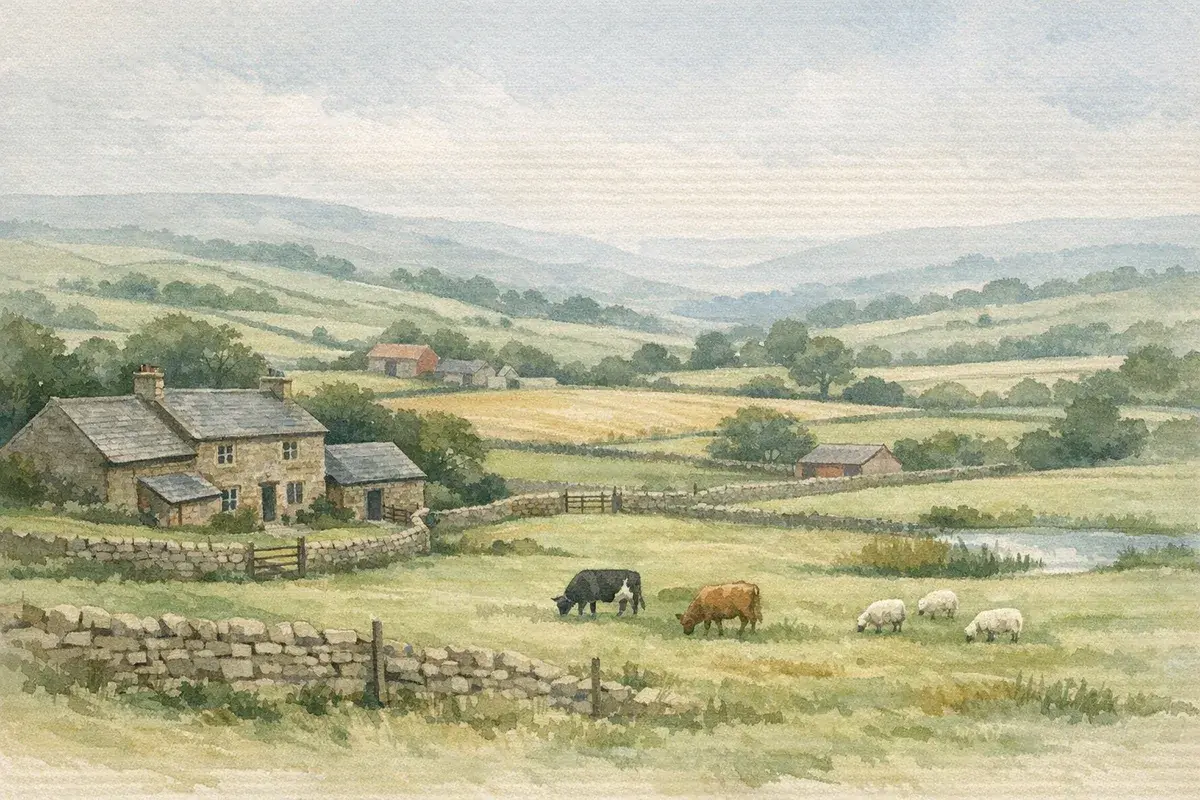
You can buy the perfect little patch of countryside, with a few acres, a yard, maybe stables and a barn… and still find the mortgage is the hardest part.
That's because a smallholding mortgage UK deal isn't always a neat fit for mainstream residential lending. Land value behaves differently to bricks-and-mortar, rural services aren't always "standard", and lenders get twitchy when income comes from livestock, livery, holiday lets, or a mix of everything.
This guide cuts through what lenders actually mean by "smallholding", how the underwriting differs, what evidence strengthens your case, and the due diligence items that can derail an offer late in the day.
What Counts As A Smallholding For Mortgage Purposes?
Mortgage lenders don't work from a single legal definition of a smallholding. In practice, they look at risk, resale, and complexity.
A property can feel like a smallholding to you, room for hens, polytunnels, a pony, yet be underwritten as a standard home. Or it can be treated as semi-commercial because the land, buildings, or income streams change the valuation and exit route.
Land Size, Use Class, And Lender Definitions
Most lenders focus on:
- Acreage and layout: A house with "a bit of land" is often fine: a house with multiple parcels, separate access points, or land split by a lane can raise extra questions.
- How saleable it is to the next buyer: If the buyer pool is smaller (remote, unusual construction, heavily agricultural), underwriting tightens.
- Whether the land is ‘amenity' or ‘working': Grazing for your own animals is typically simpler than income-generating farming.
There isn't a universal acreage cut-off, but in the real world many mainstream lenders become more cautious as land increases and the property stops looking like a typical residential home. If you're still at the "what should I be looking for?" stage, our guide on finding a smallholding for sale is useful because it frames the lender's concerns early, access, services, planning, and saleability.
Agricultural Occupancy Conditions, Ties, And Restrictive Covenants
Two words that can change your mortgage options overnight: occupancy condition.
An Agricultural Occupancy Condition (AOC), often called an agricultural tie, restricts who can live in the dwelling (typically someone solely or mainly employed in agriculture/forestry, or a qualifying dependant). Lenders worry because:
- it can reduce the open-market value,
- it can shrink the resale pool, and
- breach can trigger planning enforcement risk.
Restrictive covenants can have similar effects: prohibitions on business use, restrictions on additional dwellings, limits on livestock, or control over tracks and access.
If the property you're buying has an AOC (or something close to it), expect tighter lender choice, more scrutiny of your employment/income, and a stronger push for specialist advice.
Planning Status: Residential, Agricultural, And Mixed-Use
Planning use isn't a technicality, it's one of the first underwriting questions.
Common scenarios include:
- Residential dwelling with land: often easiest where the land is clearly ancillary and not run as a business.
- Mixed-use (for example, a dwelling plus commercial yard, stables with livery, holiday lets, farm shop): can trigger a different valuation approach.
- Agricultural buildings only (no dwelling) or a dwelling with a heavily agricultural character: tends to move you toward specialist products.
If you're buying as a newcomer, especially where you're learning the planning and lifestyle realities at the same time, our plain-English piece on buying a smallholding for beginners helps you spot the "mortgage blockers" before you get emotionally attached.
How Smallholding Mortgages Differ From Standard Residential Loans
A standard residential mortgage is built for predictability: typical construction, mains services, easy access, and a big resale market.
A smallholding mortgage UK application introduces variables, land value, outbuildings, private services, and sometimes trading income. None of this makes it impossible: it just changes how the lender measures risk.
Valuation Challenges: Land, Outbuildings, And Development Potential
Rural valuations can be messy.
Surveyors and valuers may have to separate:
- the residential value of the house,
- the agricultural/amenity value of the land,
- the value (and condition) of outbuildings, barns, stables, workshops, stores,
- any hope value (development potential) which lenders often discount heavily unless planning is already secured.
You can also get disagreement about whether buildings are truly "useful" or liabilities (asbestos roofs, failing blockwork, unsafe electrics). Some lenders will reduce LTV or require repairs before completion.
Income Assessment: Employed, Self-Employed, And Farm-Based Earnings
Underwriting gets more nuanced when income isn't a simple salary.
Typically, lenders will look at:
- Employed income: usually straightforward with payslips and P60s.
- Self-employed income: commonly two years' accounts/SA302s (sometimes three), and they'll often use an average or the lower year.
- Farm-based earnings: can be accepted, but lenders will want comfort around sustainability, particularly where profits fluctuate with input prices, weather, or stock cycles.
- Secondary income streams: livery, holiday lets, workshops, grazing licences, storage, these can help or hurt depending on how evidenced and how stable they are.
If a material part of affordability relies on business income from the holding, expect more questions and sometimes a move toward semi-commercial underwriting.
Insurance, Utilities, And Access: What Underwriters Scrutinise
This is where rural properties often snag.
Underwriters may ask about:
- Access: is it adopted highway to the boundary, or a private track? Who maintains it? Is there formal legal right of way?
- Services: private water, septic tanks, package treatment plants, oil/LPG, and whether there are modern compliance certificates.
- Flood risk: even where the house is fine, land in flood zones can influence insurance availability and cost.
- Construction type: older cottages, extensions, barn conversions, any non-standard construction can narrow lender choice.
None of these are automatic deal-breakers. But the more "rural" the setup, the more you benefit from a broker and solicitor who see these issues weekly, not once a year.
Your Main Mortgage Routes: Which Lenders And Products Fit?
There are three broad routes for financing a smallholding. The right one depends less on your dream and more on how the holding behaves, as a home, a business, or both.
Residential Mortgage On A House With Limited Land
If you're buying a dwelling with a modest amount of land used for personal enjoyment (or low-intensity grazing), you may be able to use a standard residential product.
You'll improve your chances if:
- the land is clearly ancillary to the home,
- there's no agricultural tie,
- outbuildings are in reasonable condition,
- services and access are conventional or well-documented.
This route can be attractive because pricing can be sharper and processes are more familiar.
Semi-Commercial And Commercial Lending For Larger Or Income-Generating Holdings
Once the property includes meaningful trading activity, or looks like a business asset, lenders may want a semi-commercial or commercial approach.
Typical triggers include:
- significant acreage with agricultural character,
- livery or equestrian yard income,
- holiday lets that are central to affordability,
- substantial barns/workshops used commercially,
- multiple dwellings or complex arrangements.
Commercial lending can be more flexible on unusual properties, but it can also involve:
- different affordability metrics (including debt service coverage),
- different fees and valuation methods,
- shorter terms or different rate structures.
Specialist Rural And Private Banks: When They Make Sense
Specialist rural lenders and private banks can be a sensible fit when your case is "outside the template" but fundamentally strong.
They may be more comfortable with:
- mixed income (salary + rural enterprise),
- high net worth but complex assets,
- land value that doesn't map neatly to residential comparables,
- holdings with a long-term plan (regenerative practices, diversified enterprises).
If you're unsure which route you're in, it helps to start with a lender-view of the asset rather than your personal label of "smallholding". That mindset alone can save weeks of back-and-forth.
Eligibility And Affordability: What You’ll Need To Evidence
You can have a great credit profile and still struggle with a smallholding mortgage if the lender can't clearly see (1) the property is acceptable security and (2) the income is reliable.
This is where preparation pays for itself.
Deposit Expectations, Loan-To-Value, And Interest Rate Reality
Deposits for rural property with land are often higher than standard residential purchases, especially where the holding is more agricultural or harder to value.
If you want a practical benchmark (and the reasons it moves up or down), see our guide on typical deposits for agricultural land purchases. It'll help you sanity-check what your broker is telling you and budget realistically.
In plain terms, lenders tend to price for:
- valuation uncertainty,
- resale complexity,
- and any non-standard services or construction.
So yes, rates and fees can be less forgiving than a "normal" house in town.
Accounts, SA302s, And Proving Sustainable Income
If you're employed, you'll usually be fine with the standard package.
If you're self-employed or running rural enterprises, get organised early:
- SA302s and tax year overviews (HMRC) matching your declared income.
- Full accounts (not just summaries), ideally prepared by a qualified accountant.
- Explanations for volatility: one low year isn't always fatal if you can evidence why and show recovery.
- Evidence for newer income streams: signed agreements for grazing, livery contracts, holiday let accounts.
If you're stepping up from residential lending into something more rural, our longer piece on how agricultural mortgages work in the UK digs into what lenders check and why, particularly useful if your broker says "it's a specialist case" without explaining what that means.
Business Plans And Stocking Numbers For Working Smallholdings
Where the holding is expected to "wash its face" (or even contribute to household income), a lender may ask for a business plan.
A good smallholding plan is practical, not glossy. It should cover:
- what you'll produce (livestock, eggs, veg, livery, firewood, storage, etc.),
- realistic stocking numbers (and the land capability to support them),
- forecast income and costs (feed, bedding, vet, fencing, machinery, utilities),
- your experience and who's advising you (vet, agronomist, consultant),
- contingency planning (TB restrictions, mortality, price swings).
And here's the unromantic truth: lenders like boring. They'd rather see a conservative plan you can definitely deliver than an exciting plan that depends on best-case prices and perfect weather.
The Property Due Diligence Checklist (And What Can Derail A Mortgage)
If you want to avoid the classic rural-purchase heartbreak, survey done, mortgage "approved", then everything collapses, focus on due diligence early.
Below are the issues we see most often holding up a smallholding mortgage UK application.
Title, Rights Of Way, Easements, And Ransom Strips
Solicitors and lenders will look closely at:
- legal access to the property and every parcel of land,
- rights of way (public footpaths, bridleways) crossing yards and fields,
- easements for water pipes, drains, overhead lines,
- ransom strips: small pieces of land that control access or services.
Even if you can physically drive in, lenders want it legally watertight. If access is informal or depends on goodwill, expect conditions, delays, or refusal.
Water Supply, Septic Tanks, Private Drainage, And Compliance
Private services are normal in the countryside, but they need to be compliant and maintainable.
Check:
- private water: source, rights, treatment, and testing (especially if a lender asks about potability).
- septic tank / treatment plant: location, maintenance, and whether the discharge meets current rules.
- shared systems: who pays, who maintains, and what happens if the neighbour refuses.
A vague "we've always done it this way" is exactly what underwriters hate. Put documents in a neat pack and you'll move faster.
Outbuildings, Conversions, And Permitted Development Limits
Outbuildings can be a blessing (storage, livestock housing, workshop) or a lender headache.
Common pitfalls:
- buildings used as dwellings without proper consent,
- conversions started but not signed off,
- unsafe electrics or asbestos,
- unclear boundaries for building plots.
If you're buying a smallholding for sale with a house, pay particular attention to whether any extra accommodation is lawful and insurable. Lenders can be fine with a tidy annexe or studio, less so with anything that smells like an unauthorised dwelling.
Environmental And Designation Constraints: Flood Risk, SSSI, AONB, And Nutrient Neutrality
Designations and environmental constraints don't automatically kill a mortgage, but they can:
- reduce future flexibility,
- increase costs (materials, consents, mitigation),
- affect insurance.
Key checks include:
- flood risk mapping (for buildings and access routes),
- SSSI impacts (farming operations and works can be restricted),
- AONB considerations (planning scrutiny can be tighter),
- local nutrient neutrality rules in affected catchments (relevant for certain developments).
If your plan relies on adding units, converting buildings, or materially changing use, treat these constraints as core underwriting factors, not afterthoughts.
Costs Beyond The Deposit: Fees, Taxes, And Ongoing Commitments
A smallholding purchase often looks affordable, until you line up the "country extras". Budgeting properly is part of keeping your mortgage comfortable, not just getting it approved.
Broker, Valuation, Legal, And Arrangement Fees
Typical cost headings include:
- broker fees (particularly for specialist cases)
- valuation fees (rural valuations can be more involved)
- surveys: often worth upgrading beyond the basic valuation
- legal fees: higher where title is complex, land is split, or there are multiple buildings/uses
- arrangement fees: can be larger on semi-commercial/commercial products
If the property is unusual, expect additional reports, drainage surveys, water tests, structural reports on barns, specialist roof inspections.
Stamp Duty Land Tax And The Mixed-Use Question
Stamp Duty Land Tax (SDLT) in England and Northern Ireland can get complicated when property isn't purely residential.
The key issue is often whether the purchase is treated as:
- residential, or
- mixed-use (for example, a dwelling plus genuinely commercial land/buildings).
Mixed-use treatment can significantly change the tax calculation, but it's fact-specific and HMRC can challenge aggressive positions. This is one of those areas where a quick assumption can turn into an expensive mistake, get advice from a tax specialist who understands rural property.
(Scotland and Wales have their own land transaction taxes with different rules and rates, so don't lift assumptions across borders.)
Maintenance, Fencing, Tracks, And Land Management Budgets
Ongoing costs are where new smallholders often get surprised.
Real-world line items include:
- fencing repairs and replacements (and gates, posts, strainers, never just "a bit of wire"),
- track maintenance (stone, grading, drainage),
- tree work and hedge cutting,
- pasture management (seed, fertiliser/soil amendments, weed control),
- machinery and tool upkeep,
- biosecurity, vet bills, bedding and feed storage.
If you're tempted by bargain listings, be careful: "cheap" can mean "capex heavy". Our piece on cheap smallholdings for sale in the UK is worth a read for the hidden-cost patterns we see again and again.
How To Strengthen Your Application And Avoid Delays
Speed in rural transactions isn't about rushing, it's about removing uncertainty for the lender.
The strongest applications look like someone has done this before, even if it's your first smallholding.
Choose The Right Broker, Surveyor, And Solicitor From Day One
For a smallholding mortgage UK case, your professional team matters more than most buyers expect.
Look for people who routinely handle:
- land with multiple titles or parcels,
- private drainage and water,
- agricultural ties and rural planning,
- mixed-use and diversified income.
A generalist can still be excellent, but if they're learning on your file, you'll pay for it in time.
Package Evidence Early: Plans, Maps, Accounts, And Consents
The quickest wins are admin wins.
Before the lender asks, try to have:
- a clear plan showing what you're buying (house, yards, parcels),
- access details and any private track maintenance agreements,
- building consents and completion certificates (where relevant),
- water/drainage documents and servicing records,
- accounts/SA302s and a short written explanation of your income.
If the holding is intended to be more self-reliant, be ready to explain what that means in lender language, cost control, realistic outputs, and compliance. It also helps to ground your own plan with practical learning: our guide to starting a smallholding is designed around the realities lenders and surveyors care about (infrastructure, stocking, budgets), not just the Instagram version.
Negotiate Sensibly: Price, Inclusions, And Overages
Negotiation isn't just about the headline price.
Be clear on:
- what's included (machinery, livestock handling kit, field shelters, fuel tanks),
- whether there are overage/clawback clauses on land (common where development potential exists),
- any tenancies, licences, or grazing agreements that need assigning.
If the valuer down-values because outbuildings are tired or services are questionable, you may be able to renegotiate, or you may decide to walk away. Either is better than limping into ownership with a stretched mortgage and immediate repair bills.
Conclusion
A smallholding mortgage in the UK is absolutely achievable, but it rewards buyers who treat it like a rural asset finance exercise, not a standard house purchase with a few acres tagged on.
If you want the smoothest path, focus on three things: buy a property that's straightforward security, present your income in a way an underwriter can trust, and do the unglamorous due diligence early (access, services, planning, title). That's what keeps offers from wobbling late in the process.
And when you're ready to move from "research" to "shortlist", tell AgLand what you're after - type, acreage, budget and area - so you hear the moment a matching smallholding is advertised, whether that comes from an owner direct or an agricultural agent who understands how lenders think.
Disclaimer: AgLand.co.uk is a UK agricultural land and rural property matching service, where buyers register what they are looking for and owners advertise directly to the buyers who match, and a rural resource hub. Nothing in this text is intended as legal, financial, tax, or investment advice. You should carry out your own due diligence and take advice from appropriately qualified professionals (for example, a solicitor, mortgage broker, accountant, surveyor, and planning consultant) before making decisions.