
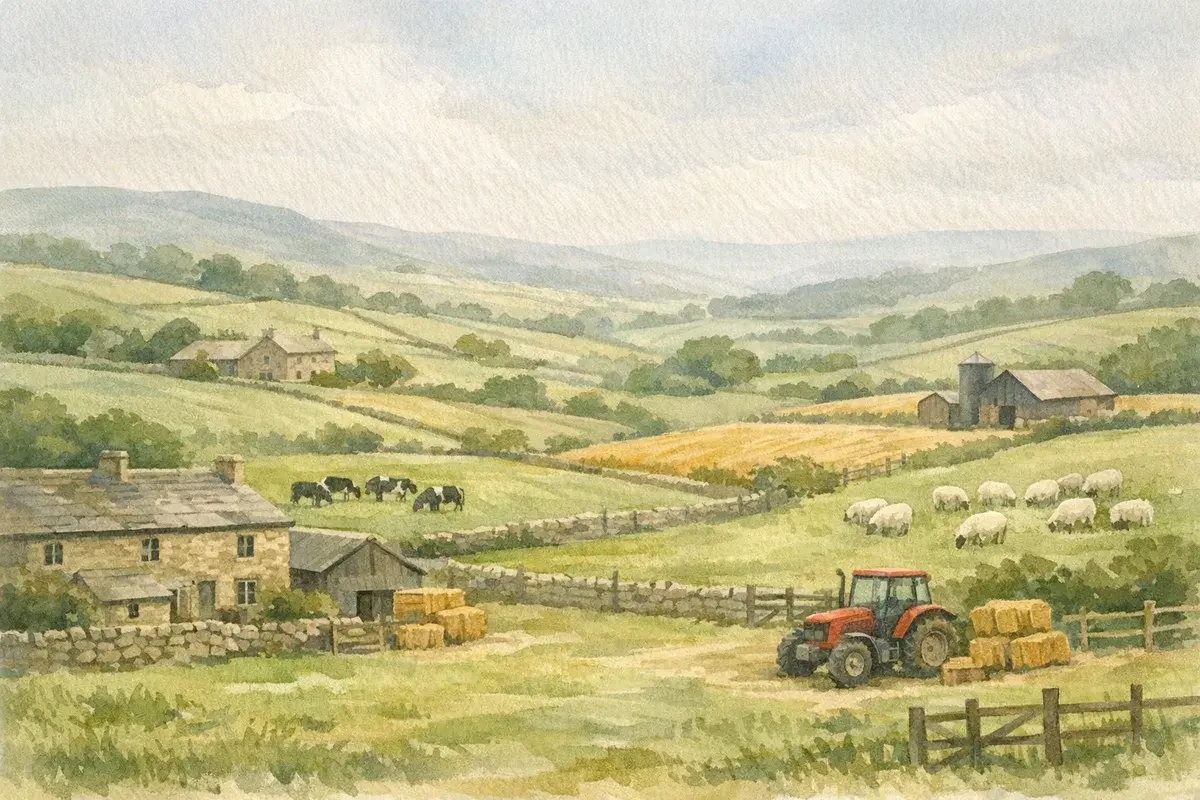
You can spot an agricultural purchase a mile off: a farmhouse that's "not quite standard", land in multiple parcels, a yard with ageing sheds, a track that becomes a river in winter, and a business plan that depends on lambing percentages, grain prices, or a holiday let you haven't refurbished yet.
That's exactly why an agricultural mortgage exists. It's finance built for rural reality, where the property is often inseparable from the business, the value is tied to land quality and use, and the legal quirks (tenancies, rights of way, occupancy conditions) can make a mainstream lender nervous.
This guide cuts through what UK lenders actually look at, how these mortgages are typically structured, what you'll pay in fees, and the practical steps that help you get from "offer accepted" to "funds released" without nasty surprises.
What Counts As An Agricultural Mortgage (And When You Need One)
An agricultural mortgage is usually the right tool when the security is more than a simple house, or when the property's value and marketability depend on agricultural use, rural location, or legal restrictions.
In practice, lenders start with a blunt question: is this primarily a residence, or a rural business asset? If it's the latter (or a mix), you're typically into agricultural, rural, or specialist commercial lending.
Typical Property Types: Farmland, Smallholdings, Farmhouses, And Mixed-Use Rural Estates
You'll commonly see agricultural mortgages used for:
- Bare land (arable, pasture, permanent grass), including blocks bought to add scale to an existing farm.
- Smallholdings where the land, buildings, and sometimes a modest enterprise (livery, eggs, veg boxes) are all part of the plan.
- Farmhouses with land and buildings, especially where the house isn't easily separable from the holding.
- Mixed-use rural estates, where there may be farm cottages, commercial units, holiday lets, storage yards, and traditional agriculture in the same title(s).
The moment your purchase stops looking like a standard suburban conveyance, and starts looking like a patchwork of titles, uses, and income streams, specialist underwriting becomes more likely.
Why Standard Residential Mortgages Often Don't Fit Rural And Farm Purchases
Mainstream residential lenders aren't "anti-farming". They're built around volume lending on property types they can value, insure, and resell quickly if things go wrong.
Common tripwires include:
- Non-standard construction (stone, cob, timber frames, thatched roofs), or older farm outbuildings close to the house.
- Agricultural buildings and land bundled with the dwelling, creating valuation and resale complexity.
- Multiple lots / multiple Land Registry titles, sometimes with ransom strips, shared access, or unregistered parcels.
- Income that's seasonal or complex, where accounts don't look like PAYE income.
If you're buying land as part of a broader strategy, it's worth understanding how lenders view the underlying asset class. We've covered the broader drivers, returns, risk, and time horizons, in our guide to investing in farmland and rural assets, which can help you frame your purchase in lender-friendly terms.
Agricultural Ties, Occupancy Conditions, And Restricted Resale: What They Mean For Finance
If there's one phrase that can change your mortgage options overnight, it's "agricultural tie".
An agricultural occupancy condition (often imposed via planning) restricts who can live in a property, typically someone employed (or last employed) in agriculture, forestry, or an associated rural enterprise.
From a lender's point of view, ties can:
- Reduce resale demand (fewer eligible buyers)
- Affect valuation (sometimes significantly)
- Increase time-to-sell risk if the lender ever needs to repossess
That doesn't mean "no mortgage". It means the lender and valuer need to be comfortable with the restriction and the likely resale market.
You should also watch for:
- Local occupancy conditions that are narrower than you expect (e.g., "in the locality", or tied to a named holding).
- Restrictions in the title (covenants limiting use, subdivision, or additional dwellings).
- Practical marketability issues: a farmhouse only accessible over a private track with complicated maintenance obligations can be as concerning as a formal tie.
If there's inheritance planning in the background, occupancy conditions and agricultural use can also interact with reliefs. It's not something to "DIY" from a blog, but it's worth being aware of the principles behind Inheritance Tax relief on qualifying rural property because lenders will ask questions when ownership structures and long-term plans are involved.
How UK Agricultural Mortgages Are Structured
Agricultural mortgages in the UK sit on a spectrum between residential and commercial finance. Some look and feel like a residential product with extra questions: others are underwritten like a trading business loan secured on land.
The structure you're offered will depend on what you're buying, how you'll use it, and how "liquid" the security is.
Term Lengths, Repayment Types, And Interest Options
Terms vary widely, but typical patterns include:
- Longer terms where the loan is fundamentally land-backed and low risk, especially for established operators.
- Shorter terms or staged lending where there's development risk, change of use, or a heavy reliance on future income.
Repayment types often include:
- Capital and interest (straightforward, steadily reduces debt)
- Interest-only (common where cashflow is seasonal, or where land value growth/exit is part of the plan)
- Part-and-part (a blend, useful if you want some capital reduction but need breathing space)
Interest options may be:
- Variable (moves with the lender's rate / wider market)
- Fixed (useful for budgeting: break costs can apply)
The "best" option is the one that matches the real cash cycle of your business. A dairy unit with predictable monthly receipts looks different from an arable business that sells grain in lumps, or a diversified holding with holiday let peaks.
Deposit Expectations, Loan-To-Value, And Security Across Multiple Titles
Deposits and LTV are not one-size-fits-all in rural finance.
In broad terms, lenders tend to be more comfortable (and price more keenly) where:
- The security is good quality land with clear access
- There's strong evidence of sustainable income
- The titles are clean and straightforward
Where it gets complex is when the "property" is actually a set of assets:
- Multiple Land Registry titles (common with farms built up over generations)
- Separate parcels, sometimes non-contiguous
- Farmhouse plus land plus buildings, where the lender wants clarity on what's being charged
This is one reason land registration and title clarity matters early. If you're dealing with older deeds, unregistered land, or boundary uncertainty, get on top of it, our primer on how rural titles get registered and evidenced explains the common issues that crop up when farms change hands.
Also note: lenders may take additional security (other land, other property, or charges over business assets) if LTV needs support.
Development, Diversification, And Overage: How Lenders View Future Value
A lot of rural purchases carry a quiet subtext: "Yes, it works now… but it'll really work once we diversify."
Lenders don't dislike diversification. Many actively prefer a holding that isn't exposed to a single commodity cycle. But they usually want to separate:
- current, evidenced income (what you can prove)
- near-term, contracted income (leases, licences, confirmed bookings)
- speculative future value (planning hope, conversion projects not yet consented)
A few lender realities worth knowing:
- Hope value (value based on possible future planning) is treated cautiously.
- If the seller has imposed overage/clawback (a payment due if you later get planning permission or uplift), the lender will want it reviewed. It can affect valuation and your ability to refinance.
- Change-of-use risk matters. A barn conversion might sound simple: the lender will ask about planning, access, services, ecology, and whether it remains ancillary to agriculture.
If your business plan relies on future consents, you'll often do better by treating that upside as a bonus, not the core affordability case.
Eligibility And Underwriting: What Lenders Assess In Practice
Underwriting for an agricultural mortgage is less about ticking boxes and more about answering: if the weather turns, prices dip, or costs spike, does this still hold together?
Expect the lender to look at you, the asset, and the business as one connected picture.
Income Proof For Farming, Contracting, And Diversified Rural Businesses
You'll usually be asked for some combination of:
- Accounts (often 2–3 years where available)
- SA302s / tax year overviews if you're self-employed or in partnership
- Business bank statements
- Enterprise breakdowns (what makes money, what's breakeven, what's loss-leading but strategically necessary)
For diversified income, lenders tend to respond well to:
- Contracts and leases (e.g., commercial units, grazing lets, telecoms masts)
- Booking history for holiday lets (and realistic occupancy assumptions)
- Evidence of demand if you're expanding an existing enterprise (not just a new idea)
Don't forget the policy backdrop. In England, direct payments have been changing and business support is increasingly tied to environmental delivery. If your cashflow assumes support payments, you need to be clear what scheme you're in and what's actually receivable. Our explainer on how farm support is evolving across the UK can help you sense-check assumptions before a lender does.
Land Quality, Buildings Condition, Access, Services, And Rights Of Way
Two holdings can be the same acreage and wildly different risks.
Valuers and lenders look closely at:
- Land quality and productivity (soil type, drainage, slope, cropping history)
- Water (mains availability, private supplies, boreholes, abstraction considerations)
- Access (adopted highway vs private track: width for machinery: third-party ownership)
- Services (electric capacity for modern kit: three-phase: telecoms)
- Rights of way and easements (public footpaths through yards, shared drives, wayleaves)
- Building condition (asbestos cement roofs, structural issues, compliance gaps)
A practical tip: if you can't clearly describe the holding on one page, access points, services, key rights, what's included/excluded, you're likely to hit friction in underwriting.
Land quality isn't just a farming conversation: it's a finance conversation too. A lender will be more comfortable when the valuer can clearly explain the land's capability and market demand, and you can too. If you need a refresher, our guide to how UK land grades and capability influence value is a useful grounding.
Tenancies, Grazing Licences, And Vacant Possession: The Impact On Borrowing
Occupational arrangements can make or break the deal.
Lenders will ask:
- Is the land vacant possession on completion?
- If tenanted, what type of agreement is it, Farm Business Tenancy (FBT), older protected tenancy, licence, informal grazing?
- What are the termination dates, break clauses, and repair obligations?
- Does the tenancy affect your ability to occupy the farmhouse (if that's part of the security)?
Even "simple" grazing arrangements can raise questions if they look like de facto tenancies.
If you're buying with tenants in situ, underwriting may still work, but affordability is then tied to rent reliability, the strength of the agreement, and the lender's comfort with the security's resale market.
And don't underestimate timing: if your mortgage offer assumes vacant possession and completion slips past a termination date, you can end up re-answering the same questions under pressure.
Costs, Fees, And Valuations You Should Budget For
An agricultural mortgage rarely fails because the interest rate is 0.25% higher than you hoped. It fails because costs and process surprises eat your timeline, your contingency, or both.
Budgeting properly, early, keeps you in control.
Arrangement Fees, Legal Costs, And Early Repayment Charges
Expect to see (depending on lender and complexity):
- Arrangement/product fees (sometimes a percentage of the loan, sometimes fixed)
- Broker fees (where you use a specialist: not always, but common)
- Legal fees (your solicitor and often the lender's legal costs too)
- Searches and reports (local authority, drainage, environmental, plus rural-specific enquiries)
- Early repayment charges (especially on fixed rates or bespoke facilities)
Rural conveyancing can be document-heavy. Multiple titles, wayleaves, sporting rights, commons, private water supplies, none of these are rare in the countryside, and each can add cost.
RICS Valuations, CAAV Input, And How Agricultural Valuations Differ
Agricultural valuation is its own discipline.
A RICS valuer will typically consider:
- Comparable evidence for land type and location
- The usability and condition of buildings (and sometimes their limited alternative use)
- Access, services, and operational layout
- Tenancies and income where relevant
- Restrictions (occupancy, covenants, designations)
In many cases, you'll also see input from a CAAV-qualified rural surveyor (or a chartered surveyor with deep rural experience). That's often where you get the most practical insight: what a typical buyer would actually pay for the holding, given the realities of farming it.
One underappreciated point: the valuer's approach can differ depending on whether the property is assessed as primarily residential, commercial/agricultural, or mixed. That classification affects the narrative in the valuation report, which affects the lender's comfort.
Insurance And Compliance Costs: Environmental, Water, Waste, And Safety
Lenders increasingly care about "non-financial" risk, because it becomes financial risk very quickly.
Depending on the property, you may need to allow for:
- Buildings insurance (non-standard construction can be pricier)
- Public and employers' liability if you have staff, visitors, or public rights of way
- Environmental considerations (contaminated land, fuel storage, legacy waste)
- Private water supply testing and treatment
- Septic tanks / package treatment plants and compliance requirements
- Asbestos surveys for older agricultural buildings
This isn't about scaremongering: it's about avoiding the classic rural buyer moment: you only discover the "real" running costs once the lender's valuer asks the awkward questions.
If you're buying in England, it can also help to understand local market nuance, some areas are dominated by lifestyle demand, others by commercial farmland buyers. That mix can subtly influence valuation confidence and resale assumptions. Our area guide to buying and owning farmland in England can help you benchmark what's typical where you're looking.
A Step-By-Step Process To Secure An Agricultural Mortgage
If you want speed and fewer unpleasant surprises, treat the mortgage as a project, with a sequence, a paper trail, and named professionals.
Pre-Application: Define The Buying Entity, Use Case, And Evidence Of Need
Before you apply, get crisp on three things:
- Who is buying?
- You personally, a partnership, a limited company, a trust, or a mix?
- This affects underwriting, tax, and legal work.
- What is the actual use?
- Pure agriculture, equestrian, mixed-use, diversification, or a future change?
- Lenders don't mind complexity, but they hate ambiguity.
- What's the evidence that it works?
- Budget, cashflow, and sensitivity (what if fertiliser rises, what if occupancy drops, what if rates move?)
- If you already farm, show historic performance and how this purchase improves efficiency or margin.
A smart move is to write a one- or two-page "lender pack summary" in plain English: holding overview, acreage split, tenure, access, services, buildings, income streams, and your repayment plan.
Due Diligence: Title, Boundaries, Easements, Planning, And Environmental Constraints
Rural due diligence is rarely about a single fatal issue. It's usually about ten small ones that compound.
Prioritise:
- Title and plan accuracy: do boundaries match what you've been shown on the ground?
- Easements: rights of way, rights to lay and maintain services, shared access obligations.
- Planning history: conditions, enforcement notices, lawful use positions.
- Designations and constraints: AONB, SSSI, flood risk, these can affect value and insurability.
- Basic operational essentials: water supply, drainage, power capacity, telecoms.
If the land is in parcels, confirm each parcel's status and documentation. It's surprisingly common to find "handshake" arrangements or historic anomalies (a gateway moved, a track widened, a boundary fence never quite where the plan suggests).
Also, if the land is or will be used for schemes, check obligations carefully, some commitments travel with the land, others are personal to the agreement holder.
Application And Offer: Timelines, Conditions Precedent, And Common Sticking Points
Agricultural mortgage timelines can be quick when the package is tidy, and slow when it isn't.
What to expect:
- Decision in principle after initial financial review
- Valuation instruction (often the pacing item)
- Underwriting questions (income breakdown, tenancies, access, occupancy restrictions)
- Offer issued with conditions
Common "conditions precedent" before funds are released include:
- Confirmation of vacant possession (where required)
- Evidence of insurance in place
- Satisfactory legal reporting on title, easements, and restrictions
- Resolution of any planning or building regulation anomalies
The best way to keep momentum is to avoid drip-feeding information. If you anticipate the awkward questions (ties, access, tenancies, diversification), address them upfront with documents and a clear narrative.
And if you're still searching, use specialist listings so you're not wasting time on properties that were never going to finance cleanly. On AgLand, you can filter rural and farm opportunities and connect directly with agents who understand how lenders view these assets.
Common Pitfalls And How To Avoid Them
Most agricultural mortgage problems are predictable. The frustrating part is you often only realise that after you've paid for searches, valuation, and a chunk of legal work.
Here are the pitfalls we see most, and how you can sidestep them.
Overestimating Borrowing Based On Hope Value Or Future Planning Consent
It's tempting to build affordability around the "version" of the holding you'll create in two years.
Lenders usually won't.
How to avoid it:
- Base your repayment plan on today's permitted use and today's evidenced income.
- Treat planning uplift as upside, not a necessity.
- If you do have a realistic planning pathway, show it properly: pre-app advice, consultant notes, comparable consents nearby, not just optimism.
Also remember: overage can limit your ability to extract value even if you win consent, because some of that uplift is contractually owed to the seller.
Under-Documenting Diversified Income And Cashflow Seasonality
Diversification is lender-friendly when it's provable.
What underwriters struggle with is vague income like "we'll run glamping and it should do well."
How to avoid it:
- Provide separate income lines for each enterprise (rent, storage, holiday lets, contracting, grazing).
- Show banking evidence and contracts where possible.
- Include a simple seasonality note: which months are lean, which are strong, and how you manage working capital.
If you're relying on policy-linked income, be precise about what scheme you're in and what's committed. Assumptions around support can be a red flag if they aren't backed by documentation and realistic delivery plans.
Missing Restrictions: Subsidy/Stewardship Obligations, Covenants, And Enforcement Risk
Restrictions aren't always obvious from a viewing.
A few examples that regularly cause late-stage stress:
- Covenants limiting non-agricultural use, additional dwellings, or commercial activities.
- Occupancy conditions (ties) that restrict who can live in a farmhouse.
- Stewardship or subsidy obligations that constrain what you can do with the land (and can affect value if misunderstood).
- Historic breaches: unauthorised residential use of a building, unconsented engineering works, or long-standing uses that aren't formally lawful.
How to avoid it:
- Ask your solicitor to run a restriction-first review early, not as a final check.
- Have your agent confirm in writing what is included: tracks, rights, services, yards, and any excluded parcels.
- Keep a "risk log" as you go, just a simple list of issues, who owns them, and what the resolution is. Sounds basic, but it prevents last-minute chaos.
If you want the smoothest path to funding, the theme is always the same: clarity beats cleverness. Clean documents, realistic numbers, and early professional input outperform even the most confident verbal assurance.
Conclusion
An agricultural mortgage is less about finding a headline rate and more about proving, on paper, that the land, the property, and your plan stack up under scrutiny. If you go in assuming it's "just a house with a bit of land," you'll often pay for that assumption in delays, re-valuations, and stressful renegotiations.
If you want to improve your odds quickly, focus on three lender-friendly habits: be specific about use, document income properly (including seasonality), and treat title/tenure/planning as first-order issues, not admin. Do that, and you'll not only get to offer faster: you'll also know the holding you're buying is financeable, insurable, and workable in the real world.
Disclaimer: AgLand.co.uk is a UK agricultural land and rural property matching service, where buyers register what they are looking for and owners advertise directly to the buyers who match, and a rural resource hub. Nothing in this text is intended as legal, financial, tax, or investment advice. You should carry out your own due diligence and take independent professional advice from suitably qualified experts (for example, an FCA-authorised mortgage adviser, solicitor, accountant, and/or chartered surveyor) before making any decisions.