
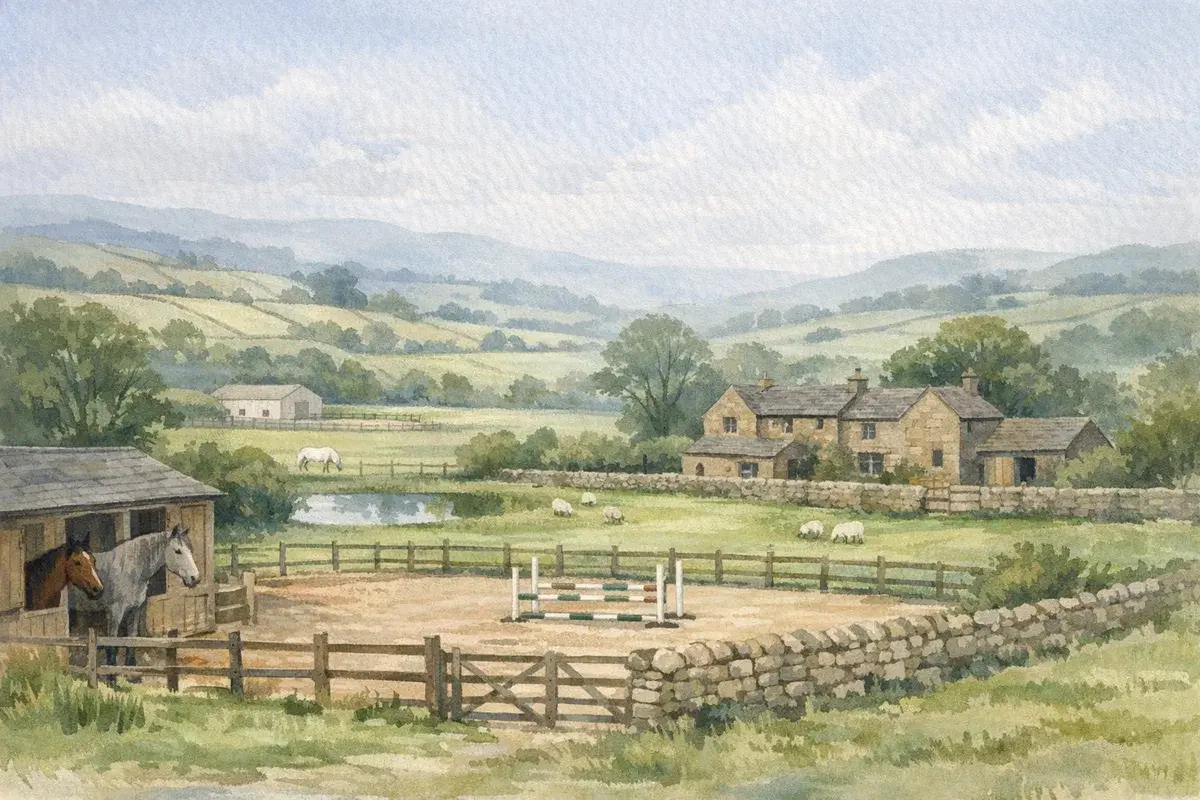
There's a particular kind of optimism that kicks in the moment you start browsing equestrian facilities for sale. You picture the tidy yard, the floodlit school, winter turnout that somehow stays dry, and a business that runs like clockwork.
Then you do a viewing and reality turns up in muddy boots: a "professional" arena with a tired base, stables that don't meet modern expectations, a water supply that won't cope with a busy yard, or a planning history that's… complicated.
This guide is here to make your next steps calmer and more commercial. Whether you're buying a private yard, a livery business, or a full riding centre, you'll know what to define, what to inspect, what to verify on paper, and what to cost properly, so you don't pay a premium for problems.
Define Your Brief: What “Equestrian Facilities” Really Means
Equestrian facilities is one of those catch‑all phrases that sounds clear, until you're ten listings in and realise every seller means something different. The fastest way to waste time (and get emotionally attached to the wrong place) is to view before you've defined what you actually need.
Riding Centres, Livery Yards, Stud Farms, And Private Yards
Start by being honest about the operating model, because that dictates everything from layout to permissions and insurance.
- Private yard: Typically fewer boxes, simpler traffic flow, less customer parking, and more emphasis on hacking and turnout. You might accept less "commercial polish" if it rides well and is easy to manage.
- Livery yard: The facility becomes a service business. You'll want safe, obvious access, plenty of storage, robust yard surfacing, and practical segregation (client horses, visiting professionals, quarantine if possible). If your search is specifically business-led, you'll find it useful to compare set‑ups against what a true livery yard for sale needs to operate smoothly.
- Riding centre / lesson yard: Think car parking, safe spectator areas, lighting, toilets, disability access considerations, and a clear H&S culture. A "nice yard" and a "teaching yard" aren't the same beast.
- Stud / breeding: Foaling boxes, separation paddocks, biosecurity, and a yard layout that reduces stress and risk. Access for vets and farriers becomes non‑negotiable.
One extra reality check: plenty of properties are marketed as equestrian but are really just "a few stables and some land". That can still be perfect, just don't pay a riding-centre premium for a private set‑up.
Land Size, Layout, And Access: What To Sketch Before You View
Before you book viewings, sketch a rough site plan on paper. Not pretty, functional.
Include:
- Vehicle movements: horseboxes, feed deliveries, muck lorries, farrier/vet parking, client cars. Can two vehicles pass? Can a lorry turn without reversing past horses?
- People flow: where clients walk, where horses move, where children might be. Separation reduces risk.
- Horse flow: stable to turnout to arena without crossing busy driveways.
- Winter practicality: where water sits, where gateways poach, and whether you'll be living in a sea of mud for five months.
Access is often the silent deal-breaker. A narrow lane with tight bends might be "fine" for you… right up until you try to attract liveries, host clinics, or run events.
Location And Catchment: Competitions, Clients, And Hacking
Location isn't just postcode prestige. It's your day-to-day operating reality.
- Catchment: If income matters, you need enough local demand within a sensible driving radius. A gorgeous yard in the wrong place can be harder to fill than a basic yard in the right one.
- Road network: How quickly can clients reach you after work? Are there bottlenecks at school-run times?
- Off-road riding: Bridleways, permissive routes, and safe quiet lanes are genuinely valuable. If hacking is poor, you'll rely more on your arena(s) and turnout, so those must be excellent.
- Regional differences: Scotland, Wales and England don't behave identically on planning and land use, and the market dynamics can vary too. If you're north of the border, you may want to narrow your research to equestrian property Scotland to stay aligned with local realities.
If you're not sure how to translate "nice location" into a buyer brief, it's worth grounding yourself in the broader checks for equestrian property for sale in the UK before you start viewing seriously.
Core Infrastructure To Inspect On Every Viewing
You can repaint a tack room and swap doors. You can't cheaply fix a wrongly-built arena, a failing drainage system, or a site layout that causes near misses every day.
Here's what experienced buyers (and the agents we work with) tend to inspect first, because it tells you whether the facility is fundamentally sound.
Stabling, Barns, Storage, And Biosecurity Set-Up
Stables are easy to count and surprisingly hard to assess well.
Check:
- Ventilation and light: Stuffy barns raise respiratory risk. Look for airflow, natural light, and whether ammonia builds up.
- Dimensions and construction: Are boxes a practical size for modern horses? Are partitions solid? Are doors safe and smooth?
- Yard surface and drainage: Standing water plus foot traffic equals slips and vet bills.
- Storage: Hay/straw, bedding, feed (vermin-proof), rug drying, and secure tack. Lack of storage forces messy workarounds that clients notice.
- Biosecurity basics: A realistic area for isolation, separate tools for mucking out, and sensible vehicle/visitor access routes.
If your non-negotiable is a ready-to-run set-up with good equine buildings, use examples of what counts as an equestrian property with stables as a benchmark, especially around layout and practicalities.
Arenas And Surfaces: Drainage, Lighting, And Maintenance Costs
An arena can add serious value. It can also quietly swallow your budget.
When you view, ask (and look) for:
- Base construction: A good base matters more than the top surface. If the base has failed, "topping up" is money down the drain.
- Drainage design: Where does water go? Is there evidence of standing water, algae, or patchy riding?
- Edging and kickboards: Are they safe and intact?
- Lighting: Floodlights are brilliant, until you realise the electrics are dated, the columns need testing, or neighbours have complained.
- Maintenance reality: Who's been harrowing? How often? What kit is included?
Turnout And Fencing: Water Supply, Shelter, And Track Systems
Turnout isn't just "acres". It's usability.
- Field shape and gateways: Narrow pinch points and single gateways get churned fast.
- Water in fields: Troughs, pipework, and winter resilience. If it's all hosepipes, your labour goes up.
- Shelter: Natural shelter (hedges/trees) or field shelters: check condition and anchoring.
- Fencing: What type, what condition, and who maintains boundaries? Budget for replacement if it's a patchwork.
- Track systems: If there's a track, inspect surfacing, drainage, and whether it's actually practical year-round.
Utilities And Services: Water Pressure, Electrics, Septic, And Broadband
Utilities don't sell the dream, but they keep the place running.
- Water: Pressure and flow rate matter for multiple stables, wash bays, and potential accommodation. Ask about supply type (mains/private) and any historic shortages.
- Electrics: Consumer unit age, external sockets, lighting circuits, and whether there's three‑phase (useful for larger operations).
- Foul drainage: Septic tanks/packaged treatment plants need compliance and maintenance. Ask when it was last serviced and whether there's any upgrade requirement.
- Broadband/mobile: If you'll run a business, take bookings, process card payments, or host clients, connectivity is now infrastructure, not a nice-to-have.
Planning, Consents, And Legal Checks That Trip Buyers Up
Most painful equestrian purchases don't fail because the yard is ugly. They fail because the paperwork doesn't match the use, or because you're buying "potential" that planning simply won't support.
You're not trying to become a planning barrister. You are trying to spot risk early and involve the right professionals before you commit.
Current Use Class, Lawful Use, And Material Change Of Use Risks
A common trap: land that's been used informally for horses for years, without clarity on what's lawful.
Key questions to ask:
- What's the current lawful use of the land and buildings?
- Is the use private (your own horses) or commercial (liveries, lessons, hire, events)?
- Has there been a material change of use, and if so, was it consented?
A small private set-up can sometimes sit quietly within a broader agricultural context, but commercial activity, vehicle movements, lighting, customer traffic, often changes the planning complexion. If you're buying as a business, you want certainty, not hope.
Permitted Development Vs Full Planning For Equestrian Buildings
In rural property, buyers often assume they can add stables or an arena later "under permitted development". Sometimes you can. Often you can't, or the conditions make it far slower and more expensive than you planned.
The practical approach:
- Treat "we can just build later" as a risk item, not a plan.
- Ask what consents already exist, and whether anything was built under prior approvals.
- If expansion is central to your numbers, focus on sites where permissions are already in place or realistically achievable.
If planning certainty is a key driver, it's worth focusing your search around equestrian land with planning permission so you're not pricing a dream that never gets built.
Rights Of Way, Access Titles, And Restrictive Covenants
Legal access sounds boring until it ruins your day.
During due diligence, your solicitor will dig deep, but you should still ask early:
- Is access adopted, private, or shared?
- Are there any bridleways/footpaths crossing the yard or turnout? That can be manageable, but you need to design around it.
- Are there restrictive covenants limiting business use, additional buildings, or even horse-related activity?
And don't ignore shared drives and yard rights. If your horsebox access relies on a neighbour's goodwill, you're buying uncertainty.
Environmental Constraints: Flood Risk, SSSI, AONB, And Nutrient Neutrality
Environmental constraints aren't "maybe problems". They're often fixed realities.
- Flood risk: It affects insurance, arena performance, and winter turnout. Look for historic pooling, nearby watercourses, and ask what happens in a wet winter.
- Designations: AONB, National Park, SSSI, each can tighten what you can build or change, with Natural England the consenting body for SSSI operations in England.
- Nutrient neutrality and protected habitats: In some areas, extra development can be delayed by mitigation requirements.
None of this is a reason to walk away automatically. It is a reason to price correctly and take professional advice early, before you've paid for surveys and solicitors on a fundamentally unworkable plan.
Financials: Pricing, Funding, And Ongoing Running Costs
Equestrian facilities can look like "land with some buildings" on paper, but the finances behave differently. There's the asset value, the operational cost base, and, if you're buying a business, an income story that needs testing.
How Equestrian Properties Are Valued (And Why Arenas Skew Comparables)
Valuation is rarely as simple as £/acre.
You're typically paying for a combination of:
- Location and residential element (if any)
- Quality of equestrian infrastructure (stabling, arenas, access, surfacing)
- Land capability (drainage, turnout usability, grass quality)
- Planning position (existing consents, lawful commercial use)
Arenas, in particular, can distort comparables because a well-built, well-drained school is expensive to replicate and can make a yard operationally viable year-round. But a poor arena can be a liability disguised as a feature.
Mortgage And Finance Realities For Mixed-Use Rural Property
Funding can get nuanced fast when you combine residential, land, and business use.
Expect lenders to look at:
- The split between residential and commercial use
- Whether income is proven (accounts) or projected (business plan)
- Condition, construction type, and title complexity
If you're buying a going concern, you may need specialist lending advice, and you should anticipate a more detailed underwriting process than a standard house purchase.
Insurance, Business Rates, And Compliance Budgets
This is where many first-time commercial buyers under‑allow.
Potential budget lines include:
- Public liability (higher if you run lessons, events, or have staff)
- Care, custody and control considerations (relevant for liveries)
- Employers' liability if you employ anyone
- Commercial property cover for buildings, tack, machinery
- Business rates where applicable, plus any reliefs (case-specific)
- Compliance: fire safety, electrical testing, legionella risk assessments in some contexts, and H&S documentation
If you're taking on clients, you're effectively buying risk as well as land. Price accordingly.
Income Potential: Livery, Schooling, Events, And Diversification
Income is possible in lots of ways, but it's rarely "passive".
Common streams:
- DIY/part/full livery
- Schooling and training packages
- Clinics, hire of arena, small events
- Storage rental (where lawful and appropriate)
- Letting of ancillary buildings (again, subject to consents)
The key is to stress-test your assumptions. What happens if you only fill 60–70% of boxes for a year? What's your contingency when hay prices spike or a wet winter increases bedding usage?
If you're buying with an investor mindset, read more on equestrian property investment thinking, particularly around yield realism, exit routes, and the premium (or discount) attached to specialist infrastructure.
Due Diligence: Surveys, Records, And ‘Red Flag’ Questions
A smart viewing tells you whether you like it. Due diligence tells you whether you should buy it.
You'll spend money here, but the goal is to spend a little to avoid spending a fortune later.
RICS Surveys, Drainage Reports, And Surface Testing
For equestrian facilities, a normal house survey often isn't enough on its own.
Consider:
- RICS building survey for residential and key structures
- Specialist inspection of stables/barns (structure, electrics, fire risk)
- Drainage checks across yard areas and arenas
- Arena surface testing and investigation into base construction if there are signs of failure
If a seller claims "brand new arena, no expense spared" but can't show build specs, invoices, or maintenance history, treat that as a prompt to verify, not a reason to trust.
Water Abstraction, Manure Management, And Yard Waste Handling
Water and waste are unglamorous, but they can become expensive compliance headaches.
Ask:
- Where does the water come from (mains/private supply)?
- If there's any abstraction, is it licensed by the Environment Agency (where relevant)?
- What's the manure system, storage, removal frequency, and contractor details?
- Where does dirty water run (wash bays, yard runoff), and is it managed sensibly?
A tidy muck heap in summer can look fine. You need to understand what happens in February.
Health And Safety, Fire Risk, And Public Liability Exposure
If you'll have staff, clients, or members of the public on site, risk management becomes part of the asset.
Look for:
- Fire separation between hay/straw and stables
- Clear access for emergency vehicles
- Safe electrics and lighting
- Slips/trips risk on yard surfaces
- Riding school-specific controls if relevant (mounting blocks, arena fencing, spectator separation)
If it's currently a trading yard, ask what their incident history looks like and what policies are in place. A professional seller won't be offended by this: they'll expect it.
Seller Evidence To Request: Plans, Invoices, And Permissions
You're trying to turn "it seems fine" into "it's evidenced".
Request:
- Planning permissions, building regs completion certificates (where applicable), and any enforcement correspondence
- Arena build details: base design, drainage plan, surface specification, installer info
- Servicing records: septic/treatment plant, electrics, water systems
- Maps/plans showing boundaries, turnout, and any rights of way
- For businesses: accounts, occupancy levels, client contracts, staff arrangements, and supplier agreements
A final red flag question that saves time: "If you were buying this yard, what would you fix first?" People often reveal the true priority list without meaning to.
Strategy: How To Find The Right Equestrian Facilities For Sale
Good equestrian facilities don't always sit around waiting for you. The best ones are often quietly marketed, priced with confidence, and snapped up by buyers who move quickly, because they know exactly what they're looking at.
Here's how to improve your odds without rushing into a mistake.
On-Market Vs Off-Market: Working With Specialist Rural Agents
On-market listings give you transparency and choice. Off-market opportunities can offer discretion and sometimes less competition, but you'll usually need relationships.
A practical approach:
- Tell specialist rural agents your non‑negotiables (access, arena type, number of boxes, land quality).
- Be clear about your timescale and proof of funds/finance readiness.
- Ask them what tends to sell fastest in that patch, and why.
We've seen buyers win simply by being the most organised: brief defined, solicitor lined up, surveyor ready, and decision-makers available.
Using Specialist Portals To Filter By Land Type, Buildings, And Tenure
General portals can be fine for broad browsing, but equestrian purchases often live and die on detail: acreage, tenure, building types, and how the land actually lays out.
Looking for land like this? Tell AgLand what you're after - type, acreage, budget and area - and we'll alert you the moment a matching property is advertised. Registering is free, and there's no commission on either side. Tell us what you're looking for.
Use filtering strategically:
- Start wide, then tighten based on your viewing learnings.
- Save searches and revisit weekly, new stock can appear and disappear quickly.
- Keep notes on "deal-breakers" so you stop repeating unproductive viewings.
Viewing Checklist And Offer Tactics In A Competitive Patch
When you're viewing equestrian facilities for sale, it helps to split your questions into three layers:
- Can it work? (access, utilities, drainage, layout)
- Is it lawful? (use, permissions, restrictions)
- Is it commercial? (true cost base, realistic income)
Offer tactics that stay sensible:
- If the property is strong but has fixable issues (fencing, surfacing, storage), quantify them and use that to shape your offer, don't just "try your luck".
- If you're relying on permissions or a change of use, consider structuring the offer with advice from your solicitor so you're not buying risk blind.
- Move quickly when the fundamentals are right. You can negotiate paint: you can't negotiate land, access, and planning history.
One small tip that's surprisingly effective: after a second viewing, stand quietly for five minutes and just listen. Road noise, dogs, neighbour activity, and aircraft routes don't show up in photos, yet they influence client experience and horse calmness more than you'd think.
Conclusion
Buying equestrian facilities for sale in the UK is rarely about finding a "perfect" yard. It's about finding a set-up with the right fundamentals, access, drainage, lawful use, and infrastructure that won't ambush your budget, then paying a price that still leaves you room to operate.
If you do three things well, you'll outperform most buyers: define your brief tightly, treat planning and evidence as seriously as the buildings, and cost the unglamorous bits (water, waste, surfaces, insurance) with brutal honesty. After that, the decision becomes much clearer, often quicker too.
Disclaimer: AgLand.co.uk is a UK agricultural land and rural property matching service, where buyers register what they are looking for and owners advertise directly to the buyers who match, and a rural resource hub. Nothing in this text is intended as legal, financial, tax, or investment advice. You should carry out your own due diligence and take independent advice from suitably qualified professionals (for example, solicitors, surveyors, planning consultants, accountants, and specialist brokers) before buying, selling, or financing any equestrian or rural property.