
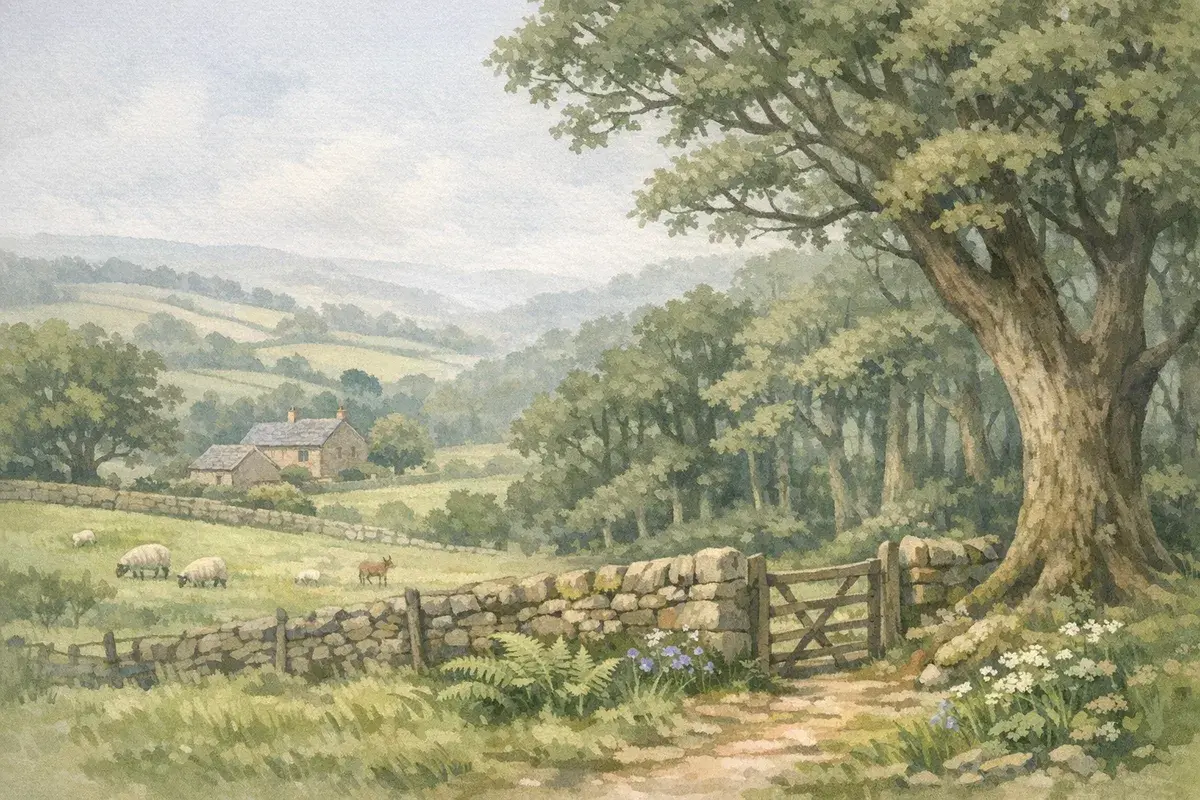
There's "woodland for sale", and then there's ancient woodland for sale. On paper it might look like the same thing: trees, boundaries, an access track, maybe a stream. In practice, ancient woodland is a different class of asset altogether.
You're not just buying timber or a lifestyle bolt‑on. You're stepping into a place with deep ecological value, real policy protection, and a set of constraints (and opportunities) that can catch out even experienced rural buyers. The upside is that, if you approach it properly, ancient woodland can be a resilient long‑term holding: a conservation asset, a privacy buffer for a farm or estate, and sometimes a strategic piece in wider land management.
This guide cuts through what counts as "ancient", how it's protected in UK planning, what you should check before you offer, what genuinely drives value, and what you can and can't do once you own it.
What Counts As Ancient Woodland And Why It Matters
Ancient woodland isn't a marketing phrase, in UK policy it has a specific meaning and a long shadow. It affects what local planning authorities will permit, what management options are realistic, and how a future buyer (or lender) will see the risk.
Ancient Woodland Inventory And Long-Established Woodland Explained
In the UK, ancient woodland generally means land that has been continuously wooded since at least 1600 in England and Wales, and 1750 in Scotland. The key word is continuously. A wood can be cut, coppiced, grazed, or partially replanted and still be "ancient" if it hasn't reverted to long‑term non‑woodland use in the historical record.
Most buyers first meet the concept via the Ancient Woodland Inventory (AWI), a mapped dataset used by planners and consultants. A few practical points matter when you're assessing a listing:
- AWI is influential, but it isn't perfect. Boundaries can be approximate, particularly on smaller fragments or where historic mapping is ambiguous.
- Not all ancient woodland is on the inventory. Some sites are "unrecorded" or disputed.
- The designation doesn't switch off commercial reality. Access, safety, and management still matter, you just have less flexibility.
There's also the idea of Long‑Established Woodland (LEW) (you'll see this language especially in Scotland). LEW typically refers to woodland present on older mapping (often 19th century sources) and can carry similar ecological expectations in practice, even if it doesn't meet the strict "ancient" threshold.
If you're at an early stage and want a wider feel for the market beyond just ancient sites, it helps to benchmark the broader category of UK woodland, then narrow down with AWI/LEW checks and site specifics.
Ancient, Semi-Natural Woodland Vs Plantations On Ancient Woodland Sites (PAWS)
Not all ancient woodland "looks" ancient. That's where the two main sub‑types come in:
- Ancient Semi‑Natural Woodland (ASNW): The trees and ground flora have developed largely through natural regeneration and long continuity. This is the classic high‑value habitat: complex structure, veteran trees, ancient woodland indicator species, and soils that have been woodland soils for centuries.
- Plantations on Ancient Woodland Sites (PAWS): These are ancient woodland soils that were historically replanted with non‑native conifers or other plantation species. The site is ancient, even if the current canopy is a relatively modern crop.
PAWS can be attractive to buyers because there's often a clear restoration story: gradually removing plantation species, widening rides, encouraging native regeneration, and bringing the site closer to ASNW condition. But it also means you must be careful about assumptions:
- A PAWS site may have timber value, but harvesting is rarely as simple as "clearfell and replant".
- Restoration can be time‑ and cash‑hungry, and you'll want to know whether any grant scheme obligations exist.
- Ecological constraints can be more sensitive than the trees suggest because the soils and seedbank can be irreplaceable.
In other words: if you're looking at ancient woodland for sale, you're buying history in the soil as much as the crop above it.
How Ancient Woodland Is Protected In UK Planning And Policy
Ancient woodland protection in the UK is less about one single "ban" and more about a stack of policy, guidance, and designations. For you as a buyer, that stack translates to risk: risk that a future project won't get consent, risk that a neighbour's proposal triggers a fight, or risk that a seemingly minor change becomes expensive to regularise.
National Planning Policy, Standing Advice, And Material Considerations
In England, ancient woodland is treated as an irreplaceable habitat in planning. The practical consequence is that developments that would lead to its loss or deterioration should be refused unless there are wholly exceptional reasons and a suitable compensation strategy (and even then, it's contentious).
A few points that matter on the ground:
- It's not just building on the woodland footprint. Impacts like access roads, services, lighting, hydrology changes, increased recreation pressure, or construction compaction can all be relevant.
- Buffers matter. If you own ancient woodland adjacent to a potential development site (yours or someone else's), planners often expect meaningful buffers and mitigation.
- Policy is a "material consideration". That means it bites even when the woodland isn't separately designated as SSSI, etc.
If your purchase is driven by a hope, but modest, that you might add a hut, a track, a small yard, or even a future conversion nearby, read this as a warning label: ancient woodland and "development hope value" rarely mix cleanly.
Designations That Change The Risk Profile (SSSI, SAC, SPA, AONB, National Park)
Ancient woodland can sit under additional designations, and each one changes what you can sensibly plan for.
- SSSI (Site of Special Scientific Interest): Management may require consent from the relevant statutory body, and operations can be restricted. A buyer should expect more formal oversight and record‑keeping.
- SAC/SPA (European site designations retained in UK law): These raise the bar for assessments where a plan or project could affect site integrity. Even works outside the boundary can be pulled in if they have likely significant effects.
- AONB / National Park: These are landscape designations rather than woodland‑specific, but they can heavily influence track upgrades, parking, signage, fencing style, and any "intensification" of use.
None of this means "don't buy". It means buy with your eyes open. If your use case is conservation, privacy, carbon, or low‑key amenity, the protections can actually be a feature: they help keep the woodland what it is. If your use case relies on infrastructure, traffic, or change of use, the same protections are friction, and friction costs money.
Buying Ancient Woodland: Due Diligence Checklist Before You Offer
Ancient woodland purchases go wrong in predictable ways: access that isn't legally secured, boundaries that aren't what you thought, public rights that bring obligations, and "light touch" management that turns out to be regulated.
If you only do one thing, do this: treat your offer as the start of due diligence, not the end of it.
Title, Boundaries, Access, And Rights (Wayleaves, Easements, Sporting)
Start with the basics, because they drive everything else.
- Title plan vs what you walk on the day. Woodland boundaries are notorious for drifting fences, old banks, and ditches that don't match Land Registry lines. If it's material, budget for a measured plan.
- Access rights (not just access "in practice"). A track you can drive today isn't the same as a legal right of way for vehicles. Clarify whether access is:
- Owned freehold
- Granted by easement
- By permissive agreement (revocable)
- By public right (which you can't control)
- Wayleaves and easements. Overhead lines, underground cables, water mains, private drainage routes, they can restrict planting, felling, and future works.
- Sporting rights and third‑party rights. You may assume you're buying the shooting rights, but they can be reserved, leased, or shared. That affects liability, access, and how "quiet" the wood will be.
If you want a more general framework for these checks across any woodland transaction, the expanded guide on legal checks when buying woodland is a useful companion, particularly on access, rights, and the first year of ownership.
Constraints And Liabilities (TPOs, Felling Rules, Pests, Safety, Public Access)
Ancient woodland comes with a management reality that's half ecology, half compliance.
- Felling rules and licences. In the UK, felling can require a licence, and exemptions are narrow. Even "tidying up" can become regulated if volume thresholds are exceeded.
- Tree Preservation Orders (TPOs) and Conservation Areas. TPOs can apply within woodland (especially around settlements). If part of the wood sits in a Conservation Area, notice procedures may apply to certain works.
- Pests, disease, and biosecurity. Ash dieback is the obvious example, but deer pressure, grey squirrel damage, and invasive plants (rhododendron, Himalayan balsam, Japanese knotweed) are the everyday costs.
- Occupiers' liability and safety. Dangerous trees near footpaths, highways, or neighbouring property are not theoretical risks. If there's public access (formal or informal), you'll need a practical inspection regime.
- Public rights of way. A footpath through the wood changes how you manage events, shooting, fencing, and even routine works.
One simple "sanity check" when you view: ask yourself, if a storm dropped a mature tree across the main route tomorrow, who is responsible and how quickly could you act? If you can't answer that confidently, keep digging.
Management Plans, Grants, And Professional Reports To Ask For
A good ancient woodland sale pack often includes more than a title plan and a few photos.
Ask for:
- A woodland management plan (even a basic one) showing objectives: conservation, timber, ride management, pest control, access maintenance.
- Grant documentation and obligations. Grants can be brilliant, but they can also carry prescriptions, long timescales, and penalties if you don't comply.
- Species surveys where relevant. Bats, badgers, dormice, great crested newts, nesting birds, the presence/absence question affects what you can do and when.
- A map of AWI/LEW and any designations. Don't rely on sales particulars.
If you intend to manage actively, it's also worth understanding what support exists for owners. The landscape changes, but there are routes through woodland management grants and professional support, and we've seen the best outcomes when buyers line up an agent/forester early, not after the first problem appears.
Valuation And Pricing: What Actually Drives The Numbers
Pricing for ancient woodland for sale can look inconsistent until you break it down. Two woods of the same acreage can sit miles apart in value because one has clean access and amenity appeal, and the other is a landlocked PAWS block with heavy designation constraints.
Size, Location, Timber Potential, Amenities, And Development Hope Value
In the UK market, the big drivers typically stack like this:
- Location and local demand. Near cities and affluent rural commuter belts, amenity demand pushes values harder than timber economics.
- Access and usability. A drivable, legally secured entrance is often the difference between "weekend woodland" and "nice photos, awkward reality".
- Amenities. Water features, internal tracks, varied topography, neighbouring land use (quiet pasture vs busy industrial edge), and the feel of privacy.
- Timber potential (carefully, with ancient sites). Where management is appropriate, timber can support costs. But ancient woodland isn't normally valued like a pure timber crop.
- Hope value. Even a whiff of potential (a neighbouring building, a former yard, a track that could be upgraded) can inflate pricing, sometimes unrealistically when ancient woodland policy is properly understood.
If you want a grounded benchmark before you get emotionally attached to a particular wood, it helps to compare against typical ranges for the cost of woodland per acre, then adjust for the very specific ancient woodland constraints and features.
How Covenants, Designations, And Access Issues Affect Value
This is where "cheap" woodland often reveals itself.
- Restrictive covenants can limit buildings, vehicles, commercial use, or even the keeping of caravans. Some are sensible: some are outdated but still enforceable.
- Designation layers (SSSI/SAC/AONB etc.) can reduce flexibility and increase professional fees, but can also stabilise the character of the place.
- Access issues (ransom strips, permissive tracks, no right to improve) can knock value sharply.
- Public access pressure can reduce amenity value for some buyers, while being irrelevant to others.
A practical tip: ask your agent to talk you through who else is likely to buy it. If the honest answer is "only conservation‑motivated buyers with a long timeframe", pricing should reflect that narrower demand.
What You Can And Cannot Do With Ancient Woodland
Most disappointment in ancient woodland ownership comes from mismatched expectations. You can do a lot, but usually not fast, not intensively, and not without thinking about consents.
Woodland Management, Thinning, Rides, And Conservation Works
If your goal is to improve condition and resilience, ancient woodland is a rewarding project.
Common, generally acceptable activities (subject to specifics and licensing thresholds) include:
- Coppicing and selective thinning to diversify structure and bring light to the woodland floor.
- Ride and glade management to create habitat mosaics, often one of the best biodiversity wins you can fund.
- Invasive species control and deer management where pressure is preventing regeneration.
- Restoration work on PAWS, usually phased and guided by a forester/ecologist.
The catch is paperwork and timing: nesting season constraints, felling licence considerations, and, if designated, additional consents. It's not a reason to avoid doing the work. It's a reason to plan it like a land manager, not a weekend gardener.
Recreation Uses (Camping, Events, Parking, Tracks) And When Consent Is Needed
A lot of buyers imagine small‑scale recreation income: woodland camping, wellbeing retreats, firewood weekends, or occasional events.
Here's the pragmatic view:
- Low‑key private recreation (walking, wildlife watching) is straightforward.
- Anything that changes intensity, regular paying guests, parking, signage, lighting, toilets, hardstanding, or track widening, can tip into planning territory.
- Traffic and neighbours become the real constraint. Even if the woodland itself feels remote, the access lane and nearest residents often decide whether a use is viable.
If you're considering monetising access, treat it like a rural business project: talk to the local planning authority early and budget for professional input. We've seen too many owners build a "small" setup first and discover later that they've created an enforcement headache.
Buildings, Tracks, Services, And Change Of Use: Where Buyers Get Caught Out
This is the section that saves people money.
- Buildings in woodland are rarely simple. Even temporary structures can be contentious if they look like a permanent change of use.
- Tracks and engineering works can require consent, and on ancient woodland the ecological impact is scrutinised. Drainage changes and soil compaction are classic problem areas.
- Services (water, electric, telecoms) can trigger wayleave negotiations and additional permissions.
If you're even half‑thinking "Could I put a cabin here?", read this before you fall in love with the idea: the reality of building on woodland is usually more constrained than buyers expect, and ancient woodland is the toughest end of that spectrum.
In short: you can manage, enhance, and enjoy ancient woodland, but the moment you move into built development or commercial intensification, you're in higher‑risk territory.
Tax, Ownership Structures, And Long-Term Estate Planning
Tax should never be the only reason you buy woodland. But it absolutely should shape how you structure ownership and how you document management.
This is also the point where "ancient woodland for sale" shifts from romance to long‑term stewardship. If you're thinking generationally, or even just thinking about exit options, get the structure right early.
Woodland Taxes In Practice (IHT, CGT, Income Tax, VAT) And Common Traps
Woodland taxation in the UK can be advantageous, but it's detail‑driven and depends on your circumstances.
Common themes you'll want to explore with a rural tax adviser:
- Inheritance Tax (IHT): Reliefs can apply in certain scenarios, but the qualifying conditions and interaction with wider estate planning matter.
- Capital Gains Tax (CGT): Disposal of land, timber, or changed use can have different outcomes. Records of costs and management can be crucial.
- Income tax: Selling timber, charging for access, or running events can create taxable income, and the line between hobby and trade isn't something to guess.
- VAT: It's easy to assume woodland is "simple" for VAT. It often isn't once you add commercial activities.
If you want a structured overview of common reliefs and where people trip up, this deeper dive on woodland tax benefits and pitfalls is worth reading, then take your own advice before acting.
Owning Personally Vs Company Vs Trust: When Specialist Advice Pays
Ownership structure isn't one‑size‑fits‑all. The right choice depends on your objectives:
- Personal ownership can be simplest and cheapest to run, but may be less flexible for succession.
- Company ownership can suit a portfolio approach, joint ventures, or where you want clearer separation of liabilities and accounts.
- Trust structures can be powerful for estate planning, but come with administration and tax complexity.
The moment any of these apply, specialist advice usually pays for itself:
- You're buying with family members and want clear exit rules.
- You expect to run any trading activity (firewood, camping, events).
- The woodland is part of a larger farm/estate restructure.
Our rule of thumb: if the woodland is meaningful money for you, treat the structure as part of the purchase, not an afterthought once completion happens.
How To Find Ancient Woodland For Sale And Buy With Confidence
Finding the right ancient woodland is partly search craft and partly relationship craft. The best buys tend to be the ones where you understand the local market, move quickly when the right parcel appears, and don't compromise on the fundamentals (access, title clarity, constraints you can live with).
Search Strategy On Specialist Portals, Local Agents, And Off-Market Networks
Start by registering what you're after with AgLand - type, acreage, budget and area - so you hear the moment a matching wood is advertised, then build outward.
- Use specialist searches to compare woodland types and contexts, including commercial woodland opportunities if your aims include structured management rather than pure amenity.
- Speak to local land agents. In many counties, the best small woods trade quietly because sellers don't want tyre‑kickers or social media footfall.
- Ask directly about adjacent land. If you're a farmer or landowner, a neighbour's awkward woodland corner can be a perfect strategic add‑on, even if it never hits the open market.
And be honest about what you're trying to buy:
- Conservation and privacy?
- A long‑term family asset?
- A managed woodland with income potential?
That clarity helps agents match you to the right stock, and stops you wasting Saturdays viewing woods that will never fit.
Viewing And Offer Strategy: Questions To Ask, Red Flags, And Negotiation Levers
When you view ancient woodland for sale, go beyond "Isn't it lovely?" and get forensic.
Questions to ask on the day:
- Show me the access on the title. Where exactly is it, and what vehicles does it allow?
- What's the management history? Any felling licences, grant agreements, or restoration prescriptions?
- Any known disputes? Boundaries, rights of way, shooting, dogs, fly‑tipping.
- What are the neighbours like? Not gossip, practicalities: public footpaths, event venues, busy farm tracks, or future development proposals.
Red flags that should slow you down:
- "Access has never been a problem" (but no deed of grant exists).
- Unclear responsibility for track maintenance.
- Evidence of dumping, encampments, or repeated antisocial access.
- A price that assumes you can build/operate commercially without groundwork.
Negotiation levers (legitimate ones):
- Legal uncertainty on access or rights.
- Costed management issues (rhododendron control, ash dieback safety works).
- The need for professional reports (ecology, boundary survey), you can sometimes agree price subject to findings.
If funding is part of your plan, don't leave it to the last minute. Woodland lending is niche, and criteria vary. It's worth understanding the practicalities of a UK woodland mortgage early, so your offer is credible and your timescales are realistic.
Buy confidently means two things: you've done the checks, and you've accepted the constraints you can't change. Ancient woodland rewards patience, and punishes assumptions.
Conclusion
Ancient woodland for sale can be one of the most satisfying rural purchases you'll ever make, but only if you treat it as a protected, living system rather than a blank canvas.
If you remember three principles, you'll avoid most expensive mistakes: secure the legal fundamentals (title and access), understand the policy/designation layers, and match your intended use to what the woodland can realistically support. Do that, and you're not just buying trees. You're taking custody of a place that's lasted centuries, and, with sensible management, can outlast you too.
Disclaimer: AgLand.co.uk is a UK agricultural land and rural property matching service, where buyers register what they are looking for and owners advertise directly to the buyers who match, and a rural resource hub. Nothing in this text is intended as legal, financial, tax, or investment advice. You should carry out your own due diligence and take professional advice from appropriately qualified solicitors, surveyors, woodland agents/foresters, planners, and tax advisers before making decisions or committing to any transaction.