
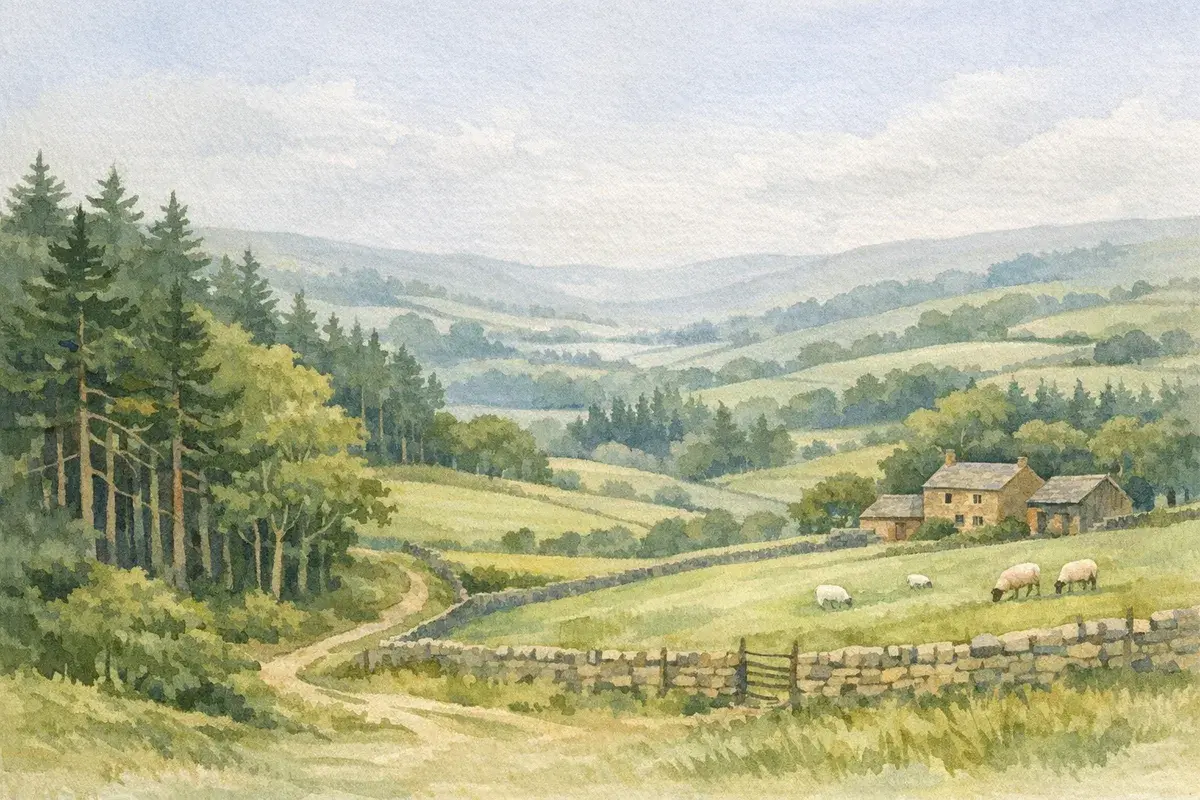
Commercial woodland for sale can look deceptively straightforward on paper: a few hundred acres, a grid reference, a species list, maybe a tempting note about "immediate thinning income". But forestry isn't like buying a field. Your return is tied to biology, access, regulation, and markets that move in cycles, and a "good" woodland can become an expensive headache if the fundamentals aren't right.
If you're looking at commercial woodland in the UK, whether as a rural investment, a diversification play for your farm business, or a longer-term asset you want to improve and eventually exit, this guide cuts through the sales patter. You'll learn what you're actually buying, why prices vary so much, how experienced buyers value and diligence sites, and what to expect from finance to completion.
What Counts As Commercial Woodland (And What You’re Really Buying)
"Commercial woodland" usually means a woodland managed primarily for timber production and sale (as opposed to purely amenity or conservation). In practice, you're buying a mix of:
- Land (with its constraints, access, and legal baggage)
- A standing crop (a biological asset that can be thinned, harvested, damaged, or improved)
- A management timeline (often decades long)
- Operational capability (roads, loading areas, extraction routes, and haulage feasibility)
A quick sanity check: if the particulars lean heavily on "lifestyle", "camping", or "off-grid retreats" and barely mention roading, species, yield class, or felling history, you may be looking at amenity woodland dressed up as commercial. For a broader view of how woodland is marketed in the UK, it's worth reading our overview on woodland for sale in the UK, commercial sits at the more technical end of that spectrum.
Productive Conifer Vs Broadleaf: Yield, Risk, And Market Demand
Most UK commercial woodland listings are conifer-led, because softwoods underpin the domestic processing sector (construction timber, fencing, palletwood, panelboard, biomass). Species choice and crop structure change the investment story:
- Conifers (often Sitka spruce, Douglas fir, larch where appropriate)
- Typically faster growth and clearer yield forecasting.
- Stronger linkage to the mainstream timber supply chain.
- Higher exposure to windthrow in some upland or exposed sites if poorly designed or older crops are unmanaged.
- Broadleaf (oak, beech, ash, sycamore, mixed native plantings)
- Can deliver high value per cubic metre in the right circumstances, but it's less predictable, slower, and often more management-intensive.
- Markets can be more localised (firewood, small sawmills, specialist uses).
- Disease risk matters: ash dieback isn't an abstract headline, on the wrong site it's a direct value hit.
Real-world takeaway: you don't need a "perfect" species mix, you need a mix that matches site conditions, access, and your intended hold period.
Freehold Title, Sporting Rights, Timber Rights, And Third-Party Interests
In UK forestry, the headline "freehold" doesn't always mean you control everything you assume you do. Before you get emotionally attached to a plan for "thinning income" or "future carbon potential", be clear on what's included:
- Timber rights: Usually included, but check for historic reservations or oddities in older titles.
- Sporting rights: Can be retained by a seller/estate or leased to a third party: that affects deer control, access, and sometimes insurance.
- Wayleaves and easements: Electricity lines, pipes, access rights for neighbours, or telecoms infrastructure can restrict operations.
- Minerals and mines: Sometimes excluded: sometimes irrelevant: occasionally a complication.
- Public access expectations: Not every woodland has a legal right of access, but permissive paths and local usage can become a practical reality you'll be managing.
If you're new to the nuts and bolts, our longer guide to buying woodland in the UK goes deeper on rights, access, designations and the "early months" realities that catch buyers out.
Why Commercial Woodland Prices Vary So Widely
Two woodlands can both be described as "commercial" and still be worlds apart in value. Price is driven less by the romantic idea of trees, and more by operability and timing: can you harvest efficiently, when will cash flow occur, and what liabilities sit behind the crop?
If you want a benchmark-style view, see our breakdown on the cost of woodland per acre, but treat any £/acre figure as a starting point, not a valuation.
Timber Crop Age Class, Stocking, Species Mix, And Roading
Commercial forestry is age-structured. A site with a meaningful proportion of near-term thinning (or harvest-ready stands) is fundamentally different from a newly planted block.
Key drivers buyers focus on:
- Age class distribution: A single-age plantation can mean a "feast then famine" income profile.
- Stocking and form: Understocked crops (windblow, poor establishment, deer browsing) reduce volume and complicate management.
- Species and yield class: Sitka on a suitable site can be a very different proposition to a mixed crop on marginal ground.
- Roading and loading: Internal roads, turning circles, and suitable stacking/loading areas can make or break harvesting economics.
A detail that's often missed: even if the timber is good, a woodland without practical roading can be "commercial" only in theory.
Access, Haulage Distance, Local Mills, And Operational Constraints
Forestry returns are heavily influenced by getting timber to market. You're not just buying trees, you're buying a logistics problem (hopefully a solvable one).
When you assess access, think like a haulier and an operator:
- Is there direct access to an adopted highway, or do you cross third-party tracks?
- Are there weight limits, weak bridges, tight villages, seasonal constraints, or road bans?
- How far is the site from local processing capacity (sawmills, panelboard, biomass plants), and is that capacity stable?
Even where access exists, the cost curve changes quickly with distance and difficulty. A cheaper woodland can be expensive once you price in extraction and transport.
Designations And Constraints: SSSI, AONB, TPOs, Felling Licences, And Wayleaves
Constraints aren't automatically deal-breakers, but they change timelines, permissions, and sometimes the silvicultural options available.
In the UK context, pay attention to:
- SSSI: Operations may require additional consents and tighter management prescriptions.
- AONB / National Park: Not "no forestry", but expect more scrutiny on design, restocking, and visual impact.
- TPOs: More common around settlements: can limit management if the woodland is not primarily forestry-designated.
- Felling licences: In most situations, felling requires permission: exemptions are limited and specific.
- Wayleaves: Can restrict planting/restocking and complicate harvesting layouts.
The practical point: constraints affect certainty. Buyers pay for certainty, because uncertainty delays income and increases professional costs.
Where To Find Commercial Woodland For Sale (On And Off Market)
Commercial woodland is traded through a mixture of open-market listings, targeted marketing to forestry investors, and quieter off-market approaches, especially for larger blocks where sellers value discretion.
Using Specialist Portals And Agent Networks To Avoid ‘Post-And-Hope' Listings
You'll see plenty of "post-and-hope" listings in the wider property world: thin details, poor mapping, no compartment data, and no operational discussion. That's risky with forestry.
Your best results typically come from:
- Specialist rural portals that understand agricultural and forestry nuance (and allow filtering by practical criteria).
- Land agents and forestry agents with genuine regional networks.
- Direct conversations: once agents know what you'll actually buy (size, species, access tolerance, timescale), you get shown better opportunities.
On AgLand it works the other way round: you register the brief - species, block size, access, budget and area - and hear the moment woodland matching it is advertised, rather than trawling generic "woodland" results. If you're also weighing alternative use-cases, you might compare commercial blocks with recreation-focused woodland opportunities, the marketing language can look similar, but the due diligence emphasis is different.
Reading Particulars Properly: Maps, Compartments, And What's Missing
A good set of particulars lets you form a view before you burn time on site visits.
Look for:
- Clear plans with boundaries, tracks, watercourses, access points, and neighbouring land use.
- Compartment schedules showing species, age, and area (hectares), ideally aligned to a management plan.
- Harvesting notes: thinning history, any recent windblow, and what's actually achievable.
- Photographs that show the ground (not just the canopy).
And then look for what's missing:
- No mention of access rights?
- No confirmation of roading condition?
- No discussion of constraints/designations?
- Vague references to "income potential" without dates, volumes, or assumptions?
Missing information doesn't always mean a bad woodland. It does mean you should price in extra diligence time, and be cautious about offering at the top end until the facts are nailed down.
Due Diligence Checklist Before You Offer
Forestry due diligence is where good deals are made, and bad surprises are avoided. Your aim isn't to eliminate every risk (you can't), but to understand which risks are priced in, which are manageable, and which could become unbankable or uninsurable.
Title, Boundaries, Rights Of Way, And Ransom Strips
Start with the legal fundamentals, because if these are weak the rest almost doesn't matter.
- Title plan vs reality: walk boundaries where possible: look for old fences that don't match mapping.
- Access rights: confirm the legal right to use every section of track you rely on.
- Public rights of way: bridleways/footpaths affect operations, safety planning, and neighbour relations.
- Ransom strips: tiny parcels that block access or services can be value killers.
- Third-party interests: sporting leases, licences, grazing rights, or informal arrangements.
If you're buying alongside farmland or as part of an estate restructure, also think ahead to tax and holding structure early, changing ownership structure after exchange can be costly and awkward.
Forestry Documents: Management Plan, Felling Licence History, And Restocking Conditions
Paperwork matters because it reveals both intent and constraint.
Ask for (and read) the following:
- Forest/woodland management plan (often a 10-year horizon) and any approvals, which should follow the UK Forestry Standard.
- Felling licence history: what's been felled, what's been replanted, and whether conditions were met.
- Restocking obligations: clearfell often comes with restocking conditions: those costs and timelines are real.
- Grant agreements: grants can be valuable, but may impose maintenance duties, replanting specifications, or restrictions on change of use.
Be pragmatic: a woodland without a tidy management file isn't automatically "wrong", but it should affect both price and your first-year workload.
Practical Site Inspection: Windthrow Risk, Pests, Deer Pressure, And Watercourses
You learn more in two hours on site than in twenty pages of particulars, if you know what to look for.
On inspection, focus on:
- Windthrow exposure: topography, edge exposure, soil type, and stand structure. Look for past windblow patterns.
- Pests and disease: signs of bark beetle activity, larch health (where relevant), ash condition, and general vitality.
- Deer pressure: browse lines, lack of regeneration, damaged restocking. Deer management is an operational cost, not an optional extra.
- Watercourses and drainage: crossings, culverts, wet areas that restrict machinery, and environmental sensitivity.
- Roading condition: stone depth, drainage, weak points, and whether a timber wagon can realistically use it in the season you'll harvest.
If you're viewing multiple sites, keep notes and photos in a consistent format. It sounds obvious, but in reality, after the third woodland in a week, details blur and expensive assumptions creep in.
How To Value Commercial Woodland: Practical Methods Buyers Use
Valuing commercial woodland is part finance, part forestry, part common sense. Buyers who do this well avoid two traps:
- Paying "£/acre" for a woodland that's operationally weak, and
- Over-engineering a spreadsheet that assumes away real-world constraints.
Standing Timber Valuation Vs Discounted Cashflow For Future Crops
Most valuations combine two lenses:
- Standing timber valuation (what the current crop could realise, net of costs)
- More relevant where thinning or harvesting is imminent.
- Highly sensitive to access, extraction method, and local market conditions.
- Discounted cashflow (DCF) for future rotations
- Useful for young crops and long-hold strategies.
- Heavily assumption-driven: yield class, mortality, thinning regime, price cycles, and discount rate.
In plain terms: standing timber value anchors you to "what's there now": DCF frames "what it could become". Good buyers use both, and sanity-check the outputs against operational reality.
Net Returns: Harvesting Costs, Replanting Liabilities, And Grant Implications
Your "headline timber price" is not your return. Net returns are shaped by costs you can't wish away:
- Harvesting and extraction: steep ground, poor brash management, weak rides, limited stacking.
- Haulage: distance, road constraints, loading set-up.
- Replanting/restocking: fencing, ground prep, plants, labour, beating-up, and protection.
- Professional fees: forestry agent, surveys, compliance work.
- Grant implications: grants may help fund restocking, but can come with rules that affect timing and species choice.
If you're buying as an investment, it's worth reading our deeper dive on woodland investment in the UK, particularly around how investors model risk and time horizons.
Comparable Evidence: What ‘£/Acre' Misses In Forestry
Comparable evidence matters, but forestry comparables are messy. £/acre ignores:
- Crop age and volume (a young plantation and a harvest-ready crop shouldn't trade similarly)
- Operability (roads, slopes, access rights)
- Constraints (designations, felling permissions)
- Liabilities (restocking conditions, storm-damaged stands)
Use £/acre only as a rough language for discussion, then bring it back to compartments, cashflow timing, and net-operable volume.
Tax, Reliefs, And Ownership Structures (UK Overview)
Tax treatment can materially affect your net outcome, but it's also an area where generic advice causes expensive mistakes. Forestry sits across income, capital, and inheritance considerations, and your position depends on how the woodland is managed, what income arises, and who owns it.
If tax is a key driver for you, don't rely on hearsay. Start with specialist advice and a clear record-keeping plan from day one. For a focused explainer of reliefs and common pitfalls, see our guide to tax angles when buying woodland.
Income Tax And Corporation Tax: Timber Receipts, Expenses, And Record-Keeping
In broad terms (and subject to your specific circumstances):
- Timber income and forestry operations can be treated differently from other trading income.
- How you account for timber receipts, management costs, and capital works matters.
- Good records aren't optional. You'll want clear separation between:
- routine management and operational costs,
- capital improvements (e.g., significant roading works), and
- any diversified non-forestry activities.
If you're planning to thin or harvest soon after purchase, talk early with your accountant about how receipts and costs will be treated, and what evidence you'll need.
IHT And CGT Considerations: When Reliefs Apply And When They Don't
Inheritance Tax (IHT) and Capital Gains Tax (CGT) can influence long-term planning, especially for family ownership.
Key points to explore with advisers:
- Whether the woodland qualifies as commercial forestry in a way that supports relief claims.
- How management activity and intent are evidenced.
- How any development hope value, amenity use, or mixed-use elements could complicate the tax picture.
This is exactly where "it worked for someone else" stories go wrong. Similar-looking woodlands can be treated very differently depending on use, ownership, and documentation.
Buying Personally Vs Through A Company Or Partnership
Ownership structure should follow strategy, not the other way round.
- Personal ownership can suit long holds, family planning, and simpler governance.
- Company ownership may suit pooled investment, ring-fencing risk, or where multiple parties need clear governance.
- Partnership structures can be appropriate where woodland is integrated into a wider rural business, but they need careful drafting.
Make the decision with your solicitor and tax adviser together, not in silos. It's the interaction between legal structure and tax outcomes that usually matters.
Finance, Legal Process, And Completion: What To Expect
Commercial woodland transactions feel familiar if you buy farmland, until they don't. Timber, access, and regulatory constraints introduce additional enquiries, and lenders can be more cautious.
Funding Options: Cash, Bridging, Specialist Rural Lenders, And Investor Syndicates
Funding tends to fall into a few routes:
- Cash: simplest, and often preferred in competitive situations.
- Bridging: occasionally used where speed matters, but cost and exit planning are critical.
- Specialist rural lenders: more likely to understand woodland value drivers than mainstream residential lenders.
- Investor syndicates / pooled capital: can unlock larger purchases, but require tight governance and a clear plan.
If you're considering debt, don't assume a "normal mortgage" approach applies. Woodland lending is niche, and security assessment can be conservative. Our guide on woodland finance in the UK explains what lenders tend to look for and how to prepare.
Solicitor And Surveyor Roles: Searches, CPSE-Style Enquiries, And Red Flags
A good rural solicitor will run the usual conveyancing process, plus additional enquiries specific to forestry and land use.
Expect:
- Title review: access, rights, reservations, restrictive covenants.
- Searches: depending on location and risk profile.
- Enquiries (CPSE-style) where relevant: utilities, occupiers, disputes, notices, contamination risk (rare but not impossible), and any agreements affecting use.
Red flags worth taking seriously:
- Unclear legal access (or access "by goodwill").
- Boundary uncertainty where neighbours are actively using the land.
- Opaque grant obligations or missing felling/replanting documentation.
- Disputes over sporting rights or uncontrolled public use.
A surveyor/forestry agent adds value by translating the paperwork into operational reality, and by stress-testing the valuation assumptions.
Overage, Options, And Uplift Clauses In Woodland Deals
Overage (uplift) clauses and option agreements are increasingly common where sellers believe there's future value beyond forestry, whether from development potential, natural capital markets, or infrastructure.
If you see:
- Overage triggered by planning, change of use, or even certain forestry events,
- Long option periods, or
- Vague trigger definitions,
…treat it as a major commercial term, not a footnote. Overpaying isn't the only risk, overage can also restrict what you do operationally if you're trying to avoid "triggering" a payment.
This is solicitor territory, but you should understand the spirit of the clause: what future is the seller trying to keep a share of?
Making It Work After Purchase: Management, Compliance, And Exit Planning
Buying well is only half the job. Commercial woodland rewards buyers who run it like an asset: clear objectives, disciplined compliance, and a management record you can hand to the next buyer.
Choosing A Forestry Agent Or Manager: Scope, Fees, And Governance
A competent forestry agent can pay for themselves quickly through better harvesting outcomes, compliance, and grant handling.
When appointing, clarify:
- Scope: strategic plan, operational contracting, grant applications, felling licence work, timber marketing.
- Fees: fixed vs percentage, and what's included (site visits, reporting, contractor procurement).
- Governance: who signs off operations, how often you review performance, what reporting looks like.
If you're buying with partners or family members, governance matters more than you think. Forestry moves slowly, until it doesn't (storm events, disease, sudden harvesting opportunities). Decide who can act quickly.
Operational Compliance: Safety, Biosecurity, Public Access, And Neighbour Relations
Forestry operations are regulated and safety-critical.
Your ongoing compliance and risk management should cover:
- Health and safety: contractor competence, risk assessments, signage during operations.
- Biosecurity: cleaning kit between sites, managing plant movements, monitoring disease issues.
- Public interface: even without formal access, people may use paths, manage it sensibly.
- Neighbours: boundary maintenance, watercourse management, deer control cooperation.
A quiet truth of commercial woodland: neighbour relations can influence everything from access tolerance to informal problem-solving when issues arise.
Exit Routes: Clearfell Sale, Long-Term Hold, Or Resale With A Management Track Record
Your exit route should be considered at purchase because it shapes what "good" looks like.
Common exits include:
- Harvest and sell: attractive where you have mature timber and good operability, but remember restocking obligations.
- Long-term hold: suits buyers comfortable with multi-rotation thinking and gradual value improvement.
- Resale with a track record: often the most underappreciated route, buyers pay for a woodland that's well-documented, compliant, and obviously manageable.
If you want resale optionality, your best friend is evidence: compartment data, operations records, licences, grant compliance, and clear mapping. Future buyers (and lenders) love certainty.
Conclusion
Commercial woodland for sale in the UK can be a brilliant acquisition, productive, resilient, and genuinely useful as part of a wider rural strategy, but only if you buy with your eyes open. Prioritise operability (access and roading), understand what rights and constraints come with the title, and value the woodland on net returns and realistic timelines rather than headline £/acre.
If you build your process around disciplined due diligence and competent ongoing management, you give yourself options: income through thinning/harvest, long-term capital growth, and a clean resale story when the time is right.
Disclaimer: AgLand.co.uk is a UK agricultural land and rural property matching service, where buyers register what they are looking for and owners advertise directly to the buyers who match, and a rural resource hub. Nothing in this text is intended as legal, financial, or investment advice. You should carry out your own due diligence and seek advice from suitably qualified professionals (for example, solicitors, surveyors, forestry agents, and tax advisers) before making decisions or commitments.