
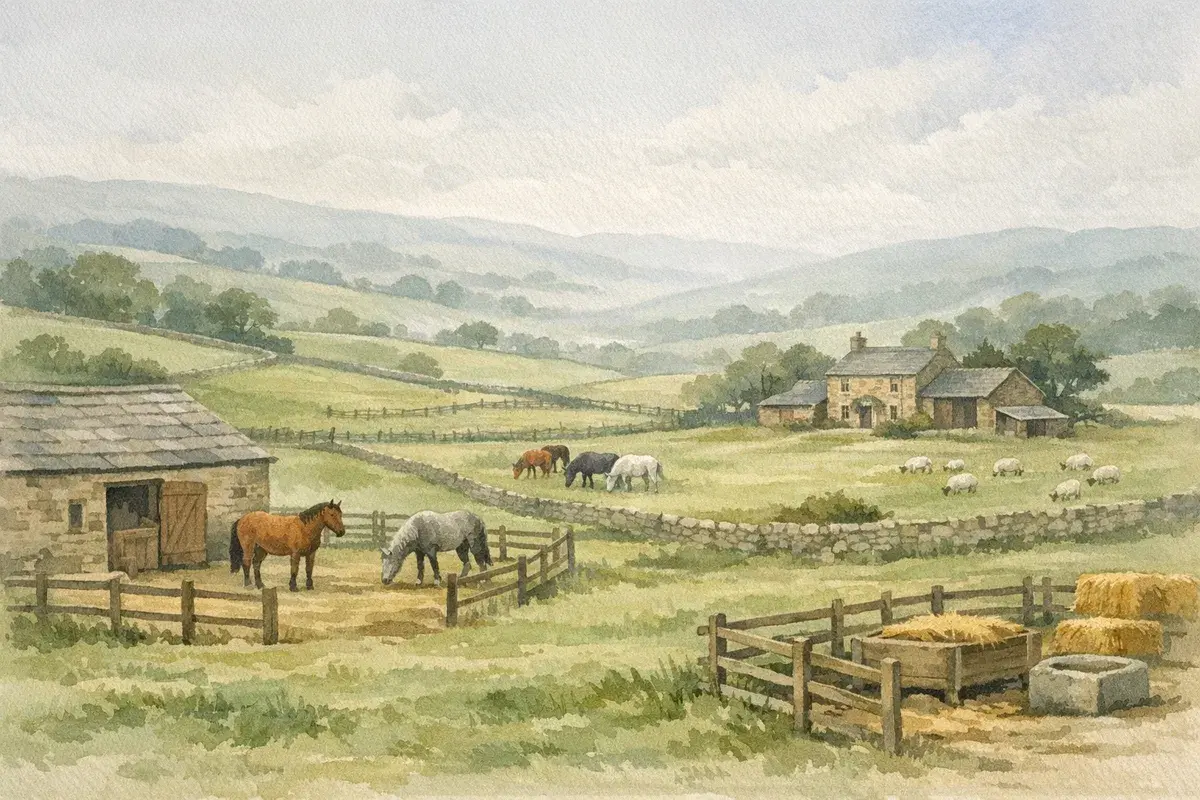
You can fall in love with a Scottish yard in five minutes: the view, the stone steadings, the promise of hacking straight from the gate. But equestrian property in Scotland isn't bought on romance. It's bought on access rights, ground conditions, planning history, water and drainage reality, and whether the place will still work in February when the wind turns and the fields cut up.
This guide is written for you as a buyer (or investor) who wants to get it right first time, whether you're moving horses home, expanding a rural business, or looking for a property that can earn its keep. We'll keep it UK‑specific, Scotland‑specific, and practical: what counts as equestrian use, how location changes the deal, what to check before you offer, and where the costs and consents can surprise you.
What Counts As Equestrian Property In Scotland
In Scotland, "equestrian property" can mean anything from a house with a couple of acres and two looseboxes to a full commercial centre with an indoor school, parking, and a run of turnout.
The important bit isn't the lifestyle label in the brochure. It's how the land and buildings are used (and permitted to be used), because that affects planning, rates/tax, mortgages, and what you can realistically do on day one.
Equestrian Vs Agricultural Use: Why The Distinction Matters
Horses are a strange beast in land‑use terms. Grazing horses can look like farming, but in planning and valuation it's often treated as equestrian/recreational rather than agricultural, particularly where the primary activity is riding, schooling, livery, or leisure.
Why you should care:
- Planning control: A change from agricultural use to equestrian use can require consent. If you're buying "a field for horses" that's historically been agricultural, you need to understand whether it's already in equestrian use, and whether that use is lawful.
- Buildings and siting: Agricultural buildings have their own planning context. Stables, ménages and lighting are judged differently, especially near neighbours.
- Tax and rates: A private yard attached to a dwelling can look very different to a livery business for business rates and VAT considerations.
If you're also weighing up broader rural land considerations (soils, access, crofting, tenancies), it's worth cross‑reading AgLand's Scotland‑specific overview on how agricultural land is valued and bought in Scotland to anchor the equestrian questions inside the wider rural context.
Typical Property Types: Smallholdings, Yard-Only, House With Land, And Purpose-Built Centres
Most Scottish equestrian purchases fall into a few repeatable "shapes". Each has its own traps.
- House with land (private setup): Often 2–15 acres with a small stable block and maybe a sand school. The risk is assuming the "horse bits" are all consented, or that the land drains like your last place.
- Smallholding with equestrian angle: A mixed setup, some grazing, some buildings, maybe a workshop or holiday let. These can be brilliant, but you'll need to be clear what's residential, what's business, and what's genuinely permitted.
- Yard‑only / facilities‑only: A standalone yard with stabling, parking and turnout, but no dwelling (or perhaps a flat/office). Finance, security, and running costs tend to be more complex, and you'll be judged on the business case.
- Purpose‑built centres: Often with indoor schools, larger arenas, marked parking, and established rights of access. The upside is functionality: the downside can be higher ongoing compliance, staffing, and neighbour sensitivity.
If you're still defining what you're looking for, the broader UK checklist is useful as a baseline, then you adapt it for Scottish ground and planning nuance. See the practical overview on what to look for when buying an equestrian property.
Where To Buy In Scotland And How Location Changes The Deal
Two properties can look identical on paper, same acreage, same stable count, same asking price, and still perform completely differently because of where they sit. In Scotland, location affects more than commuting and views: it changes your hacking options, how quickly ground breaks up, how hard it is to get contractors out, and what your local planning authority will tolerate.
Riding Access: Bridleways, Core Paths, And Local Networks
Scotland's access landscape is different to much of the UK. You're dealing with a mix of:
- Core paths designated by local authorities
- Tracks, estate roads and forestry routes (sometimes permissive, sometimes not)
- Public roads with variable verges and visibility
- Informal networks that "everyone uses" until a gate gets locked
Practically, you want to answer three questions before you get attached:
- Can you get off the road quickly? A yard that forces you onto fast A‑roads to reach quieter tracks will wear thin.
- Is access resilient year‑round? Forestry closures, deer management, or seasonal farm operations can change what's rideable.
- Are there conflict points? Dog walking hotspots, bike trails, or narrow pinch points can create daily friction.
It's worth doing an old‑fashioned check: park up, walk a couple of the likely routes, and speak to someone local who rides. Brochure maps don't show the gate that's always chained or the boggy section that swallows hooves in November.
Climate, Ground Conditions, And Shelter: What To Expect By Region
Scotland isn't one climate. Even within a single council area, soil type, elevation and exposure can change your management costs.
A few broad patterns you'll recognise when you view:
- West coast and upland edges: Generally wetter and windier. Drainage, hardstanding, and shelter become non‑negotiable, not "nice‑to‑have".
- East coast and some lowland belts: Often drier with better natural going, but don't assume, heavy clays and compacted gateways still bite.
- High rainfall pockets: You'll spend more time and money on track surfacing, muck storage logistics, and keeping feed dry.
Shelter matters as much as drainage. Look for existing hedges, mature trees in the right place (not over buildings), landform that breaks the wind, and safe winter turnout options. If you're relying on a single flat field with no sacrifice area, Scotland will teach you manners.
And remember: contractors' availability varies. If you're buying somewhere remote, ask yourself how quickly you can get a digger, stone, and a fencer when something fails mid‑winter.
Key Due Diligence Checks Before You Offer
This is the section that saves you money. Equestrian property problems are rarely subtle: they're usually physical (water, ground, access) or legal (title, rights, restrictions). The trick is spotting them early enough to price them properly, or walk away.
Title, Boundaries, Servitudes, And Rights Of Access
In Scotland, title can include conditions and servitudes (legal rights and burdens) that are easy to overlook if you're only thinking about fences and fields.
What to check (with your solicitor):
- Exact boundaries: Don't assume the post‑and‑wire fence is the legal line. Verify against title plans and, if needed, a measured plan.
- Access rights: If the only decent access is over a track you don't own, make sure you have a recorded right to use it with horseboxes and deliveries.
- Services running through the land: Water pipes, telecoms, drains, private cables, these can restrict where you can put an arena or new stables.
- Shared maintenance obligations: If you're buying into a shared private road, understand who pays, how decisions are made, and what happens when someone refuses.
A quick, practical viewing tip: look for "tells" that boundaries have been argued, double fencing, odd strips left ungrazed, or a gate that clearly used to sit somewhere else.
Water Supply, Drainage, And Private Systems
Horses make you obsess about water in a way you never did with a normal house.
You're looking at three separate water/drainage realities:
- Domestic supply (mains or private)
- Yard supply (troughs, automatic drinkers, wash bays)
- Waste and run‑off (including wash‑down water and yard drainage)
If there's a private supply, you'll want clarity on:
- where the source is (spring, borehole)
- whether it's shared
- what treatment is installed
- whether flow is reliable in dry spells and freeze events
For drainage, don't be shy. Ask where water goes in heavy rain, then look for:
- standing water lines on the edge of arenas
- silt staining on stable walls
- poached gateways and "permanent mud" zones
If you're considering adding or upgrading an arena, the drainage conversation becomes central. It's one reason buyers gravitate to setups that already work, like a proven equestrian property with an arena, you're not paying to learn the hard way.
Flood Risk, Peat, Contamination, And Ground Stability
Scotland's rural properties can come with ground‑related baggage that only shows up when you dig, or when your insurer asks questions.
Key checks include:
- Flood history: Not just rivers. Surface water and field run‑off can be just as disruptive for yards.
- Peat and organics: In some areas, peat depth and soil structure affect track construction, drainage design and stability.
- Historic uses: Old farm dumps, fuel storage areas, or former industrial uses on rural edges can create contamination risk.
- Ground stability: Slopes, embankments, and poorly compacted made ground can be expensive if you plan new buildings.
You don't need to become a geotechnical engineer, but you do need the right professionals early. If the dream is an indoor school or large earthworks, treat ground conditions as a first‑order decision, not a footnote.
Planning And Consents In Scotland For Stables, Arenas, And Changes Of Use
Planning is where Scottish equestrian purchases can go from straightforward to "why is this taking six months?". The good news: plenty of yards are consented properly. The catch: plenty aren't, and you inherit the risk.
When You Need Planning Permission Vs Permitted Work
There isn't a single rule that covers every stable, arena or track. Whether you need consent depends on what's being built, where it sits, and whether it represents a material change of use.
In practice, the safest approach is:
- Assume new stables, arenas, hardstanding, lighting, new access points, and meaningful change of use may require permission.
- Ask the seller for the planning history (references, drawings, conditions) and check it against what's actually on the ground.
If your goal is to buy land specifically because it already has the right approvals (or could realistically obtain them), you'll find the deeper planning lens helpful: how to think about equestrian land with planning permission.
Ménages, Lighting, Access Tracks, And Parking: Common Approval Triggers
Arenas and associated works often trigger scrutiny because they change the look, drainage and traffic profile of a site.
Typical "trip points" include:
- Ménage construction: excavation, imported stone, drainage outfalls, membranes, these are not invisible works.
- Lighting: glare and neighbour amenity are common reasons for objections.
- Access tracks: especially if they alter water run‑off or cut through sensitive landscape.
- Parking and commercial activity: if you're running lessons, clinics, or livery with regular comings and goings, planners will look at traffic and noise.
If you're buying a property with existing facilities, read conditions carefully. It's not unusual to see restrictions on:
- hours of use
- commercial use vs private use
- the number of horses
- events and amplified sound
Building Standards, Welfare, And Neighbour Considerations
Planning isn't the only compliance layer. Building work may trigger Building Standards requirements depending on type and specification.
Then there's the real‑world welfare and neighbour piece, which can matter just as much for your quality of life:
- Manure and muck storage: location, run‑off control, and collection logistics
- Noise and light: early morning yard routines travel surprisingly far
- Smell and flies: manageable, but only if designed for it
- Boundary relationships: a stable block hard up against a neighbour's garden is asking for long‑term tension
A quiet rule of thumb from agents we work with: if a setup only functions because everyone nearby is unusually tolerant, it's fragile. You want a yard that's designed to be a good neighbour, not one that survives on goodwill alone.
Land And Facilities: Getting The Practicalities Right
Most "problem" equestrian properties aren't inherently bad, they're mismatched. Too many horses for the acreage, stables that can't breathe, storage that forces daily workarounds, or fencing that looks tidy but isn't safe.
Acreage And Carrying Capacity: Matching Land To Horse Numbers
Scotland's grass growth and ground resilience vary hugely by region, soil and shelter. So rather than obsess over a single acres‑per‑horse number, think in terms of pressure points:
- Do you have a sacrifice area for winter?
- Can you rotate grazing without losing safe turnout?
- Is there space for hay storage that stays dry and accessible?
- Can a vehicle get to the fields without churning everything up?
A practical viewing exercise: imagine two weeks of heavy rain and you still need to turn out, bring in, and move hay. Where do the horses stand? Where do you walk? Where does the water go?
Stable Design, Storage, And Biosecurity Basics
A stable block can look smart and still be a pain to run.
You're aiming for:
- Ventilation without draughts (especially in older stone buildings)
- Safe electrics and water that won't freeze at the first cold snap
- Storage that matches your reality: feed, bedding, tack, rugs, tools, fuel
- Separation options: an isolation stable, or at least a workable quarantine area
If you're prioritising ready‑to‑run infrastructure, it can help to compare against proven templates of an equestrian property with stables so you're not reinventing what "functional" looks like.
Biosecurity isn't just for big yards. Even a private setup benefits from basics like:
- a clear muck route that doesn't cross feed areas
- a wash area with controlled run‑off
- sensible visitor parking away from turnout
Fencing, Field Layout, And Safe Handling Areas
In Scotland, fencing takes a beating: wind, wet ground, fallen branches, and the occasional "helpful" deer.
Check:
- Fence type and condition: post spacing, wire tension, rot at ground level
- Gates: width for vehicles, latch safety, and whether gateways are already poached
- Field layout: awkward shapes create dead corners and handling headaches
- Handling areas: do you have a level, safe space to catch, groom, and load?
Don't underestimate loading. A property can have perfect stables and still be a nightmare if there's nowhere safe to turn a trailer, park a horsebox, or wait out a spook.
If you're looking at a more commercial setup, livery yard, riding school, or centre with multiple income streams, you'll want to benchmark what "complete" looks like. The guidance on equestrian facilities for sale can help you sanity‑check whether you're paying for a business, a hobby farm, or something in between.
Money, Tax, And Running Costs
Equestrian property in Scotland can be a brilliant long‑term hold, land, lifestyle, potential diversification. But the numbers only work if you're honest about what drives value and what quietly drains cash.
Valuation Drivers: Land Quality, Permissions, And Income Potential
Valuers (and savvy buyers) tend to focus on a handful of value drivers:
- Ground that stays usable: good drainage, sensible field access, and shelter
- Consented infrastructure: arenas, stables, access, parking, paperwork matters
- House quality and flexibility: if there's a dwelling, its condition and appeal affects resale far beyond the "horse bits"
- Commercial potential: livery, storage lets, clinics, if permitted and realistic locally
If you're buying with a return in mind (rather than purely lifestyle), treat it as an investment property with operational risk. This deeper dive on equestrian property investment is a useful companion when you're pressure‑testing yield assumptions.
Business Rates, Council Tax, VAT, And Letting Implications
Tax and rates are fact‑specific, so you'll want tailored advice. But as a buyer, you can still ask the right questions early.
Key prompts:
- Is the property primarily a dwelling with private stables, or a business premises? That affects whether parts may fall under council tax or business rates.
- Are there any existing letting arrangements? DIY livery, full livery, grazing lets, holiday accommodation, each has different implications.
- VAT position: if you're buying a trading business, or significant commercial elements exist, VAT can become relevant.
Don't gloss over paperwork. Ask for:
- current rates/council tax bills
- accounts (if a business is being sold)
- details of any licences, contracts or regular clients
Insurance, Maintenance, And Utilities: Budgeting For Year One
Your first year is when "small" issues become recurring invoices.
Build a realistic budget line‑up:
- Insurance: buildings, public liability (even private yards benefit), employers' liability if you have staff, care/custody/control for livery
- Utilities: water (especially if private systems need maintenance), electricity for lighting, heated tack rooms, electric fencing, pumps
- Surfacing and stone: tracks, gateways, around water troughs, parking
- Fencing: repairs are inevitable: set aside a pot
- Tree and ditch work: preventative maintenance beats emergency call‑outs
A slightly boring but very effective tactic: during viewings, photograph the "hard‑used" areas (gateways, yard edges, arena perimeter). Then, at home, price the fixes with local contractors. It keeps your offer grounded in reality.
Buying Process And Specialist Support
Buying equestrian property in Scotland is rarely a straight line. The best outcomes usually come from a structured search, fast verification, and the right specialists in your corner.
Structuring The Search: What To Filter And What To Verify
Filters help you shortlist. Verification helps you avoid expensive surprises.
Start with filters like:
- minimum acreage and number of paddocks
- existing stabling count and type
- arena/indoor school requirements
- access type (private drive, shared track, public road)
- proximity to your essential services (vet, farrier, feed suppliers)
Then verify:
- planning history and any conditions
- water source and winter reliability
- boundary accuracy and access rights
- state of drainage and surfacing
Whichever side you're on. Buyers tell AgLand what they're looking for and hear the moment something fits. Owners advertise straight to the buyers who already match, for one flat fee and no commission. Register as a buyer or check your matches.
Who To Instruct: Rural Solicitor, Surveyor, Land Agent, And Planning Consultant
You don't need a crowd for every purchase, but you do need the right people when complexity appears.
- Rural solicitor (Scottish property experience): title, servitudes, access, securities, and local conveyancing norms.
- Surveyor: not just the house, outbuildings, roof structures, drainage, and condition issues that affect insurability.
- Land agent: valuation reality, local market knowledge, and negotiation strategy.
- Planning consultant (when needed): if you're relying on future permissions, or regularising existing uses.
We often see buyers save money by paying for a targeted specialist opinion early, rather than discovering, after purchase, that the "easy" arena extension isn't straightforward.
Negotiation Levers: Conditions, Extras, And Timing
Equestrian deals have a few negotiation angles that normal residential purchases don't.
Consider:
- What's included: field shelters, jumps, arena harrow, mowers, fuel tanks, even a container, small items add up.
- Proof of compliance: if the seller can't evidence permissions or lawful use, that can affect price or conditions.
- Timing and seasonality: winter viewings reveal ground truth. Summer viewings can hide drainage issues.
- Conditional offers: where appropriate, you can build in conditions around surveys, consents, or access verification (your solicitor should guide the Scottish specifics).
A human tip from years of watching transactions: negotiate calmly, but don't negotiate against yourself. If a key risk is unresolved, water, access, planning, treat that as a decision point, not a bargaining chip.
Conclusion
If you buy equestrian property in Scotland the right way, you end up with something rare: land that works, facilities you can run without daily compromise, and a planning position that doesn't keep you awake at 2am. The fastest route there is simple (not easy): get clear on your intended use, test the ground and water like you mean it, and treat access and consents as non‑negotiables.
When you're viewing, keep asking one grounded question: Will this place still function in a wet, dark week in February, safely, legally, and within budget? If the answer is yes, you're probably close.
Disclaimer: AgLand.co.uk is a UK agricultural land and rural property matching service, where buyers register what they are looking for and owners advertise directly to the buyers who match, and a rural resource hub. Nothing in this text is intended as legal, financial, tax, or investment advice. You should carry out your own due diligence and seek guidance from suitably qualified professionals (for example, a Scottish rural solicitor, chartered surveyor, land agent, tax adviser, and planning consultant) before making decisions or committing to any transaction.