
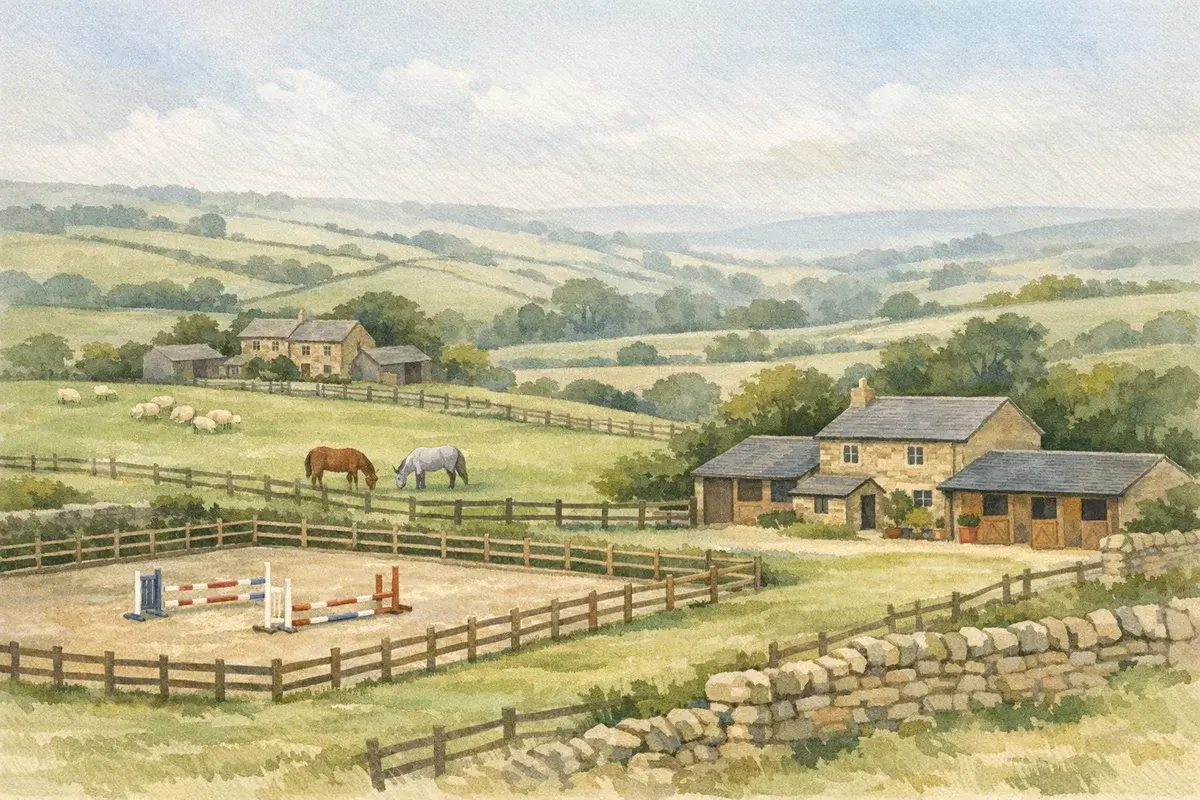
You can tell a lot about an equestrian property with arena in the first ten minutes of a viewing. The gate width. The trackway. Whether the yard sits dry underfoot or squelches before you've even reached the stables. And of course, the arena: does it ride consistently, drain properly, and feel like somewhere you'll actually use in January, not just admire on a sunny day in May?
In the UK, buying an equestrian setup is rarely just "a house with land". You're effectively buying a small operating system: planning history, access rights, drainage performance, services capacity, and (sometimes) a business model. Get the fundamentals right and the property supports you for years. Miss one key detail, like a restricted use condition, a compromised arena base, or a public footpath slicing through turnout, and you can inherit expensive problems.
This guide is written for UK buyers who want to assess an equestrian property with arena properly: what to prioritise, what to verify, what to budget for, and how to compare listings with a clear head.
Define Your Use Case And Non-Negotiables
Arenas are expensive to build and even more expensive to rebuild. So before you fall for a neat post-and-rail frontage or a shiny set of stables, get brutally clear on what you need the property to do.
The fastest way to overpay (or buy the wrong place) is to shop with a vague brief like "a few acres and an arena". Your use case dictates everything: minimum land area, type of arena, parking and access, insurance, planning risk, and even whether lenders will view the setup as residential-with-land or as a semi-commercial venture.
Private Riding Vs Commercial Use And Livery Implications
Ask yourself a simple question: is anyone other than your household going to ride, keep a horse, or pay you on site? If the answer is "maybe", treat it as "yes" for due diligence.
- Private use usually means fewer moving parts: lower visitor numbers, simpler parking needs, and less pressure on neighbours.
- DIY or assisted livery, training, clinics, or hiring out the arena introduces public liability, traffic, noise, lighting, safeguarding policies for minors, and potentially business rates depending on how the site is used.
Even occasional arena hire can change the risk profile. Neighbours who were relaxed about one rider schooling can become vocal when there are eight cars and a horsebox on a Tuesday evening.
If you're aiming for a more involved yard setup, it's worth reading AgLand's overview on buying the right yard and land because it frames the practical checks (access, drainage, rights of way) that tend to matter more than cosmetic finish.
Land Requirement, Turnout, And Horse Numbers
There's no single "acres per horse" rule that works across the UK, soil type, rainfall, management, and whether you can rotate fields all matter. But there are hard realities:
- Heavy clay + high stocking density often equals churned gateways, poached pasture, and winter turnout that becomes a welfare issue.
- Free-draining loams/sands are more forgiving, but you'll still need a plan for reseeding, resting paddocks, and managing ragwort and weeds.
Think in terms of functionality, not just acreage:
- Can you split turnout into sensible paddocks?
- Is there a sacrifice area or all-weather pen for wet spells?
- Do you have separate zones for schooling, turnout, muck storage, and vehicle movements?
If the property already includes a yard, compare the stable provision and layout to what you actually need. Many buyers get distracted by "more stables" when they'd be better served by fewer boxes and better flow. For a deeper look at stable-focused setups, AgLand's guide to yards with existing stable blocks is a useful reference point.
Access For Lorries, Emergency Vehicles, And Year-Round Use
Access is where dream properties quietly fail.
Check:
- Junction visibility onto the public highway (especially on fast A-roads and rural bends).
- Lane width and passing places for 7.5t deliveries, horseboxes, and (if you're commercial) client trailers.
- Turning circles, reversing a trailer through a yard gate in the rain gets old quickly.
- Emergency access: fire appliances and ambulances need reliable access and clear addressing.
Then test "year-round" honestly:
- Is the track hardcore all the way, or does it pinch to mud?
- Do you have drainage grips, ditches, and somewhere for water to go?
- Does the arena flood or freeze because it's in a hollow?
Your non-negotiables should be written down before you view. It's amazing how persuasive a nice kitchen can be when you haven't set your deal-breakers in advance.
Arena Types, Specs, And What “Good” Looks Like In Practice
In listings, arenas are often described with optimistic shorthand: "all-weather", "professional build", "good drainage". In practice, an arena is only as good as its base, its drainage design, and how it's been maintained.
A well-built arena can be the difference between riding consistently through winter and losing months of training. A poorly built one becomes a money pit that never quite rides right.
Arena Size, Orientation, And Local Weather Exposure
Common UK arena sizes include:
- 20m x 40m: fine for general schooling, kids' ponies, and space-conscious sites.
- 20m x 60m: more versatile for dressage work and larger horses.
- Larger or bespoke builds: sometimes seen on commercial yards, eventing setups, or training facilities.
Orientation matters more than many buyers expect:
- If the arena is aligned so that low winter sun hits you straight in the eyes on one rein, it can be genuinely unpleasant.
- Exposure on higher ground can be brilliant for drying, but punishing in wind, especially for lightweight surface mixes.
Ask locally (or simply stand still and listen): are you in a wind tunnel, a frost pocket, or a sheltered vale that holds moisture?
Surface Build-Up, Drainage, And Membrane Basics
Arenas generally involve:
- Formation and sub-base (levels, compaction)
- Drainage (pipes, falls, outfalls)
- Membrane or geotextile (separates layers)
- Base layer (often stone)
- Riding surface (sand, sand-fibre, waxed blends, etc.)
You don't need to be an engineer, but you do need evidence.
Practical checks during a viewing:
- Look for standing water along the long sides and corners.
- Check whether the surface depth is consistent or "thin" in the high-traffic track.
- Ask where water discharges. If the outfall is unclear or blocked, drainage performance can collapse.
Documentation to request:
- Who built it, and when?
- Any invoices/specification?
- Maintenance logs (grading, rolling, top-ups)?
Be wary of "recently resurfaced" if it's actually a thin cosmetic top layer on a compromised base. That's lipstick on a very expensive pig.
Lighting, Fencing, Mirrors, And Noise Considerations
Lighting is a big value-add, but it's also where planning, neighbour relations, and costs collide.
- Planning: permanent floodlighting can require consent: light spill is a common objection.
- Running costs: older halogen systems can be eye-watering: modern LED is better but still needs proper installation.
- Noise: an arena near a boundary hedge can amplify sound, especially with lessons, PA systems at clinics, or even just regular hoof-fall on boards.
Also check:
- Fencing: is it safe, consistent height, and secure? Any sharp edges or exposed posts?
- Gates: wide enough for a tractor/arena leveller?
- Mirrors: helpful but not essential: check they're secure and not a maintenance headache.
If you're specifically searching for equestrian facilities where the arena is part of a broader setup (parking, multiple barns, staff space), it can be helpful to read the guidance on purpose-built equestrian facilities, because the "extras" often determine whether the arena is actually usable at scale.
Planning, Law, And Compliance Checks That Catch Buyers Out
Planning is the bit most buyers think they'll deal with later, right up until a solicitor flags a breach, a neighbour mentions a historic complaint, or a lender asks awkward questions.
For an equestrian property with arena, you need to understand what's authorised, what's tolerated, and what might be at risk of enforcement.
Change Of Use, Material Change, And When Planning Permission Is Needed
In UK planning terms, keeping horses is not automatically "agriculture". Horses are generally considered equestrian/recreational unless they're being used for genuine agricultural work.
That matters because a material change of use (for example, from agricultural grazing to equestrian use with jumps, fencing for paddocks, or an arena) can require planning permission.
A few common tripwires:
- An arena constructed without consent (or without satisfying conditions)
- Stables built as "agricultural" but used as livery
- Intensification: private use drifting into a commercial yard
You're not trying to become a planning officer. You're trying to avoid buying someone else's planning problem.
Permitted Development, Agricultural Use, And Why Equestrian Is Different
Permitted development rights (PDR) can help farmers put up certain agricultural buildings, but equestrian use sits differently.
If a building was erected under agricultural PDR, using it primarily for equestrian activities can be contentious. Likewise, an arena is rarely something you can assume falls neatly under agricultural permissions.
If your plan is to add an arena, extend one, or formalise a mixed-use setup, start from the correct premise: you may need planning permission, and conditions will matter.
When you're actively looking for a site where consents are already in place (or where a future arena is realistic), you'll save time by prioritising land with equestrian-friendly planning already addressed. It's not a guarantee of smooth sailing, but it does reduce the "unknown unknowns".
Restrictions And Designations: Green Belt, AONB, SSSI, And Public Rights Of Way
UK rural property comes with layers:
- Green Belt: not a blanket "no", but development is more tightly controlled.
- National Landscapes (AONB): higher bar for visual impact: lighting and large structures can be tricky.
- SSSI: significant constraints, anything affecting habitats, drainage, or land management can trigger extra scrutiny.
- Public rights of way: footpaths, bridleways, byways can run through or alongside paddocks.
Rights of way aren't just a map issue. They affect:
- Biosecurity (dogs, gates left open)
- Rider safety (interaction with the public)
- Privacy and insurance considerations
Your solicitor can check definitive maps and title documents, but you should also walk the boundaries yourself. If the property relies on a "gentleman's agreement" about a path being unused, assume it can be used the day after you complete.
One more: look for restrictive covenants and occupancy conditions (including agricultural ties on dwellings). They can materially affect value and mortgage options.
Buildings And Infrastructure: Stables, Barns, And Essential Services
Arenas get the spotlight, but the day-to-day success of an equestrian property is usually decided by the boring stuff: water pressure, safe electrics, sensible storage, and whether you can handle muck without annoying everyone within 300 metres.
Stable Layout, Ventilation, Fire Safety, And Biosecurity
When you walk a stable block, don't just count doors. Think workflow and horse health.
Key checks:
- Ventilation: ammonia smell is a red flag. Look for airflow without draughts.
- Light: natural light is a welfare positive and makes daily jobs easier.
- Safety: stable fronts, bolts, and grills should be robust: check for protruding fixings.
- Fire risk: separation between hay/straw storage and stabling is ideal: ask about extinguishers and whether wiring has been upgraded.
Biosecurity is another quiet deal-maker. If there's a clear quarantine box/area and sensible segregation for visiting horses, that hints the yard has been run professionally.
Water Supply, Electricity Capacity, Waste, And Manure Management
Water is non-negotiable.
- Is it mains or private supply?
- If private, what's the source, and is there evidence of reliability in dry spells?
- Are there multiple trough points, or are you dragging hoses everywhere?
Electricity:
- If you want lighting, hot wash, clippers, a CCTV system, or to run a small business, you'll need adequate capacity.
- Ask about the consumer unit, any three-phase supply, and whether outbuildings are on proper armoured cable.
Waste and manure:
- Where does muck go, how is it stored, and how often is it removed?
- Is the muck heap located away from watercourses and neighbour boundaries?
If the answer is "we've always just put it there", treat that as a prompt to check for runoff risk and complaints history.
Storage For Feed, Bedding, Machinery, And Hay Quality Control
A lot of "lovely" yards fail on storage. You need dry, secure, rodent-resistant space for:
- Feed and supplements
- Bedding
- Rugs and tack
- Machinery (muck trailer, topper, leveller)
- Hay and straw (and ideally separate from stables)
Good hay storage isn't just about volume. It's about keeping bales off the floor, maintaining airflow, and reducing spoilage. A damp hay stack is money evaporating.
Whichever side you're on. Buyers tell AgLand what they're looking for and hear the moment something fits. Owners advertise straight to the buyers who already match, for one flat fee and no commission. Register as a buyer or check your matches.
Land Quality, Drainage, And Day-To-Day Practicalities
In the UK, land is rarely "just land". It's soil structure, rainfall patterns, slope, gateways, shade lines, and whether the field behind the arena turns into a bog by November.
Buyers often focus on acreage and overlook usability. But usability is what determines vet bills, time spent dragging a barrow through mud, and whether your pasture survives more than two winters.
Soils, Flood Risk, And Protecting Turnout In Winter
Start with the basics:
- What's the soil type? Clay behaves very differently from sandy loam.
- Is the land flat, sloping, or in a bowl?
- Are there ditches, grips, or land drains, and do they actually work?
Flood risk is not only about rivers. Surface water flooding and saturated ground can be just as disruptive, particularly on low-lying sites.
Practical winter-protection ideas (that you should look for or budget to create):
- Sacrifice paddock / all-weather turnout area
- Hardcore around gateways and water troughs
- Rotational grazing setup with sensible subdivision
If the land has been overgrazed, you'll see it: sparse sward, weeds, churned access points, and "mud corridors" along fence lines.
Field Shelters, Fencing Standards, And Safe Grazing Management
Fencing is one of those costs that sneaks up. Walk it properly.
- Post-and-rail looks great but needs maintenance.
- Stock fencing with a top line can be effective, but check tension and repairs.
- Electric fencing systems: check energiser location, earthing, and overall logic.
Field shelters:
- Are they well-sited (not in the wettest corner)?
- Do they have safe bases and drainage?
- Were they installed with any required permissions?
Also consider boundary security. If you're near a road, railway, or public access point, "good enough" fencing isn't good enough.
Hacking, Bridleways, And Local Riding Access Mapping
An arena is brilliant, but hacking is what makes many equestrian properties feel liveable.
Check:
- Proximity to bridleways and quiet lanes
- Safe crossings (or the lack of them)
- Whether you can make circular routes without long stretches on fast roads
Don't rely on a listing line like "great outriding". Ask for specifics and look at definitive maps. If you're buying in an area you don't know, it's worth visiting at typical riding times, weekday evenings and weekend mornings, to get a feel for traffic and local use.
Regional context matters too. Land, climate, and access can vary sharply across the UK. If you're considering buying north of the border, you may find it useful to compare market realities and typical setups in AgLand's Scotland-focused equestrian guidance.
Money, Tax, And Lending: What Changes When Horses Are Involved
Equestrian property sits in an awkward middle ground: part residential, part land, part specialised infrastructure, and sometimes part business. That mix affects valuation, mortgage availability, ongoing costs, and (for some buyers) tax treatment.
Valuation Drivers: Arena Quality, Land Type, And Income Potential
Valuers will usually look beyond "it has an arena" and focus on:
- Build quality and expected remaining life of the arena
- Whether the land is usable year-round or compromised by waterlogging/flooding
- The yard's efficiency (layout, parking, security, storage)
- Local demand for equestrian use (and any restrictions that cap use)
Income potential can support value where it's genuine and sustainable, think stable rental, arena hire, or training, but only if planning, access, and neighbour tolerance stack up.
If you're approaching the purchase with a returns lens (or you might in future), it's worth grounding your assumptions using AgLand's overview of equestrian property as an investment. It's a useful reminder that demand is local, costs are real, and compliance is part of the operating model.
Mortgages, Insurance, And Liabilities For Visitors And Clients
Lending can be straightforward for a house with a small amount of land. It becomes more specialist when:
- There's significant acreage
- There are multiple outbuildings
- There's clear commercial use (livery, events, frequent visitors)
You may need a broker familiar with rural/equestrian lending.
Insurance: if anyone visits, rides, or keeps a horse there outside your immediate household, you're into a more serious liability position.
Consider:
- Public liability limits appropriate to your use
- Employer's liability if you have staff (even part-time)
- Professional indemnity if you're instructing (where applicable)
- Yard rules, signage, and incident reporting processes
And don't forget road risk: increased vehicle movements can be a factor in claims and neighbour complaints.
Tax Flags: VAT, Business Rates, And Trading Vs Hobby Positioning
Tax is highly fact-specific, so this is about flags to discuss with a qualified adviser, not DIY interpretations.
Common UK considerations include:
- VAT: if you're charging for livery, schooling, arena hire, or events, VAT may become relevant depending on turnover and how services are structured.
- Business rates: some equestrian facilities can attract business rates (or mixed treatment) depending on use.
- Trading vs hobby: HMRC looks at badges of trade and the reality of activity. A "hobby yard" that quietly operates like a business can create risk.
Your accountant should understand rural enterprises, and your solicitor should flag anything in the title or planning file that points towards (or restricts) business use.
One more money point that's easy to miss: running costs. An arena needs maintenance. A yard needs repairs. Drainage needs clearing. Budget for it from day one, not when it becomes urgent.
Due Diligence And Professional Team: How To Buy With Confidence
A good equestrian purchase is rarely about spotting a bargain, it's about systematically removing nasty surprises.
Treat due diligence like a staged filter. If a property fails a key test, move on early. The time you save can go into the right purchase.
What To Ask The Agent And What To Verify On Site
Ask the agent direct questions, then verify independently:
- What's the planning history for the arena, stables, and any buildings converted or added?
- Any conditions restricting use (private only, no lighting, limits on horse numbers, etc.)
- Are there rights of way, easements, or shared accesses?
- What services are connected (mains water, private drainage, broadband, yes, it matters for CCTV and running a business)?
On site, verify:
- Gate widths and vehicle movements
- Drainage signs (standing water, rushes, soft spots)
- Noise sources (roads, shooting, industry, busy footpaths)
And do a neighbour-sensitivity check. If the arena is close to a boundary and you intend to use it in the evenings, you need to know what you're walking into.
Surveys, Drainage Reports, And Arena Maintenance Records
Beyond a standard building survey, equestrian property often benefits from targeted investigations:
- Drainage assessment of arena and key land areas
- Condition check of the arena base and surface depth
- Inspection of outbuildings (structural frame, roof condition, electrical safety)
- Water supply testing if private
If the seller can produce maintenance records, arena grading frequency, surface top-ups, drainage jetting, that's a green flag. Silence and hand-waving isn't.
Instructing The Right Specialists: Land Agent, Solicitor, Planner, And Equine Consultant
Your "team" matters more here than it does for a typical suburban purchase.
Consider instructing:
- A land agent who understands rural valuations, access, and land quality
- A solicitor experienced in rural titles, rights of way, and restrictive covenants
- A planning consultant if there's any ambiguity around use, consents, or conditions
- An equine consultant/yard designer if you're planning changes (they'll spot workflow flaws you'll otherwise only discover in winter)
Experienced rural agents will often say the same thing: most expensive problems weren't hidden, they were just not checked. If you're disciplined about verification, you can buy with confidence rather than hope.
How To Search Smarter And Compare Listings Like A Pro
The UK equestrian market is full of "nearly right" properties. Searching smarter is about narrowing the field to those that match your non-negotiables, then comparing them on the things that actually affect day-to-day use.
Filtering For Arenas, Outbuildings, Acreage, And Access Constraints
When you search for an equestrian property with arena, don't just filter on "arena". Filter for what makes the arena usable:
- Parking/turning for trailers and lorries
- A sensible separation between yard traffic and grazing
- Outbuildings with legitimate use (not "agricultural storage" in name only)
- Access that works in winter
Then split your shortlist into:
- Buy-and-run: arena and yard are already robust
- Buy-and-improve: fundamentals are sound but you'll upgrade surfaces, fencing, storage
- High-risk: planning uncertainty, compromised access, drainage red flags
That structure keeps you honest about budget and timescales.
Spotting Red Flags In Listing Details And Photos
Listings can be revealing if you read between the lines.
Watch for:
- "Arena requires attention" (translation: cost)
- Photos taken only from one corner of the arena (why not show the whole perimeter?)
- No mention of lighting but visible floodlight columns (planning question)
- A beautiful summer photo-set with no winter context (ask for winter photos or visit after rain)
- Vague acreage ("approx." with no plan) where the usability depends on exact boundaries
Also look for the small operational clues:
- Is the muck heap visible and sensibly placed?
- Are there hardcore areas around gates, or is everything grass-to-door?
- Do the paddocks have meaningful subdivision?
Viewing Checklist: Test The Arena, Walk The Land, And Check Services
A viewing should feel more like an inspection than a stroll.
Bring boots, a notepad, and (if you can) someone who's not emotionally invested.
Your checklist:
- Walk the arena edge, corners, and centre: look for soft spots and unevenness
- Find the drainage outfall if possible
- Check the trackways and yard surface for winter resilience
- Walk boundaries and look for rights of way signs/stiles
- Locate water supply points and check pressure where you can
- Stand still and listen: roads, dogs, footpath traffic, neighbouring livestock
And ask for what you'll need later: planning documents, warranties, invoices, service records.
The goal isn't to nit-pick. It's to compare properties fairly, so you don't choose the one that photographs best over the one that works best.
Conclusion
A genuinely good equestrian property with arena is a rare kind of convenience: you're not constantly firefighting mud, access issues, or patching up a surface that never quite rides true. But you only get that convenience if you buy with your head as well as your heart.
Define your use case early, interrogate the arena build and drainage like it's a major structure (because it is), and treat planning status as a core value factor, not an afterthought. Then focus on the unglamorous essentials: services, storage, muck management, access, and winter usability.
If you do those things, you'll be in the small minority of buyers who can look back a year after completion and say: "Yes, this place actually works."
Disclaimer: AgLand.co.uk is a UK agricultural land and rural property matching service, where buyers register what they are looking for and owners advertise directly to the buyers who match, and a rural resource hub. Nothing in this text is intended as legal, financial, tax, or investment advice. You should carry out your own due diligence and seek guidance from appropriately qualified professionals (for example, a solicitor, chartered surveyor, accountant, planning consultant, and equine specialist) before making decisions.