
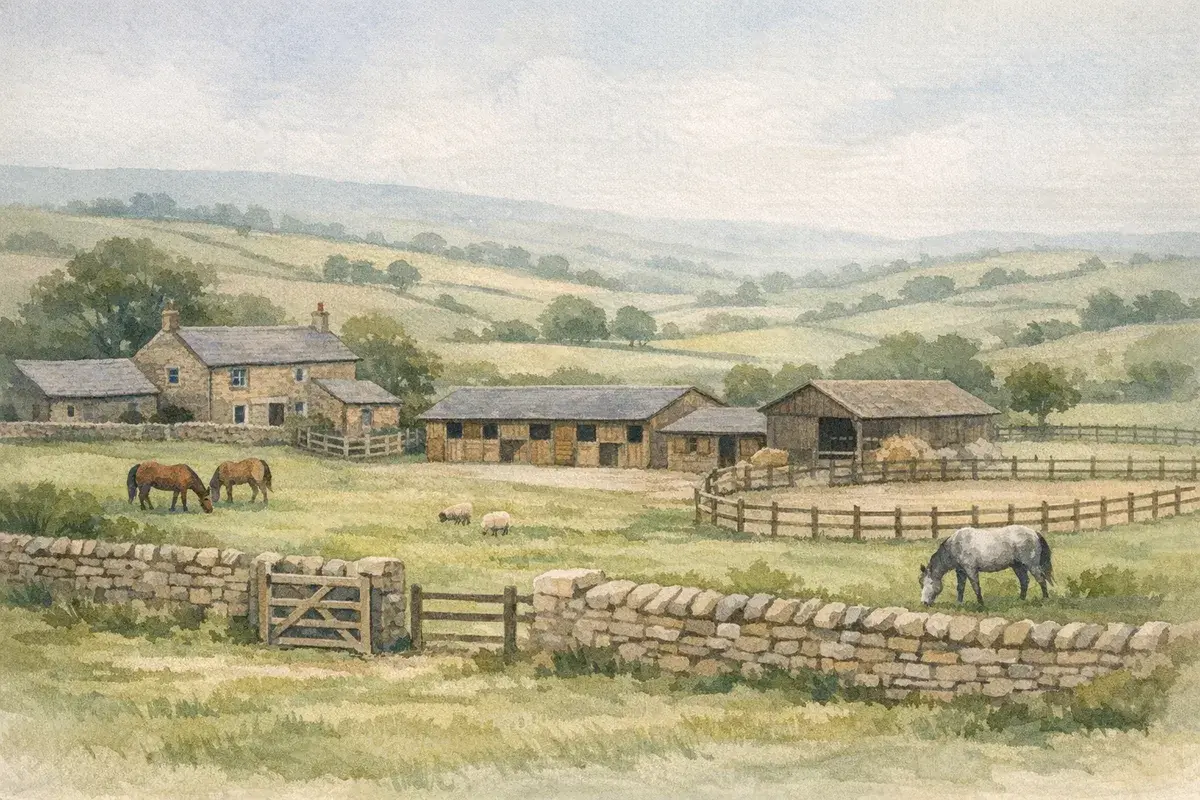
Buying an equestrian property with stables sounds straightforward until you're standing in a "perfect little yard" with soggy gateways, a murky water supply, and a planning history that reads like a courtroom drama.
If you're spending serious money on land, buildings, and a lifestyle (or business) that depends on them, you need more than a pretty stable block and a nice hack. You need land that holds up through a UK winter, access that won't become a neighbour dispute, and paperwork that won't quietly block the very use you're buying for.
This guide walks you through what actually matters in the UK: how equestrian use differs from agricultural use, what to look for in fields and yards, the planning traps around stables and arenas, and the legal and financial checks that can make or break a deal.
What Counts As An Equestrian Property With Stables In The UK?
In everyday conversation, "equestrian property with stables" can mean anything from a house with two loose boxes to a fully-fledged livery yard with an arena, staff accommodation and a decent turnover.
For buyers, the key is pinning down use (private vs commercial), infrastructure (stables, storage, turnout, parking, tracks), and permissions (what's lawful today vs what's merely "always been done").
If you want a wider view of how yards are assessed in practice, access, drainage, rights of way, and day-to-day usability, AgLand's deeper guide to finding and assessing equestrian property for sale in the UK is a good companion read once you've got your shortlist.
Equestrian Vs Agricultural Use: Why The Distinction Matters
This is where a lot of UK buyers get caught out.
- Grazing horses is not automatically "agriculture". In planning terms, land used for keeping horses for leisure is typically treated as equestrian use. Agricultural use usually relates to producing food, fibre, or breeding/keeping livestock in an agricultural sense.
- "Horses are livestock" is true in some contexts, but planning is its own world. A field that has been "just horses" for years might still be considered a change from agriculture to equestrian, depending on the facts (and the local planning authority's view).
- Why you should care: the distinction can affect whether existing stables are lawful, whether you can add an arena, and what conditions or enforcement risk you inherit.
A practical way to think about it: if the land is being used in a way that looks and operates like a horse property, tracks, jumps, stable yard traffic, muck heap, regular deliveries, assume you'll need to be clear on the planning position, not just the title plan.
Typical Setups: Private Yards, Smallholdings, And Commercial Livery
Most UK equestrian properties with stables fall into a few common categories:
- Private yard (2–8 stables): usually focused on turnout, sensible storage, and good access for trailers. Planning is often simpler, but the land still needs to work in winter.
- Smallholding with stables: you may have mixed uses, grazing, hay, maybe a barn or workshop. These can be brilliant, but they're also where use-class boundaries and "what's allowed" get messy.
- Commercial livery/training yard: higher traffic, staff/clients on site, more intense wear on surfaces, bigger insurance and liability issues, and often business rates and VAT considerations.
If your end goal is income, treat it as a commercial property decision as much as a lifestyle one, especially when you get to valuations, insurance, and tax.
Location And Land: Finding The Right Acres For Horses
In the UK, land is rarely "neutral". Soil type, rainfall, slope, gateways, and access to the road can be the difference between a yard that runs smoothly and one that turns into a mud-management project every November.
A big part of buying well is being honest about your reality:
- Are you turning out year-round, or will you need sacrifice paddocks and winter housing?
- Do you need trailer access in all weather?
- Is off-road riding essential to you (or your clients)?
Acreage Rules Of Thumb, Grazing Quality, And Stocking Rates
Acreage is one of those topics that attracts sweeping statements. In practice, stocking rate depends on grass growth, soil, drainage, management, and whether you're importing forage.
Still, you can use a few UK-appropriate rules of thumb as a starting point:
- 1–2 acres per horse is often quoted for decent grazing with good management.
- If land is heavy clay, shaded, or waterlogged, you may need more land (or accept more stabling and bought-in forage).
- If you're aiming for commercial livery, assume higher wear: turnout management becomes a system, not an afterthought.
When viewing, don't just look at grass length. Look for:
- Poaching and compaction: deep hoof marks around troughs and gateways tell you how the land behaves.
- Weed burden and toxicity risks: ragwort management should be visible (or at least discussed).
- Field layout: lots of small, awkward paddocks can be great for rotation, unless they're all accessed through one boggy pinch point.
- Water in fields: trough placement, supply reliability, and how pipes are protected from frost.
If you're comparing properties across regions, remember that the same acreage can perform very differently. A few well-drained acres can beat "more land" that's unusable for months.
Access To Off-Road Riding: Bridleways, Byways, And Permissions
If hacking matters, you're not just buying a yard, you're buying a network.
In the UK you'll commonly hear:
- Public bridleways: rights for horses and pedestrians.
- Restricted byways/byways open to all traffic (BOATs): can be useful but may bring cyclists, walkers, and (on BOATs) vehicles.
Practical checks you can do early:
- Ask for the nearest safe access point (not just "there's a bridleway nearby").
- Consider road crossings and sight lines, your "five-minute hack" might involve a nasty junction.
- If you're relying on informal permissions across a neighbour's land, treat that as fragile unless documented.
And don't ignore parking. If you'll have clients, lessons, or clinics, you need space for cars and horseboxes without turning the verge into a battleground.
Neighbours, Biosecurity, And Nuisance Risks (Smell, Flies, Noise)
An equestrian property with stables changes how a place feels, deliveries, farriers, mucking out, occasional early starts.
Before you fall for the view, take ten minutes to think like a neighbour (and like Environmental Health):
- Muck heaps: where will it sit, how close is it to boundaries/watercourses, and how will it be removed?
- Flies and smell: particularly near houses, gardens, and outdoor seating areas.
- Noise and lighting: arenas, security lights, and vehicle movements can become flashpoints.
Biosecurity is another underappreciated angle. Shared access tracks, neighbouring livestock, and frequent comings-and-goings can increase disease risk. A tidy, well-planned yard layout usually signals good management, and fewer neighbour headaches.
Planning And Change Of Use: Stables, Arenas, And Ancillary Development
Planning is where "dream yard" purchases can unravel.
In the UK, you're often dealing with a mixture of:
- what's shown on historic planning consents,
- what has been built or used since,
- what the local authority tolerates,
- and what you want to do next.
If your shortlist includes land where you'll need to regularise use, add buildings, or create an arena, it's worth reading up specifically on equestrian land with planning permission so you understand what planners typically want to see (and what tends to trigger objections).
When You Need Planning Permission (And When You Don't)
There's no single rule that fits every site, but common UK realities include:
- New stables or significant buildings often need planning permission, particularly if they're not genuinely for agriculture.
- Change of use from agriculture to equestrian may require permission, especially where the use changes the character of the land (surfacing, jumps, frequent vehicle movements).
- "Permitted development" can apply in some agricultural contexts, but it's not a free pass for equestrian development. If in doubt, assume you need advice and written clarity.
Your job as a buyer is to avoid relying on "the seller says it's fine." Ask for:
- planning references and decision notices,
- building regs completion certificates where relevant,
- evidence of lawful use (where the history is complex).
Ménages, Lighting, Hardstanding, And Access Tracks
Arenas and yard surfacing are where planning and practicalities collide.
- A ménage isn't just "a flat bit." Drainage, construction depth, and local ecology matter, and planners often scrutinise visual impact.
- Lighting can be a neighbour-relations issue and a planning issue (especially in darker rural areas).
- Hardstanding and tracks can look minor on paper, but they change runoff, visibility, and the perceived intensification of use.
If an arena is on your must-have list, you'll want a clearer sense of how these properties are marketed and evaluated. AgLand's guide to equestrian property with an arena goes into the practical checks buyers often miss (surface condition, drainage, and whether it's properly consented).
Restrictions To Watch: AONB, Green Belt, SSSI, Flood Zones, And Ecology
Certain designations can make development slower, costlier, or simply unlikely:
- Green Belt: development is tightly controlled: "need" arguments can be difficult.
- AONB and National Landscapes: design and visual impact become central: lighting and prominent buildings can be contentious.
- SSSI and protected habitats: ecology surveys and mitigation may be required.
- Flood zones and surface water risk: not just a house issue, yards, access tracks, and arenas can become unusable.
A very practical point: flood risk doesn't have to mean "never buy," but it should change your inspection. Look for high water marks, silt lines, or "temporary" sandbags that aren't as temporary as they sound.
If you plan to run a commercial yard, planning risk is business risk. Build in time and budget for professional input before you assume you can add stables, expand parking, or install lights.
Stable Block And Yard Design: What To Inspect Before You Buy
A stable block can photograph brilliantly and still be a headache to own.
When you view an equestrian property with stables, you're assessing three things at once:
- Horse welfare and usability (ventilation, light, safe movement)
- Durability (drainage, surfacing, rot, corrosion)
- Security and management (storage, layout, vehicle flow)
And yes, you're also assessing your future workload. If the yard layout forces you to wheelbarrow uphill through a bottleneck every day, you'll resent it by week three.
Ventilation, Drainage, Flooring, And Fire Safety Basics
Start with the fundamentals:
- Ventilation: stables should smell like air, not ammonia. Look for high-level vents, airflow paths, and signs of condensation.
- Drainage: yard falls, channels, and where water goes matter. Standing water is a red flag for slipping and long-term surface damage.
- Flooring: check for uneven mats, broken concrete edges, and damp rising through floors.
- Fire safety: ask about electrics, storage of hay/straw, and separation between high-risk storage and stabling. Even small private yards benefit from clear access for emergency vehicles and sensible storage habits.
If the property includes older timber buildings, look closely for rot at the base of posts and around door frames. Repairs can be simple, or they can reveal a bigger rebuild.
Tack Rooms, Feed Stores, Wash Bays, And Secure Storage
This is where quality-of-life (and theft risk) shows up.
- Tack room: is it secure, dry, and sensibly located? If it's an afterthought, you'll end up improvising.
- Feed store: look for vermin protection and whether it stays cool and dry.
- Wash bay: drainage and slip resistance matter: check where wash water goes.
- Rug drying and laundry: if you'll run a busy yard, these become operational essentials.
Also think about delivery reality: where does a feed lorry turn, where does bedding get dropped, and can you keep the working area separate from client parking?
Utilities And Services: Water Supply, Power, Waste, And Manure Handling
Utilities are unglamorous, and they're where costs creep in.
- Water: is it mains, private supply, or a mix? What's the flow rate? Are troughs on reliable lines? A "fine in summer" supply can become a winter nightmare.
- Power: check the condition of the consumer unit, outdoor sockets, lighting, and any outbuildings. Poor wiring in stables is a serious risk.
- Waste and drainage: what's connected to mains drainage vs septic tank treatment? If there's a house on site, you'll want clarity on capacity and compliance.
- Manure: where is it stored, how often is it removed, and do you have space for a trailer or skip without blocking operations?
A tidy muck area with sensible access is one of the best "hidden indicators" that the yard has been run properly.
Legal Due Diligence: Title, Rights, And What Can Stop You Using The Yard
Legal due diligence is where you protect yourself from buying a problem that looks invisible on a viewing.
For equestrian property with stables, the big legal risks tend to sit in:
- access rights,
- restrictions on use,
- and occupation arrangements (especially where yards are run as a business).
If you're browsing more complex sites, multi-stable yards, training facilities, or places marketed as income-producing, you may also want to explore the broader market for equestrian facilities for sale to get a feel for what "good paperwork" looks like compared to "it's all a bit informal".
Rights Of Way, Access Easements, And Yard Traffic
Yard access isn't just "can you get in?" It's can you operate.
Ask your solicitor to confirm:
- the legal right to use the access track/drive (and for what types of vehicles),
- who maintains it and how costs are shared,
- whether there are restrictions on commercial traffic.
Also look for public rights of way crossing the property. That doesn't automatically mean "don't buy", but it changes day-to-day management:
- gates and fencing must be appropriate,
- arena placement and jumps can become sensitive,
- privacy expectations should be realistic.
Covenants, Overage, And Restrictions On Equestrian Use
Covenants can be surprisingly blunt. You may see:
- restrictions on business use,
- limits on building additional structures,
- prohibitions on certain animals or activities,
- requirements to keep land "agricultural".
Overage is another one to watch, especially if there's development potential. If you're thinking long-term (new arena, extra stables, maybe a second dwelling subject to planning), overage clauses can materially change the economics.
This is the moment to be unromantic: if the title contains a restriction that blocks your intended use, it's not "probably fine." It's a stop sign until a professional confirms otherwise.
Tenure And Occupation: Vacant Possession, Licences, And Livery Agreements
If the yard is occupied, DIY liveries, grazing licences, a trainer subletting facilities, your purchase can come with strings.
Key questions:
- Will you get vacant possession on completion?
- Are there written agreements (licences, leases, livery contracts)?
- Are there deposits, liabilities, or ongoing disputes?
For a commercial yard, clarity here is essential. Informal arrangements can be workable day-to-day but create problems on sale, on financing, and if a relationship breaks down.
A good solicitor with rural/equestrian experience is worth their fee on this category of purchase. You're not being fussy, you're being sensible.
Money Matters: Financing, Insurance, Tax, And Running Costs
Equestrian property can be deceptively expensive after the keys change hands. The purchase price is only the start: the operating costs follow you every month.
If you're looking at this through an investor lens (even if you'll also keep your own horses on site), it's worth thinking in terms of resilience: how the property performs when occupancy dips, forage prices rise, or maintenance lands all at once.
AgLand's piece on equestrian property investment goes deeper into yields, demand drivers, and what experienced buyers watch for, useful context if you're considering livery income or long-term capital value.
Mortgages And Valuations For Equestrian Property
Financing equestrian property with stables can be more nuanced than a standard residential mortgage.
Expect lenders/valuers to look at:
- how much of the value is residential vs commercial,
- the quality and permanence of equestrian buildings,
- planning status and lawful use,
- local market comparables (which can be thin in rural areas).
If the property is a going concern (livery yard with turnover), you may be dealing with business elements as well as bricks and mortar. That can mean more documentation, more scrutiny, and sometimes specialist lending routes.
Insurance You'll Likely Need: Buildings, Liability, And Care/Custody/Control
At minimum, think about:
- Buildings insurance (stables, barns, stores)
- Public liability (visitors, clients, delivery drivers)
If you're taking horses in for livery, schooling, or training, you may also need care, custody and control style cover (insurers use slightly different wording/policies). Add employers' liability if anyone works for you.
Insurers will care about practical risk controls: fire safety, electrical condition, yard security, and how you store hay, fuel and machinery.
Rates, VAT, And Tax Treatment For Commercial Yards
Once the yard is run commercially, you're in a different administrative world.
- Business rates: parts of the property may be rateable if used for a business.
- VAT: depending on your structure and turnover, VAT registration may be relevant (and it affects pricing and cashflow).
- Income tax/corporation tax: business profits are taxed differently from private use.
Even if you're not "aiming to run a business," be careful about drifting into commercial reality, regular paid liveries, lessons, clinics, without getting proper advice on structure, compliance, and insurance.
Running cost reality check (often underestimated):
- arena maintenance and resurfacing cycles,
- fencing and gateways,
- drainage and surfacing repairs,
- manure removal,
- water infrastructure,
- security.
If the numbers only work when nothing breaks, the numbers don't work.
A Practical Buying Process: From Search To Offer To Completion
Good equestrian purchases rarely happen by luck. They happen because you compare like-for-like, ask awkward questions early, and keep your professionals close.
How To Search Effectively And Compare Like For Like
Start by defining your non-negotiables in plain terms:
- minimum turnout acres that remain usable in winter,
- number of stables that are genuinely serviceable,
- hacking access (or an arena if hacking is limited),
- vehicle access for horseboxes,
- planning "headroom" for what you want to add.
Whichever side you're on. Buyers tell AgLand what they're looking for and hear the moment something fits. Owners advertise straight to the buyers who already match, for one flat fee and no commission. Register as a buyer or check your matches.
If you're looking north of the border, note that processes and market dynamics can differ. For region-specific considerations, see AgLand's guide to equestrian property in Scotland, useful if your search area crosses the England/Scotland line.
A tip we've seen work well: keep a simple comparison sheet for each viewing, acres, access width, water type, drainage notes, rights of way, planning references, and estimated "must spend" items in year one.
Your Professional Team: Land Agent, Surveyor, Solicitor, And Planning Advice
Equestrian property is multi-disciplinary. The best outcomes come when you accept that early and build a team accordingly.
- Rural land agent: helps you sanity-check value, negotiate, and spot operational issues.
- Surveyor: ideally someone comfortable with rural outbuildings, drainage, and non-standard construction.
- Solicitor: with rural property experience (rights, covenants, access, occupation, overage).
- Planning consultant (as needed): particularly if you're relying on change of use, new buildings, or regularising what exists.
If you're buying a yard that's already trading, consider specialist input on business structure, insurances, and contracts too. Paying for advice before exchange is usually cheaper than paying for a fix after completion.
Viewing Checklist: Questions To Ask And Red Flags To Document
Take photos (with permission), note measurements, and don't be shy about walking gateways and tracks.
Land and access
- Where does water sit after heavy rain?
- Can a lorry/horsebox turn and leave without reversing onto the road?
- Any shared tracks, who maintains them?
Yard function
- How is manure handled and how often is it removed?
- Is there secure storage for tack and machinery?
- Where are hay and bedding stored (and how far from stables)?
Paperwork and planning
- Ask for planning references for stables/arena/lighting.
- Clarify current use: private, livery, lessons, events?
- Any neighbour issues or complaints?
Red flags that deserve a pause
- "It's always been like that" in response to planning questions.
- Boggy yard with no clear drainage strategy.
- Informal occupancy arrangements with paying liveries but no paperwork.
- Restricted access that would make day-to-day operation awkward.
A good yard feels calm and functional. You should be able to picture a wet Tuesday in February and still think: yes, I can run this.
Conclusion
An equestrian property with stables is one of the most rewarding rural buys you can make, when the land holds up, the access works, and the permissions match the reality on the ground. Get those three right and everything else becomes manageable.
Your best leverage is diligence: inspect winter wear, follow the water, read the title, and treat planning as a first-class issue, not an afterthought. If you're buying for income, be even stricter, because lenders, insurers and future buyers will be.
If you take one practical step after reading this, make it this: write down your intended use (private horses, livery, training, events), then ask your professionals to stress-test the property against that use before you commit.
Disclaimer: AgLand.co.uk is a UK agricultural land and rural property matching service, where buyers register what they are looking for and owners advertise directly to the buyers who match, and a rural resource hub. Nothing in this text is intended as legal, financial, tax, planning, or investment advice. You should carry out your own due diligence and seek guidance from appropriately qualified professionals (for example, a rural solicitor, chartered surveyor, planning consultant, and tax adviser) before making decisions or transactions.