
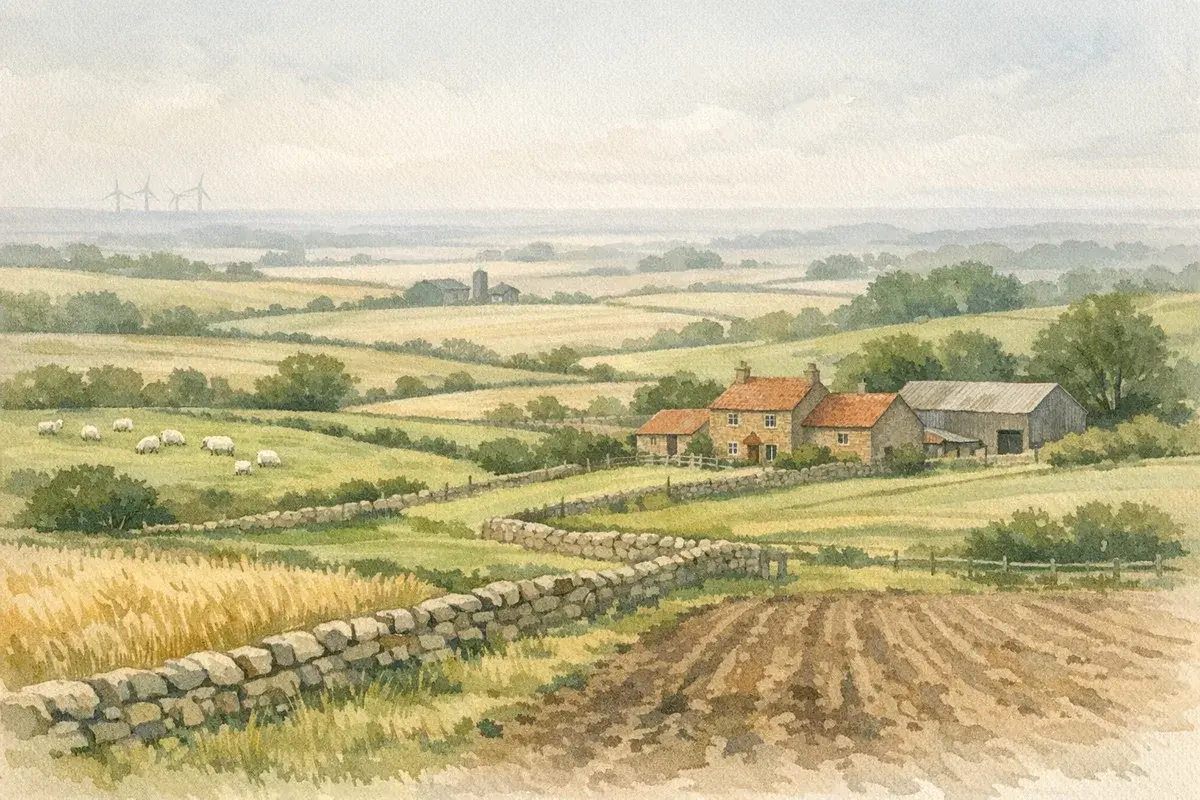
East Anglia has a habit of making arable buyers a little overconfident.
From the road, it's all big skies, clean field edges and straight hedgelines, land that looks like it should farm itself. But the deals that go smoothly here aren't won by optimism. They're won by doing the unglamorous work: understanding soil variability (often within the same field), water reality (not just "is there a borehole?"), and the deal structure that controls what you can actually do in year one.
If you're looking at arable land in East Anglia, whether you're a farming business expanding, a landowner restructuring, or an investor trying to buy sensible, resilient acres, this guide cuts through the marketing gloss and focuses on what changes outcomes: value drivers, due diligence, tenure, constraints and the practical questions you should be asking before you commit.
Why East Anglia Leads The UK Arable Market
East Anglia's reputation isn't just tradition, it's fundamentals.
First, there's the concentration of genuinely productive arable land. Large, workable blocks, relatively low altitude, and long growing seasons have historically supported high-output systems. That doesn't mean every acre is Grade 1 perfection, but the region does have a greater share of high-quality land compared with many other parts of the UK.
Second, the market is unusually liquid. You'll often find more repeat buyers (established farming businesses, neighbouring estates, long-term investors) who understand the local realities and can move decisively. That depth of demand tends to support values even when commodity prices wobble.
Third, the region's infrastructure favours commercial farming. Access to grain stores, processors, ports and major road links can reduce haulage pain, small differences that become very real when you're shifting thousands of tonnes.
But here's the catch: East Anglia is also where the "little problems" turn expensive quickly. A field that's 9/10 on soil can be 5/10 on water. A tidy block can hide awkward easements. And a clean-looking tenancy can limit cropping choices for years. If you treat East Anglia as "easy mode", you tend to pay for it later.
One useful way to ground your expectations is to benchmark the region against the rest of the country, values, drivers and constraints, before you start falling in love with a particular farm. Our breakdown of regional land price patterns is a helpful reality check when you're trying to sense what's genuinely "market" versus what's specific to a single holding.
The East Anglia Arable Map: Norfolk, Suffolk, Cambridgeshire, Essex
East Anglia isn't one uniform arable landscape. It's a patchwork of soil series, water availability and farm structure. If you're buying, you'll do better thinking in "micro-regions" than county lines.
- Norfolk: Big arable units, a strong sugar beet and barley presence in many areas, and some of the UK's most productive sands and loams, plus significant irrigated vegetables in the right places. But water constraints can bite hard.
- Suffolk: Often a blend of strong combinable cropping and mixed farming edges. You'll see high-output arable systems, but also more variability in soil and field layout depending on where you are.
- Cambridgeshire: Fens and peat in places, very high output potential and specialist cropping, yet with distinct risks around shrinkage, oxidation, drainage infrastructure and environmental management.
- Essex (north and rural pockets): Serious arable land in the right areas, sometimes with strong access to markets. But fragmentation, development pressure and designations can be more of a feature than buyers expect.
Typical Farm Types And Cropping Rotations
A lot of East Anglian arable still revolves around high-performing combinable crops, wheat, barley, oilseed rape (where it still stacks up), and beans, with sugar beet remaining important in many local rotations.
Where soils and water allow, you'll also encounter higher-value systems: potatoes, onions, carrots and other veg, plus seed crops and specialist contracts. That's where the land's "headline" price can start to make sense, because the gross margin potential is different.
If you're evaluating a holding, ask for more than the last crop list. You want to understand:
- the rotation logic (was it agronomy-led or cashflow-led?)
- blackgrass pressure and control strategy
- how often fields are trafficked in marginal conditions
- whether soil structure is being actively managed (cover crops, organic matter strategy, controlled traffic where used)
And don't ignore what's not being grown. If everyone around you has moved away from a crop, there's usually a reason.
Irrigation Reality: Abstraction, Storage, And Water Risk
In East Anglia, water is frequently the difference between "good arable land" and "strategic arable land". The problem is that irrigation is often talked about casually, until you try to rely on it.
Your starting questions should be blunt:
- Is there an abstraction licence? If so, what are the hands-off flow conditions and seasonal limits?
- What's the source (borehole, river, reservoir, shared scheme)?
- What's the infrastructure condition (pumps, mains, hydrants, telemetry) and what does it cost to maintain?
- Is there storage (reservoir) and does it have any planning or safety obligations?
Even where you have a licence, availability isn't guaranteed in practice, particularly in dry years or where catchments are under pressure. If irrigated output is part of your business case, you need a buyer's mindset that treats water like a title issue: verify it, document it, and stress-test it.
Looking for land like this? Tell AgLand what you're after - type, acreage, budget and area - and we'll alert you the moment a matching property is advertised. Registering is free, and there's no commission on either side. Tell us what you're looking for.
What Arable Land In East Anglia Costs In 2026
Prices in East Anglia can feel punchy, especially for clean, scalable blocks with good road frontage and a clear management story.
That said, 2026 is not just about "what's the average per acre?" The better question is: what are buyers paying for, and what are they discounting?
If you want a national baseline before zooming in on East Anglia, it's worth reading our overview of current UK farmland price drivers in 2026. It'll help you separate broad market momentum from East Anglia-specific premiums.
What Actually Moves The Price: Soil, Water, Shape, Access, And Scale
In practice, East Anglian arable value is often a scorecard.
- Soil and versatility: Deep, resilient loams that carry crops in both wet and dry seasons usually command a premium. But buyers are increasingly wary of land that performs brilliantly in one weather pattern and collapses in another.
- Water (again): A credible irrigated proposition can add meaningful value, if it's verified. Conversely, land marketed as "irrigable" without documented rights and infrastructure gets marked down quickly by serious buyers.
- Field shape and work rate: A 50-acre field that's actually workable (few poles, no awkward corners, good gateways) can out-compete a "larger" block that's full of friction.
- Access and road frontage: The boring stuff: do you have HGV-friendly access, passing space, visibility splays, and gateways that don't become a winter bog? It affects operating cost and neighbour relations.
- Scale and consolidation: Size still matters because it changes fixed cost per hectare and labour efficiency. Contiguous acres tend to outperform a scattered portfolio, even if the latter has a slightly better soil average.
Also watch the "hidden premium" buyers put on certainty. If title is clean, boundaries match what's on the ground, wayleaves are documented, and drainage is understood, people pay more because they're buying fewer surprises.
How To Compare Guide Prices Vs Achieved Prices
Guide prices are marketing tools. Achieved prices are market truth, but you rarely see the full context unless you're close to the deal.
If you're comparing opportunities, try this approach:
- Normalise area: Confirm what's being valued, gross, net, in-hand, excluding tracks/dykes/headlands. Small differences distort "per acre" comparisons.
- Adjust for tenure: A field sold with vacant possession is not the same asset as the same field sold subject to an FBT, even if the soil is identical.
- Price in constraints: Is there an SSSI edge, a public footpath through the middle, a pipeline easement, or an overage clause that changes the future upside?
- Check local comparables: Not just county-level, same soil type, similar access, similar water reality.
When you're getting into the detail, we find buyers benefit from thinking in hectares (because so much agronomy and scheme planning is built that way) and being consistent about it. If you want a practical framework for comparing deals fairly, our guide to how price per hectare is actually calculated is designed for exactly this, especially where gross vs net area gets fuzzy in fenland and dyke-heavy blocks.
Soils, Yield Potential, And Practical Due Diligence
In East Anglia, you can drive past a field that looks uniform and still have three different management zones under the surface.
The smart move is to treat "soil" as more than a grade on a brochure. You're buying a production system: water movement, structure, organic matter, pH, nutrient indices, and the ability to travel without causing damage.
A quick, high-value starting point is to cross-reference the holding with Agricultural Land Classification (ALC) data, but do it carefully. Mapping is useful: it's not gospel at field scale. Our explainer on using an ALC map properly in land decisions can help you avoid the classic trap of assuming the map equals the margin.
Key Soil Groups And What They Mean For Management
You'll come across several broad soil situations across East Anglia. Each comes with a different "management tax".
- Light sands and sandy loams: Often easy to work and quick to warm up, potentially very high-performing with the right rotation and organic matter strategy. But they can be droughty, and nutrient management can be less forgiving. If you're paying a premium here, water access and soil health planning matter.
- Medium/heavier loams and clay loams: Can be excellent all-rounders with strong yield stability. But timing is everything, get on too early or too late and you'll pay in compaction and workability for seasons.
- Fen peat and peaty soils: Highly productive in the right systems and famous for specialist cropping, yet they come with long-term considerations: oxidation, shrinkage, wind erosion risk, and the need for robust drainage and water management. Insurance and infrastructure maintenance can be a bigger line item than first-time buyers expect.
What you should ask for (and verify) before you lean on "yield potential":
- recent soil analyses and nutrient indices (field-by-field)
- lime history and pH trends
- maps from yield monitors or soil EC scanning, if available
- evidence of a soil structure strategy (not just a one-off subsoiling invoice)
Field Drainage, Compaction, And Legacy Issues To Look For
Drainage is one of the easiest things to underestimate because it's underground and, in dry years, invisible.
On viewing days, look for clues:
- damp patches or rushes in low areas
- historic "wet corners" that always crop differently
- outfalls and ditches that are silted, shaded or poorly maintained
- mismatched crops or uneven establishment that might suggest structure issues
And then do the unglamorous checks:
- Is there a drainage plan? When was it last renewed?
- Who maintains the ditches/drains? Are there Internal Drainage Board rates in fen areas?
- Any history of soil movement or landfill? (You'd be surprised what turns up near old yard sites.)
Compaction is the other East Anglian classic, often driven by late beet lifting, potato traffic, or simply trying to "just get it done" in a wet autumn. If you're buying into that legacy, you need to budget time and money to repair structure, and you need to be realistic about what you can achieve in the first two seasons.
Tenure And Deal Structures: Vacant Possession, FBT, Licences, And Contract Farming
In East Anglia, the same land can trade at meaningfully different values depending on what you're actually buying: control, timing, and risk.
There's no universally "best" structure, only the structure that fits your objective.
How Tenure Impacts Value, Control, And Timeline
Here's how the main arrangements typically play out in practice:
- Vacant possession: You take control immediately (or on the agreed completion date), choose the rotation, and capture the upside. You also carry the operational risk from day one. This is often what expanding farming businesses want.
- Farm Business Tenancy (FBT): Predictable income for landlords: operational continuity for tenants. For buyers, it's about term length, rent review clauses, repair obligations, and break options. An FBT can make sense if you're investing, but it can constrain you if you need to integrate the land into your own operation quickly.
- Licences to occupy / grazing licences: Often short-term and flexible, but they need careful drafting. Don't assume "licence" automatically means you can remove the occupier easily, get proper advice.
- Contract farming agreements: Useful where you want exposure to farming returns without day-to-day operations, but the detail matters: who buys inputs, who owns crops, how profit share is calculated, and who carries compliance risk.
If you're comparing land that's in-hand versus tenanted, don't just ask "what's the rent?" Ask: what's my realistic timeline to change anything, and what's the cost of waiting?
If you're newer to buying arable, or you're used to residential conveyancing, it's worth grounding yourself in how agricultural transactions differ in England, tenancies, access, schemes, and practical risks. Our guide to buying and owning agricultural land in England is a solid primer to read alongside your solicitor's advice.
Cropping, Inputs, And ELM Options During A Transition
Transition periods are where good intentions go to die.
If you buy land with a sitting crop, a tenant in place, or a contract farming handover, you need to be crystal clear on:
- who owns the crop in the ground
- who's paid for fertiliser and sprays already applied
- how straw is treated (sold, chopped, removed) and what that means for organic matter
- what happens to stored grain or inputs on farm
On the environmental side, you'll also want to think about how any Environmental Land Management (ELM) options (or existing stewardship agreements) interact with your plan. You can't always "switch" schemes neatly at completion, and certain options can affect cultivation flexibility.
A practical tip: if you're buying as an owner-occupier, ask your agent early about the handover calendar, not just legal completion. In arable, the real handover is often dictated by drilling windows, harvest, and the point at which you can realistically change practice without harming the crop or breaching agreements.
Planning, Designations, And Constraints That Catch Buyers Out
Most arable purchases don't start with planning. But plenty of regrets do.
Even if you're buying "just land", you're still buying a bundle of constraints, some visible, some buried in paperwork, and some that only show up when you try to do something slightly different (a new access, a grain store, a reservoir, diversification, even just moving machinery more efficiently).
Highways, Rights Of Way, Easements, And Wayleaves
These are the deal-friction items that can turn a clean block into a management headache:
- Highway access: A field gate onto a fast road isn't automatically a usable access for frequent HGV movements. Visibility, mud on the road, and neighbour sensitivity matter.
- Public rights of way: Footpaths and bridleways aren't deal-breakers, but they affect operations, biosecurity and the ability to fence or plant.
- Easements: Rights for neighbours (or you) to pass over tracks, to run services, or to drain can affect how you farm and what you can build.
- Wayleaves: Overhead lines, poles, underground cables and pipelines are common. The key is documentation: location plans, maintenance rights, compensation arrangements, and restrictions on planting/building.
If you're buying a larger block, map these constraints early. You don't want to discover, after exchange, that your best field is the one you can't irrigate, deepen drains on, or reconfigure gateways for.
Environmental Constraints: SSSI, AONB, NVZs, And Local Nature Sites
Environmental designations aren't automatically "bad". But they can change your cost base and your options.
Common ones to look out for:
- SSSI: Strong protections, potential restrictions on operations, and usually a need for careful liaison with the relevant statutory bodies.
- AONB / National Landscape: More sensitivity around new buildings, tracks, lighting and certain types of development.
- NVZs: Compliance affects fertiliser planning, storage requirements and record keeping.
- Local nature sites and priority habitats: Often less obvious in sales particulars, but still influential when you're planning works or entering schemes.
Two practical realities in East Anglia:
- Designations can be patchy. You might have one designated corner that affects a whole-farm plan.
- The biggest constraint is often not the designation itself, it's the time and uncertainty it adds when you want to make changes.
So, treat constraints like you treat soil: quantify them. What do they stop you doing? What do they slow down? What do they cost to manage well?
If you're scanning the market and want a broader sense of what's available nationally (without wading through irrelevant residential stock), you can also explore our dedicated hub for arable farmland for sale in the UK, then narrow to East Anglia and compare like-for-like holdings.
A Step-By-Step Buying Checklist For East Anglian Arable Land
This is the part that saves you from expensive "learning". Use it as a working checklist, and involve the right professionals early (land agent, rural solicitor, agronomist, drainage contractor, planning consultant, and an accountant who actually understands farming).
Pre-Offer: Desktop Checks, Neighbours, And Overages
Before you make an offer, aim to know what you're really buying.
Desktop and market checks
- Confirm area and boundaries against plans, watch for ditches, tracks and headlands that change net farmed area.
- Check the holding's context: nearby livestock units, poultry sites, industry, odour/noise sources, and potential neighbour conflict points.
- Sense-check the asking price against comparable arable deals and what's driving local demand.
Talk to people (yes, really)
- If appropriate, speak to neighbouring farmers. They'll often tell you the truth about flooding, access issues, or that one field that "never dries".
- Ask who farms it now and how, owner-occupied, contractor, or tenant. You're trying to understand the management history.
Overage and uplift
- If there's any hint of development potential (even minor), check for overage clauses. Overage can be fair, but it must be understood, duration, triggers, percentage, and definitions.
Pre-Exchange: Surveys, Title, Water, And Environmental Reports
Between offer acceptance and exchange is where you earn your confidence.
Title and legal
- Confirm rights of way, easements and wayleaves are all documented.
- Check whether mineral, sporting or timber rights are included.
- Verify boundaries: what's on the plan should match what's fenced/hedged on the ground.
Water and drainage
- Verify abstraction licences, transfer rights, storage consents, and infrastructure ownership.
- Confirm drainage responsibilities and any Internal Drainage Board implications where relevant.
Environmental and compliance
- Identify designations (SSSI, AONB/National Landscape, NVZ, local sites) and understand operational implications.
- If you're planning ELM or stewardship, confirm what agreements exist already and what obligations transfer.
Soil and performance
- Walk the land properly. Dig pits. Look for structure, rooting depth and wetness layers.
- Review cropping history, weed burden and any evidence of herbicide resistance issues.
If you want an extra layer of confidence specifically for high-grade opportunities, it's worth being clear on what "top quality" really means and what you should verify beyond the headline. Our guide focused on Grade 1 arable opportunities is useful context when you're weighing up a premium purchase.
Finally, build your timeline around farming reality. Legal completion is one date: operational control is another. The best East Anglian deals are the ones where your solicitor's timetable and your agronomy timetable actually talk to each other.
Conclusion
Buying arable land in East Anglia can be a brilliant move, but the winners here don't just "buy East Anglia". You buy a specific soil-water-access-tenure package, in a specific catchment, with specific constraints and opportunities.
If you take one mindset into your search, let it be this: certainty is value. Certainty on water rights. Certainty on drainage. Certainty on tenure and handover. Certainty on what you can and can't change.
Do the field walking, ask the awkward questions early, and don't be afraid to slow down before exchange. In a region this competitive, due diligence isn't what stops you buying, it's what stops you buying the wrong thing.
Disclaimer: AgLand.co.uk is a UK agricultural land and rural property matching service, where buyers register what they are looking for and owners advertise directly to the buyers who match, and a rural resource hub. Nothing in this text is intended as legal, financial, tax, or investment advice. You should carry out your own due diligence and seek independent advice from suitably qualified professionals (for example, rural solicitors, chartered surveyors, land agents, tax advisers, agronomists, and planning consultants) before making decisions or entering into any transaction.