
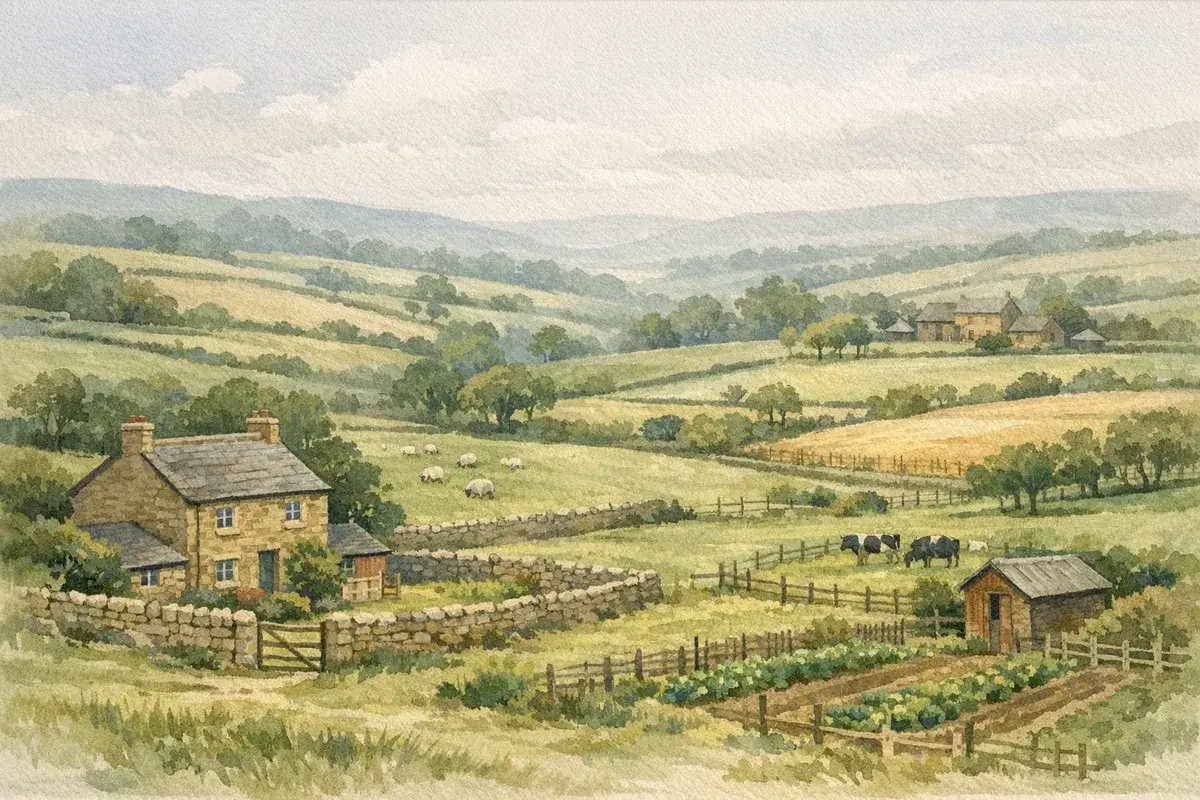
Ask ten rural people "what size is a smallholding?" and you'll get ten answers, some in acres, some in animal numbers, and at least one in exasperated sighs.
In the UK, "smallholding" is more of a practical label than a fixed category. A well-managed 3 acres of good lowland with water and decent fencing can support more than a scrappy 15-acre block of wet rushy ground with no track and a broken boundary. So instead of chasing a magic acreage, you're better off working out what you want the land to do, and what it can realistically carry.
This guide breaks down common UK smallholding sizes, what each band typically supports, and the less-obvious factors (soil, access, planning, time, money) that quietly decide whether your dream setup feels easy… or like you're constantly firefighting.
What “Smallholding” Means In A UK Context
In everyday UK property talk, a smallholding is usually a small parcel of rural land, sometimes with a house, sometimes without, used for small-scale agriculture, lifestyle production, or part-time enterprise.
The key is intent and use: you're keeping livestock, growing produce, managing grass, perhaps selling something (even occasionally), and you need land that functions like a working unit rather than a big garden.
Smallholding Vs Farm Vs Croft Vs Equestrian Property
These labels overlap, but they're not interchangeable:
- Smallholding: typically a mixed-use setup, a bit of grazing, a veg patch, poultry, maybe a barn or polytunnel, sometimes a small commercial angle. Often owner-run, sometimes alongside another job.
- Farm: usually implies larger scale and/or primary agricultural income. In practice, many "farms" are under 100 acres, and many "smallholdings" are over 20 acres, the label doesn't always match the balance sheet.
- Croft (Scotland-specific): a legally recognised form of land tenure in crofting areas. Crofts can be quite small, and crofting comes with its own rules, rights, and responsibilities. If you're looking in the Highlands and Islands, you're in different territory to an English smallholding.
- Equestrian property: land primarily set up for horses, arenas, stables, turnout, grazing management, and access for vehicles/horseboxes. You can run horses on a smallholding, but "horse land" has different infrastructure and wear-and-tear.
Why There's No Single Legal Definition
There's no one UK-wide legal definition of "smallholding" that fixes it to a specific acreage. Instead, you'll see different thresholds used in different contexts:
- Planning looks at whether buildings are reasonably necessary for agriculture (and what that agriculture is).
- Rural lenders often focus on how the property is used, what income (if any) is generated, and the complexity (outbuildings, land types, occupancy conditions).
- Land agents use "smallholding" as a market term: a package that appeals to lifestyle buyers, small-scale producers, and rural families.
That's why the most useful question isn't "how many acres counts?" but "what can you actually do on X acres of this land, in this location, with your time and budget?"
If you're at the very start of the journey, it's worth reading up on the practical first steps of starting a smallholding, because size is only one piece of the setup puzzle.
Common Smallholding Sizes In The UK (And What They Typically Support)
Below is a pragmatic way to think about UK smallholding sizes. It's not a promise, it's a starting point, assuming average lowland conditions and decent management. Your mileage will vary (sometimes a lot).
Under 1 Acre: Gardens, Micro-Livestock, And Lifestyle Use
Under an acre is rarely a "smallholding" in the traditional sense, but it can still be productive if you're realistic.
What it often supports:
- A serious kitchen garden with raised beds
- A small polytunnel
- A modest orchard
- A handful of hens (subject to neighbours and local restrictions)
What it usually doesn't support well:
- Grazing animals that need rotation (sheep, goats) unless you're buying in most feed and managing very tightly
- Horses (you can keep a horse on small acreage only if you have off-site grazing/turnout and good facilities, otherwise you'll churn it up)
1–5 Acres: The Classic Starter Smallholding
This is the band many UK buyers mean when they say "smallholding". It's enough land to feel rural, keep a few animals, and grow a meaningful amount of food.
Typical uses:
- A couple of small paddocks for rotation
- Poultry plus veg growing
- A few sheep or goats (depending on grass and how intensively you manage)
- Maybe a pony with additional arrangements (more on this below)
This is also where beginners often get caught out: 2–3 acres looks generous until you start carving out space for parking, buildings, a veg area, composting, handling pens, and a "messy corner" you didn't plan for.
If you're buying for the first time, the common pitfalls are well covered in buying a smallholding for beginners, especially around access, boundaries, and what you assume you'll be allowed to build.
5–20 Acres: Serious Productivity And Grazing Flexibility
In UK terms, 5–20 acres can be a genuinely capable smallholding.
What changes here is flexibility:
- You can rotate grazing properly (resting fields, managing parasites)
- You can carry livestock without the land looking permanently "tired"
- You've got space for hay storage, handling areas, and maybe a small yard
It's also the range where people start running proper micro-enterprises: breeding stock, small-scale meat boxes, eggs, or horticulture, assuming you've got the time and local demand.
20–50 Acres: Part-Time Farming Territory
At 20–50 acres, you're edging into "small farm" territory even if the listing still calls it a smallholding.
Benefits:
- You can keep meaningful numbers of livestock and produce some of your own forage
- You can separate land uses: grazing, hay, winter keep, woodland, horticulture
But there's a catch: this size starts to demand more machinery, infrastructure, and time. Topping, harrowing, hedge cutting, fence repairs, they scale up fast.
50 Acres Plus: When A "Smallholding" Starts Looking Like A Farm
Once you're beyond 50 acres, the label is largely marketing. Plenty of people still call it a smallholding if it's owner-run or mixed-use, but in operational terms you're managing a farm unit.
At this scale, decisions about:
- equipment ownership vs contractors
- grazing plans and forage budgets
- water systems and tracks
- business structure and tax treatment
…become central, not optional.
And if you're searching the market, you'll often find these larger "smallholdings" bundled as packages with a house, buildings, and blocks of land. If that's your direction of travel, being precise about what you want (rather than trawling general property sites) saves time, our guide to finding the right smallholding plot is built around the checks that matter in the UK.
How Much Land You Need For What You Want To Do
Acreage only becomes meaningful when you attach it to a plan. "A few sheep and veg" could mean anything from hobby animals and a tunnel… to a tightly managed rotational system with breeding stock and sales.
Below are practical UK rules-of-thumb, with a big warning: your grass growth, soil, and management matter as much as your acreage.
Horses And Ponies: Grazing, Turnout, And Sacrifice Paddocks
Horses are often the reason people buy land, and also the reason small plots get wrecked.
In much of lowland UK, a common planning assumption for grazing is around 1.5–2 acres per horse if the land is primarily for turnout, but that's not a universal rule, and it doesn't account for laminitis-prone ponies that need restricted grazing.
If you're working with small acreage, you'll want:
- divided paddocks to rest grass
- a sacrifice area / turnout pen for wet months (so you don't poach the whole field)
- a plan for manure storage and removal
On heavy clay, you can trash 2 acres with one horse over winter. On free-draining land with good management, you can keep it looking like a golf course.
Sheep, Goats, And Pigs: Stocking Practicalities And Rotation
For sheep and goats, "enough land" is really "enough rest". Parasite management and sward recovery are the hidden drivers.
Practical considerations:
- Sheep: need safe fencing and routine foot/health handling. You'll also want a small area you can keep very clean for lambing or isolations.
- Goats: brilliant escapologists. Your fencing budget matters more than your acreage.
- Pigs: will turn grass into bare soil quickly. If you're keeping pigs on a smallholding, rotation is everything, and you'll need somewhere sensible for them in winter.
A small number of animals on 2–5 acres can work well if you split the land, rest paddocks, and accept you'll buy in feed/hay at times. Trying to "stock it up" because the acreage looks big on a map is how people end up with stressed animals and stressed owners.
Poultry And Eggs: Space, Biosecurity, And Neighbour Considerations
Poultry is where tiny acreages can shine, but it's also where neighbour relationships matter.
Think about:
- space and ground health: even a small flock can turn an area into mud if it's not moved or managed
- biosecurity: wild bird contact, rodents, feed storage
- noise and odour: cockerels and close neighbours rarely mix
If your plan is eggs for sale (even informally), you'll also want to think about routine: collecting, cleaning, storage, and keeping everything tidy and defensible.
Vegetables, Polytunnels, And Small-Scale Horticulture
If your dream is produce, acreage becomes less important than:
- soil quality
- water supply
- shelter from wind
- access for deliveries
A well-run quarter to half an acre can produce a surprising amount of veg, especially with polytunnels and intensive bed systems. The limiting factor is usually time, not land.
But don't ignore infrastructure: composting area, tool storage, wash/pack space, vehicle access, and somewhere you can work when it's raining sideways (because, well, UK).
Woodland, Agroforestry, And Fuel: Productive Acres Aren't All Grass
Not all productive land is grazing.
Even a few acres that include:
- a woodland strip (for shelter, biodiversity, possibly firewood)
- hedgerows and field margins
- an agroforestry layout (trees with grazing/veg alleys)
…can add real value to your setup.
The trade-off is management skill and permissions. Felling rules, public rights of way, and habitat constraints can shape what you can do and when, and that's worth understanding early, not after you've bought.
The Factors That Change “Enough Land” More Than Acreage
Two smallholdings can be the same size on paper and completely different in reality. These are the factors that most often make a 5-acre plot feel either "perfect" or "impossible".
Soil Type, Drainage, And Grass Growth (Your Real Carrying Capacity)
Your land's true "size" is its carrying capacity, how much it can produce and how well it stands up to feet, hooves, and wheels.
- Free-draining loams: usually easier for year-round grazing and access.
- Heavy clay: productive in summer, punishing in winter: poaching risk is high.
- Peaty/upland soils: can be very fragile: grass growth and season length are different.
If you can, look at the sward. Rushes, standing water, bare patches at gateways, they tell you more than a brochure ever will.
Parcel Shape, Access, And Water Supply
A long thin field with awkward corners can be harder to fence and manage than a neat block.
Check:
- proper access for vehicles (not just "a right of way over a neighbour's yard")
- water: mains, troughs, natural supply, and who maintains pipework
- handling areas: where will a vet park? where does a trailer turn?
This is where detail helps. On AgLand, owners and agents advertising to buyers who already match usually spell out access points, boundaries, and services, and when you're weighing up plots, those details are gold.
Local Climate And Altitude: Upland Vs Lowland Reality
A "10-acre smallholding" in sheltered lowland England is not the same proposition as 10 acres at altitude with late springs, earlier winters, and slower growth.
In upland areas you may need:
- more land per animal
- more bought-in forage
- more robust tracks and drainage
None of this is a deal-breaker, it just changes what "enough" looks like.
Your Time, Machinery, And Budget
This is the bit people don't like admitting: time is a limiting resource.
Be honest about:
- how many hours a week you can commit year-round
- whether you'll own machinery, hire it, or use contractors
- how you'll cope when life happens (illness, work deadlines, family stuff)
A smaller, well-designed setup you can manage properly often beats a larger one that you can't keep on top of.
If your plan depends on borrowing to make it work, it's worth understanding how rural lending differs from standard residential finance, our overview of smallholding mortgage options in the UK will help you frame the right questions before you fall in love with a viewing.
Planning, Buildings, And Permissions: The Hidden Land Requirement
Acreage isn't just about grazing. It's also about what you can legitimately site and build, and whether the planning position matches your intended use.
This is where the phrase "it's only a smallholding" can lull buyers into a false sense of security. In the UK, planning is local, evidence-driven, and sometimes painfully strict.
Field Shelters, Stables, And Agricultural Buildings: What's Typically In Scope
A few realities to keep in mind:
- Field shelters can trigger planning issues depending on permanence, siting, use, and local authority approach.
- Stables are often treated differently to agricultural barns because equestrian use isn't automatically "agriculture" in planning terms.
- Agricultural buildings may benefit from permitted development rights in some cases, but there are conditions, limits, and prior notification processes.
If your whole plan requires a barn, a track, hardstanding, or a change of use, you need to understand the local planning context before you exchange.
For a UK-specific breakdown of the traps and the sensible routes through them, see our guide to smallholding planning considerations.
Residential Use, Agricultural Ties, And Occupancy Risks
Some smallholdings come with occupancy conditions (often called an agricultural tie). That can affect:
- who is allowed to live there
- mortgage options and resale demand
- what evidence you might need to show compliance
Even where there's no tie, trying to justify a new dwelling on "a few acres" is rarely straightforward. Planning authorities generally want to see genuine, functional need, and they will scrutinise it.
If you're buying a smallholding with a house, check the planning history and any conditions carefully, not casually.
Access Tracks, Services, And Waste: What Buyers Often Miss
The unglamorous stuff can make or break a smallholding.
- Tracks: if you can't get feed, bedding, or a vet to the yard in winter, your acreage won't save you.
- Utilities: water and electric supply can be expensive to extend.
- Waste: manure management, fallen stock arrangements, and (if you've got a house) private drainage responsibilities.
A classic mistake is budgeting for livestock and fencing, then discovering you also need a proper gate entrance, hardcore, drainage work, and a water connection, and suddenly the "cheap" land doesn't look cheap at all.
Costs And Value: How Size Affects Price Per Acre And Ongoing Overheads
Smallholdings are emotionally charged purchases, and the economics are a bit counterintuitive.
Why Smaller Plots Often Cost More Per Acre
In the UK market, smaller parcels often achieve a higher price per acre because:
- more buyers can afford them
- they suit lifestyle demand (horses, hobby farming, privacy)
- they sometimes come with a house, buildings, or "ready to go" infrastructure
That's why you'll see a 3-acre setup with decent access and a stable block priced in a way that makes a 40-acre grazing block look "cheap". You're not only buying land: you're buying usefulness.
If your priority is entry price, you'll inevitably come across listings marketed around affordability, but do the sums properly on access, services, and repair work. Our overview of cheap smallholdings in the UK is a good reality-check on what "cheap" typically means in practice.
Running Costs That Scale With Land: Fencing, Hedges, And Maintenance
A bigger smallholding isn't just a bigger dream, it's a bigger maintenance schedule.
Costs that scale with land include:
- fencing (materials and labour)
- hedge cutting and boundary upkeep
- topping / mowing
- gateways and tracks (the first places to fail)
- water infrastructure (troughs, pipe runs, frost protection)
A useful way to think about it: land is a "subscription". You'll pay in money, time, or both, every year.
Tax And Reliefs: When A Smallholding Looks Like A Business
Tax on rural property in the UK can be nuanced. The big dividing line is often whether your smallholding is run as a commercial business with evidence of genuine trading, versus a lifestyle setup with occasional sales.
Areas that can be affected by how you run it include:
- record-keeping expectations
- how improvements and costs are treated
- longer-term planning around succession and ownership
This is a space where you should take advice early. A decision you make in year one (how you structure things, what you document, how you describe use) can matter later.
Also worth saying: if you buy land expecting it to fund itself, be cautious. The numbers can work for some enterprises, but small-scale agriculture rarely forgives sloppy budgeting.
How To Choose The Right Size Smallholding Before You Buy
Choosing the right size is really about choosing the right system. Here's a practical way to do it without disappearing down internet rabbit holes.
A Simple Needs Audit: Outputs, Stock Numbers, And Land Types
Start with the end in mind, and be specific.
Ask yourself:
- What are you producing (eggs, lamb, veg, hay, breeding stock, just your own freezer)?
- How many animals, realistically, in year one and year three?
- What land types do you need (grazing, hardstanding, woodland, sheltered veg ground)?
- What's your winter plan (housing, sacrifice area, bought-in forage, turnout)?
Then stress-test it:
- If you lose a paddock to flooding, does the plan collapse?
- If you can't put up the building you assumed, does it still work?
- If you can only visit once a day midweek, is it still viable?
The point isn't to over-engineer it, it's to stop acreage becoming a proxy for an undefined dream.
Due Diligence Checklist: Title, Rights, Schemes, And Restrictions
Smallholding due diligence is a little different to buying a normal house.
At minimum, you want clarity on:
- boundaries and who owns/maintains them
- rights of way (public footpaths, private easements, access rights)
- water rights and supply
- restrictive covenants and overage/clawback
- designations (AONB, SSSI, conservation constraints)
- what's included: mineral rights, sporting rights, timber, fixtures
And if you're buying with buildings, don't just glance at them, understand lawful use, condition, and any enforcement history.
Finding Suitable Land And Getting Specialist Advice
When you're ready to look seriously, use a search process that reflects how smallholdings are actually bought.
- Be specific about what matters operationally: access, water, outbuildings, land type, and the ability to subdivide.
- Treat "potential" as a cost, not a feature, until planning and budgets are proven.
- Speak to professionals early: rural surveyors, agricultural valuers, planning consultants, and specialist solicitors.
Looking for land like this? Tell AgLand what you're after - type, acreage, budget and area - and we'll alert you the moment a matching property is advertised. Registering is free, and there's no commission on either side. Tell us what you're looking for.
If your shortlist includes a house on the land, it's worth reading what to look for in a smallholding with a house, because residential elements (services, access, occupancy, condition) can dominate the risk profile even when the land looks perfect.
Conclusion
So, what size is a smallholding in the UK? In practice, it's usually somewhere in the 1–20 acre range, but that's just the headline. The more useful answer is: a smallholding is "big enough" when your land, layout, permissions, and time budget match what you're trying to do.
If you're unsure, aim for a setup that gives you options: water you can rely on, access that works in winter, and enough room to rotate and rest ground. Then scale your stock numbers to the land you've actually got, not the land you imagine you've got.
And remember: buying rural property is rarely just a transaction. It's a long-term relationship with a place, and places have quirks.
Disclaimer: AgLand.co.uk is a UK agricultural land and rural property matching service, where buyers register what they are looking for and owners advertise directly to the buyers who match, and a rural resource hub. Nothing in this text is intended as legal, financial, or investment advice. You should carry out your own due diligence and seek guidance from appropriately qualified professionals (for example, solicitors, surveyors, accountants, tax advisers, and planning consultants) before making decisions.