
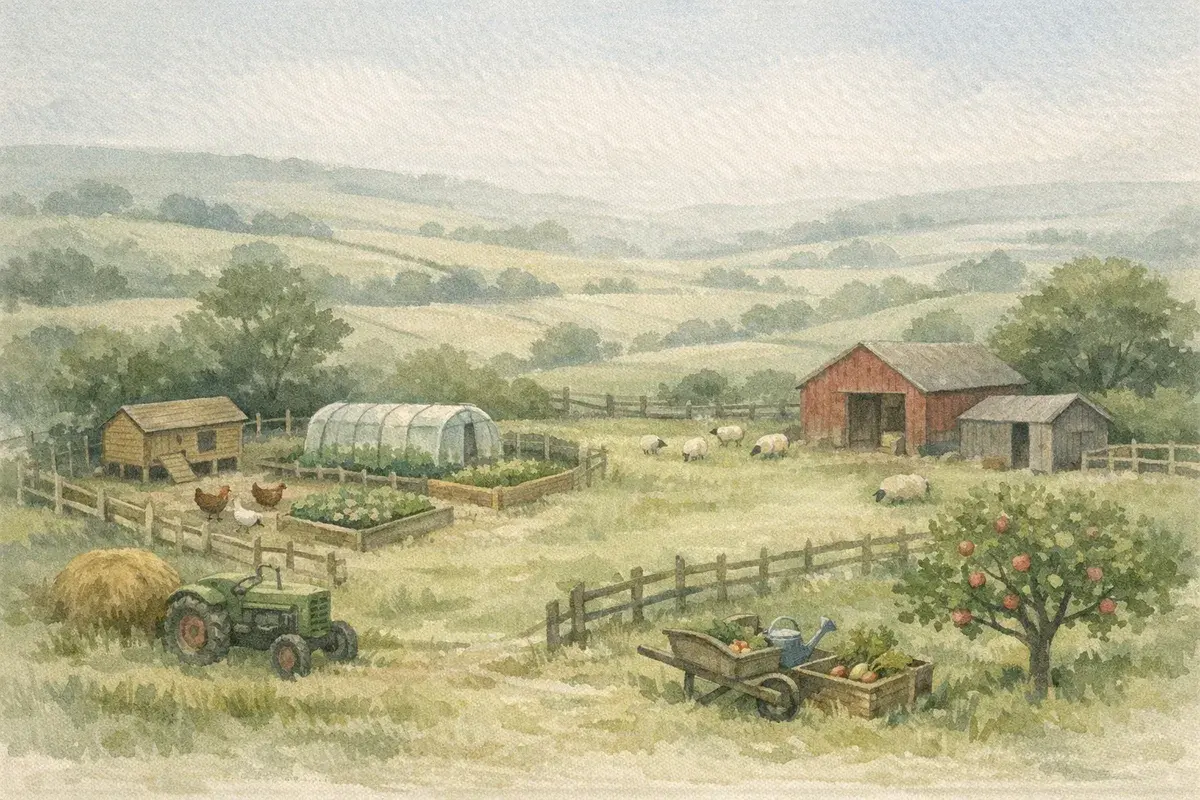
If you're asking how many acres for a smallholding, the short answer is: it depends on what you want to do, where you are in the UK, and whether you're aiming for self-sufficiency, lifestyle farming, or a modest income. For many buyers, 5 to 20 acres is the sweet spot, but plenty of viable smallholdings work on less or much more.
The real question isn't just acreage. It's what the land can support, how much infrastructure is already in place, and whether the holding has the right mix of pasture, paddocks, buildings, water, and access. A tidy 7-acre block in Devon can be more useful than 20 poor acres of wet, awkward ground in parts of Cumbria (not ideal, frankly), so context matters.
In broad terms, a smallholding in the UK usually starts around 2 to 5 acres for hobby growing and a few animals, rises to 5 to 15 acres for more flexible mixed use, and often sits around 10 to 30 acres where buyers want sheep, poultry, orchards, market gardening, or horse grazing. But acreage alone does not define practicality.
What does? Stocking rate, soil quality, drainage, shelter, buildings, access roads, and local planning. If you're buying in Somerset, Herefordshire, North Yorkshire, or the Scottish Borders, you'll also find very different land values and local expectations, which can make the same acreage perform very differently.
How Many Acres A Smallholding Usually Needs
There is no single magic number. The right size depends on whether you want a lifestyle smallholding, a productive holding, or something that can generate a serious side income. That said, most buyers are surprised by how quickly land gets used up once you factor in rotation, shelter belts, composting, tracks, and keeping stock off sensitive areas.
For a genuine smallholding, 3 to 5 acres can work well if your goals are modest. Think kitchen garden, orchard, a flock of poultry, perhaps a couple of sheep or goats, and a yard for equipment. Once you want rotational grazing, hay ground, or multiple species, 5 to 15 acres usually feels more comfortable.
Typical Acreage By Smallholding Type
A hobby smallholding is often under 5 acres. This is enough for a large veg plot, polytunnel, fruit, a few hens, and maybe a pony or two if the land is well managed. A self-sufficiency orientated holding tends to sit closer to 8 to 15 acres, because you need more room for crops, livestock rotation, and winter feed storage.
A commercial smallholding is more variable. It might be 10 acres of intensive horticulture near a town, or 30 acres of mixed grassland in a rural county where land is cheaper and labour is harder to find. For example, a small market gardening operation in Kent may thrive on fewer acres than a low-input livestock unit in the Highlands.
- 2 to 4 acres: Ideal for gardens, fruit, poultry, and a few light-grazing animals.
- 5 to 10 acres: Strong all-round size for mixed use and flexible stock keeping.
- 10 to 20 acres: Better for rotational grazing, larger orchards, and more serious production.
- 20+ acres: Moves towards a small farm rather than a classic smallholding.
We'd argue that many first-time buyers overestimate how much land they can manage alone. Acreage sounds generous until fencing, mowing, soil improvement, and livestock care arrive. A smaller, better-equipped holding often beats a bigger, bare one.
What You Can Do On Different Acreage Sizes
The use case matters more than the headline number. Two acres of fertile, well-drained land near a farmhouse can support a hugely productive setup, while ten acres of heavy clay with no buildings may feel awkward and costly to improve. It's all about intent and practicality.
If you want a few hens, a veg patch, soft fruit, and maybe a small orchard, 1 to 3 acres can already work. If you want grazing, you need to think in terms of stocking rate, which is the number of animals land can support without degrading the sward. That depends on grass growth, rainfall, and management rather than acreage alone.
Livestock And Grazing Needs
For sheep, many lowland holdings in England might support roughly 5 to 8 ewes per acre in good grass conditions, but that is only a rough guide and changes through the seasons. In wetter western counties such as Cornwall, Devon, and parts of Wales, grass may grow well but ground conditions can limit practical stocking. In drier or poorer land, the number may be much lower.
For horses, the rule of thumb is often around 1 to 2 acres per horse for grazing, though winter housing, exercise, and hay supply can increase land needs significantly. Pigs, goats, and poultry each bring different demands too, especially around fencing and shelter.
- Poultry: Can fit into a compact space, but ranging and hygiene still matter.
- Sheep: Need decent pasture, secure fencing, and handling facilities.
- Goats: Require strong boundaries and will test every weakness.
- Horses: Need more than grass, including hard standing and muck management.
For mixed use, flexibility is king. A holding with 6 acres split into house plot, orchard, pasture, and a paddock can be more useful than a single broad field. Why? Because mixed land use reduces reliance on one income stream or one crop type.
Growing Fruit And Vegetables
If your aim is food production, land quality can matter more than raw size. A well-run market garden on 1 acre can be very productive, particularly with irrigation, manure, tunnels, and a nearby customer base. But if you want to produce a substantial share of household food all year, you'll usually want several acres to allow for rotation, paths, storage, and pollinator-friendly edges.
Thinking long term helps. Fruit trees take years to mature, and sheltered, south-facing land in counties such as Kent, Essex, or Worcestershire can lift productivity markedly. North-facing slope, poor drainage, and exposure to wind can halve the value of the same acreage.
Land Quality, Buildings, And Planning Matter More Than Raw Acreage
A smallholding is not just about area on a map. The best holdings have decent access, useful outbuildings, water supply, and enough shelter to keep both animals and machinery manageable. Without those, even a generous acreage can become a constant project.
Good buildings can dramatically reduce the acreage you need. A barn for feed, a secure store for tools, a polytunnel, and a hardstanding yard can let you do far more on 4 to 6 acres than an empty field ever could. In market terms, that infrastructure often adds value, too, especially where permissions are already established.
Soil, Drainage, And Aspect
Soil type shapes what is realistic. Free-draining loam in parts of Leicestershire or East Anglia can support grazing and cropping efficiently, while heavy clay in parts of Shropshire or Somerset can become poached easily in wet weather. Poaching means soil and pasture damage from livestock treading, and it can quickly reduce productivity.
Aspect matters as well. South-facing land catches more sun and tends to be better for fruit, vines, and early-growing crops. Sheltered sites reduce winter feed needs and make outdoor work far easier. Would you rather have 8 productive acres or 15 awkward ones? Most buyers would choose the former.
Planning And Use Class Issues
If you're buying land for a smallholding, check what is already authorised. Agricultural land, equestrian land, and land with residential curtilage each raise different planning questions. A field may be perfectly suitable for grazing but carry no right to build a new dwelling, which is a crucial distinction for anyone hoping to live on site.
In counties with strong rural demand such as Surrey, Gloucestershire, and Hampshire, a parcel with existing buildings and good access can command a premium. Meanwhile, in some parts of Wales, Northern Ireland, and northern England, acreage may be cheaper, but infrastructure and planning constraints can still shape what you can actually do. Whether the council treats the holding as agriculture rather than hobby or equestrian use is the hinge, because that classification drives permitted development rights, business rates and livestock record duties, as the rules a working smallholding has to meet explain.
| Holding Type | Typical Size | Best Suited For | Notes As Of June/2026 |
|---|---|---|---|
| Hobby Smallholding | 2 to 5 acres | Gardens, poultry, fruit, light livestock | Often easiest to manage for first-time buyers |
| Mixed Smallholding | 5 to 15 acres | Rotational grazing, orchards, veg, sheep | Most common target band for lifestyle buyers |
| Commercial Smallholding | 10 to 30 acres | Market gardening, livestock, niche food production | Needs stronger infrastructure and business planning |
| Small Farm | 30+ acres | Broader livestock or arable use | Often beyond what buyers mean by smallholding |
What Smallholding Land Costs Across The UK
Price is another reason acreage alone can mislead. Land values vary sharply by region, land quality, and whether there are buildings, hope value, or development prospects. As of June/2026, rough market expectations for bare agricultural land differ widely across the UK.
In broad terms, lower-grade grazing land in parts of northern England and Wales may sit much lower than good arable land in southern England. Add a farmhouse, barns, or a residential element, and the numbers change again. That is why a smallholding search in Norfolk, Somerset, or Dorset can feel very different from one in Lancashire or the Scottish Borders.
| UK Area | Typical Bare Land Range Per Acre | Market Notes As Of June/2026 |
|---|---|---|
| South East England | £8,000 to £15,000+ | High demand, limited supply, strong lifestyle buyer competition |
| South West England | £6,000 to £11,000 | Good demand for lifestyle holdings and equestrian use |
| Midlands | £5,000 to £9,000 | Varies strongly by access, buildings, and soil quality |
| Northern England | £3,500 to £7,500 | More affordable acreage, but building stock can be limited |
| Wales | £3,000 to £6,500 | Good value in many rural areas, with local variation |
| Scotland | £2,500 to £6,000 | Large variation by location, access, and quality |
Those are broad guide ranges, not guarantees. A small parcel with a farmhouse near Bath can cost more per acre than a much larger agricultural block in less sought-after territory. Equally, a cheap holding may need fencing, drainage, access work, or building repairs that soon absorb the apparent saving.
Why Infrastructure Changes The Price Equation
Buildings, water, power, tracks, and existing planning consent can push values up sharply. If a holding already includes a barn conversion potential, livestock sheds, or a yard in usable order, the acreage becomes much more than a simple land purchase. The infrastructure may be what you're really buying.
That is especially true for buyers looking at smallholdings near commuter counties such as Buckinghamshire, Oxfordshire, and parts of Kent. A modest acre count with strong infrastructure can be more expensive and more desirable than a larger bare block further out.
Choosing The Right Acreage For Your Goals
So how many acres for a smallholding should you actually target? Start with your intended output, your budget, and the amount of work you can realistically handle. Then stress-test the plan for winter, wet weather, fencing maintenance, and time off (because yes, you will want some).
For most first-time buyers, 5 to 10 acres is a sensible middle ground. It is big enough to feel like a real holding, but not so large that every job becomes a major undertaking. If your priority is self-sufficient growing, a smaller but better-located holding may be enough. If you want sheep, horses, or a duck flock with rotations, you may need more.
Practical Buyer Checklist
Before deciding on acreage, ask a few straightforward questions. How much land can you manage yourself? Do you want livestock, crops, or both? Will you need separate areas for grazing and resting land? Can the holding support winter mud without becoming unusable?
We'd also suggest thinking in seasons rather than acres. A holding that works in July can fail in January if drainage is poor or shelter is lacking. Many buyers discover that the most important part of a smallholding is not size at all, but resilience. Whatever size you settle on, the order of work stays the same: confirm legal access, a reliable water supply and stock-proof boundaries, then get fencing, sheds and access works finished before any animals arrive, which is the sequence followed in our guide to setting up a smallholding from scratch.
- Budget: Match acreage to total purchase and improvement costs.
- Labour: Be honest about how many hours you can give each week.
- Access: Check road access for livestock, deliveries, and machinery.
- Water: Confirm supply for both stock and irrigation.
- Buildings: Prioritise usable barns, sheds, and hardstanding where possible.
- Future use: Leave room for expansion, diversification, or resale appeal.
In the end, the best acreage is the acreage that suits your actual life. A compact, well-sited holding in Lincolnshire may outwork a larger but awkward parcel elsewhere. That is the real lesson when asking how many acres for a smallholding.
Conclusion
There is no one-size-fits-all answer to how many acres for a smallholding, but most buyers will find somewhere between 5 and 15 acres gives the best balance of ambition and manageability. Smaller holdings can work beautifully for intensive growing or light livestock, while larger ones suit more ambitious mixed-use plans.
The key is to match acreage to land quality, buildings, access, and the way you actually want to live and work. Get that balance right, and even a modest holding can feel far bigger than it looks on paper.
Disclaimer: AgLand.co.uk is a UK agricultural land and rural property matching service, where buyers register what they are looking for and owners advertise directly to the buyers who match, and a rural resource hub. Nothing in this text is intended as legal, financial, or investment advice. You should carry out your own due diligence and seek guidance from appropriately qualified professionals (for example, solicitors, land agents, surveyors, and financial advisors) for your specific circumstances.