
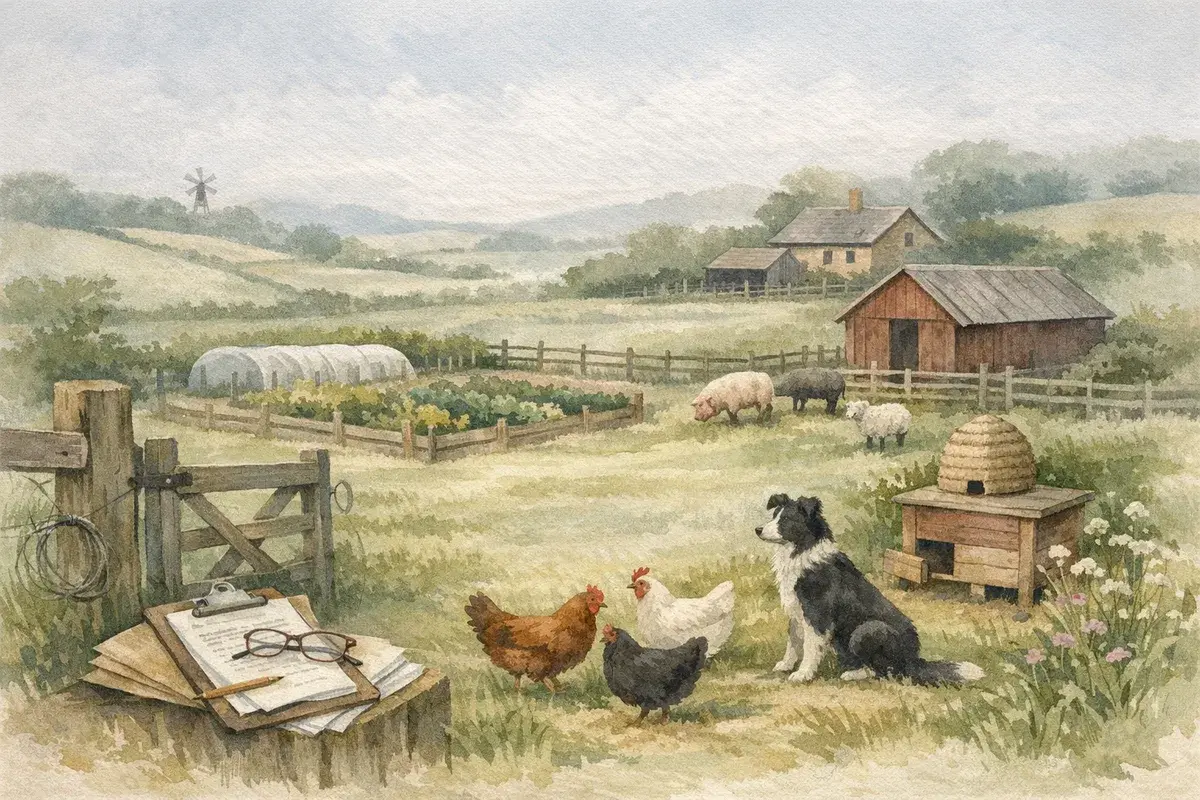
If youare buying, setting up, or expanding a smallholding, understanding smallholding rules and regulations UK is the difference between a workable rural business and an expensive headache. The main issues usually involve planning, livestock welfare, environmental controls, and whether your land use changes trigger a tax or licensing check.
Most first-time buyers ask the same thing: what can I actually do on the land? The honest answer is that it depends on what the holding already is, what you plan to keep or grow, and whether the local authority sees the activity as agriculture, a lifestyle use, or something that needs permission.
That matters in every county, but the detail shifts. A Devon smallholding with sheep and a veg patch will face different pressures to a North Yorkshire yard with poultry, a manure store, and a farm shop, while land close to villages in Surrey or Cheshire may attract tighter planning scrutiny because of amenity, traffic, and noise concerns.
What Counts As A Smallholding In The UK
There is no single legal definition of a smallholding in the UK, which confuses plenty of buyers. In practice, it usually means a modest rural property where land is used for farming, growing, grazing, keeping livestock, or a mix of those uses, often alongside a dwelling and outbuildings.
The legal label matters less than the actual use. A smallholding might be a few acres with poultry and market gardening, or twenty acres with sheep, ponies, and a polytunnel setup, but if the use is agricultural the rules are generally more permissive than for a hobby holding or equestrian site.
Agricultural Use Versus Hobby Use
This distinction is important because many rights and exemptions depend on whether the land is genuinely agricultural. Agricultural use normally means land is used for growing crops, rearing livestock, or horticultural production with a degree of commercial intent, even if profits are modest at first.
A hobby holding, by contrast, often means the land is mainly for personal enjoyment, pets, or informal land management. That can affect planning, business rates, permitted development rights, and whether the council will treat a structure as agricultural or domestic.
- Agricultural use: sheep, cattle, arable, horticulture, or poultry kept as part of a working enterprise.
- Domestic use: gardens, family outings, or keeping a few animals without a business purpose.
- Equestrian use: horses and related facilities often sit outside agriculture unless there is a wider farming enterprise.
Wed argue that buyers should pin this down early. If the land is described as a smallholding in an estate agents brochure, that is marketing language, not a legal status.
Typical Smallholding Sizes And Rural Setups
Theres no minimum acreage, but scale affects what is practical. In Cornwall, Herefordshire, and parts of Northumberland, a smallholding of 3 to 10 acres may suit poultry, market gardening, or goats; in East Anglia, larger acreages are often needed for arable or grazing to be commercially meaningful.
What you can sensibly run depends on soil, water, access, and existing buildings. A good paddock with a barn and mains water can be more useful than twenty awkward acres with no track, poor drainage, and a restricted access lane ('fun' for nobody, least of all the vet).
Planning Permission, Permitted Development, And Buildings
Planning is where many smallholding plans slow down. Some changes can be done under permitted development rights, which are pre-approved by law, but many structures, uses, and conversions still need express consent from the local planning authority.
That includes barns, field shelters, feed stores, processing rooms, worker accommodation, and changes of use from agriculture to equestrian, leisure, or retail. The answer can turn on details such as height, footprint, proximity to highways, and whether the building is truly needed for agricultural purposes.
Farm Buildings, Field Shelters, And Change Of Use
Farm buildings are often the first area to check. A barn on land in Cumbria may be eligible for agricultural use without full planning issues, but converting it into a café, workshop, or holiday let is a different proposition entirely and usually brings a full planning assessment.
Field shelters, mobile pens, and polytunnels also sit in a grey area unless designed and sited carefully. Councils will ask whether they are genuinely temporary, whether they affect landscape character, and whether they create noise, odour, or traffic impacts for neighbours.
- Permitted development: some agricultural buildings and operations can proceed without full planning permission.
- Material change of use: shifting from agriculture to another use can require consent.
- Lawful development certificate: useful proof that a structure or use is lawful, especially before a sale.
If youre near an Area of Outstanding Natural Beauty or on a sensitive rural edge, expect closer scrutiny. In the South Downs, the Cotswolds, and parts of Dorset, visual impact and access often matter as much as the building itself.
Storage, Access, And Rural Diversification
Many smallholders branch into diversification to make the numbers work. That might mean a farm shop, pick-your-own fruit, glamping, or a roadside honesty shed, but each can trigger planning, highways, food hygiene, and sometimes licensing requirements.
Access is often underestimated. If delivery vans, feed lorries, and customers all need to use the same narrow lane, the council may want visibility splays, surfacing details, or evidence that traffic can be managed safely.
Livestock Welfare, Identification, And Movement Rules
Keeping animals brings its own rulebook. Whether you keep sheep in Welsh border counties, cattle in Cheshire, alpacas in Kent, or poultry in Somerset, youll need to follow welfare standards, identification rules, and movement controls.
The basics are common sense, but enforcement is real. Animals need appropriate housing, feed, water, shelter, fencing, and veterinary care, and the keeper must know how to recognise illness, injury, and biosecurity risks before they spread.
Animal Welfare, Housing, And Biosecurity
Animal welfare law sets broad requirements, but practical standards matter more day to day. Your handling system, quarantine pen, muck management, and clean water supply should all suit the species you keep and the weather conditions typical in your part of the country.
Biosecurity means keeping disease off the holding and limiting spread if it arrives. That may involve foot dips, separate tools for new stock, isolation pens, and a sensible plan for visitors, especially if you are running workshops or open days.
- Welfare: animals must be fed, watered, housed, and protected properly.
- Biosecurity: reduce the risk of disease entering or leaving the holding.
- Record keeping: treat medicines, births, deaths, and treatments seriously.
Livestock Identification And Movement Reporting
Sheep, cattle, and pigs have specific identification and movement rules. Ear tags, holding registers, movement licences, and movement reporting all need to be right, because a mistake can create problems with traceability, subsidy checks, or future sales.
A smallholding with a few store lambs is still subject to the rules. Even if you are not a full-time farm business, local markets and abattoirs will expect paperwork to be complete and accurate.
As of June 2026, the practical message is simple: keep ID systems organised from day one, because retrospective fixes are always more stressful than getting the paperwork right before the stock arrives.
Environmental, Waste, And Water Regulations
Smallholdings often sit at the point where agriculture meets environmental compliance. Manure, slurry, silage, fuel storage, water abstraction, and drainage can all trigger obligations, especially on land near streams, ditches, or designated habitats.
For buyers in Devon, Norfolk, Lancashire, and the Scottish borders, this is not a niche issue. Runoff, odour, and pollution complaints can escalate quickly, particularly where larger houses or villages are close by.
Manure, Slurry, And Nuisance Control
Manure and muck look harmless until they are badly managed. If stored too close to watercourses or neighbours, they can create pollution, flies, smell, and enforcement action, especially where stock numbers increase without better infrastructure.
Slurry and dirty water need even more care. If you plan to keep cattle or pigs, check whether existing yards, tanks, and drains are compliant and whether you have enough storage for wet periods, which is where the UK climate likes to test everyone.
Water Abstraction, Wells, And Drainage
If your holding relies on a borehole, well, or stream abstraction, you may need permission or a licence depending on volume and use. Drainage works can also need consent if they affect ordinary watercourses, ditches, or neighbouring land.
This is especially relevant in low-lying areas such as Lincolnshire, Somerset Levels, and parts of Cambridgeshire, where water management is central to productive use. A field that floods once a winter is annoying; a field that floods every winter is a business plan problem.
| Issue | Typical Trigger | Who Usually Checks | As Of |
|---|---|---|---|
| Planning permission | New buildings, change of use, diversification | Local planning authority | June 2026 |
| Livestock records | Sheep, cattle, pigs, poultry movements | Animal health and trading bodies | June 2026 |
| Water controls | Boreholes, abstraction, drainage works | Environment regulator | June 2026 |
| Waste storage | Manure, slurry, farm plastics, chemicals | Local authority and environment regulator | June 2026 |
That table is not a substitute for local advice, but it shows where most compliance pressure lands. The actual paperwork will depend on the holdings layout, the species kept, and any nearby protected land or water.
Tax, Business Rates, And Compliance By Region
Tax treatment can be just as important as planning. A smallholding may qualify for agricultural property relief on inheritance tax in some cases, while business rates may apply to shops, yards, workshops, or intensive commercial activity that is no longer treated as purely agricultural.
County and regional context matters here because land values, diversification opportunities, and council attitudes vary widely. A smallholding on the edge of Oxfordshire can face different planning and rating pressures from one in Shropshire or County Durham, even if the acreage is similar.
Inheritance Tax, Business Rates, And Land Use
Inheritance tax reliefs can be significant for estates with working farmland, but the detail depends on occupation, ownership, and agricultural use at the relevant time. If the land is partly domestic or partly diversified, advisers will often slice the holding into separate elements for tax analysis.
Business rates are most likely where there is non-domestic activity. That could include a retail unit, holiday accommodation, self-storage, or a processing room, so a mixed-use smallholding needs a careful review rather than a blanket assumption that everything is exempt. That mixed character shapes the purchase tax too, because a holding sold as a house with land is commonly treated as residential or mixed use rather than plain farmland, and the SDLT bill on a rural purchase follows that classification rather than the acreage.
Regional Practical Differences Across The UK
In Wales, planning and environmental expectations can be especially sensitive in scenic and conservation-heavy areas. In Scotland, land use and agricultural tenancy structures can create different ownership and occupation issues, while in England local plan policies often vary sharply from one county to the next.
Estate agents and rural buyers should also watch local market expectations. In parts of Cheshire and Hampshire, buyers may pay more for established infrastructure and good road access, while in more remote upland areas the value may sit more in land quality, shelter, and grazing rights than in polished buildings.
As of June 2026, a modest smallholding in strong commuter-rural locations can command a premium if it has consented buildings, suitable access, and a clean compliance history. But a problematic holding with unclear use, poor records, or enforcement risk can lose value fast, because uncertainty puts off both lenders and buyers.
How To Stay Compliant And Keep The Holding Saleable
The best smallholdings are the ones that are easy to explain. Clear land use, tidy records, sensible access, and lawful buildings make life easier whether youre farming, diversifying, or preparing for a future sale.
Keep a folder, digital or paper, with planning decisions, maps, livestock records, invoices for infrastructure, water tests, and any environmental correspondence. It sounds dull, but buyers and solicitors love nothing more than evidence that the holding has been run properly.
- Check planning status: confirm what is lawful before building or converting anything.
- Keep livestock records: identify animals, log movements, and store medicine details.
- Manage waste properly: store muck, chemicals, and plastics safely.
- Review access: make sure vehicles can enter and leave the holding safely.
- Get local advice early: especially where the site is near sensitive neighbours or habitats.
Wed argue that the most saleable smallholdings are not always the prettiest. They are the ones where a buyer can see a legitimate use, manageable maintenance, and no obvious compliance trap waiting in the hedgerow.
Conclusion
Smallholding rules and regulations UK can feel broad, but the core idea is straightforward: know what the land is used for, what buildings are lawful, how livestock and waste are managed, and whether any diversification needs permission. If you get those basics right, the holding is far more likely to be workable, financeable, and saleable.
The exact rules will vary by county, site history, and intended use, so the safest approach is to treat each holding as a specific case rather than rely on assumptions. That is the point where good records, sensible infrastructure, and local professional guidance really pay for themselves.
Disclaimer: AgLand.co.uk is a UK agricultural land and rural property matching service, where buyers register what they are looking for and owners advertise directly to the buyers who match, and a rural resource hub. Nothing in this text is intended as legal, financial, or investment advice. You should carry out your own due diligence and seek guidance from appropriately qualified professionals (for example, solicitors, land agents, surveyors, and financial advisors) for your specific circumstances.