
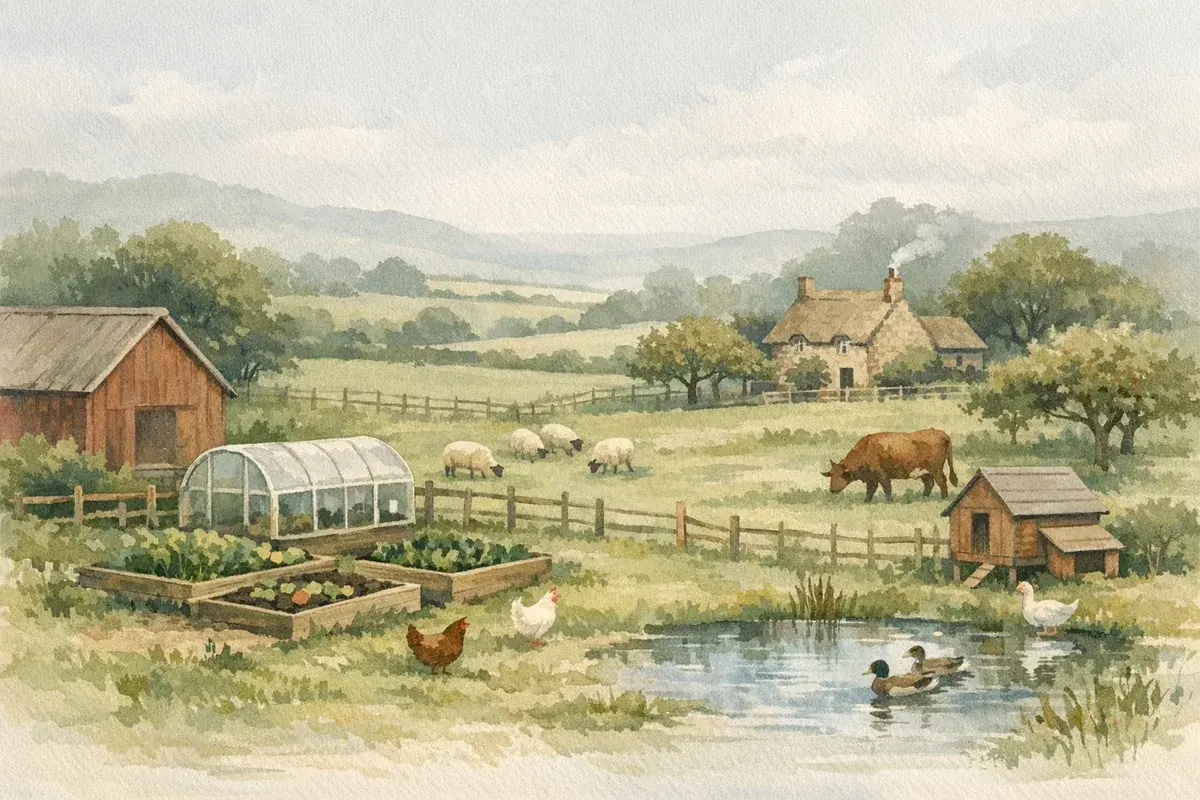
If youre asking what is a smallholding UK, the short answer is this: its a small rural property, usually with land, used for farming, hobby production, or a mixed country lifestyle. The exact meaning can vary, but the practical features are fairly consistent.
In plain terms, a smallholding sits somewhere between a house with a large garden and a full commercial farm. It might include a few acres, livestock, pasture, orchard ground, or barns, and it often attracts buyers who want income potential as well as space.
That mix is why the term matters. For buyers, it affects borrowing, planning, and day-to-day management. For agents, it shapes how a property is marketed, valued, and matched to the right audience.
What A Smallholding Means In The UK
A smallholding is generally a small rural holding of land and buildings that can support agricultural activity on a modest scale. There is no single statutory size that defines it, which is where a lot of confusion starts (and where brochures can get a bit loose with the phrase).
In practice, a smallholding might be anything from 1 to 50 acres, though many UK examples sit around the 2 to 20 acre mark. The land may be grazing, paddocks, woodland, orchards, beds for vegetables, or a combination of all four.
Smallholding Versus Farm Versus Lifestyle Property
A smallholding is not the same as a larger commercial farm, because it usually lacks the scale needed for full-time commodity production. It is also not quite the same as a lifestyle property, because there is usually a proper working element to the land rather than simply green views.
Wed argue the best test is use, not just acreage. If the land is intended for livestock, crops, market gardening, or self-sufficient production, it often reads as a smallholding even when the acreage is modest.
- Smallholding: Small rural holding with productive land and buildings.
- Farm: Typically larger, more commercial, and income-led.
- Lifestyle property: Country home with land, but limited agricultural use.
- Equestrian smallholding: Land and buildings suited to horses and grazing.
That distinction matters to lenders, valuers, and planners. It also matters to buyers searching in counties such as Devon, Somerset, Herefordshire, Welsh borders, Yorkshire, and parts of Kent, where mixed-use rural property is in constant demand.
Typical Sizes, Land Uses, And Buildings
There is no official acreage threshold, but most buyers picture a smallholding as a manageable parcel of land with a dwelling and useful outbuildings. In England and Wales, that often means a house, barn, yard, field shelters, and enough land to justify machinery, livestock, or productive gardening.
What counts as manageable depends on the enterprise. A market garden near Cambridge or Kent may work on just a few acres, while sheep grazing in Exmoor or Cumbria may need more land to be remotely viable. Most UK buyers end up somewhere in the 5 to 20 acre band, though stocking reality decides more than the headline figure, with horses usually allowed around 1 to 2 acres each, and how many acres a smallholding actually needs breaks the ranges down by holding type.
Common Land Uses On Smallholdings
Smallholdings are usually diverse rather than specialist. That versatility is part of their appeal, especially for buyers who want to diversify income or use the land more intensively than a standard garden allows.
- Grazing land: Let for sheep, cattle, goats, or horses.
- Market gardening: Small-scale vegetable and cut-flower production.
- Orchards and soft fruit: Apple, pear, plum, berries, and similar crops.
- Woodland and coppice: Firewood, biodiversity, and amenity value.
- Agri-diversification: Farm shops, workshops, storage, or holiday use.
The buildings are just as important as the acreage. A sturdy barn, basic yard infrastructure, water supply, and good access can make a modest holding far more useful than a larger but poorly served parcel.
Regional Differences Across The UK
Demand looks different by county. In Devon and Cornwall, buyers often want a house with land, ponies, and tourism potential. In Lincolnshire or East Anglia, the focus may be arable-adjacent land, storage, or horticulture. In Northumberland and parts of Scotland, larger acreages can still be affordable, though infrastructure can be more basic.
Planning and title issues also vary. In some parts of the Home Counties, a smallholding may be under pressure from development value, while in the West Country it may be protected by landscape sensitivity and tighter local policy.
Who Buys Smallholdings And Why
The buyer pool is broader than many people think. Some are established farmers downsizing, some are newcomers seeking a rural start, and some are investors looking for land with optionality. The attraction is usually a mix of space, flexibility, and personal use.
Rural buyers often want more than a house. They want self-sufficiency, a bit of income, or the ability to run a small enterprise without the overheads of a full-scale farm.
Common Buyer Types
Each buyer type comes with a different brief, which is why good marketing needs to be precise rather than fluffy. A holding that is perfect for poultry may be useless for a horse buyer, and a dream equestrian site may be awkward for a vegetable grower.
- New Entrants: Buyers starting a small rural business.
- Downsizers: Farmers reducing scale but keeping land use.
- Equestrian Buyers: People needing grazing, stables, and rides.
- Self-Sufficiency Buyers: Households wanting food production and space.
- Investors: Buyers seeking land value, amenity, or diversification.
In counties such as Gloucestershire, Shropshire, and North Yorkshire, this demand often gets intense where good access, pretty settings, and useful buildings all line up. In those areas, smallholdings can command a premium because buyers rarely find the same specification twice.
Planning, Tax, And Practical Buying Issues
Buying a smallholding is not just about liking the view. You need to look at planning status, agricultural ties, access rights, drainage, water, environmental constraints, and how the holding has been used historically.
Thats because a smallholding can be wonderfully flexible on paper, but restrictive in practice. A field that looks ideal for ponies may be subject to a covenant, flood risk, or limited vehicle access, and that changes everything.
Planning And Use Class Considerations
Planning permission is a major issue where buyers want to add buildings, convert barns, or change use. Some works can fall under permitted development, but rural sites often need a careful check from the local planning authority.
In Cheshire, Surrey, and parts of the Cotswolds, planning risk is often as important as land quality. A buyer may pay more for an existing lawful use than for a larger holding with uncertain development potential.
Letting, Rent, And Income Potential
Some smallholdings are owner-occupied, while others have land let to third parties. Grazing agreements, mow-and-rake arrangements, and storage lets can all generate modest income, though the numbers should be tested properly.
As of May 2025, market data seen across rural instruction and buyer search trends suggests smaller holdings with a house and 2 to 10 acres can often attract a wider audience than bare land alone, particularly in southern England and accessible commuter counties. Bare land values vary sharply by quality and location, but productive land close to strong demand centres tends to outperform less accessible parcels.
| Typical Smallholding Feature | Why It Matters | Practical Buyer Impact | As Of |
|---|---|---|---|
| House plus 2 to 10 acres | Broadest appeal to lifestyle and hobby buyers | Often quicker to market than bare land | May 2025 |
| Barn or yard infrastructure | Supports livestock, storage, or workshops | Can materially improve value and usability | May 2025 |
| Good road access | Useful for trailers, livestock, and machinery | Reduces day-to-day friction and future risk | May 2025 |
| Water and fencing | Essential for grazing and mixed enterprise use | Usually avoids immediate capital spend | May 2025 |
Tax treatment can also change depending on use. A property with genuine agricultural use may be assessed differently from one that is largely residential with a bit of land attached, so advisers will usually want to see how income is generated and documented.
How Smallholdings Are Valued In Todays Market
Valuation depends on a blend of factors: acreage, land quality, building condition, access, location, and whether the property offers income or development potential. There is no simple per-acre rule, because the house often drives the top line while the land shapes the applicant pool.
As of May 2025, the strongest smallholding sales tend to be those that combine usability with charm. Think decent access, flexible buildings, manageable acreage, and a house that does not require a full rebuild before you can live on site.
What Pushes Value Up Or Down
Proximity to major roads and towns can boost interest, especially in counties such as Somerset, Warwickshire, and Northamptonshire where buyers may want rural space without isolation. Good pasture, strong fencing, mature shelter belts, and outbuildings can all add practical value.
By contrast, poor drainage, awkward access, rundown roofs, and restrictive title issues can knock value back hard. So can over-promising in the listing (a common irritation), especially when land is actually surplus paddock rather than proper working ground.
- Location: Near strong demand centres usually helps.
- Land quality: Productive pasture or arable-grade land is prized.
- Buildings: Dry, adaptable structures improve utility.
- Income: Existing letting or farming income can support price.
- Constraints: Rights of way, covenants, and flood risk may reduce appeal.
For agents, the lesson is clear. Market the holding for what it genuinely is. For buyers, the question is simpler: does the land support the life or business you actually want, or just the idea of it?
What A Buyer Should Check Before Purchasing
A smallholding can be a brilliant purchase, but only if the legal and practical details stack up. Buyers should inspect boundaries, access, services, water supply, drainage, outbuildings, land condition, and any agricultural agreements already in place.
They should also check whether the land has an AOC or occupancy restriction, which can limit who may live there. If that sounds niche, it is, but niche issues have a habit of becoming expensive at the worst possible moment.
Due Diligence Essentials
A sensible smallholding review is part legal, part practical, and part common sense. It should happen before emotional attachment takes over (because that happens fast with a lovely place and a nice view).
- Title and boundaries: Confirm ownership, rights, and extent.
- Access: Check legal and physical access for vehicles and machinery.
- Services: Verify water, power, drainage, and broadband.
- Land condition: Look for wet ground, weeds, and fencing quality.
- Planning history: Review consents, breaches, and lawful uses.
In areas such as Powys, Devon, and the Scottish Borders, weather and access can be as important as acreage. A wet entrance track or a steep lane can turn a promising smallholding into a daily slog, particularly in winter.
What Is A Smallholding UK In Practice
So, what is a smallholding UK? It is a small rural holding with land and often buildings, used for farming, husbandry, or mixed country living. The key point is flexibility: it sits between a house with land and a commercial farm, and that makes it useful to a wide range of buyers.
In real life, the best smallholdings are practical, not just picturesque. If the access works, the land suits the intended use, and the paperwork is clean, a smallholding can be a rewarding asset as well as a home.
Disclaimer: AgLand.co.uk is a UK agricultural land and rural property matching service, where buyers register what they are looking for and owners advertise directly to the buyers who match, and a rural resource hub. Nothing in this text is intended as legal, financial, or investment advice. You should carry out your own due diligence and seek guidance from appropriately qualified professionals (for example, solicitors, land agents, surveyors, and financial advisors) for your specific circumstances.