
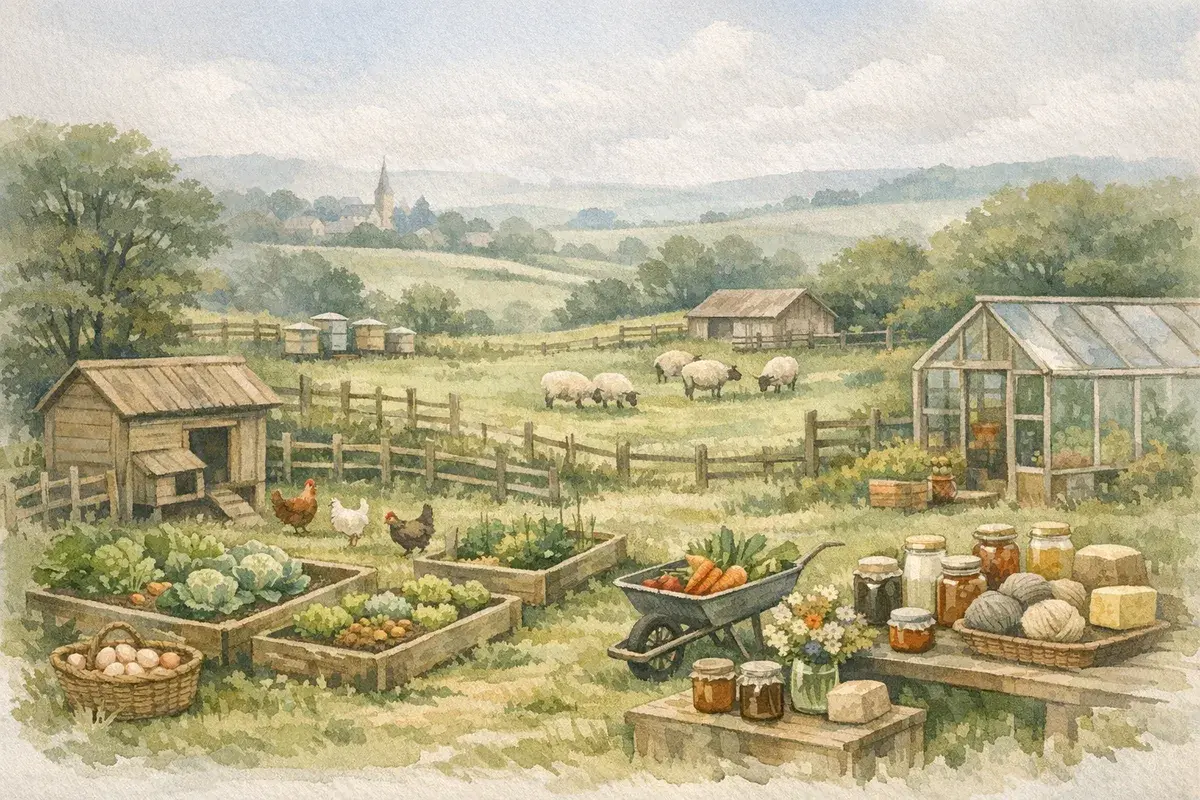
If you're wondering how to make money from a smallholding UK, the short answer is this: focus on a few income streams that suit your land, buildings, time, and local market. A smallholding can support sheep, eggs, produce, storage, rural lets, or even a niche tourism offer, but the best returns usually come from matching the enterprise to the holding rather than forcing the holding to fit the idea.
That means treating the place like a mixed business, not just a patch of fields. A couple of acres in Kent might suit flowers, vineyard rows, or a roadside honesty box, while a larger upland holding in Cumbria may stack up better for grazing, hay, or seasonal tourism. We'd argue the biggest mistake is chasing every possible income stream at once. The sharper move is to start with one or two that already have demand nearby, then build from there.
For many owners, the first question isn't what can I sell, but what can I sell consistently, legally, and without burying myself in labour? That's where the detail matters. Profit on a smallholding often comes from margin, not volume, so good pricing, low overheads, and decent presentation can matter more than scale.
Choose The Right Income Stream For Your Land
The most reliable way to make money from a smallholding is to pick an enterprise that fits the soil, location, access, and your own appetite for graft. A damp Devon parcel near a tourist route has very different prospects from a 12-acre block in Lincolnshire beside arable land. Think about geography first, then business model.
As of August 2025, demand remains strongest where people can buy directly from the smallholding, reach it easily, or link it to a local story. That can mean fresh eggs, microgreens, pumpkins, meat boxes, Christmas trees, rural storage, or letting out a field edge for campervan parking if planning allows. The quieter the location, the more important it is to keep marketing simple and the operation practical.
Match Enterprise To Acreage And Labour
A smallholding only makes money when the work fits the time available. A couple running a weekend enterprise can often manage chickens, market gardening, or a small flock of sheep, but full-time enterprises like dairy or intensive horticulture usually need proper labour and infrastructure.
- Low labour: firewood, hay, grazing, storage, or seasonal tree sales.
- Medium labour: eggs, poultry, cut flowers, small-scale veg, and direct meat sales.
- Higher labour: market gardening, livestock finishing, tourism, and farm shops.
In practice, the most profitable hectares are often the ones closest to the yard, water, and road access. Why? Because repeated handling time quietly kills margin.
Look At Local Demand By County
County context matters more than many new owners realise. In Surrey, Kent, and Herefordshire, higher-value local produce and lifestyle-led buyers can support premium pricing. In parts of Yorkshire, Shropshire, and the East Midlands, larger land blocks and better road links can favour grazing, poultry, or storage-based income. In Cornwall, Dorset, and Pembrokeshire, tourism-linked ideas may be stronger, especially where footfall is seasonal but lively.
We'd also note that urban fringe areas like Cheshire, Essex, and Oxfordshire can work well for direct sales because there's a bigger customer base within half an hour's drive. If your smallholding sits miles from anywhere, you may need a product that ships well or a business that doesn't rely on visitors.
Build Reliable Revenue From Livestock And Produce
Livestock and produce remain classic smallholding income streams because they can turn modest acreage into regular turnover. The catch is that they only work well when you understand costs, compliance, and throughput. A dozen hens can produce cash quickly, but they also need housing, feed, biosecurity, and daily attention.
As of August 2025, direct-to-consumer food sales continue to hold up where quality is clear and provenance is strong. Customers will pay for eggs, lamb boxes, pork, mutton, honey, and seasonal vegetables if the offer is simple and trustworthy. The trick is not just producing food, but packaging it into something people want to buy again.
Small Livestock With Strong Sales Potential
Chickens are often the starter enterprise. Eggs sell well through farm gates, village networks, and local subscription schemes, while point-of-lay hens can also be sold on after their first laying cycle. Ducks, quail, and geese may suit niche markets, though they are not always the easiest route to steady profit.
Sheep and pigs can work well if you already have fencing, handling systems, and abattoir access. In Wales and parts of the West Country, lamb and pork boxes can command stronger local interest, especially when marketed around breed, welfare, and outdoor rearing. In the north, upland grazing may be better suited to low-cost finishing or conservancy grazing than high-input fattening.
Market Gardening And Seasonal Crops
Small areas can produce impressive returns if the crop is high value and well presented. Salad leaves, herbs, asparagus, raspberries, cut flowers, and pumpkins are all common choices because they suit direct sales and repeat buying. A tunnel or polytunnel can make a huge difference by lengthening the season and improving yield consistency.
Roadside sales still work in many counties, especially where local traffic is steady and the display is tidy. But don't overestimate this route. It works best for recognisable, impulse-driven products and needs secure access, good signage, and frequent restocking.
| Income Stream | Typical Strength | Common Constraint | As of Aug 2025 Note |
|---|---|---|---|
| Eggs | Fast turnover | Daily labour | Good local demand where repeat custom exists |
| Vegetables | High margin on small plots | Seasonality | Works best with direct sales and tunnels |
| Lamb or pork boxes | Premium pricing | Processing logistics | Needs clear branding and reliable butchery access |
| Honey | Low land requirement | Weather risk | Strong in pollinator-rich rural and suburban areas |
Use Buildings, Ground And Access To Create Extra Income
Many smallholdings make more money from underused assets than from the fields themselves. A redundant barn, a hardstanding area, a stable block, or even a bit of roadside frontage can produce income with far less day-to-day work than livestock. This is often the difference between a hobby and a business.
Storage, grazing lets, workshops, and rural workspace demand are all relevant, especially near market towns and commuter belts. In counties such as Oxfordshire, Hampshire, Warwickshire, and Suffolk, there is often steady appetite for secure rural storage or small business space, provided access, parking, and insurance are managed properly. Whether those uses pay usually comes down to road frontage, mains services and secure gated access rather than the acreage behind them, which is why our wider guide to earning income from land starts with the site rather than the size.
Rural Lets And Storage
Letting out a barn for dry storage or light use can be a neat earner if the building is sound and the lease terms are clear. Machinery storage, caravan storage, hay and straw space, and hobby units can all work, though fire safety, access rights, and building condition need proper thought.
Outside prime tourism areas, storage can be a more dependable income than visitor-based ideas. It's not glamorous, but it can be steady (which, frankly, is often better).
Field-Let And Grazing Income
If you're not farming every acre yourself, field lets can be a tidy source of passive income. Grazing licences, hay lets, and mowing agreements are common routes, especially where neighbouring farmers need extra grass or an outlying grass field. In parts of Northumberland, Norfolk, and Leicestershire, neighbours often value convenient grazing more than a high-spec business plan.
Make sure the arrangement is properly documented. A grazing licence is different from a tenancy, and that distinction matters if you want flexibility later. Good boundaries, water access, and stock-proof fencing make a huge difference to the rent you can ask.
Sell Direct And Add Value To What You Already Produce
Direct sales can transform a smallholding because they keep more of the final sale price in your pocket. Instead of selling liveweight lamb or wholesale veg, you're selling a branded product to the end customer. That usually means better margin, though it also means more admin, more customer contact, and a higher standard of presentation.
As of August 2025, consumers remain willing to pay for traceability, freshness, and local provenance, especially when inflation has made people more selective rather than purely price-led. Farmers' market stalls, honesty boxes, local delivery drops, and subscription schemes all continue to work, but only when the product is reliable and the story is simple.
Simple Sales Channels That Work
An on-site honesty box is still a strong option for eggs, changeable produce, logs, and flowers. It suits smallholdings with good passing trade, low spoilage risk, and trustworthy local traffic. A weekly veg box or direct meat box can be better for holdings near towns such as Taunton, Bath, York, or Truro, where customers may actively seek local food with minimal faff.
Define the offer clearly. People buy less easily when they have to guess what they're getting. One of the best smallholding lessons is that convenience sells almost as well as quality.
Adding Value Without Overcomplicating Things
Value-added products can lift income, but they should still suit your set-up. Jam, chutney, dried herbs, knitted goods from wool, cut-and-come-again salad packs, and branded firewood bundles all add a layer of margin. The product doesn't need to be fancy, just clear and convenient.
In practical terms, keep the range tight. Too many product lines can swamp a smallholding with labels, packaging, stock control, and wasted time. We'd argue that three good products usually beat ten patchy ones.
- Brand: use a name, local reference, and consistent packaging.
- Traceability: customers like to know where food came from.
- Repeat buying: build rhythm through subscriptions or seasonal offers.
Control Costs, Planning And Compliance Before Chasing Profit
You can't make money from a smallholding if compliance or hidden costs keep eating the margin. Before investing in stock, tunnels, or visitor facilities, look hard at planning, animal welfare, water supply, waste, access, and insurance. These are not side issues. They are the business.
Planning permission can affect glamping, change of use, hardstanding, signage, polytunnels, and any retail or event activity. In rural counties with strong landscape protection, such as Devon, Somerset, North Wales, and the Cotswolds, checks become even more important. If you're near an Area of Outstanding Natural Beauty or a National Landscape, assume scrutiny will be higher and process times may be longer.
Know Your Fixed And Variable Costs
Smallholders often underestimate bedding, feed, vet bills, fencing, water, fuel, feed storage, and waste disposal. A flock or herd can look profitable on paper and still disappoint if repeat costs are not tracked properly. Keep a simple account of each enterprise, not just the whole holding.
As of August 2025, feed and energy costs remain a key pressure point for many rural businesses, so efficiency matters. The easiest way to improve return is often to reduce dead mileage, share equipment, and buy only what earns its keep.
Check The Practical Legal Bits
Animal registration, food hygiene, business rates, environmental rules, water abstraction, and public liability cover all need attention. If you host visitors, park vehicles, or sell goods on site, your risk profile changes quickly. That's why smallholdings that mix farming and public access need tighter records than people expect.
It's also wise to think about succession and ownership structure. If the business grows, the legal shape of the property can matter as much as the land itself, especially where family members, partners, or outside investors are involved.
Conclusion
The best answer to how to make money from a smallholding UK is to keep it focused, local, and realistic. Choose one or two enterprises that fit your acreage, labour, and county market, then price them properly and protect the margin with sound cost control.
Whether you're selling eggs in Kent, grazing cattle in Shropshire, or letting storage space in Oxfordshire, the money usually comes from doing a few things well rather than doing everything. Start with demand, keep overheads tight, and let the smallholding shape the business rather than the other way round.
Disclaimer: AgLand.co.uk is a UK agricultural land and rural property matching service, where buyers register what they are looking for and owners advertise directly to the buyers who match, and a rural resource hub. Nothing in this text is intended as legal, financial, or investment advice. You should carry out your own due diligence and seek guidance from appropriately qualified professionals (for example, solicitors, land agents, surveyors, and financial advisors) for your specific circumstances.