
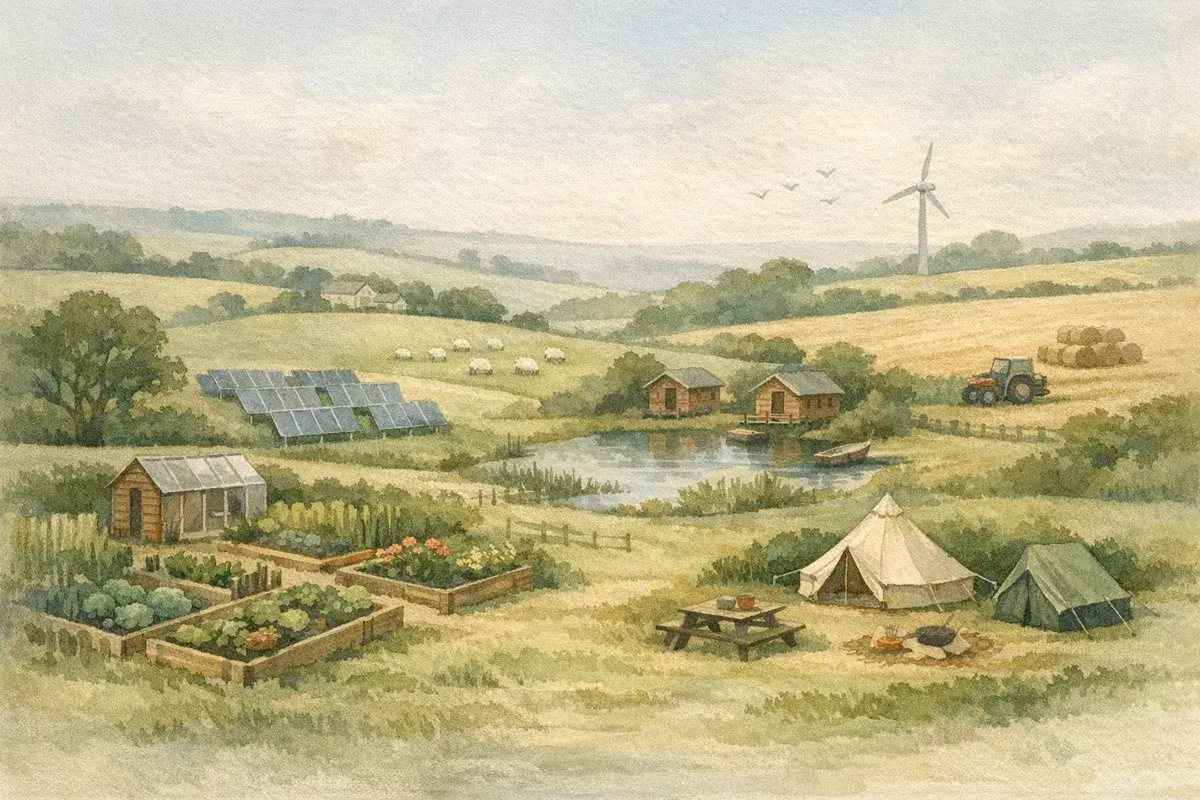
How to make money from land uk depends on what you own, where it sits, and how much work you're willing to do. The good news? There are several routes to income, from grazing lets and diversified storage to timber, solar, and development value.
Some land makes money quietly through long leases. Other parcels need active management, planning thought, or a good local tenant to turn a decent return (we'd argue the best land income often comes from a mix, not a single bet). If you own a few acres in Lincolnshire, a block of mixed arable in Norfolk, or rough pasture in Devon, the right route will be different.
This guide looks at the main ways to generate income from land in the UK, what drives value in different counties, and where the real costs sit. It also covers the practical bits owners often overlook, like access, planning, tax treatment, and the impact of soil quality on long-term returns.
Start With The Land You Actually Have
The first step is simple: assess the asset honestly. A hectare of roadside land in Kent is not the same as ten acres of wet grassland in the Scottish Borders, and the earning potential can differ as much as the landscape does.
Look at soil class, drainage, access, water, existing buildings, road frontage, and proximity to towns or infrastructure. Strong access can be worth a lot on its own, especially on the edge of the South East, parts of Cheshire, or around market towns in Yorkshire where storage, equine, and light industrial demand can be steady.
High-Value Features That Change The Game
Road frontage, mains services, and secure gated access can open up more income options. A field without access may still earn as grazing land, but a site with services and visibility may support a far better use, from farm diversification to commercial letting.
Think beyond the obvious. A paddock near a village in Somerset might suit horse livery. A former farmyard in Staffordshire could be ideal for container storage. A block near a grid connection in East Anglia may attract renewable interest faster than expected.
- Grade 1 or 2 land: often better suited to longer-term agricultural or diversification strategies.
- Poorer pasture: may still earn through grazing, carbon, or habitat options.
- Buildings or yards: can create stronger rental income than bare land.
- Residential edge: often improves interest in storage, equestrian, or development-led uses.
Don't ignore constraints. Rights of way, covenants, flood risk, and biosecurity issues can all limit income or add costs. If the land floods in winter, for example, a long grazing let may work, but year-round yard use probably won't.
Use Agricultural Lets To Generate Steady Income
For many owners, the simplest route is still agricultural rent. Grazing lets, mowing licences, and farm business tenancies can provide predictable income with relatively low effort, especially where the land already sits in a working farming area.
As of June 2026, typical returns vary sharply by quality and location. Better arable land in eastern counties can command stronger rents than marginal pasture in upland areas, but the exact figure depends on local demand, soil, drainage, and landlord obligations.
Grazing Lets And Short-Term Occupation
Grazing is often the easiest way to start, particularly on permanent pasture in counties like Devon, Cumbria, or Herefordshire. It suits owners who want income without heavy infrastructure spend, and it can work well for horse owners, sheep keepers, or smallholders looking for extra acreage. If you would rather work the land than let it, the arithmetic changes and the acres nearest the yard, water and road tend to carry the margin, a theme that runs through these smallholding income ideas ranked by labour load.
A short-term grazing arrangement can be flexible, but the paperwork matters. Licences, insurance, fencing responsibilities, water supply, and animal welfare standards should all be clear before livestock arrive. If they're not, disputes can crop up quickly.
Farm Business Tenancies And Longer Leases
A Farm Business Tenancy, or FBT, is a tenancy created under modern agricultural tenancy rules in England and Wales. It can suit landowners who want a longer-term rural income from arable or mixed land without farming it themselves.
Longer leases can suit blocks in Lincolnshire, Cambridgeshire, or Norfolk, where larger farm businesses often want scale and certainty. They're not a quick win, though. You'll need proper advice on rent review, repairs, access, and whether the holding includes buildings, accommodation, or sporting rights.
| Income Route | Typical Use | Indicative Strength As Of June 2026 | Best Fit |
|---|---|---|---|
| Grazing licence | Short-term livestock use | Low to moderate | Pasture, flexible occupation |
| Farm Business Tenancy | Longer agricultural occupation | Moderate to strong | Arable or mixed blocks |
| Mowing licence | Hay or forage production | Low to moderate | Good grassland, low management |
| Sporting let | Game or fishing income | Moderate to strong | Estate land, waters, woodland |
As a rule of thumb, the more secure and productive the land, the easier it is to let. The downside is that better land also tends to attract more management expectations, so the net return is what matters, not just the headline rent.
Diversify Into Storage, Equestrian, Or Leisure Uses
Farm diversification is where many owners find the best uplift. Why? Because the land itself may not be the main profit driver. Location, convenience, and local demand often matter more than soil type.
In practical terms, storage yards, container sites, equestrian facilities, small workshop lets, and leisure uses can outperform pure agricultural income on suitable sites. This is especially true on the fringes of towns in counties like Essex, Kent, Hampshire, and the West Midlands, where commercial shortages can make rural land attractive.
Storage And Yard Lets
Secure storage is one of the most common rural income routes. It works best where there's good road access, hardstanding, fencing, and sensible security. A redundant yard in North Yorkshire or a field edge site in Gloucestershire can become a genuine income earner if it's well set up.
Rent levels vary widely. A bare paddock with poor access may only support a low monthly return, while a tarmacked, serviced yard near a busy route can achieve much more. The capital cost of surfacing, drainage, and fencing can be significant, so the payback period needs checking carefully.
Equestrian And Leisure Income
Equestrian land can be very profitable in the right place. Horses need turnout, stabling, safe access, and often nearby residential demand, which is why sites close to commuter belts or affluent villages can perform well.
Leisure uses are broader than many owners realise. Caravan storage, dog walking, fishing rights, glamping, and small event spaces can all produce income, but they usually require stronger planning awareness and better neighbour relations than basic agricultural use.
- Equine use: best near towns, riding schools, and established horse communities.
- Storage use: best with access, security, and low overheads.
- Leisure use: often higher yield, but more planning-sensitive.
- Woodland walks or fishing: can add secondary income to wider estate land.
The key question is whether conversion costs make sense. A field in Surrey may justify investment in surfacing and fencing because demand is strong. A remote plot in Powys may be better kept simple and low-cost.
Consider Renewable Energy And Natural Capital
Some of the strongest land income opportunities now sit outside traditional farming. Solar, battery storage, wind, peat, woodland, and habitat schemes are all part of the mix, though each comes with different risks and commitments.
As of June 2026, solar grid interest remains strongest where grid capacity exists and the land is reasonably flat, accessible, and close to infrastructure. East Anglia, Lincolnshire, parts of Kent, and some M4 corridor locations remain active, but every site lives or dies on local technical detail.
Solar And Battery Storage
Solar farms can offer attractive long-term rents, especially on lower-grade land or sites with less intensive agricultural value. Battery storage is even more location-specific, usually depending on grid connection prospects and planning policy.
These uses can create strong income, but they are rarely simple. Lease terms, decommissioning obligations, inflation uplifts, and land restoration duties matter a great deal. If a developer offers a glossy headline figure but the legal detail looks thin, pause (and get proper advice).
Woodland, Carbon, And Habitat Schemes
Woodland creation, biodiversity schemes, and carbon-related opportunities can suit marginal soil, wet corners, or awkward parcels that are hard to farm efficiently. In parts of Scotland, Wales, and upland England, this can be a realistic way to improve whole-farm returns over time.
We'd say these options are best when they fit the land rather than fight it. A poorly performing field on the edge of a floodplain in Norfolk may do better in habitat use than in repeated low-yield cropping.
Improve Value Through Planning And Mixed Use
Planning can be the difference between modest income and a much stronger asset. Land with the right status can produce rental income today and development value tomorrow, but that upside is never guaranteed.
Land on the edge of expanding settlements in counties like Surrey, Bedfordshire, or Cheshire may attract more interest than isolated rural holdings. Even without immediate development, planning potential can improve negotiating strength when letting, selling, or restructuring an estate.
Permitted Development And Rural Buildings
Some agricultural buildings can benefit from permitted development rights, depending on the use, location, and prior approvals. That can make conversion to storage, offices, or light industrial use more achievable, but the detail is highly technical.
Old cattle sheds, grain stores, and redundant dairy buildings often sit on sites with more income potential than their current use suggests. The building fabric may be tired, but if the shell is sound and the access is good, there could be real value there.
Mixed Income Often Wins
In practice, the best-performing holdings often combine several income streams. A farm in Wiltshire might include an agricultural tenancy on the bulk of the land, a storage yard, and a small woodland lets arrangement on the margins.
That spreads risk. If crop returns weaken or a tenant leaves, another income stream can soften the blow. It also makes the asset more attractive to investors and buyers who want resilience rather than a single-use site.
Before changing use, check the local planning policy, highways access, drainage implications, and any ecology constraints. A promising idea can stall fast if the access road is unsuitable or the land sits inside a protected landscape.
Know The Costs, Returns, And Tax Implications
Income is only half the story. Costs, tax, and management time can take a large bite out of gross returns, especially where the site needs fencing, surfacing, drainage, insurance, or a managing agent.
Tax treatment depends on ownership structure, occupation, trading activity, and the type of income. Agricultural rent, diversified business income, and capital appreciation can each be treated differently, so mixed-use land should be reviewed carefully rather than assumed to be simple.
| Cost Or Factor | Why It Matters | Typical Impact As Of June 2026 | Watch For |
|---|---|---|---|
| Fencing and access | Enables lawful occupation and security | Can materially reduce early returns | Subsoil, gateways, visibility |
| Planning and surveys | Needed for non-farm uses | Often essential before spend | Ecology, drainage, highways |
| Insurance and liability | Protects against claims and loss | Recurring overhead | Public liability, fire, tenants |
| Tax and structure | Affects net income and sale value | Can change the economics entirely | VAT, SDLT, inheritance planning |
Don't confuse turnover with profit. A site that rents well but costs heavily to maintain may underperform a quieter holding with lower income and fewer headaches. The best decision is the one that leaves money in your pocket after everything is counted.
For estate agents, that means presenting land with both gross and net logic. For owners, it means asking a blunt question: what will this land actually yield after costs, not just on paper?
Conclusion
The best answer to how to make money from land uk is to match the land to the right use, then price in the real costs. Agricultural lets, diversification, renewables, and planning-led opportunities can all work, but location, access, and quality will shape what's realistic.
Some holdings will suit steady income. Others will suit a longer game with higher upside. Either way, the strongest returns usually come from careful assessment, local knowledge, and a willingness to be flexible over time.
Disclaimer: AgLand.co.uk is a UK agricultural land and rural property matching service, where buyers register what they are looking for and owners advertise directly to the buyers who match, and a rural resource hub. Nothing in this text is intended as legal, financial, or investment advice. You should carry out your own due diligence and seek guidance from appropriately qualified professionals (for example, solicitors, land agents, surveyors, and financial advisors) for your specific circumstances.