
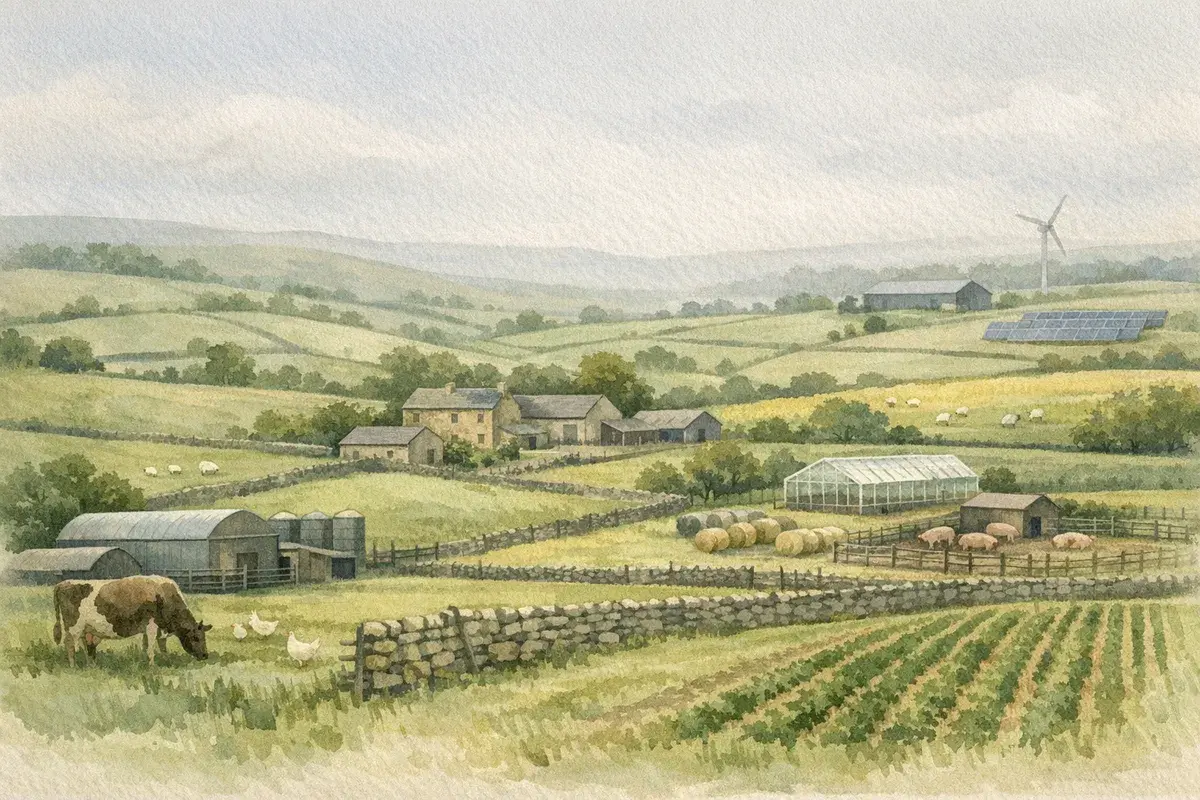
Stand on the edge of a modern UK poultry site or a high-output dairy unit and you'll feel it straight away: intensive farming isn't just "more animals" or "more tonnes". It's a whole system, capital-heavy buildings, tight supply contracts, compliance paperwork, and a level of operational discipline that can look more like manufacturing than traditional husbandry.
If you're a farmer weighing up a change, a landowner considering a let, or a buyer trying to understand what you're actually purchasing, "intensive" has real consequences. It can lift output per hectare and stabilise cashflow, yet it also brings planning scrutiny, environmental permitting thresholds, neighbour sensitivity, and a very different risk profile.
This guide cuts through the confusion and keeps it UK-specific: what counts as intensive here, how the systems work, what the rules look like in practice, and, crucially, what it means for land value, lettings, and due diligence.
What Counts As Intensive Farming In A UK Context
In the UK, "intensive farming" isn't a single legal label you can slap on a holding. It's a practical description of a system where output is pushed by higher inputs and tighter control, often through housing, specialist infrastructure, bought-in feed or fertiliser, and frequent interventions.
You'll also hear related terms, high-output, high-input, housed, controlled-environment, finishing unit, mega-dairy, and they all circle the same point: intensity is about the production model, not just the acreage.
For context, it helps to separate day-to-day language from where the law bites. Planning officers, Environment Agency (or the relevant devolved regulator), lenders, and insurers typically care less about what you call the system and more about the measurable consequences: stocking density, manure volumes, vehicle movements, emissions, nutrient loading, and whether the unit crosses a permitting threshold.
Intensity Vs Scale: The Practical Difference
Scale is size. Intensity is pressure.
- A large beef and sheep farm can be extensive: low stocking rates, animals mostly outdoors, low purchased inputs.
- A smaller unit can be intensive: high stocking density in buildings, high feed throughput, and high output per hectare.
Where people get caught out is assuming the bigger place is automatically "more intensive". In reality, a 20–40 acre site with several modern poultry sheds can have a far larger environmental footprint (and compliance requirement) than hundreds of acres of grazing.
If you're comparing holdings, don't just ask "how many acres?" Ask what's happening per acre, per day, and per production cycle.
Typical Metrics: Stocking Density, Output Per Hectare, Inputs, And Housing Days
In practice, intensity shows up in a few repeatable metrics:
- Stocking density / throughput: birds per shed, pigs per place, cows per cubicle, and the number of batches or turns per year.
- Output per hectare: litres of milk per hectare, tonnes of wheat per hectare, tonnes of potatoes/veg per hectare, or birds/pigs finished per hectare of the holding (including land used for manure/spread).
- Purchased inputs: bought-in feed, fertiliser, crop protection products, bedding, energy, and contract labour.
- Housing days: how much of the year animals are indoors and the degree of environmental control (ventilation, temperature, lighting).
- Nutrient flows: the practical reality of nitrogen and phosphate, how much is imported in feed/fertiliser versus exported in product, and what remains as manure/slurry/digestate.
A useful rule of thumb: the more the system relies on infrastructure and imported inputs, the more "intensive" it tends to be, and the more carefully you should think about planning, permits, neighbours, and long-term operating resilience.
How Intensive Systems Have Evolved In The UK
UK intensive farming didn't appear out of nowhere. It's been shaped by a tug-of-war between consumer expectations (cheap, safe, consistent food), retailer specifications, global commodity pricing, and a policy landscape that's shifting fast.
If you're making land or investment decisions now, the key isn't nostalgia: it's understanding what forces are still pushing intensity, and which ones are pushing back.
Market Drivers: Retail Specs, Contract Supply, And Cost Pressure
A lot of intensity is essentially a response to variance.
Retail and foodservice supply chains reward consistency: weight bands, uniformity, assured standards, and predictable volume week in, week out. That's easier to achieve when you can control variables, housing, feeding, genetics, and health.
Then there's cost pressure. If your margin per unit is slim (which is common in commodity production), you either:
- reduce cost per unit via scale/efficiency,
- improve output per unit via intensity,
- add value via processing/branding,
- or diversify away from pure commodity exposure.
A practical lens on this is commercial farming models: owner-occupied, tenanted, contract-farmed, or integrated supply chains. If you want a broader grounding, AgLand's guide to commercial farm structures and profit drivers is a useful reference point for how these models shape decision-making.
Policy And Payments: From BPS To ELM And Environmental Conditionality
Policy has also nudged the dial.
Historically, direct payments under the Basic Payment Scheme (BPS) supported many businesses regardless of intensity. As England transitions away from BPS and towards Environmental Land Management (ELM) options, and with devolved nations running their own pathways, farms are increasingly pushed to justify their systems through either:
- market performance (tight cost control and output),
- environmental performance (scheme income tied to outcomes),
- or a mix of the two.
That matters because intensive units can be great at producing a consistent food product, but they may face higher scrutiny on nutrients, ammonia, water quality, and local impacts, so the compliance overhead becomes part of the business model.
If you're assessing a holding's future income, you'll want to understand how payments and scheme rules interact with land use and stocking, especially if the deal relies on scheme-related cashflow. AgLand keeps an updated overview of UK agricultural subsidies and schemes to help you sanity-check assumptions (and spot where a seller's narrative is a little… optimistic).
The Main Intensive Farming Systems You’ll See Across The UK
The UK's intensive systems aren't one uniform thing. They vary by region, land type, supply chain, and planning history. Some are obviously "intensive" (you'll see the sheds from half a mile away). Others look traditional from the lane but are run with intensive economics behind the scenes.
Intensive Livestock: Poultry, Pigs, And Housed Dairy
Poultry (broilers and layers) is the classic example because production is housed, batch-based, and infrastructure-led. The big moving parts are shed design, ventilation and heating, litter management, biosecurity, and the logistics of feed deliveries and bird movements.
Pigs range from outdoor breeding units to highly controlled finishing. Even where breeding is extensive, finishing can be very intensive: high feed throughput, slurry systems, and strict health protocols.
Housed dairy is a more nuanced category. Many UK dairy farms still graze, but higher-output herds increasingly rely on extended housing, TMR feeding, larger parlours/robots, and significant slurry storage. The intensity isn't just the cows: it's the whole support system, silage capacity, clamp run-off controls, water supply, electricity resilience, and labour availability.
A detail buyers sometimes miss: intensive livestock often increases the importance of separation distances (practical biosecurity and neighbour amenity), and of land for nutrient spreading even when most production happens inside.
Arable And Horticulture: High-Input Cereals, Potatoes, Vegetables, And Protected Cropping
Intensity isn't limited to animals.
- High-input arable can involve tight rotations, higher fertiliser and crop protection spend, drying and storage infrastructure, and high-spec machinery.
- Potatoes and field veg can be intensely managed with irrigation demand, soil structure risk (compaction), high labour peaks, wash/pack facilities, and contract compliance.
- Protected cropping (polytunnels, glass, controlled-environment systems) can concentrate production, and planning sensitivity, into a small footprint.
Land capability matters a lot here. The same "40 acres" can be a completely different business depending on soil type, drainage, slope, climate, water availability, and access for heavy kit.
If you're trying to judge whether a farm can actually carry an intensive cropping plan (or whether the last operator simply got lucky with weather and a strong contract), it's worth reading up on assessing agricultural land capability and how it translates into realistic cropping and infrastructure options.
Mixed Systems And Specialist Enterprises: Where Intensity Shows Up Indirectly
Some systems look mixed or traditional but carry intensity indirectly:
- A mixed farm running a high-output arable enterprise and finishing cattle might have intensive nutrient flows and a heavy machinery footprint even if stocking looks moderate.
- A farm with anaerobic digestion (where present) can bring digestate storage and spreading intensity, plus traffic and contracting.
- Specialist enterprises, like egg packing, on-farm processing, or large-scale storage, may not increase stocking density, but they can create planning and neighbour issues similar to intensive units.
And don't forget grassland. "Intensive" can mean a well-run grazing platform with tight rotation, reseeding, drainage, and high stocking at grass. If that's your route, optimising the basics (soil pH, covers, recovery days) often outperforms throwing more inputs at the problem. AgLand's guide to pasture and grazing management is a practical place to start.
Economics And Performance: Why Some Farms Go Intensive
You don't go intensive because it's fashionable. You do it because you believe the numbers work, and because you can run a tighter, more technical business.
But those numbers only hold if you're honest about costs, volatility, and operational risk.
Capital And Operating Costs: Buildings, Feed, Labour, Energy, And Finance
Intensive systems tend to shift the cost base from "land and time" to capital and throughput.
Typical cost buckets you'll see in UK intensive units:
- Buildings and fixed equipment: sheds, cubicles, parlours/robots, ventilation, slurry systems, lighting, feeding systems, yards and roads.
- Utilities: electricity is a big one (ventilation, lighting, milking, pumping). Water supply and storage can be critical on livestock and veg units.
- Feed and bedding: often the single largest variable cost for poultry, pigs, and dairy. Exposure to commodity prices matters.
- Labour and compliance time: skilled staff, training, and the "hidden labour" of paperwork, assurance audits, medicine records, manure plans, maintenance logs.
- Finance: interest rate risk and covenant pressure if you're leveraged.
A small but real point: intensive units are unforgiving about downtime. A breakdown you'd tolerate in an extensive system (say, a water leak or ventilation fault) can become an emergency inside hours.
Margins, Volatility, And Risk Management: Contracts, Hedging, And Scale Efficiency
Intensive farming is often sold as "higher margin". Sometimes it is. Often it's higher turnover with a tighter margin, and profitability depends on keeping the system in its sweet spot.
Common stabilisers include:
- Supply contracts: especially in poultry and veg, where price and specification are pre-agreed (with plenty of clauses you should read twice).
- Forward buying / hedging: feed, fertiliser, and energy strategies that reduce nasty surprises.
- Scale efficiency: spreading fixed costs (management time, kit, buildings) across more output.
But scale cuts both ways. If you're wrong, wrong genetics, wrong feed spec, wrong ventilation design, wrong staff structure, you can lose money faster at scale.
This is also where management structure matters. If you're a landowner or investor rather than an operator, you'll often look at using a professional operator. There are businesses set up specifically for this, and the choice can change both returns and risk. AgLand's overview of UK farm management companies is helpful if you're exploring that route.
System Resilience: Disease, Supply Chain Disruption, And Climate Exposure
Resilience is where intensive systems are either brilliantly robust, or brutally fragile.
- Disease: Higher density and frequent movements can increase exposure. Biosecurity, zoning, visitor protocols, and downtime between batches aren't "nice-to-haves".
- Supply chain disruption: If you rely on daily feed deliveries, specialist parts, or a single processor, you need contingencies.
- Climate exposure: Some risks reduce (less reliance on grazing days), others increase (heat stress in housed systems, water availability for cooling and cleaning, flood risk to yards and stores).
If you're evaluating a site, ask a simple question: What happens here on the worst day of the year? Power cut, road closed, extreme heat, disease restriction, staff shortage, does the system still function?
Planning, Permitting, And Compliance: The Rules That Shape Intensive Units
This is where many "good on paper" intensive projects come unstuck.
In the UK, the practical constraint isn't always whether the system works technically. It's whether you can get consent, operate compliantly, and keep operating when scrutiny ramps up.
Rules vary by nation (England, Scotland, Wales, Northern Ireland) and by local authority, and they change. So treat this as orientation, not a substitute for professional advice.
Planning Permission And Change Of Use: What Triggers Applications And Conditions
Some agricultural development can proceed under permitted development rights, but intensive units commonly trigger full planning due to:
- scale and building design,
- traffic and highway safety,
- landscape/visual impact,
- odour, dust, noise and lighting,
- ecology and protected sites,
- proximity to homes or sensitive receptors.
Even when permitted development applies, prior notification and conditions can still bite, and you can find yourself dealing with drainage details, external materials, and siting constraints.
A very practical buyer/landlord point: planning permissions often come with operational conditions, hours of operation, landscaping, HGV routing, noise limits, or restrictions on future expansion. Those conditions can affect value and flexibility far more than people expect.
Environmental Permitting And The IED Thresholds: When A Unit Becomes Regulated
For certain intensive pig and poultry installations, you may need an environmental permit once you exceed thresholds under the UK's implementation of the Industrial Emissions framework.
In plain terms: if a unit crosses the regulated capacity thresholds (measured in places for poultry and pigs), you move into a different world, formal permits, monitoring, reporting, and potentially significant capex to meet best available techniques.
If you're buying or leasing an existing unit, don't assume the paperwork is "admin". You need to confirm:
- what the permitted capacity is,
- whether the installation has been modified,
- whether monitoring/maintenance obligations are being met,
- and whether there's any compliance history that could come back around.
NVZs, Slurry And Manure Rules, And Diffuse Pollution Controls
Even outside formal permitting thresholds, nutrient management can become the make-or-break issue.
Key UK realities include:
- NVZ rules where applicable (noting NVZ designation differs across the UK).
- Slurry storage expectations and the direction of travel: regulators have become much tougher on run-off, yard drainage, and storage adequacy.
- Diffuse pollution enforcement: watercourses, ditches, and field gateways are routinely scrutinised after pollution incidents.
If you're intensifying livestock, you should treat slurry and dirty water infrastructure like core production kit, because it is. Under-size it and you'll pay twice: once in emergency emptying and once in enforcement risk.
Animal Welfare, Assurance, And Transport Requirements
Intensive systems live under a microscope, sometimes fairly, sometimes not.
In practice, you'll be operating within a web of:
- statutory welfare requirements,
- assurance standards (which can be stricter than law),
- veterinary medicine controls and records,
- transport and movement rules.
Assurance is commercially important because it can be a gatekeeper to certain buyers and processors. If the unit's business model depends on a specific supply chain, you need to know exactly what standards are required, what audits look like, and what "non-conformance" would cost you.
Environmental And Community Impacts: What Gets Scrutinised
Whether you're building new, expanding, or buying an existing intensive unit, scrutiny tends to cluster around a handful of impacts. Some are measurable in modelling. Others are more human: perception, trust, and whether the village feels listened to.
Nutrients, Water, And Air: Nitrate, Phosphate, Ammonia, Odour, And Dust
These are the headline issues in intensive livestock and high-input cropping:
- Nitrate and phosphate: the risk isn't only what's applied: it's where and when, and whether soils can hold nutrients without loss to water.
- Ammonia emissions: particularly relevant for poultry and pig units, and increasingly scrutinised near designated nature sites.
- Odour and dust: hard to model perfectly and often decisive for neighbour relationships.
- Water demand and run-off: cleaning regimes, yard drainage, washdown, and storm events.
A pragmatic approach is to assume someone will ask: Where does everything go? Feed in, fertiliser in, water in, product out. The remainder has to be stored and managed without pollution.
Soils And Biodiversity: Compaction, Rotation Pressure, And Habitat Trade-Offs
For intensive arable and horticulture, the quiet constraint is often soil structure.
Tight rotations, heavy harvest equipment, and frequent trafficking can drive:
- compaction,
- reduced infiltration,
- higher run-off risk,
- yield instability in wet/dry extremes.
Biodiversity scrutiny can also increase where intensity reduces habitat diversity, hedges removed for efficiency, fewer fallow areas, simplified rotations.
If you're buying land for high-output cropping, it's worth understanding how the land is officially classified and what that implies for planning sensitivity and long-term use. AgLand's explainer on the UK land grading system and ALC classifications will help you interpret what "Grade 2" or "BMV" really means in practice.
Traffic, Visual Impact, And Neighbour Relations: Managing Local Sensitivities
Neighbour concerns are often less about what you do day-to-day and more about peaks:
- feed deliveries at dawn,
- muck spreading windows,
- bird movements,
- harvest convoys,
- lighting at night,
- and the look of buildings in an open landscape.
The farms that handle this well tend to do a few unglamorous things consistently:
- set clear HGV routes and stick to them,
- manage hedges/earth bunding and building finishes thoughtfully,
- keep yards tidy (it signals control),
- and communicate early rather than late.
You can't please everyone. But you can avoid unforced errors, especially if you're operating close to housing or tourist routes.
Land And Property Implications For Buyers, Sellers, And Landlords
If you're dealing with rural property, buying, selling, or letting, intensive farming changes what matters.
It shifts value away from "nice boundary and pretty views" and towards infrastructure, compliance status, and operational practicality. It also changes the risk profile in ways that solicitors and valuers don't always capture in a standard checklist.
Site Suitability: Access, Services, Drainage, Separation Distances, And Biosecurity
For intensive opportunities, site fit is everything.
Check the basics, but check them like you mean it:
- Road access: can articulated lorries turn safely? Are there weight limits, narrow bridges, school routes, or seasonal bottlenecks?
- Utilities: electricity capacity, back-up generation, water supply and storage, telecoms reliability.
- Drainage and flood risk: yards, clamps, stores, and dirty water separation.
- Separation distances: not just minimum legal distances (where applicable), but practical distances for odour, flies, and biosecurity.
- Biosecurity layout: clean/dirty zones, perimeter security, visitor control, and how vehicles move around site.
If you're buying land with "potential" for an intensive unit, don't guess. Assess what the holding can realistically support field-by-field and infrastructure-by-infrastructure. A good starting point is AgLand's guide to identifying the best and most versatile agricultural land, because versatility often determines whether your Plan A becomes Plan B.
Title And Legal Checks: Rights Of Way, Easements, Covenants, And Neighbouring Uses
Intensive systems collide with legal details.
In due diligence, you (and your solicitor) should get very specific on:
- public rights of way through yards or near sheds (biosecurity, public perception, safety),
- easements and wayleaves for services,
- restrictive covenants limiting use, buildings, or nuisance,
- water abstraction rights and discharge consents where relevant,
- neighbouring uses (houses, schools, equestrian livery, nature designations) that increase sensitivity.
And don't ignore the practical: if the neighbour's property is downwind and closer than you assumed, your "compliant" plan may still be commercially unworkable.
Tenancies And Contract Farming: Who Controls The System And The Compliance Risk
If you're a landlord, control is the core question.
- Under a tenancy, the tenant may be the operator and carry day-to-day compliance risk, but your asset can still be affected by enforcement, contamination, or reputational issues.
- Under contract farming or share farming, responsibilities can be shared in ways that look tidy on paper but become messy during an incident.
If the holding's future relies on intensification, you need agreements that clearly allocate:
- who applies for permissions/permits,
- who owns and maintains infrastructure,
- who carries assurance and audit obligations,
- who is responsible for nutrient management and record keeping,
- and what happens at exit (removal, reinstatement, dilapidations).
If you're unsure which operating model best fits your objectives, it's worth revisiting the broader framework of commercial farming structures in the UK (and then getting advice tailored to your circumstances).
Valuation And Deal Structure: Yields, Overage, Development Potential, And Red Flags
Valuing property linked to intensive farming can be counterintuitive.
- A modern permitted poultry site can be worth a great deal as a going concern, but can be far less flexible for alternative uses.
- High-spec dairy infrastructure may add value, unless it's the wrong layout for the market, or unless slurry storage is inadequate and requires major capex.
Deal structure often matters as much as headline price:
- Overage/clawback: common where there's development potential or a future expansion angle.
- Yield-based thinking: investors may value income stability from contracts, but will discount for permitting, neighbour, or disease risk.
- Red flags: unresolved planning breaches, unclear permit status, incomplete nutrient records, or "temporary" structures that have become permanent by stealth.
The most expensive surprises in intensive assets are usually the ones you can't see on a viewing day.
How To Assess An Intensive Farming Opportunity Before You Commit
If you're tempted by an intensive farming opportunity, whether you're buying a unit, leasing land, or planning a new build, the win is rarely in the negotiation. It's in the due diligence.
The mindset to adopt is simple: assume the system is viable only once it passes the compliance, infrastructure, and market tests.
A Practical Due Diligence Checklist: Records, Permits, Plans, And Infrastructure
Use this as a working checklist and expand it for your system type:
1) Planning and consents
- All planning permissions and approved plans (including conditions)
- Evidence of compliance with conditions (landscaping, traffic routes, drainage details)
- Any enforcement history or ongoing complaints
2) Environmental and nutrient management
- Permit status (where relevant) and latest monitoring/inspection outcomes
- Manure/slurry storage calculations and actual capacity
- Nutrient management plan and landbank evidence for spreading
- Records of exports/imports of manures or digestate
3) Physical infrastructure
- Power capacity, back-up generation, maintenance logs
- Water supply tests/capacity and storage
- Drainage layout (clean/dirty separation) and pollution control measures
- Condition of buildings, ventilation, equipment, and yards
4) Commercials and contracts
- Supply contracts, processor terms, and performance penalties
- Input purchasing strategy (feed, fertiliser, energy)
- Historic performance data (mortality, FCR, yields, milk quality)
- Insurance cover and claims history
5) Site context
- Neighbours, rights of way, access constraints
- Sensitivities: designated sites, watercourses, flood history
- Expansion headroom (physical and regulatory)
If your intensive plan relies on "good land", verify what that actually means beyond the sales particulars. Soil, drainage, access and planning constraints are decisive. The AgLand resource on how to assess agricultural land capability can help you structure those checks logically.
When To Bring In Specialists: Land Agents, Planners, Environmental Consultants, And Tax Advisers
You're not expected to be a one-person expert in planning law, nutrient regulation, building design, finance, and animal health. The smart move is knowing when to call people who do this every week.
In UK intensive projects, the specialists that usually pay for themselves are:
- A specialist land agent (values, deal structure, local market reality, negotiation)
- A planning consultant (strategy, likely objections, conditions you can live with)
- An environmental consultant (permitting, ammonia/nutrients, drainage, compliance systems)
- A vet / nutritionist / technical adviser (system design and performance assumptions)
- A tax adviser (structure, reliefs, VAT, succession implications)
And if you're a landlord or investor looking for operational delivery without running the unit yourself, a professionally managed route can reduce risk, provided responsibilities are crystal clear. Exploring specialist operators via UK farm management businesses is often part of that conversation.
Conclusion
Intensive farming systems in the UK can be highly productive and commercially robust, when the site is right, the compliance is tight, and the market route is genuinely bankable. But they're not forgiving. The same traits that drive performance (high throughput, tight tolerances, infrastructure dependence) also magnify weak planning, poor nutrient strategy, or shaky contracts.
If you're buying, selling, or letting land tied to intensive production, think like an operator and a regulator at the same time. Check consents and permit thresholds early, stress-test the infrastructure, and interrogate nutrient and neighbour risk as hard as you interrogate price.
And if you're still at the search stage, prioritise holdings where access, services, separation, and land capability give you options, because optionality is what keeps you in control when markets, policy, or weather shift.
Disclaimer: AgLand.co.uk is a UK agricultural land and rural property matching service, where buyers register what they are looking for and owners advertise directly to the buyers who match, and a rural resource hub. Nothing in this text is intended as legal, financial, tax, or investment advice. You should carry out your own due diligence and seek independent professional advice from appropriately qualified advisers (for example, land agents, solicitors, planners, surveyors, accountants, environmental consultants, and vets) before making decisions or commitments.