
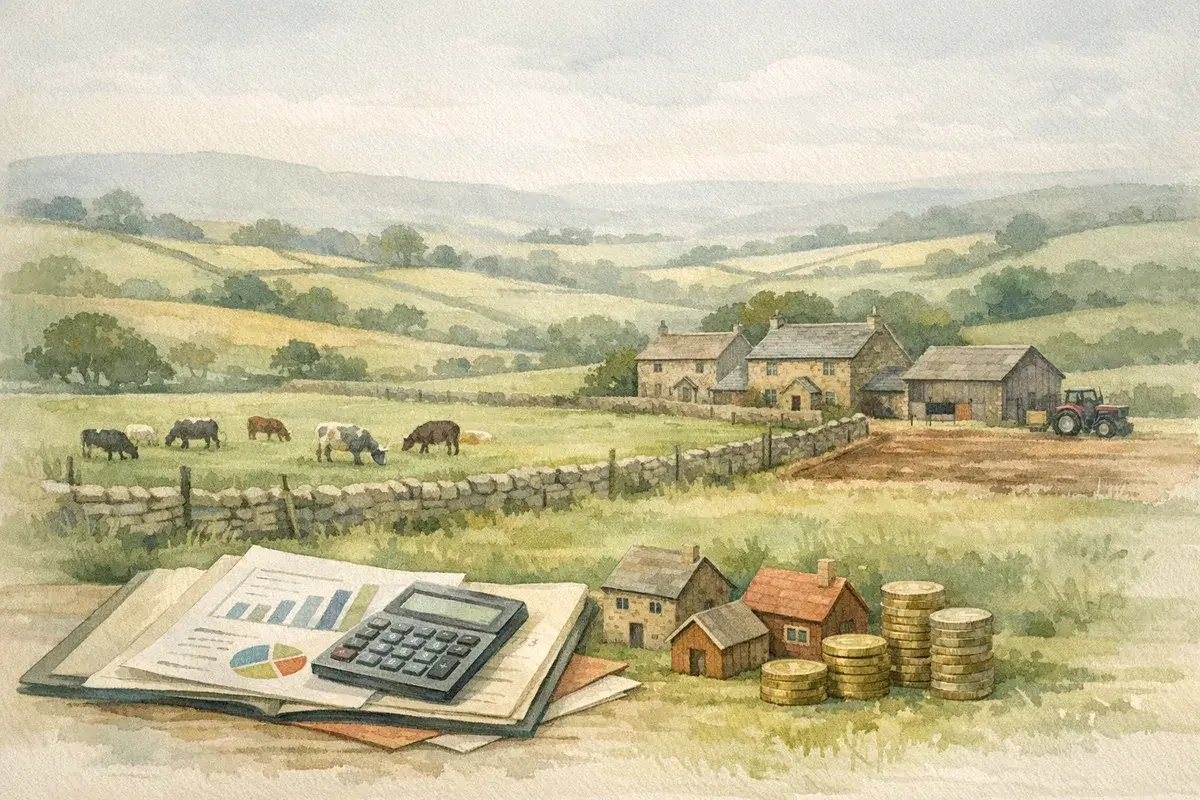
You can look at a rural listing, do the back-of-an-envelope maths, and still be miles off the true cost of borrowing. Not because you can't do the sums, but because agricultural mortgages in the UK don't behave like vanilla residential deals. Security can be "non-standard", income can be seasonal, and the lender's view of risk can change dramatically depending on tenancies, planning status, and how the holding actually earns its keep.
That's where an agricultural mortgage calculator earns its place. Used properly, it's a quick way to estimate repayments, pressure-test affordability, and compare scenarios before you spend money on surveys and solicitors. Used casually, it can give you a false sense of certainty.
This guide shows you how to use a calculator like a pro: what to feed into it, what to ignore, what to stress-test, and how to turn the numbers into something your broker, agent, and lender can work with.
What An Agricultural Mortgage Calculator Can (And Can’t) Tell You
An agricultural mortgage calculator is best thought of as a scenario engine, not a promise. It helps you understand the relationship between loan size, term, interest rate and repayment type, then lets you test what happens when one of those variables changes.
The Core Outputs: Monthly Payments, Total Interest, And Loan-To-Value
Most calculators give you three useful anchors:
- Monthly payment (or quarterly/annual, if you convert it), based on the interest rate and term.
- Total interest over the term, which is the "real" cost of borrowing when you hold everything constant.
- Loan-to-value (LTV), i.e., the loan amount as a percentage of the property's value.
Those outputs are genuinely helpful for rural purchases because they let you quickly compare options like:
- "If I put in another £50,000 deposit, what does that do to my repayment and total interest?"
- "If rates move 1.5% higher, can the business still carry the debt?"
- "If I shorten the term to reduce total interest, does the payment become unrealistic in lean years?"
Where it gets practical is when you pair the repayment output with the reality of agricultural cashflow: lumpy income, input costs that come before sale proceeds, and occasional big-ticket capex (drainage, grain storage, handling kit) that can't be ignored.
Where Calculators Commonly Mislead: Fees, Variable Rates, And Non-Standard Security
A calculator can mislead you in three classic ways:
- It assumes the interest rate is "clean" and stable. In the real world, your rate might be variable, tracker-linked, or fixed for only part of the term. If you're comparing offers, you'll want to sense-check against current UK farm borrowing pricing, not just a generic number you've seen online. (We keep a running view of farm borrowing costs in the UK so you can ground your assumptions.)
- It ignores fees and timing. Arrangement fees, valuations, legal work, broker fees, and sometimes monitoring or exit costs can change the effective cost of a deal, especially on shorter terms.
- It treats all property as standard security. A farmhouse with an agricultural tie, bare land with access issues, a holding with a tenancy, or a mixed-use yard with commercial lets can all change the lender's appetite. The calculator can't "see" any of that.
So the right mindset is: use the calculator to narrow your options and ask better questions, not to decide you're definitely approved at X% over Y years.
The Key Inputs You’ll Need Before You Start
You'll get far better outputs if you gather the right inputs first. In agriculture, a small detail can shift the lender's view (and hence the pricing) more than you'd expect.
Property And Security Details: Acres, Buildings, Tenancies, And Title Constraints
Before you plug in numbers, be clear on what you're actually buying, and what a lender can take as security.
Have to hand:
- Total acreage and land type (arable, pasture, woodland, upland). Lenders and valuers look at quality, access, and marketability.
- Buildings: traditional barns, modern sheds, grain stores, livestock housing, plus age/condition and any obvious compliance issues.
- Residential element: farmhouse, cottages, annexes, and whether they're occupied, let, or restricted.
- Tenancy position: FBTs, AHA tenancies, grazing licences, or informal arrangements. These can impact vacant possession and valuation.
- Title constraints: rights of way, ransom strips, easements, private water, septic arrangements, shared drives, sporting/mineral reservations, most of which appear in the title register and plan held by HM Land Registry.
Even if your calculator only asks for "property value", your job is to think about what that value represents and whether it's a clean, mortgageable asset.
Borrower And Business Details: Accounts, Cashflow, And Off-Farm Income
Agricultural borrowing is often assessed on a blend of asset strength and income resilience.
Prepare:
- Last 2–3 years' accounts (or as many as you have), plus management accounts if the last year is old.
- Cashflow forecast that reflects seasonality (for example, fertiliser and feed costs landing months before sales).
- Existing borrowing: HP/lease, overdrafts, other mortgages, inter-company loans.
- Off-farm income: PAYE roles, spouse income, contracting, holiday lets, storage income, anything consistent and evidenced.
If you're self-employed (as most farm businesses are), lenders will want clarity and proof. If you need a deeper run-through of how underwriters read your figures, our guide to the self-employed route for farm borrowing is a useful checkpoint.
Deal Assumptions: Term Length, Repayment Type, And Interest Structure
Decide what you're modelling:
- Term length: 10, 15, 20, 25+ years. Rural deals often sit outside typical residential assumptions.
- Repayment type: capital-and-interest, interest-only, or part-and-part.
- Interest structure: fixed, variable, tracker, or a blended facility.
And be honest about your risk tolerance. A low payment on interest-only can look lovely on a calculator… right up until rates move or the exit plan doesn't happen.
How To Use The Calculator Step By Step For A Farm Or Rural Property Purchase
Here's a straightforward process we've seen work well for buyers who want to move quickly but not blindly.
Set A Realistic Purchase Budget: Deposit, SDLT, And Professional Costs
Start with the total cash you can commit, then work backwards.
Your budget isn't just "price + mortgage". It's typically:
- Deposit (often a bigger chunk than residential lending)
- Stamp Duty Land Tax (SDLT) on any residential element and certain mixed-use structures
- Valuation and survey costs (farm valuations can be more involved)
- Legal fees and searches (rural titles can be… character-building)
- Broker fees (if applicable)
- Working capital buffer for the first 6–12 months
On deposit specifically, the number that matters is what's realistic for this asset. Bare land, mixed-use, and non-standard security can push deposit expectations up. For a practical sense-check, see what typically drives the deposit required for an agricultural mortgage and the common real-world ranges for farmland deposits in the UK.
Then, when you use your calculator, run it two ways:
- Best-case deposit (what you'd like to put in)
- Likely deposit (what the lender may insist on)
If the deal only works in best-case mode, you've learned something valuable early.
Model Multiple Scenarios: Rate Rises, Shorter Terms, And Higher Deposits
A single output is almost meaningless. You want a small set of scenarios you can compare.
A solid stress-test pack usually includes:
- Base rate + 1% and + 2% (or another realistic jump), particularly if you're not fixing for the full term.
- Term sensitivity: your preferred term, then 5 years shorter.
- Deposit sensitivity: your initial deposit, then +5% and +10%.
- Repayment type: capital-and-interest versus part-and-part.
If you're trying to choose an interest assumption, use current market context rather than guesswork. We track agricultural mortgage interest rates specifically for UK rural borrowing so your calculator inputs aren't floating in space.
The trick is to judge the "pain point": at what combination of rate and term do repayments start to squeeze the business (or your household)? That pain point is what you plan around.
Convert The Results Into A Lender-Ready Summary For Your Broker Or Agent
Once you've run scenarios, turn them into a one-page summary. This helps you move faster with brokers, agents and lenders, and it signals you're organised.
Include:
- Purchase price and property type (bare land / mixed farm / farm with farmhouse / equestrian etc.)
- Deposit and source of funds (cash, sale proceeds, equity release)
- Loan requested and target LTV
- Preferred repayment type and term
- Stress-tested repayment level (your "comfortable max")
- Headline income evidence (accounts, off-farm income, rental contracts)
- Notes on anything non-standard (tenancies, ties, access, planning)
If you haven't already, it's worth reading a broader overview of how agricultural mortgages work in the UK so your summary matches the way underwriters think.
You don't need to be perfect. You just need to be clear, and consistent.
Costs To Include Beyond The Headline Rate
A calculator tends to spotlight the interest rate, because that's what it can easily compute. But two deals with the same rate can have very different all-in costs.
Arrangement, Valuation, Legal, And Broker Fees
Common cost headings include:
- Arrangement fee: sometimes a flat amount, sometimes a percentage of the loan.
- Valuation fee: can be higher for farms or mixed-use holdings due to complexity.
- Legal fees: rural transactions often involve extra work (rights, easements, split titles, overage clauses, occupancy restrictions).
- Broker fee: if you're using a specialist.
A quick way to make your calculator more honest is to spread upfront costs over the initial fixed period (or over, say, five years) and treat that as part of the "effective" cost of borrowing.
Early Repayment Charges, Exit Fees, And Product Transfers
If you're fixing the rate, early repayment charges (ERCs) can be material, especially if you think you might sell land, refinance, or restructure the holding.
Also watch for:
- Exit/admin fees (less common than they used to be, but still crop up)
- Product transfer fees if you switch deals with the same lender
- Partial repayment rules (some products allow overpayments without penalty up to a limit)
For farms, flexibility is often worth paying for. A deal that's 0.25% cheaper but locks you in tightly can be a false economy if it stops you selling a block of land or refinancing when an opportunity comes up.
Insurance And Compliance: Buildings, Public Liability, And Environmental Risks
Some costs sit outside the mortgage offer but matter to affordability:
- Buildings insurance (and whether the lender has minimum requirements)
- Public liability and employer's liability where relevant
- Environmental and compliance risks: slurry, fuel storage, asbestos, contaminated land, private drainage, issues that can trigger remediation or conditions.
Your calculator doesn't know any of this. You do. If the holding has older buildings or higher-risk operations, build in a contingency so your repayment comfort level isn't sitting on a knife-edge.
Agricultural Mortgage Types And How They Change The Numbers
The same loan amount at the same rate can produce completely different outcomes depending on structure.
Capital And Interest Versus Interest-Only Versus Part-And-Part
- Capital and interest: higher monthly payments, but you're steadily paying down the debt. This is the cleanest structure if you want long-term security and a straightforward affordability case.
- Interest-only: lowest payment, but you need a credible repayment strategy (sale of land, refinance, investment proceeds, business growth). Lenders will interrogate the plan.
- Part-and-part: a compromise, some capital repayment, some interest-only, often useful where cashflow is seasonal but you still want the debt to reduce.
When you use an agricultural mortgage calculator, make sure it's clear which repayment type you're modelling. If it only models capital-and-interest, you can still use it, but your real-world payment could differ.
Fixed, Variable, Tracker, And Capped Rates: What To Stress-Test
Stress-testing matters most on variable or tracker deals, but even fixed rates need context.
What to model:
- If you fix: test what happens when the fixed period ends and the rate reverts higher.
- If you go variable/tracker: model at least two rate rises and ask "could I still pay this during a poor year?"
- If you choose a cap: model at the cap rate, not today's rate.
A useful habit is to stress-test repayments against your worst normal year, not your best year. If your cashflow can only service the mortgage when everything goes right, it's not really affordable.
Development, Bridging, And Refinance: When A Standard Calculator Isn't Enough
A standard calculator struggles when the facility isn't a simple long-term mortgage, for example:
- Development lending (staged drawdowns, interest rolled up, planning risk)
- Bridging finance (short terms, higher rates, exit dependence)
- Refinance with debt consolidation (multiple facilities, changing security)
In those cases, the calculator still has value for rough comparisons, but you'll want a broker-led model that accounts for drawdowns, fees, timing, and the exit route.
If your deal is clearly commercial in nature, say a trading yard, diversified income, or a larger-scale operation, your pricing and structure may sit closer to a commercial agricultural mortgage than a simple land loan. That changes the assumptions you should be plugging into any calculator.
UK-Specific Deal Breakers And Due Diligence Checks To Run Alongside The Calculator
This is the bit that catches people out: the calculator says "yes", but the due diligence says "not like that".
Planning Status, Agricultural Ties, And Permitted Development Assumptions
You can't calculator your way out of planning reality.
Be cautious if your affordability relies on:
- A change of use that hasn't been granted
- New residential value from a barn conversion that's only an idea
- Permitted development assumptions (which can be powerful, but are conditional and fact-specific)
- Agricultural occupancy conditions (ties) on a farmhouse, which can reduce market value and narrow lender appetite
If the property's "future value" is doing the heavy lifting in your plan, you need specialist advice early, from planning consultants and surveyors who understand rural restrictions.
Tenancies, Grazing Licences, And Sporting Rights: Impact On Valuation And Lending
Income from tenants or grazing can strengthen affordability, but it can also complicate lending.
Check:
- Length and terms of any Farm Business Tenancy (FBT)
- Any AHA tenancy (often a much bigger valuation and possession issue)
- Grazing licences: are they genuinely licences, or do they look like tenancies in practice?
- Sporting rights: are they included, reserved, or let separately?
A lender cares about two things: (1) the reliability of the income, and (2) how easily they could sell the asset if everything went wrong. Tenure can change both.
Basic Payment Scheme Transition, Environmental Schemes, And Income Evidence
In the UK, BPS is being phased out in England, and farm businesses are adapting through productivity, diversification, and environmental schemes.
From a lending perspective, the key is evidenced, repeatable income.
Be prepared to show:
- What proportion of historic income came from direct payments
- How you're replacing it (or reducing reliance on it)
- Evidence for diversified income (contracts, occupancy rates, accounts breakdown)
- Clear assumptions around environmental scheme income, obligations, and timings
This isn't about "good" or "bad" schemes, it's about demonstrating that your repayment plan stands up even as policy and payments evolve.
If you're unsure which lenders are comfortable with your specific mix of trading and property, it helps to start by understanding the landscape of agricultural mortgage lenders in the UK before you get too attached to a single set of calculator outputs.
How Lenders Typically Assess Farm Borrowing In The UK
When you're using an agricultural mortgage calculator, you're usually modelling one thing: the payment.
A lender is modelling several things at once: affordability, resilience, security, and exit options.
Affordability Versus Asset-Backed Lending: DSCR, ICR, And Stress Rates
Many agricultural deals sit somewhere between:
- Affordability-led (can you service the debt from income?), and
- Asset-backed (is the security strong enough, even if income is volatile?).
You'll hear terms like:
- DSCR (Debt Service Cover Ratio): broadly, net operating cash available to service debt divided by the debt payments.
- ICR (Interest Cover Ratio): how comfortably profit/cash covers interest.
- Stress rates: lenders may test affordability at a higher rate than the product rate.
This is why your calculator stress-testing matters. If you only model at today's rate, you may be ignoring the lender's own internal test.
Practical tip: build a simple "coverage" check for yourself.
- Take your annual debt payments from the calculator.
- Compare them to a conservative estimate of sustainable net cash.
- If the margin is thin in an average year, the lender will likely see it too.
Deposit And LTV Expectations For Bare Land, Farmhouses, And Mixed-Use Holdings
Different assets tend to attract different LTV appetites.
In broad terms (and always case-dependent):
- Bare land can require stronger deposits because resale can be more sensitive to local demand and access.
- Farmhouses may be treated partly like residential property, but ties, condition, and rental status matter.
- Mixed-use holdings can be attractive if income is diversified, but underwriting is more involved.
This is why you'll often hear "it depends" from good brokers. Not because they're being evasive, because the asset details genuinely change the answer.
What Improves Terms: Cash Reserves, Track Record, And A Clear Business Plan
If you want your calculator output to resemble what you can actually obtain, focus on the factors that typically sharpen terms:
- Stronger deposit / lower LTV
- Cash reserves (it signals resilience through volatility)
- A proven trading record (or a credible, well-supported plan for new entrants)
- Clear business plan showing how the holding makes money and how debt is serviced
- Clean, well-presented information pack (accounts, forecasts, tenancy schedules)
One of the most underrated ways to improve your outcome is simply being organised. Underwriters are human: the easier you make it to understand risk, the easier it is for them to say yes, or to say yes on better terms.
And if your deal involves multiple income streams or a more trading-led operation, be ready for the lender to look beyond "property value" and into the business itself.
Conclusion
An agricultural mortgage calculator is a powerful tool, provided you treat it like the first draft, not the final answer. Use it to set a realistic budget, test rate shocks, compare repayment structures, and decide what level of borrowing still lets you sleep at night.
Then do the grown-up part: layer in the real-world costs, run UK-specific due diligence (planning, ties, tenure, income evidence), and package your findings into a lender-ready summary. You'll waste less time, spend money in the right places, and negotiate from a position of clarity.
If you're actively searching, pairing your numbers work with specialist rural listings and knowledgeable agents makes the process far less hit-and-miss. And when you're ready to talk terms, bring your scenarios and stress-tests, because that's what turns a hopeful enquiry into a credible application.
Disclaimer: AgLand.co.uk is a UK agricultural land and rural property matching service, where buyers register what they are looking for and owners advertise directly to the buyers who match, and a rural resource hub. Nothing in this text is intended as legal, financial, tax, or investment advice. You should carry out your own due diligence and seek independent advice from appropriately qualified professionals (for example, an FCA-authorised mortgage broker, solicitor, accountant, surveyor/valuer, and planning consultant) before making decisions.