
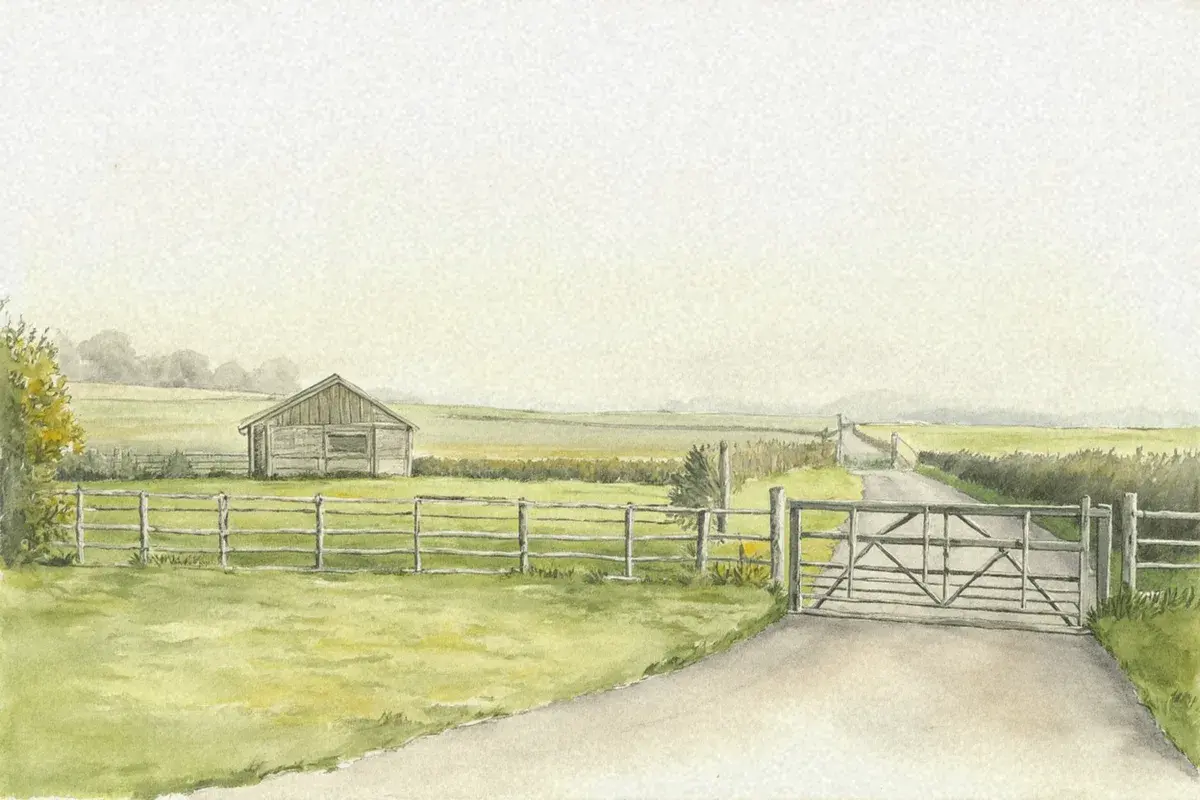
A paddock, field, or small plot sells at auction in the same way as a farm: the buyer is bound when the hammer falls and completes on a fixed date. The work is in the legal pack. A small parcel split off a larger holding needs legal access, a clean title plan, clear boundaries, and a decision on overage before it goes into the catalogue, because bidders can't negotiate any of that after the hammer.
This guide is for owners selling a small parcel, typically under about 20 acres (8 hectares), in England and Wales, often from land they keep next door.
Can you sell a paddock or small field at auction?
Yes. Small parcels are common auction lots, bought by neighbours, horse owners, smallholders, and investors buying land with hope value. At a traditional auction, the RICS Common Auction Conditions set the deposit at the greater of 10% of the price or the stated minimum deposit, and completion at 20 business days after the contract date if the contract gives none. The modern method of auction runs on a different timetable with a reservation fee paid by the buyer.
Two things are different for a small lot.
Fixed costs weigh more. Legal pack preparation, searches, a plan, and the auctioneer's entry fee cost broadly the same whether the lot is 3 acres or 300. Some auctioneers set a minimum fee or a minimum lot value, and some recover their fee from the buyer instead of the seller. Get the fee terms in writing before you instruct. Our guide to the cost of selling land at auction sets out the usual fee structures.
Guide and reserve are closer together than sellers expect. Under the Advertising Standards Authority's ruling on guide prices in property auction ads, your reserve must sit within the guide range, or within 10% of a single-figure guide, unless the auctioneer updates the guide whenever the reserve moves above it. On a paddock guided at £50,000, the reserve can't exceed £55,000. See auction reserve and guide prices.
Does the paddock have legal access?
Access is the first thing bidders check and the most common reason a small lot fails to sell. There are three situations.
| Situation | What the legal pack needs |
|---|---|
| Paddock has frontage to a public road | Confirmation the frontage is adopted highway, with no strip of third-party land between the field and the road. A local authority highway search shows the extent of the adopted highway |
| Paddock is reached across your retained land | A right of way granted in the transfer, shown on the plan, saying who can use it, on foot or with vehicles and livestock, and who maintains it |
| Paddock is reached across someone else's land | Evidence that the existing right of way benefits this parcel, for example in the title register or old deeds |
A gateway that has always been used isn't the same as a legal right. Nor is a field that touches the road only if there's a narrow strip in someone else's ownership in between. That strip, sometimes called a ransom strip, can control access to the whole field.
Public rights of way are the other side of access. A footpath or bridleway across the paddock stays there after the sale, and the new owner inherits the duties that go with it. The landowner responsibilities for public rights of way include keeping the route clear, getting the highway authority's consent for new gates or stiles, and restrictions on bulls. The local authority's definitive map shows which rights of way are recorded, and your solicitor's searches should pick them up.
Is the paddock its own title, or part of a larger one?
If the paddock is already a separate registered title, the sale is simpler. If it's part of the title to your house or farm, you're selling part of a title, and the transfer needs a plan that identifies the land clearly. HM Land Registry's guidance on preparing plans for HM Land Registry applications sets out what the plan must show. A surveyor's measured plan is worth paying for where the boundary runs through open ground or along a hedge that has moved over the years.
If the land has never been registered, the sale triggers compulsory first registration under section 4 of the Land Registration Act 2002, and the buyer must apply within two months of completion, according to HM Land Registry's practice guide on first registrations. Registering before the auction takes the question out of the buyer's due diligence. See registering unregistered agricultural land.
Splitting off part of your land also changes what you keep. Our guide to selling part of agricultural land covers the effect on your retained land: access, services, and value.
What rights should you keep over the paddock?
Once the paddock sells, you have no rights over it unless the transfer reserves them. Before auction, walk the boundary with your solicitor's plan and list what crosses it.
- Drains and water. Field drains, a water pipe to a trough on your side, or a spring that feeds your land.
- Cables and wayleaves. Overhead lines and underground cables usually belong to the network operator under a wayleave or easement. Check the paperwork so the legal pack is accurate.
- Access for maintenance. A right to go onto the paddock to repair a boundary wall or clear a ditch.
- Restrictive covenants. Limits on what the buyer can do, such as no dwellings, no commercial use, or no more than a set number of horses. A covenant protects your house or retained land, but every restriction narrows the pool of bidders.
All of these go in the special conditions and the draft transfer in the legal pack. Bidders price what they can see. A covenant added after the hammer isn't possible without the buyer's agreement.
Who is responsible for fencing the new boundary?
In England and Wales there's no general legal duty on a landowner to fence land. The duty comes from the transfer, old deeds, or practicalities. When you split off a paddock, the special conditions usually deal with it in one of three ways:
- The buyer must put up a stock-proof fence along the new boundary within a set period and maintain it.
- You fence before completion, and the transfer says who maintains it afterwards.
- The boundary is left as it is, with a hedge or existing fence, and the transfer says who owns it.
If you graze stock next door, fencing is more than a courtesy. Under section 4 of the Animals Act 1971, the person whose livestock strays onto someone else's land is liable for the damage caused. A clear fencing covenant avoids a row with a new neighbour. Note that the title plan shows general boundaries only, not the exact line, so a hedge or ditch can still be disputed later. Our guide to agricultural land boundary disputes covers how those arise.
Should you add overage when selling a field at auction?
Overage (also called clawback or uplift) gives you a share of any rise in value if the buyer or a later owner gets planning permission or another trigger event happens. It's common on fields at the edge of a village, next to a settlement boundary, or with road frontage. It has four moving parts, all of which must be in the legal pack:
| Term | What it says |
|---|---|
| Trigger | The event that makes overage payable, such as grant of planning permission, starting development, or a sale with permission |
| Percentage | Your share of the uplift, for example 25% or 30% of the increase in value |
| Period | How long it lasts, as a fixed number of years from completion |
| Security | How it's protected, usually a restriction on the buyer's title at HM Land Registry, sometimes backed by a legal charge |
Overage has a price. Bidders deduct the value of what they'd be giving away, and some won't bid on land with overage at all. A 30% overage for 25 years on a field with realistic development prospects may noticeably reduce the hammer price. The same clause on a field with no realistic prospects costs you very little and may never pay out. Whether it's worth including is a judgement for you, your solicitor, and a RICS-registered valuer.
What is hope value and how does it affect the guide price?
Hope value is the amount a buyer will pay above agricultural value because they think the land might one day get planning permission. It's speculative by definition. A field allocated in the local plan, or next to one that is, may attract bids well above agricultural value; a field in the open countryside may attract some hope value from buyers taking a long view; a field in the Green Belt or a National Landscape usually attracts less.
Auction is one way of finding out what bidders will actually pay for hope. It isn't a valuation, and it can go either way. If you think the land has development potential, a RICS-registered valuer or a planning consultant can tell you whether it's realistic, and whether to sell now, with overage, or to promote the land yourself. Our guide to selling agricultural land to developers covers promotion and option agreements.
How much capital gains tax is due when you sell part of your land?
If you're a UK resident individual, a gain on land you've held as an investment or in a farming business is usually chargeable to capital gains tax. The calculation for a part disposal differs from a whole sale.
The A over A plus B formula. Under section 42 of the Taxation of Chargeable Gains Act 1992, the original cost of your whole holding is apportioned. A is the sale price of the paddock. B is the market value of the land you keep. The cost allocated to the paddock is the total cost multiplied by A divided by A plus B.
Illustration, with round numbers: you bought 50 acres (20 ha) for £100,000. You sell a 5-acre (2-ha) paddock at auction for £60,000. The 45 acres you keep are worth £540,000. The paddock's share of cost is £100,000 × 60,000 ÷ 600,000 = £10,000. Before selling costs and your annual exempt amount, the gain is £50,000. At the 2026 to 2027 CGT rates of 18% and 24%, that's between £9,000 and £12,000 depending on your income, before any reliefs.
Small part disposals. Section 242 of the same Act lets you elect not to treat a sale as a disposal where the price is no more than a fifth of the market value of the holding and no more than £20,000, and your total land sales in the tax year don't exceed £20,000. The proceeds are deducted from your base cost instead, so the gain is deferred until you sell the rest. It suits a small strip or corner, not most paddocks.
Garden and grounds. If the paddock is part of the garden and grounds of your home, private residence relief may apply. HMRC's helpsheet HS283 says grounds must serve chiefly for ornament or recreation, the permitted area is normally up to 0.5 hectares (about 1.2 acres) including the house, and relief applies to grounds you occupy at the time of disposal. A paddock let out for grazing is unlikely to count. Sell the house first and the paddock afterwards, and relief on the paddock is usually lost.
Timing and reporting. The disposal date is the date of the unconditional contract, which at a traditional auction is the fall of the hammer. Bare land isn't residential property, so a UK resident reports the gain through self assessment rather than the 60-day UK property return. Our guides to capital gains tax on agricultural land and reducing capital gains tax on a land sale go further, and your accountant can confirm the figures.
Next steps
- Get your solicitor to check the title and confirm legal access to the paddock from the road.
- Commission a plan of the paddock that meets HM Land Registry's requirements if you're selling part of a title.
- Decide on rights you're keeping, fencing terms, covenants, and overage, and have them drafted into the special conditions.
- Ask a RICS-registered valuer about agricultural and hope value, and ask your accountant about the CGT position and any small part disposal election.
- Get the auctioneer's fee terms, including any minimum fee, in writing before you instruct.