
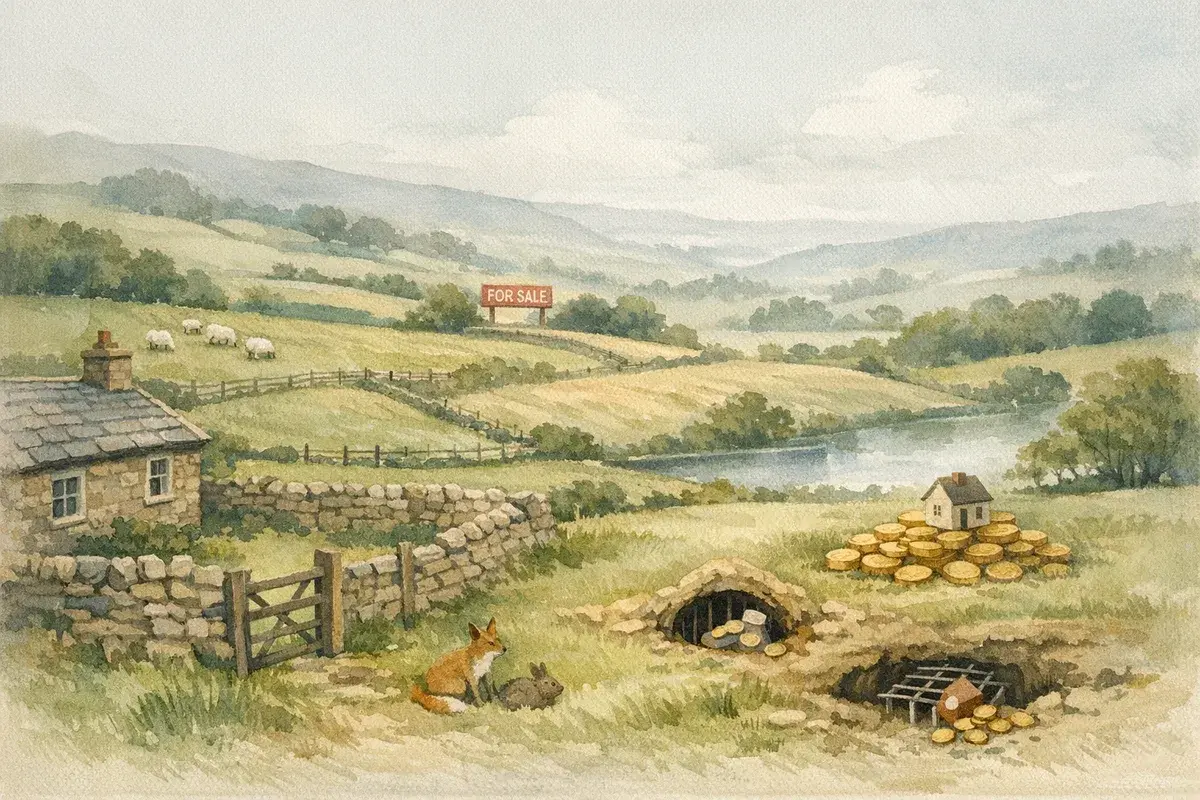
Selling land is rarely "just" a sale. In the UK, one field can carry a paper trail of historic titles, family transfers, old farm tracks, tenancies, and, crucially, tax history. And when the price has moved sharply (as it often has where development hope value, renewables, or lifestyle demand is in the mix), the capital gains tax (CGT) number can feel like it's doing the negotiating for you.
If you're looking at reducing capital gains tax on a land sale, the best results usually come from getting the basics right early: establishing the correct base cost, claiming the reliefs you're genuinely entitled to, and structuring the disposal so the tax year (and the transaction documents) don't accidentally work against you. The worst outcomes tend to come from assumptions, "it's agricultural so it must be exempt", "it's the family farm so PRR will cover it", or "the option money isn't really part of the price".
Below is a practical UK-only guide to where the CGT bill is really made (or avoided), and the common traps HMRC tends to probe on rural land disposals.
Start With The Basics: What You’re Actually Taxed On
Before you get anywhere near reliefs, you need a clean calculation. Plenty of CGT "planning" fails because the underlying numbers are wrong, often due to a poor apportionment across mixed assets (land, buildings, farmhouse, rights, development uplift) or missing costs that are perfectly allowable.
If you want a deeper foundation first, it's worth reading our more detailed explainer on how gains, rates and rural-specific pitfalls work in practice: how CGT on agricultural land is calculated in the UK.
Capital Gain Vs Sale Proceeds: The 30-Second Difference
Your CGT isn't charged on the full sale price. It's charged on the gain.
In simple terms:
- Sale proceeds: what you receive for the asset (usually the completion money, plus anything that counts as part of the consideration).
- Less base cost: what you paid (or what the asset is treated as having cost you, e.g., probate value on inheritance).
- Less allowable costs: certain purchase/sale costs and capital improvements.
What's left is the chargeable gain. Then you apply reliefs (if available), set off losses (if you have them), deduct your annual exempt amount, and apply the relevant CGT rate.
A rural example: if you sell 20 acres with a small yard, and part of the price is clearly "development hope", the question isn't only "what's the price?", it's "what part of that price relates to the asset you're disposing of, and what did that asset cost you on the right date?"
Key Dates And Valuations: Acquisition, Inheritance, Gifts, And 31 March 1982 Rebased Values
The date you're treated as acquiring the land (and the value at that time) often decides the size of the gain.
Common UK scenarios:
- You bought the land: base cost is generally your purchase price plus acquisition costs.
- You inherited it: base cost is usually the probate value at the date of death (not what the family "thinks it was worth"). If the estate value was conservative and never properly evidenced, that can come back to bite when you sell.
- You received it as a gift: for CGT, gifts are typically treated as taking place at market value (even if no money changed hands). There are exceptions where hold-over relief applies (more on that later).
- Pre-31 March 1982 ownership: there are special rules that can use the 31 March 1982 value as a rebased starting point in certain cases. This is one of those areas where a decent valuation and records matter, because if HMRC asks, "where did that figure come from?", you need an answer that isn't a shrug.
If you're still hearing "agricultural land is exempt anyway," be careful. Some land sales can be structured to reduce CGT, and some land may produce little/no CGT because the base cost is high, reliefs apply, or losses offset it, but blanket exemption isn't the default position. We cover that myth (and the genuine exceptions) in our guide to whether agricultural land is exempt from CGT.
Allowable Costs You Shouldn't Miss: Fees, Improvements, And Apportionments
Allowable costs can feel fiddly, but they're one of the cleanest ways of reducing capital gains tax on a land sale because they're grounded in evidence.
Typically relevant on rural disposals:
- Professional fees: legal fees for buying/selling, survey/valuation costs directly linked to acquisition or disposal, and sometimes certain agent fees.
- Capital improvements (not maintenance): think new drainage, new farm tracks, significant reseeding or land restoration tied to a lasting improvement, new services brought in, or structural upgrades to qualifying assets. Repairs and routine maintenance are usually revenue in nature and don't normally add to CGT base cost.
- Apportionment across mixed assets: if you sell a block that includes, say, bare land, a building, and some rights, you may need a defensible split of base cost and sale proceeds. This is where a rural surveyor's valuation approach can save you later.
A practical point: if your land disposal is part of a bigger set of decisions (farm diversification, splitting off a yard, selling a building for conversion, granting an option), keep one running folder, plans, invoices, dated photos, and notes on what you did and why. You don't want to rebuild evidence years later when HMRC queries a number.
For a broader view of the wider tax picture beyond CGT, Income Tax, VAT angles, SDLT on linked transactions, and the "what did you actually sell?" question, see the main tax implications when selling agricultural land.
Reliefs That Can Legitimately Cut The CGT Bill
Reliefs are where you can make the biggest percentage difference, but they're also where people overreach. HMRC is generally less interested in clever wording and more interested in the underlying facts: was it your residence, was it a trading business, was the land genuinely tied to that trade, and do the dates line up?
Private Residence Relief Where Land Comes With A Home (And The Permitted Area Rules)
If land is sold with your home (or was part of your home), Private Residence Relief (PRR) can exempt all or part of the gain.
But rural PRR is full of "yes, but…" moments:
- PRR is mainly about the dwelling-house and the land that's required for the reasonable enjoyment of it as a residence.
- There's a concept of a permitted area (often discussed as up to about half a hectare including the house and garden), but larger areas can qualify if you can justify them as needed for reasonable enjoyment given the property's character.
- Agricultural use, paddocks, or fields can be contentious. If land is primarily agricultural rather than residential amenity, PRR may not stretch as far as you'd like.
Where it gets especially delicate is when a farmhouse has been occupied in connection with a working farm, but parts of the holding have clearly been used as farmland rather than as the "grounds" of the residence. If your sale includes a farmhouse plus land, don't assume PRR covers everything, get a proper view of what's realistically within PRR and what isn't.
Business Asset Disposal Relief: When Land Counts As Part Of A Trading Business
Business Asset Disposal Relief (BADR) (what many still call Entrepreneurs' Relief) can reduce the CGT rate on qualifying disposals, hugely valuable when it applies.
The catch: land doesn't qualify just because you're a farmer. It usually needs to be tied to a trading business and disposed of in a way that meets the BADR conditions. Rural cases that can work include:
- selling assets used in the trade when you're disposing of all/part of the business:
- selling land that's been used in your farming trade, alongside a disposal of the business interest, within relevant time windows:
- certain partnership scenarios where the land is partnership property and the structure supports BADR.
But if the land has drifted into being held mainly for investment, for example, it's been let out on terms that look more like an investment asset, or it's been kept back as a long-term capital store, BADR may be harder to justify.
This is an area where the story matters: what you did on the land, who did it, how the business was run, what the accounts show, and whether the disposal is truly connected with withdrawing from (or reducing) the trade.
Rollover Relief And Hold-Over Relief: Deferring Gains When Reinvesting Or Gifting
If you're not trying to eliminate CGT but to defer it, these can be powerful.
- Rollover relief can apply when you dispose of certain business assets and reinvest the proceeds into other qualifying business assets within the required time limits. In effect, the gain is rolled into the base cost of the new asset.
- Hold-over relief can apply on certain gifts, deferring the gain so that the recipient takes on a reduced base cost.
These reliefs are often central to succession planning: you might be moving land to the next generation, reshaping the holding, or reinvesting in infrastructure that supports the trading business.
If gifting is on the table, don't guess your way through it. The CGT treatment of gifts, and when deferral is available, is nuanced, especially if there are tenancies, development value, or mixed-use elements involved. We've laid out the main considerations (and where people slip up) in our guide to CGT when gifting agricultural land.
Timing And Structuring Choices That Often Make The Biggest Difference
Once the calculation is solid and you've identified the reliefs that might apply, the next lever is structure. And this is where you can accidentally create a tax problem even if the commercial deal looks fine.
Use Of Annual Exempt Amount And Spousal Transfers: Simple Planning That Still Works
Even though the annual exempt amount has reduced significantly in recent years, it still matters, especially if you can legitimately use two allowances within a household.
In broad terms:
- Each individual has an annual CGT allowance (subject to the rules in force for the tax year).
- Transfers between spouses/civil partners who live together are generally on a no gain/no loss basis for CGT, meaning you can potentially share ownership before sale so both allowances (and potentially both sets of CGT bands) are available.
This is simple in principle but practical in execution: you need to ensure the transfer is done correctly, documented properly, and timed before exchange/completion in a way that reflects genuine ownership.
Also remember: it's not just the annual exemption. The split can affect which CGT rates apply if one of you is in a lower tax band.
Staggered Disposals, Options, And Conditional Contracts: Managing The Tax Year And The Completion Date
Rural land deals aren't always a clean "agree today, complete in 28 days" process. You may have:
- disposals split across parcels:
- conditional contracts subject to planning:
- option agreements:
- promotion agreements:
- delayed completions while access, services, or title issues are tidied up.
Two timing points matter for CGT:
- When you're treated as disposing of the asset (this is not always the day you receive the money).
- Which tax year the disposal falls into, which can affect allowances, rates, and how the gain stacks with your other income.
With conditional contracts and options, you also need to be clear what counts as "consideration" and when. In the real world, the paperwork may include non-refundable option fees, staged payments, overage, or abnormal cost sharing. Those details can change the CGT picture.
If you're preparing a sale, it's worth working through the transaction structure alongside the practical sale-readiness steps, boundaries, rights, access, constraints, because they often determine whether you can exchange/complete in a tax year you actually want. Our practical checklist is here: get your land ready for sale in the UK.
Selling The Land Vs Selling The Entity: Sole Ownership, Partnerships, And Companies
Sometimes the "asset" you sell isn't the land itself.
Depending on how you own the holding, you might be considering:
- selling land you own personally (sole ownership):
- selling land held within a partnership structure:
- selling shares in a company that owns land.
Each route can produce different tax outcomes and different buyer appetites.
A few practical realities we see in the UK rural market:
- Buyers often prefer land rather than shares, because they want clean title and fewer inherited liabilities.
- Sellers sometimes prefer shares, because share disposals can (in the right circumstances) interact differently with reliefs and can be operationally simpler if there are multiple assets.
- Partnerships add complexity: who owns what, what's in the partnership accounts, and whether land is partnership property can change the relief position.
This is one of those "don't do it backwards" areas: start with the commercial deal and the buyer's requirements, then ask your tax adviser what structures are realistic without tripping anti-avoidance rules or creating unexpected Stamp Duty Land Tax consequences for the buyer.
Watch The Red Flags: HMRC Hot Buttons On Rural Land Disposals
If you want to reduce CGT safely, you also need to avoid turning a capital disposal into something HMRC treats very differently. Rural transactions are especially prone to blurred lines, between farming and development, between investment and trade, between a clean sale and a long-running project.
Trade Or Investment: When A "Capital" Sale Can Be Taxed As Income
Here's the uncomfortable truth: sometimes the biggest tax risk isn't "too much CGT". It's that the profit is treated as income instead of a capital gain.
If HMRC views what you've done as trading (for example, buying/selling land as a venture, or carrying out development activity that looks like a trade), the profit can be subject to Income Tax (and potentially National Insurance) rather than CGT.
Factors that can move the needle include:
- your intention at acquisition (and whether that intention changed):
- the level of work done to create value (planning, servicing, plot sales):
- frequency of similar transactions:
- how it's presented in accounts and documentation.
This doesn't mean you can never enhance land before sale, far from it. It means you should understand where the line is, and document commercial reasons carefully.
Development Value, Overage, And Promotion Agreements: How They Affect Timing And The Chargeable Gain
Development uplift is where rural CGT gets spicy.
If your deal includes:
- overage (additional payments triggered by planning permissions, future sales, or milestones), or
- a promotion agreement (where a promoter seeks planning and sells the land for a fee/percentage),
…you'll want to understand how and when those future payments are taxed.
Key issues to stress-test:
- Do you have one disposal with contingent consideration, or multiple disposals?
- How is the overage drafted, and what exactly triggers it?
- Are you receiving payments over several tax years, and if so, how does that interact with rates and reporting?
Also watch how costs are allocated. For example, if promoter fees, planning costs, or infrastructure costs are netted off against proceeds, you'll want clarity on how that affects the gain calculation.
If diversification is part of the story, say, you've moved from pure cropping into commercial lets, renewables, storage, or equestrian use, your relief position can change over time. We've seen landowners accidentally weaken relief claims by letting the business drift from "trading" into "investment" without realising the tax impact until a disposal is on the table. This is covered in more depth here: how diversification can affect CGT.
Connected Parties, Undervalue, And Documentation: Getting Valuations And Evidence Right
Sales to family members, neighbouring businesses, partnerships, or companies you control are common in rural Britain. They're also an HMRC favourite because the scope for undervalue (or just sloppy paperwork) is obvious.
A few rules-of-thumb that keep you safer:
- If you're selling to a connected party, you may be treated as selling at market value for CGT, even if the price is lower.
- If there's a mix of assets (land, buildings, rights, entitlements), get a proper valuation and apportionment.
- Keep documentation that supports the "why" behind a transaction, board minutes (for companies), partnership notes, professional valuations, and correspondence.
And don't underestimate how often rural disposals involve "extra" value that isn't obvious on day one: a ransom strip, an access right, an easement, a wayleave, a hope value angle. If it affects price, it will usually affect the CGT workings too.
Process And Compliance: Reporting, Deadlines, And Record-Keeping
Even when you've done everything right, you can still create problems by missing deadlines or failing to evidence the numbers. HMRC doesn't just look at whether you paid tax, it looks at whether you reported correctly and on time.
CGT Reporting Routes And Deadlines, Including UK Property Reporting Where Relevant
In the UK, CGT reporting can involve more than one route depending on what you sold and who you are.
Common scenarios for landowners:
- Self Assessment: many gains are reported through your annual tax return.
- UK property reporting: some disposals involving UK land/property can trigger an additional reporting requirement and payment on account within a shorter window.
Whether the accelerated property reporting applies, and the deadlines, can depend on factors such as whether the disposal is of UK residential property, and whether any CGT is actually due after reliefs and losses. The safest approach is to assume there may be a short fuse and confirm early, especially if part of the land is residential in character (farmhouse, bungalow, cottage, building plot) or if you're selling a separate dwelling.
Records To Keep For Rural Land: Plans, Basis Of Apportionment, And Improvement Evidence
Rural record-keeping isn't glamorous, but it's often what protects a relief claim.
Aim to keep (and be able to retrieve):
- Title documents and plans, including Land Registry plans and any historic conveyances that explain rights or retained land.
- A written apportionment where you've split value across farmhouse/curtilage, buildings, bare land, and development potential, ideally supported by a rural surveyor's valuation.
- Invoices and contracts for capital improvements (track installation, drainage schemes, new services, major building works).
- Evidence of use where reliefs hinge on it (cropping records, stewardship agreements, grazing licences, tenancy documents, farm accounts).
- Planning history: applications, decisions, S106/CIL where relevant, and promotion/option documentation.
If you've sold a yard, a barn, or a building with land, and especially if the building is being treated differently for relief purposes, keep the evidence that shows what it was used for and when. More on building-specific angles is in our guide to CGT and agricultural buildings.
Professional Advice: When To Bring In A Land Agent, Surveyor, And Tax Adviser
If you're trying to reduce capital gains tax on a land sale, you're usually juggling three disciplines:
- Land agent: market strategy, structuring the sale pack, negotiating heads of terms, and sanity-checking how the deal is being positioned.
- Rural surveyor/valuer: apportionments, development value assessment, PRR land justification, and defensible market valuations (especially for connected party deals or historic base cost work).
- Tax adviser (and sometimes a solicitor with rural specialism): relief eligibility, transaction timing, drafting implications (options/overage), and compliance.
A sensible trigger to get advice early is when any of the following are true:
- a farmhouse is involved (PRR questions):
- you're claiming BADR or any deferral relief:
- there's development value, overage, or a promoter:
- you're selling to family or a connected business:
- the land has been in the family a long time and valuations are hazy.
On AgLand, we often see sellers leave this too late, after heads of terms are agreed, when small drafting choices can already have locked in the tax timing. The best time to bring your advisers in is when you're shaping the deal, not just documenting it.
Conclusion
Reducing capital gains tax on a UK land sale isn't about one magic relief, it's about stacking small, defensible decisions: a correct base cost, a robust split of value where assets are mixed, properly evidenced improvements, and a transaction structure that doesn't accidentally sabotage the reliefs you're aiming for.
If you take one practical step today, make it this: map your land's history (how you acquired it, how it's been used, what's been built or improved, and what exactly is being sold) before you get too far into negotiations. Once a deal is drafted, you can't easily rewind the tax consequences.
Disclaimer: AgLand.co.uk is a UK agricultural land and rural property matching service, where buyers register what they are looking for and owners advertise directly to the buyers who match, and a rural resource hub. Nothing in this text is intended as legal, financial, tax, or investment advice. You should carry out your own due diligence and take professional advice (for example from a qualified tax adviser, solicitor, land agent, and/or chartered surveyor) based on your circumstances before acting.