
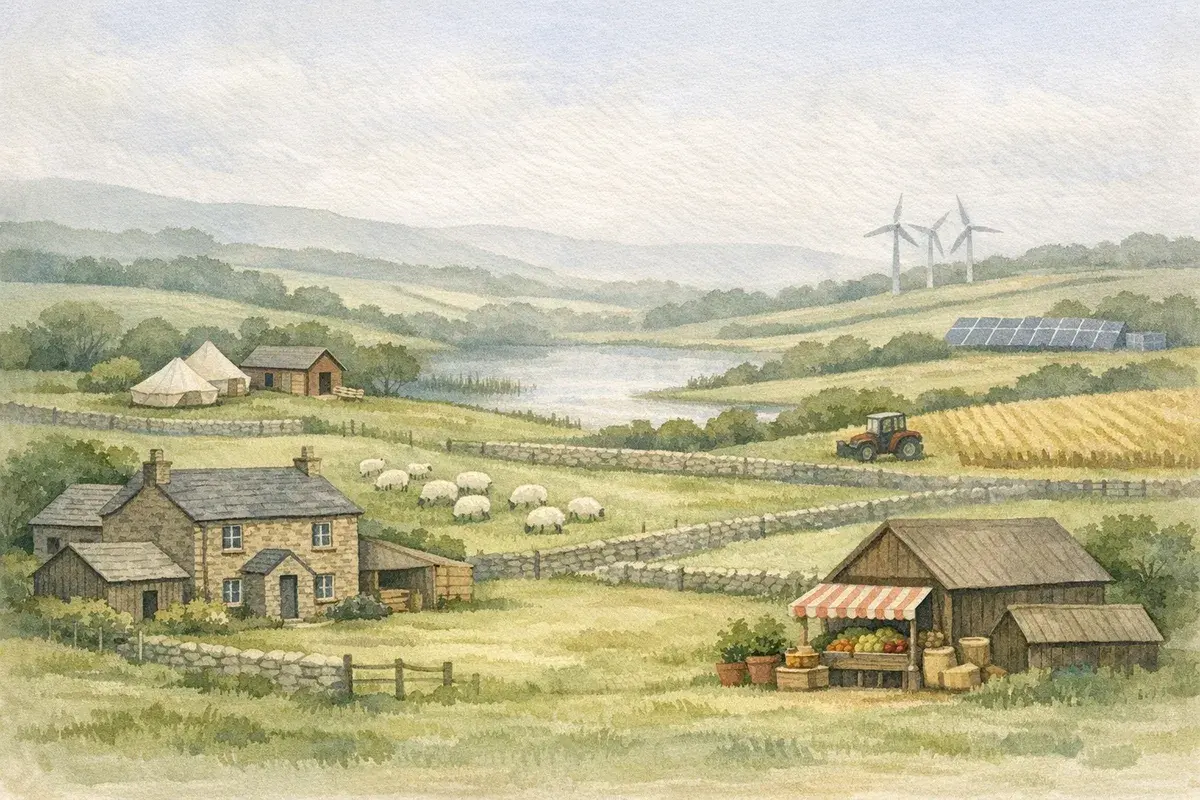
Diversification can feel like the sensible, grown-up answer to volatile commodity prices and shifting support schemes: turn a redundant range of buildings into storage, add a few holiday lets, sign a solar option, maybe create a yard for local trades.
But there's a quieter side to farm diversification that catches people out. The moment land or buildings stop being "just agricultural" and start being used (or valued) differently, you can change the tax story, sometimes dramatically. Capital Gains Tax (CGT) is often the big one, not because you've done anything wrong, but because you've created value that HMRC treats as a taxable gain when you sell, gift, restructure, or agree certain development deals.
This guide is written for UK farmers and landowners who want to diversify without stumbling into avoidable CGT problems. You'll see where the common traps sit, how gains are usually calculated, which reliefs can help (and when they don't), and what you should document before you lay a single metre of hardcore.
Why Farm Diversification Can Trigger Capital Gains Tax
Farm diversification doesn't automatically create a CGT bill. CGT is typically triggered when there's a disposal, selling an asset, gifting it, transferring it to a company, granting certain long leases, or entering arrangements where value is effectively realised.
So why does diversification matter? Because it often:
- Changes the asset's value (agricultural value vs commercial or development value)
- Changes what the asset "is" for tax purposes (trading asset vs investment asset)
- Creates a mixed-use picture that makes reliefs harder to claim cleanly
A simple example: a traditional barn used for farming may have modest agricultural value. Convert it (or even just start using it) for storage lets, workshops, or holiday accommodation and its market value can jump. That uplift might not be taxed today, but when you sell the farm, sell the building, gift it to a child, or move it into a different structure, the "gain" may be much larger than you expected.
There's also a timing point that's easy to miss: you can trigger CGT without selling the freehold. Certain deal structures, option agreements, conditional contracts, leases with premiums, or transfers into a partnership/company, can create disposals or part-disposals.
If you're still deciding what route to take, it's worth pressure-testing the commercial upside alongside the tax angles. We've set out a range of routes and planning considerations in our guide to practical diversification options for UK farms (linking here because the "best" idea on paper isn't always the best idea after tax and risk).
The key mindset shift is this: diversification can turn a long-held, low-turnover farm asset into a high-value, highly "visible" asset to HMRC, especially when there's paperwork, planning permissions, and third-party income involved.
How CGT Is Calculated On Diversified Farm Assets
At its simplest, CGT is charged on the gain:
Gain = disposal proceeds (or market value) – allowable costs – reliefs
But diversified farms rarely stay "simple". The devil tends to sit in five places.
1) What counts as the "asset" you've disposed of?
You might sell:
- a whole title
- part of a field (a part-disposal)
- a building with yard and access
- rights (easements/wayleaves) or a long lease
- a development interest under an option/conditional contract
The tax analysis depends on what exactly moved and what you retained.
2) Your base cost (and why records matter more than you think)
Your base cost may be:
- what you paid originally (plus stamp duty land tax and legal costs)
- probate value if inherited
- market value at the time of certain historic transfers
If your holding has been in the family for decades, you're often reconstructing cost and boundaries from old conveyances. That's doable, but only if you start early.
3) Enhancement expenditure vs repairs
If you've spent money improving an asset, some costs may be deductible as enhancement expenditure (broadly, capital improvements that add enduring value). Routine repairs are generally not.
Diversification blurs this line. Re-roofing a barn might be "repair": creating a new commercial unit with services may be "enhancement". Your invoices, specs, and dates matter.
4) Mixed-use apportionments
A diversified yard might include:
- one unit you let
- one unit used for the farm trade
- shared access, drainage, and hardstanding
If you later dispose of the yard, you may need a just and reasonable apportionment of proceeds and costs between different uses/assets.
5) The rates and exemptions (and why "agricultural" isn't a blanket shield)
In the UK, CGT rates depend on whether you're:
- an individual, trustee, partnership, or company
- disposing of residential property (often higher rates for individuals) versus non-residential assets
- able to claim any reliefs
The common misconception is that farmland is "CGT-free". It isn't. Some situations reduce CGT or defer it, and some people have losses or allowances that soften the hit, but the idea of a general exemption causes expensive planning mistakes. There is no blanket exemption for agricultural land either, only reliefs such as Business Asset Disposal Relief, rollover relief and gift relief that have to be matched to the facts of the disposal, which our breakdown of what people actually mean by agricultural land capital gain exemption works through one by one.
If you want the deeper version on how gains, rates, and common traps work in the rural context, our explainer on CGT on UK agricultural land is a useful companion to this diversification-focused guide.
One practical point: if you diversify into anything that looks even remotely "dwelling-like" (holiday cottages, barn conversions, residential annexes), the CGT treatment can change again. Residential status can pull in different rates and complicate relief claims, so don't leave that question until the buyer's solicitor raises it.
Common Diversification Projects And Their CGT Pitfalls
You can diversify brilliantly and still end up with a CGT headache later, usually because the project quietly changes use, value, and eligibility for reliefs.
Below are the projects we see most often, and where the "gotchas" tend to sit.
Letting Property And Holiday Accommodation
Holiday lets and small residential conversions can be a strong income stream, but tax characterisation is everything.
Common CGT pitfalls include:
- Creating residential property (or something that HMRC treats like it). That can mean higher CGT rates on disposal and different relief mechanics.
- Splitting a farmhouse and cottages onto separate titles for finance or management, then selling one later. The timing and the history of use can matter.
- Assuming a ‘trading' label. Running holiday accommodation can be trading-like in some cases, but many arrangements still look like investment property unless you provide substantial services.
If part of your diversification involves buildings that were previously purely agricultural, it's worth understanding the building-specific angle. We've covered the nuances around CGT on agricultural buildings, particularly where usage evolves over time and when a "building" is actually part of a wider disposal.
Commercial Yards, Storage, And Industrial Lets
Letting out storage units, workshops, or hardstanding is one of the most popular diversification routes because it's comparatively low capex and uses existing assets.
The CGT traps tend to be structural rather than obvious:
- Investment vs trading: rental income is typically investment income, and that can make certain business reliefs harder to claim.
- VAT and deal structure knock-ons: while VAT isn't CGT, choices you make (opt to tax, lease terms, premiums) can change the shape of the disposal later.
- Access and "ransom strips": if the value sits in access rights, services, or a narrow strip of land, that can create unexpected part-disposal computations.
A very normal pattern is: you set up a yard, it goes well, then a neighbour offers to buy it, or a developer wants it for logistics. The sale price often reflects commercial value, not agricultural value, so the gain is larger than you would have modelled when it was "just the back yard".
Renewables: Solar, Wind, Battery Storage, And Grid Options
Renewables can be a game-changer for long-term farm income, but they're paperwork-heavy, and the paperwork can have tax consequences.
Watch for:
- Options and conditional contracts: granting an option is not always tax-neutral in practice once premiums and rights are carved out. The tax point can arise before the "big sale".
- Leases vs disposals: a long lease with a premium can be treated differently to an annual licence fee.
- Multiple assets in one deal: land, easements, cable routes, substation plots, access tracks, and wayleaves can each have their own value.
- Future disposal complexity: selling the farm with an operational solar lease in place can alter who buys, what they pay, and how valuers allocate consideration.
And here's the human reality: many landowners sign renewables paperwork during a busy season, focusing on the headline rent. Your future CGT position can hinge on the definitions in those documents, rights granted, term length, break clauses, and whether you're effectively sterilising land for other uses.
Equestrian Use, Livery, And Non-Agricultural Grazing
Equestrian use is a classic "looks simple, isn't simple" diversification.
Issues that can affect CGT later:
- Change of use away from agriculture: grazing horses is not the same as grazing livestock for agriculture. That can affect planning status, and it can also influence how HMRC views the asset's business use.
- Capital improvements: ménages, stabling blocks, parking, and lighting can increase value, and the base cost/enhancement records become more important.
- Fragmentation: you might end up carving off a neat "equestrian parcel" with its own access. That can be a future sale unit, good commercially, but it creates a clean CGT disposal event.
It's not that equestrian is "bad" from a tax perspective. It's that it can nudge an asset away from relief-friendly farming activity into a mixed/investment profile unless you structure and document it carefully.
Development Uplift, Option Agreements, And Overage
If there's one diversification area where CGT can go from "background consideration" to "core deal risk", it's development.
Key pitfalls:
- Options/conditional contracts can create early tax complications if there are premiums or part-disposal elements.
- Overage (clawback) can bring future receipts years after the main sale. That raises questions about when gains are taxed and how they're calculated.
- Hope value vs agricultural value: once development potential is in play, especially if you've pursued planning or promotions, valuations and HMRC scrutiny tend to increase.
- Income vs capital arguments: if HMRC considers you to be trading in land (or operating in a way akin to a development trade), gains can be taxed as income rather than capital in some circumstances.
If you're contemplating selling land that has diversified uses or development potential, you'll want to understand the wider picture of selling agricultural land and the tax implications, because CGT rarely sits alone when there's uplift on the table.
Business Reliefs That Can Reduce Or Defer CGT
Reliefs are where planning becomes worthwhile, but also where assumptions get dangerous.
Two landowners can run "the same" diversification in practical terms, yet get very different tax outcomes because of ownership, documentation, and whether the activity is genuinely part of a trading business.
Below are the reliefs you'll hear most often in farm diversification conversations.
Business Asset Disposal Relief (BADR) And When It Applies
BADR (formerly Entrepreneurs' Relief) can reduce CGT on qualifying disposals of business assets, but it's not a blanket relief for "farmers" or "farm-related" assets.
In broad terms, it tends to be relevant when you're disposing of:
- all or part of a business, or
- assets used in a business when certain conditions are met
The common diversification snag is that many projects, particularly straightforward property lets, look like investment activity, not trading. BADR is far harder to secure where the asset is held mainly to generate rent.
That doesn't mean you should avoid rental diversification. It means you should be realistic: if your plan relies on BADR to make the numbers work, you need specialist advice early and you need to run the activity in a way that supports the claim (where possible).
Rollover Relief And Replacement Of Business Assets
Rollover Relief can allow you to defer CGT when you dispose of a qualifying business asset and reinvest in another qualifying business asset within the permitted time window.
Where it can help in diversification:
- You sell a parcel of land or a building used for the farm business and reinvest into other land/buildings used in the business.
Where people come unstuck:
- Reinvestment into non-qualifying assets (for example, buying an investment property rather than a business asset)
- Timing: missing the window because a purchase drags on
- Mixed-use assets: trying to roll over gains where only part of the asset is genuinely used for the trade
This is one of those areas where "close enough" isn't close enough. If the relief is needed, your accountant and land agent should be looking at the reinvestment plan as part of the disposal strategy, not as an afterthought.
Gift Hold-Over Relief And Family Succession Planning
Gifting land or buildings to family is common in long-term succession planning. But for CGT, a gift is often treated as a disposal at market value.
Gift Hold-Over Relief (where available) can defer the gain so the recipient effectively takes over your base cost.
Why this matters for diversification:
- If an asset has been diversified and increased in value (commercial use, planning potential, residential conversion), the latent gain can be significant.
- If you're trying to move assets around the family before a sale, the order and timing can be the difference between deferring a gain and crystallising it.
If you're weighing up gifting as part of a broader restructure, especially where diversified assets sit in different titles, read our guide on CGT when gifting agricultural land and then discuss your exact facts with a tax adviser. Family intentions are straightforward: HMRC's mechanics are not.
Incorporation And Why Relief Is Not Automatic
Incorporating part of the farm business (moving land/buildings into a company) is sometimes suggested as a way to "tidy up" diversified ventures, ring-fence risk, or attract investment.
Two caution flags:
- Transferring assets to a company can trigger CGT because it's a disposal (often at market value).
- Relief on incorporation isn't automatic. It tends to depend on whether you're incorporating a business and the nature of that business. A portfolio of rental properties, for example, may not qualify in the way people assume.
Also: incorporation can have knock-on effects for future extraction of profits, IHT planning, and decision-making in a family setting. So it can be right, but it's rarely a "quick fix" for diversification CGT.
The Big Interaction: CGT, Inheritance Tax, And Income Tax
If you only look at CGT, you can end up optimising the wrong thing.
Most UK farm decisions sit in a three-way junction:
- CGT when you dispose of assets
- Inheritance Tax (IHT) in succession planning
- Income tax on profits (and sometimes on what you thought was capital)
Diversification changes the balance between these taxes, and sometimes a "tax-efficient" move for CGT creates an IHT problem (or vice versa).
Private Residence Relief, Farmhouses, And Multiple Dwellings
The farmhouse is often where reliefs become emotionally charged and technically complex.
Private Residence Relief (PRR) can exempt all or part of the gain on your main home, but farm setups rarely fit the neat suburban pattern.
Examples of where diversification complicates things:
- Selling a farmhouse separately from the farm, or selling part of the grounds for a building plot.
- Creating additional dwellings (annexes, holiday cottages, barn conversions) and later selling one unit.
- Mixed occupation (for example, if part of a property is used in a business in a way that restricts PRR).
Also, what looks like "one home" to you can look like multiple assets to HMRC depending on layout, access, separate services, and how it's marketed/sold.
IHT APR And BPR: How Diversification Can Help Or Harm
Many landowners diversify partly to future-proof the farm for the next generation. Sensible. But diversification can shift the IHT relief profile.
Broadly:
- APR (Agricultural Property Relief) is tied to agricultural use/value.
- BPR (Business Property Relief) can apply to certain business assets, but it's sensitive to whether the business is mainly trading or mainly investment.
The risk area is where a farm begins to look like:
- a farm plus a substantial property investment business, or
- a business where non-agricultural/investment elements become dominant
That doesn't mean "don't diversify". It means: if IHT reliefs are part of your long-term plan, you need to keep an eye on the trading/investment balance and document the operational reality.
Income Versus Capital: Getting The Characterisation Right
Here's the uncomfortable truth: HMRC can sometimes argue that what you thought was a capital gain is actually income, taxed at income tax rates, if the activity looks like trading.
This is most likely around:
- frequent buying/selling of land or plots
- development activity (especially if you're actively promoting, servicing, and selling)
- deal structures where value is extracted in a way that resembles trading receipts
On the flip side, rental income from diversified property is usually income (and taxed as such), but the sale of that property later is typically capital, unless the facts point the other way.
If you're unsure, don't rely on "what other people do". Have your accountant map the likely treatment before you sign heads of terms, because once the paperwork sets the commercial intent, it's harder to argue the opposite later.
Practical Steps To Protect Your Position Before You Diversify
The best CGT outcomes are usually created before you diversify, when you still have choices.
You don't need to turn every project into a tax dissertation. But you do need to treat diversification like a transaction, not a hobby: clarify ownership, paper the deal properly, and keep evidence.
Map Titles, Ownership, And Historic Use Before Any Change
Start with a "what exactly do we own, and who owns it?" exercise:
- Pull title plans and check boundaries match reality.
- Identify any separate titles, rights of way, ransom strips, and access routes.
- Confirm whether assets are owned personally, jointly, via a partnership, trust, or company.
- Note historic use: what was farm trade use, what was let, what was private.
This matters because CGT is computed by reference to the legal asset disposed of and the ownership history. If you're planning to carve off a yard for commercial lets, for instance, you may later want the flexibility to sell it or refinance it. Clean title and clean access make that easier, and reduce arguments over valuations and apportionments.
If you're still carrying the belief that "it's farmland, so it's exempt", correct that now. Our article on whether agricultural land is exempt from CGT in the UK is a good reset before you build plans on a myth.
Structure Agreements To Support Reliefs And Limit Risk
Heads of terms and template leases are where problems are born.
A few examples of structuring points that can affect tax outcomes later:
- Lease length, break clauses, and whether there's a premium
- Who pays for infrastructure (and who owns it)
- Whether an option agreement includes staged premiums
- How overage is calculated, when it's triggered, and what counts as "implementation"
- Whether you're granting easements/wayleaves separately
You're not trying to "game" the system. You're trying to ensure the legal documents reflect the commercial reality and don't accidentally create a disposal or muddy relief eligibility.
Keep Evidence: Trading Activity, Time Spent, And Business Plans
HMRC decisions often come down to evidence, not vibes.
If you want to support claims that an activity is part of your business (and not merely passive investment), keep:
- business plans and budgets
- marketing records and enquiry logs
- diaries of time spent managing diversified operations
- invoices showing the nature of services provided
- board/partnership meeting notes where decisions are made
This is especially relevant for holiday accommodation, livery, events, or anything service-heavy.
When To Bring In A Land Agent, Accountant, And Tax Adviser
Bring in professionals earlier than you think, ideally before you:
- apply for planning (if it changes the value materially)
- split titles
- grant an option, sign a lease, or agree overage
- spend meaningful money on capital works
A good agricultural land agent helps you understand market value and deal terms: a rural accountant helps you model cashflow and tax: a tax adviser helps you stress-test reliefs and defend positions if queried.
And when a disposal is on the horizon, selling a diversified parcel, a yard, a building, or the whole holding, don't just ask "what's the rate?" Ask "what can we do, legally, to reduce the exposure?" Our guide to reducing CGT on a land sale is a practical starting point for the questions you should be asking your advisers.
One last, pragmatic tip: if you're using AgLand to gauge market appetite - how many registered buyers are actually looking for a holding like yours, and where that demand sits - treat that as part of your planning toolkit. The tax outcome is often shaped by how the asset will eventually be packaged and sold.
Conclusion
Farm diversification can be a genuinely smart move, commercially and operationally. But it changes what your assets are worth, how they're used, and how HMRC may categorise them. That's why "capital gains tax farm diversification" isn't a niche concern: it's one of the main reasons profitable projects later feel strangely disappointing when you finally sell or transfer assets.
If you take one practical lesson from all this, make it this: treat diversification like a future disposal from day one. Get titles and ownership clear, structure agreements carefully, and keep evidence of what the business actually does. Then, when you do come to sell, gift, or restructure, you're choosing from options, rather than reacting to surprises.
Disclaimer: AgLand.co.uk is a UK agricultural land and rural property matching service, where buyers register what they are looking for and owners advertise directly to the buyers who match, and a rural resource hub. Nothing in this text is intended as legal, financial, tax, or investment advice. You should do your own due diligence and take advice from appropriately qualified professionals (such as a solicitor, accountant, chartered tax adviser, and/or RICS surveyor) based on your circumstances.