
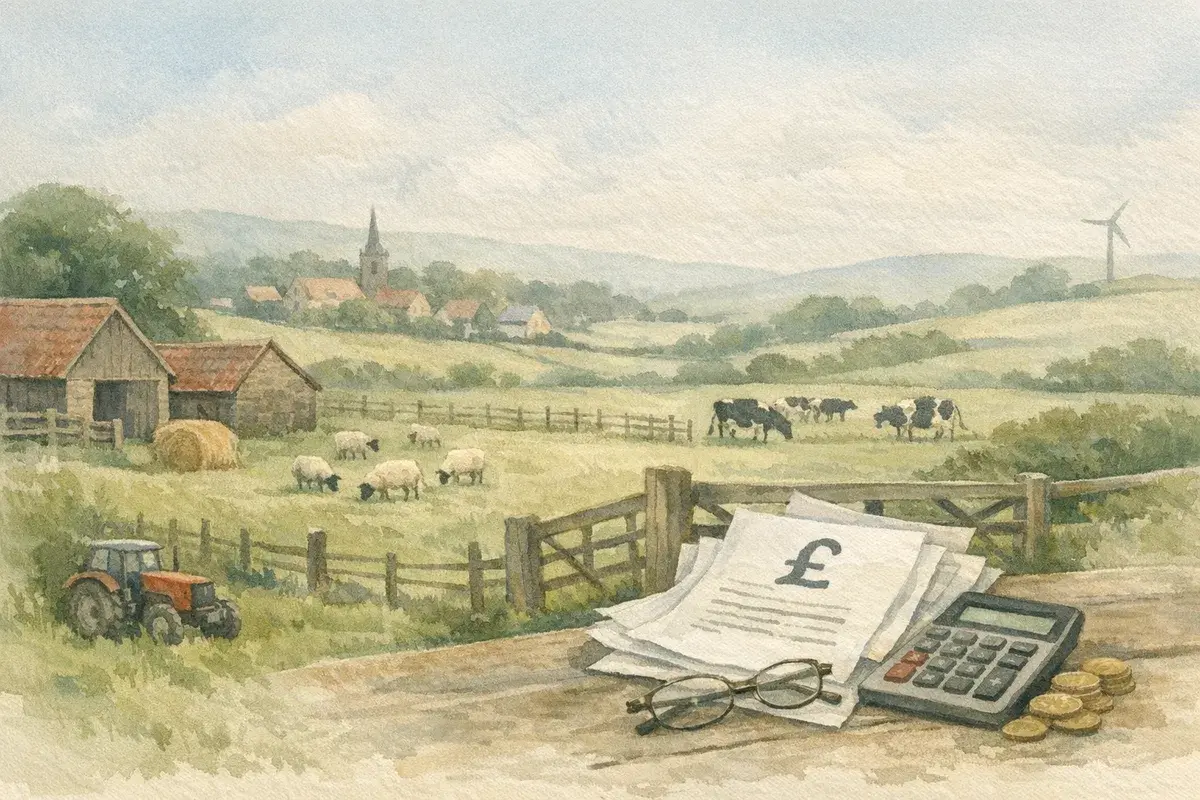
Family farm tax uk is one of the biggest planning issues facing agricultural businesses right now. If you're thinking about succession, inheritance tax, or keeping the farm in family hands, the key rules can make a huge difference.
The short answer? Most family farms can still qualify for valuable tax reliefs, but the outcome depends on land use, ownership structure, tenancy status, and how the business is run. Get those details wrong, and a farm that looks sound on paper can still face a painful tax bill.
That's why this guide focuses on the practical side. We'll look at how the main UK taxes affect family farms, where the common traps sit, and what rural families across counties like Yorkshire, Somerset, Lincolnshire, Cheshire, Devon, and Aberdeenshire should be checking now. We'd argue that early planning is far cheaper than a rushed fix after a retirement, death, or land sale.
How Family Farm Tax Works In The UK
When people ask about family farm tax uk, they're usually talking about inheritance tax, but that's only part of the picture. Capital gains tax, income tax, stamp duty land tax, and even VAT can all matter when land, buildings, machinery, or partnership shares change hands.
The main reliefs for agricultural businesses are Agricultural Property Relief and Business Property Relief. Agricultural Property Relief, or APR, can reduce inheritance tax on qualifying agricultural property, while Business Property Relief, or BPR, can help where assets are part of a trading business rather than simply land held for investment.
Inheritance Tax And The Main Reliefs
For many farms, the first question is whether land and buildings qualify for relief at 100% or 50%. That depends on who owns the asset, how it's used, and whether the occupation rules are met.
Owner-occupied farmland, farmhouses, farm cottages, and qualifying farm buildings are often central to the calculation. But the farmhouse element is closely scrutinised, and it normally has to be of a character appropriate to the holding with someone actively farming from it.
- Agricultural land: Can often qualify for APR if it's actively farmed.
- Farmhouse: Usually needs close operational connection to the holding.
- Farm buildings: Relief may apply if they support agricultural use.
- Let land: Relief can still apply, but the rules differ by letting arrangement.
In practice, the relief position can vary sharply between a hill farm in Cumbria, an arable block in East Anglia, and a mixed unit in Gloucestershire. That's not a quirk. It's the result of different use patterns, occupation structures, and tenancy terms.
Capital Gains Tax And Succession
Capital gains tax, or CGT, can bite when land or buildings are sold, gifted, or transferred into or out of a partnership. If a parent gifts land to a child but keeps some benefit, the tax outcome can be far from simple. Where the plan is an outright sale rather than a family transfer, VAT and the income tax treatment of land held as trading stock can come into play as well, which our walk-through of the tax on selling farm land takes in order.
Hold-over relief, rollover relief, and incorporation relief may help in some cases, but they all come with conditions. If you're planning to pass the farm on gradually, you need to map out the tax position before the first transfer, not after it.
What Counts As A Family Farm For Tax Purposes
There's no special legal label that automatically makes a holding a family farm for tax purposes. HMRC looks at facts, not sentiment, so the structure of ownership and the real nature of the business are what matter.
A traditional family farm may be owned by parents but operated through a partnership with children, or it may sit inside a limited company with land held separately. Some farms are a patchwork of owner-occupied land, tenanted land, and let cottages, which can produce mixed tax results.
Owner-Occupied, Tenanted, And Mixed Holdings
Owner-occupied land often gives the clearest route to APR, but not always the simplest planning. Tenanted land can also qualify in some cases, though the position depends on tenancy type, dates, and occupancy conditions.
Mixed holdings need careful review. A farm in Oxfordshire with a substantial let cottage portfolio may have very different tax exposure from a fully commercial dairy in Cheshire, even if the annual turnover is similar.
- Owner-occupied farm: Usually the cleanest relief profile, if farming use is clear.
- Tenanted farm: Relief may apply, but tenancy terms matter.
- Mixed estate: Different assets can attract different tax treatment.
- Non-farming assets: Woodland, holiday lets, and commercial units need separate analysis.
Partnerships, Companies, And Trusts
Many family farms sit inside partnerships because they help with succession and day-to-day management. But partnership agreements need to match the tax and ownership reality, otherwise the paperwork can create more problems than it solves.
Companies can work well for some businesses, especially where there's diversification into contracting, renewable energy, or food processing. Trusts may also appear in older succession plans, though trustees now need to be especially aware of periodic charges and relief testing.
| Tax Issue | Why It Matters | Typical Farm Scenario | As Of |
|---|---|---|---|
| Inheritance Tax | Can charge on death or lifetime gifts | Passing land to the next generation | April 2025 |
| Capital Gains Tax | Can apply on gifts or sales | Transferring part of the farm to a child | April 2025 |
| Income Tax | Affects profits, rent, and drawings | Partnership farming and diversification income | April 2025 |
| Stamp Duty Land Tax | Can apply on land purchases | Buying adjacent grassland or buildings | April 2025 |
Estate Planning Strategies For Farming Families
Good succession planning is rarely about one magic fix. It's usually about combining ownership, occupation, and business structure so the farm can move to the next generation without forcing a sale of productive land.
That means putting wills, partnership agreements, share structures, and occupancy arrangements under the microscope. The aim is simple: keep the farm viable, keep the family aligned, and keep the tax bill within reason.
Passing The Farm To The Next Generation
Gifts can be useful, but they need to be timed carefully. If a parent gives away land and then carries on enjoying the benefit without proper structure, the transfer can still sit inside the estate for tax purposes.
A phased approach is often better. For example, a dairy farm in Shropshire might pass operating control to an adult child through partnership shares first, while the parents retain some income and housing rights in a documented way.
Using Wills And Partnership Agreements Properly
A well-drafted will should reflect the real farm structure, not just a neat headline ownership split. If the will clashes with the partnership deed, the farm may become tangled at the worst possible time.
Partnership agreements should deal with retirement, death, valuation, and dispute resolution. We'd argue that every family farm should treat these as essential documents, not admin to be dealt with later.
- Wills: Direct the real ownership plan and reduce uncertainty.
- Partnership deeds: Clarify profit share, capital interests, and exit terms.
- Occupancy rights: Protect housing and operational continuity.
- Lifetime gifts: Can help, but should be timed around tax rules.
Regional Factors That Affect Family Farm Tax
Regional land values can change the size of the tax exposure even where the reliefs are similar. A hectare of prime arable land in Lincolnshire may carry a very different financial risk from improved pasture in West Wales or upland grazing in Scotland.
That matters because tax is worked out on value as well as structure. In the South East, where farmhouse and acreage values are often higher, families may need more detailed planning to avoid forced asset sales. In parts of the North East, the issue may be less about land value and more about mixed-use holdings, diversification, and tenancy history.
County-Level Differences In Practice
In Norfolk and Suffolk, arable land values and larger blocks can increase the pressure on estate planning. In Somerset, Devon, and Cornwall, smaller mixed farms often face a different problem, with cottages, tourism income, and lifestyle diversification complicating the tax picture.
Scotland brings its own considerations, particularly where large grassland units, sporting rights, or long-term family inheritances are involved. In Wales, smaller fragmented parcels and strong environmental schemes can also affect how land is used and valued.
Current Market Context For Family Farms
As of April 2025, prime arable land in eastern counties and the Midlands generally remains under strong demand, which keeps values firm. Lower-quality pasture and upland land can be more variable, but good roadside access, diversified income, and planning potential can still support strong prices.
For tax planning, that means the family balance sheet can look very healthy while the cash position remains tight. That's the classic farm problem: the asset is valuable, but the business may not have enough liquid cash to fund a tax bill without borrowing or selling land.
Common Tax Traps And How To Avoid Them
The biggest mistakes are usually ordinary ones. Families wait too long, assume every asset gets the same relief, or forget that a practical farming arrangement is not the same as a legal title on paper.
Another recurring issue is diversification. A converted barn used as a holiday let, a solar array, or a farm shop can all change the tax profile of the wider business. Sometimes that's helpful. Sometimes it isn't.
Farmhouses, Cottages, And Diversification Assets
The farmhouse is often the most challenged asset in a succession case. If it's occupied by someone who's no longer closely involved in the farming business, relief can be reduced or lost.
Farm cottages can be similarly tricky. A cottage occupied by a farm worker may sit in a different relief position from one let on an open market basis, and a holiday let usually needs separate analysis altogether.
The Importance Of Timing
Timing can decide the outcome. A transfer made too close to a health event, retirement, or business restructuring can create avoidable tax friction, while an earlier, staged plan may fit the relief rules far better.
That is why families in places like Lancashire, Herefordshire, and Northamptonshire often review the farm structure years ahead of a handover. It sounds cautious because it is. But caution is what protects the holding.
- Farmhouse status: Keep evidence of active farm use and operational connection.
- Let property: Review tenancy terms and relief eligibility early.
- Diversification income: Separate trading, investment, and mixed-use assets.
- Late planning: Can block reliefs that might otherwise have been available.
Conclusion
Family farm tax uk is ultimately about structure, evidence, and timing. The reliefs can be generous, but only if the farm is organised in a way that matches the rules and the reality of how it is run.
For most farming families, the best approach is to review ownership, partnership arrangements, wills, and asset use together, then keep checking them as the business changes. That is especially true where land values are high, diversification is growing, or the next generation is already involved. Get it right, and the farm stands a far better chance of staying intact for the future.
Disclaimer: AgLand.co.uk is a UK agricultural land and rural property matching service, where buyers register what they are looking for and owners advertise directly to the buyers who match, and a rural resource hub. Nothing in this text is intended as legal, financial, or investment advice. You should carry out your own due diligence and seek guidance from appropriately qualified professionals (for example, solicitors, land agents, surveyors, and financial advisors) for your specific circumstances.