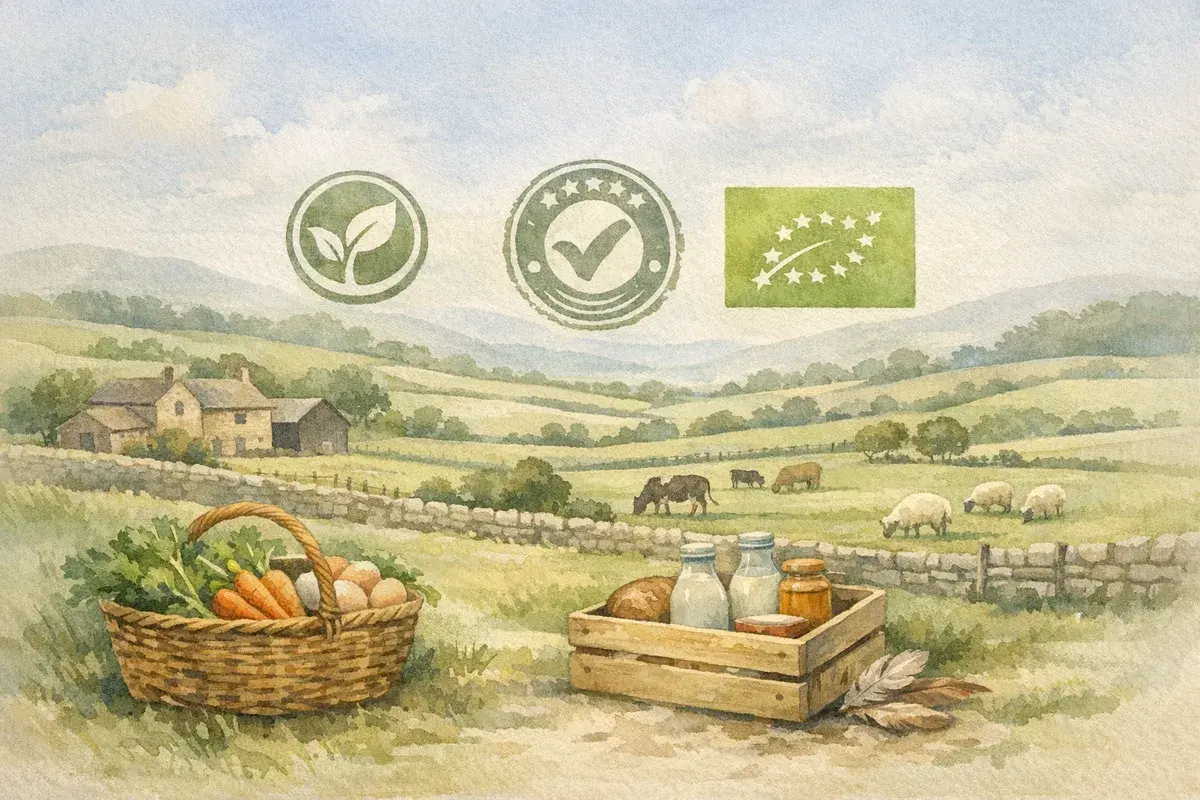
You've probably seen "organic" splashed across packaging, farm shop boards, Instagram posts, and box-scheme flyers, sometimes with a neat little logo, sometimes without. In the UK, those organic farm symbols aren't just decoration. They're shorthand for a regulated system of standards, inspections, records, and (crucially) legal labelling rules.
If you're farming, selling, buying produce, or even buying a rural business that trades on an organic story, understanding what the logos mean, and what they don't mean, can save you from expensive mistakes. This guide cuts through the noise: the core UK organic symbols, where the EU leaf still pops up, how to read codes and origin statements, and how to use marks correctly on-pack, online, and at point-of-sale.
Why Organic Symbols Matter In UK Farming And Food
Organic symbols matter because they turn a claim ("we're organic") into something verifiable. In the UK, "organic" is a protected labelling term for food and feed, meaning you can't simply decide to use it because your approach feels low-input or traditional. The marks and the certifier code are how buyers, inspectors, and Trading Standards quickly see whether the claim is backed by certification.
Consumer Trust, Price Premiums, And Market Access
For customers, a recognised symbol reduces the need for detective work. They don't have to interrogate your spray records or ask how you handle livestock health, the logo and code point to a formal assurance scheme with published rules.
For you, that trust can translate into:
- Price premiums where the market supports it (often strongest in direct-to-consumer, speciality retail, and some livestock categories).
- Market access to buyers who require certification as a condition of supply.
- Brand protection, a clear, regulated claim is harder for less scrupulous operators to mimic without consequences.
And yes, premiums aren't guaranteed. But without the right symbol and wording, even a genuinely organic system can be forced to sell as conventional.
Compliance, Traceability, And Audit Readiness
The symbol is just the tip of the iceberg. Behind it sits traceability, the boring-but-valuable stuff: input approvals, purchase invoices, field histories, livestock movements, cleaning schedules, and batch-level paperwork.
If you're already running a tight ship, organic labelling can become an advantage because it forces disciplined record-keeping that also helps with:
- dispute resolution (what happened, when, and why)
- customer queries and complaints
- lender/investor confidence
- smoother staff handovers
A practical point we see a lot: problems rarely start with "the farm did something terrible". They start with "we did the right thing but can't prove it fast enough." Organic marks, used correctly, are designed to make proof easier.
The Core UK Organic Symbols You’ll See Most Often
In the UK market, the most common organic identifiers tend to be: (1) the certification body's own mark, such as the Soil Association or OF&G, (2) the certifier code number, and sometimes (3) the EU organic logo. There is no official UK organic logo.
If you're ever unsure what you're looking at, work backwards from the code. That's where the accountability sits.
The Certifier Code And Origin Statement
There is no official UK or GB organic logo. What the labelling rules require on prepacked organic food in Great Britain is:
- a control body code in the format GB-ORG-XX, identifying the certification body that audited the business
- an origin statement saying where the agricultural ingredients were farmed
Logos are optional. The one you are most likely to see is the certifier's own mark. The EU organic logo can also appear on GB products, but only where the food meets the EU rules for using it.
Soil Association Certification Mark
The Soil Association Certification mark is widely recognised by UK consumers. When you see it used correctly, it indicates the operator is certified by Soil Association Certification and is meeting organic standards within that certification framework.
From a seller's perspective, it can also be a commercial asset: customers often actively look for it, and some retailers/wholesalers prefer dealing with certifiers they know well.
But treat it like any other controlled mark: you can't just drop it into a menu, label template, or social media graphic because it "sounds about right". Artwork versions, sizing, clear space, and context matter, and approval is typically part of the workflow.
Organic Farmers & Growers (OF&G) Mark
OF&G (Organic Farmers & Growers) is another well-known UK certification body mark. You'll see it on a wide range of products, especially where supply chains involve multiple businesses (producer, packhouse, processor, brand owner) and each link needs to be appropriately certified or handled under certified procedures.
If you're trying to map logos to real-world compliance, it helps to understand the underlying rulebook first. AgLand's explainer on organic farming standards in the UK is a solid foundation because it separates "what consumers assume" from "what inspectors actually check".
The EU Organic Leaf On UK Products: When It Can Still Appear
Since Brexit, the EU organic "leaf" hasn't vanished from UK shelves, but it's not a free-for-all. Whether you can use it depends on where you're trading, where the product is certified, and how the supply chain is set up.
Labelling Rules For Great Britain Vs Northern Ireland
This is where UK-only nuance matters.
- Great Britain (England, Scotland, Wales): the EU leaf may appear on some products, but it must be used in line with the applicable rules for the market you're placing goods on, and only where the product meets the relevant EU organic requirements (typically tied to exports or EU-recognised certification routes).
- Northern Ireland: prepacked organic food produced in Northern Ireland must carry the EU organic logo, with a control body code in the format XI-ORG-XX and an origin statement such as "UK (NI) Agriculture" or "EU Agriculture".
If you sell across GB and NI, or you pack in one and ship into the other, you'll want your certifier's view early, before labels are printed and stock is sitting in a warehouse.
Importing, Exporting, And Mixed-Supply Chains
The EU leaf often shows up in three real-life scenarios:
- You export to the EU and need EU-compliant organic labelling.
- You import organic ingredients and your finished product labelling reflects that chain.
- You operate mixed supply chains (some lines for GB-only, some for EU/NI), and packaging has to be managed carefully.
Mixed supply chains are where people get caught out. A brand might assume "it's organic everywhere", but the permitted logo set and mandatory text can differ by market. One label, two markets, one mistake: that's how expensive reprints happen.
If you're setting up certification for the first time or expanding into exports, it's worth reading AgLand's practical guide on organic farming certification in the UK so you understand what your certifier will expect before you scale up packaging or production.
How To Read An Organic Label Properly
A good organic label reads like a small compliance checklist: logo + certifier code + origin statement, and wording that matches what the product actually is.
If you're buying, it helps you verify claims quickly. If you're selling, it helps you avoid accidental mislabelling.
The Certifier Code: Who Audited The Business And Where
The certifier code tells you which certification body is responsible for auditing the operator (the farm, processor, packer, or brand owner, whoever is named on the label).
Practical uses of the code:
- Buying wholesale: you can request the supplier's current certificate and cross-check it matches the code and the business name/address.
- Farm shops and delis: if you stock multiple local suppliers, codes help you keep your paperwork straight.
- Due diligence: if you're acquiring a farm business that claims organic status, the certifier and scope of certification should be immediately confirmable.
Origin Statements: UK Agriculture, UK/Non-UK Agriculture, And Specific Countries
Origin statements are often overlooked, but they're a key part of honest labelling.
You'll commonly see:
- UK Agriculture (ingredients farmed in the UK)
- UK or non-UK Agriculture (a mix)
- Non-UK Agriculture
- or a named country, such as Welsh Agriculture, where at least 98% of the agricultural ingredients were farmed there
This matters commercially. Customers who buy organic for environmental reasons often also care about food miles and domestic production, and Trading Standards cares about misleading impressions. If your packaging and your marketing imply "British organic" while your origin statement says otherwise, you're storing up trouble.
Organic, In-Conversion, And Partly Organic Claims
This is where labelling gets subtly risky.
- "Organic" generally indicates the product meets the organic standards and the operator is certified for that activity.
- "In-conversion" (where permitted) refers to produce from land during the conversion period under organic management but not yet fully organic status.
- Less than 95% organic: if under 95% of the agricultural ingredients are organic, organic can only be mentioned in the ingredients list, not in the product name or description.
If you're planning a switch, the conversion timeline is not just an agronomy issue, it's a marketing and cashflow issue too, because it affects what you can claim and when. AgLand's guide to the organic farming conversion period lays out what "conversion" looks like in practice and how it typically impacts selling routes.
And if you're writing copy for labels, menus, or web listings, base it on the standards and your certificate scope, not what you intend to become next year.
What The Symbols Do Not Guarantee (And Common Misconceptions)
Organic symbols are powerful, which is why misconceptions spread fast.
A logo confirms certification to organic standards. It doesn't automatically mean "best on every metric a consumer cares about." Sometimes it aligns. Sometimes it doesn't. Your job (especially in direct sales) is to communicate clearly without overclaiming.
Organic Vs Free-Range, Pasture-Fed, Grass-Fed, And Regenerative
These terms often get bundled together in customers' minds, but they're different frameworks.
- Free-range is typically about access and confinement (and rules vary by species/product).
- Pasture-fed / grass-fed are feeding claims that may or may not be independently verified.
- Regenerative is an emerging umbrella term with no single regulated UK definition across food labelling.
- Organic is a regulated certification scheme with defined production rules and inspections.
You can be organic and not market yourself as regenerative. You can be regenerative-ish and not be certified organic. You can be pasture-based and not certified at all. None of these are inherently "good" or "bad", but they're not interchangeable.
Pesticides, Antibiotics, And Animal Welfare: The Nuance
Customers often assume organic means:
- zero pesticides
- never any antibiotics
- gold-standard welfare in every situation
Reality is more nuanced.
Organic standards restrict synthetic inputs and set rules around animal health management, living conditions, and husbandry. But organic farming still involves active management, and animal welfare includes treating sick animals appropriately. The point is to prioritise prevention and responsible systems, not to abandon treatment when it's needed.
If you sell direct, it's worth having a simple, honest "what organic means on our farm" statement that matches your certificate scope. Overpromising is where reputations unravel.
If you're still getting comfortable with the formal side, AgLand's overview of organic farming requirements in the UK is useful because it translates standards into the day-to-day reality: inputs, rotations, livestock management, segregation, storage, and documentation.
How Farms And Rural Businesses Get Authorised To Use Organic Marks
You don't "apply for a logo". You certify a business (and specific activities), then you're authorised to use certain marks on certain products in certain ways.
That sounds picky. It is. But it's also what keeps the claim meaningful.
Certification Steps, Inspections, And Record-Keeping Expectations
In broad terms, you're looking at:
- Choose a certification body suitable for your enterprise (livestock, arable, horticulture, processing, packing, retail).
- Apply and submit key documents (maps, field histories, livestock plans, input lists, procedures).
- Conversion management where applicable.
- Inspection, typically annual, with the possibility of additional visits depending on risk and complexity.
- Certification decision and issuance of your certificate and schedule (scope matters).
Inspectors don't just look at fields and animals: they look at systems: segregation between organic and non-organic, cleaning regimes, supplier verification, complaint handling, traceability checks, and whether records reconcile.
If you want a clearer feel for how audits run (and what "good paperwork" looks like), AgLand's guide to the organic farming inspection process is a practical walk-through.
Packaging, Online Listings, And Point-Of-Sale Signage: Approval Workflows
Here's a common trap: you update your label, menu, website, or farm shop signage… and assume certification automatically covers whatever wording you choose.
In reality, most certification systems expect you to:
- use approved artwork versions of marks
- keep claims consistent with your certification scope (e.g., "organic" vs "in-conversion")
- submit certain materials for approval (especially new labels)
- ensure traceability from product back to certified suppliers and batches
This applies to online listings and social media, too. An Instagram post can be "advertising". A product page can be "labelling". The medium changes: the consumer impression doesn't.
Risks: Enforcement, Trading Standards, And Costly Reprints
The main risks of getting organic marks wrong aren't theoretical:
- Enforcement action (including being required to remove or amend misleading material)
- Suspension or restrictions from your certifier if non-compliance is serious
- Commercial losses from delisting, recalls, or having to relabel stock
- Costly reprints of packaging and POS materials (often the most painful bit, because it's immediate cash)
Budget matters here. Certification isn't just an annual fee, it touches packaging design, storage systems, staff time, and admin. If you're building a business plan, AgLand's breakdown of the cost of organic certification in the UK helps you think beyond the headline number and into the "hidden" operational costs.
Using Organic Symbols In Farm Retail, Box Schemes, And Direct-To-Consumer Sales
Direct-to-consumer is where organic symbols can do a lot of heavy lifting, but it's also where casual wording causes the most accidental mislabelling.
The rule of thumb: the closer you are to the customer, the more your personal credibility is on the line. A logo used sloppily doesn't just risk compliance: it makes you look careless.
Farm Shops, Farmers' Markets, And Catering: Practical Labelling Setups
In farm retail and markets, you're often juggling small batches, multiple suppliers, and a mix of prepacked and loose produce. Practical setups that work well include:
- A "certified organic" board behind the counter with your current certificate displayed (and a system to replace it promptly when renewed).
- Clear shelf-edge labels that specify which items are organic (and avoid vague phrases like "grown naturally" right next to non-organic produce).
- Separate crates and storage areas for organic vs non-organic to reduce mix-ups.
- Simple product tickets that include the certifier code where appropriate (especially if you repack or label).
If you supply catering (cafés, farm venues, events), be especially careful with menu language. "Organic ingredients" can be interpreted as "everything organic" unless it's clearly qualified.
Online Sales And Social Media: Avoiding Misleading Impressions
Online, a few patterns cause problems:
- Using organic logos on a homepage when only a small product subset is certified.
- Taglines like "organic farm" when you're in conversion or only certain enterprises are certified.
- Bundle products (veg boxes, meat boxes) where not every line is organic, but the overall presentation implies it is.
A safer approach is to be explicit:
- "Certified organic where stated"
- "Our certified organic products are marked with…"
- "In conversion (certified) since…"
And keep a tidy document trail for online listings: screenshots, product specs, and supplier certificates. It sounds fussy, until you have a complaint, a competitor grumble, or a platform query.
One more commercial angle: many farms pair organic with diversification (farm shops, cafés, glamping, events, processing). If that's your direction of travel, AgLand's piece on practical diversification routes for UK farms can help you stress-test which ideas actually stack up with your land, buildings, and planning constraints.
What This Means For Agricultural Property And Rural Business Buyers
If you're buying a farm, smallholding, rural business, or even taking on a tenancy, organic status can look like a ready-made advantage. Sometimes it is. Sometimes it's a fragile asset that disappears the moment management changes.
The smart move is to treat "organic" as a due diligence item, like water, drainage, planning history, and rights of way, not as a marketing bullet point.
Due Diligence: Certificates, Input Histories, And Conversion Status
If a seller says "it's organic", you want to see:
- the current certificate and schedule (scope, enterprises, addresses)
- conversion status for relevant parcels (and dates)
- input history and restrictions (what's been used, when, and where)
- rotation and stocking history that supports the claim
- any non-compliances and corrective actions from recent inspections
A common pitfall: a farm might be well managed but not certified, or certified for one enterprise but not another. Another: land might be in conversion, but the buyer assumes it's fully organic and values it accordingly.
If you're buying for the long term, also look at the "systems" side, storage segregation, cleaning processes, neighbour boundary risks (spray drift), and the practical reality of maintaining standards.
Tenancies, Contract Farming, And Shared Infrastructure: Who Holds Certification
Organic certification attaches to the operator and activities, not just the land. That matters when:
- you're taking on a Farm Business Tenancy and need to know who controls inputs and records
- you're entering a contract farming agreement and need clarity on responsibilities
- you share grain stores, machinery, handling kit, or packhouse space across organic and non-organic operations
The question to ask early is: who is the certified business, and what exactly is certified? Then check how that changes at completion.
Valuation And Income Considerations: Premiums, Costs, And Operational Constraints
Organic status can influence income, but it can also bring constraints that affect "normal" farming choices:
- restricted input toolbox (and potentially higher reliance on management skill, rotations, and labour)
- certification and inspection costs
- greater paperwork burden
- segregation and storage requirements
- conversion periods that affect cashflow
From a valuation perspective, lenders and buyers tend to be persuaded by evidence:
- historic sales data showing premiums achieved
- contracts and customer relationships
- enterprise gross margins under the actual system
- proof that the certification is stable and transferable (or at least maintainable)
Whichever side you're on. Buyers tell AgLand what they're looking for and hear the moment something fits. Owners advertise straight to the buyers who already match, for one flat fee and no commission. Register as a buyer or check your matches.
Conclusion
Organic farm symbols in the UK are more than marketing, they're compliance shorthand. If you're selling, they help you protect your premium and communicate quickly: if you're buying, they help you verify what's real and what's just good copywriting.
Use the logos like you'd use any regulated claim: with paperwork behind it, wording that matches your certification scope, and a cautious approach to packaging and online content. And if you're acquiring land or a rural enterprise where "organic" is part of the story, treat certification like a core asset, one you test, not just trust.
Disclaimer: AgLand.co.uk is a UK agricultural land and rural property matching service, where buyers register what they are looking for and owners advertise directly to the buyers who match, and a rural resource hub. Nothing in this text is intended as legal, financial, or investment advice. You should carry out your own due diligence and seek guidance from appropriately qualified professionals (for example, certification bodies, solicitors, accountants, surveyors, and planning advisors) before making decisions.