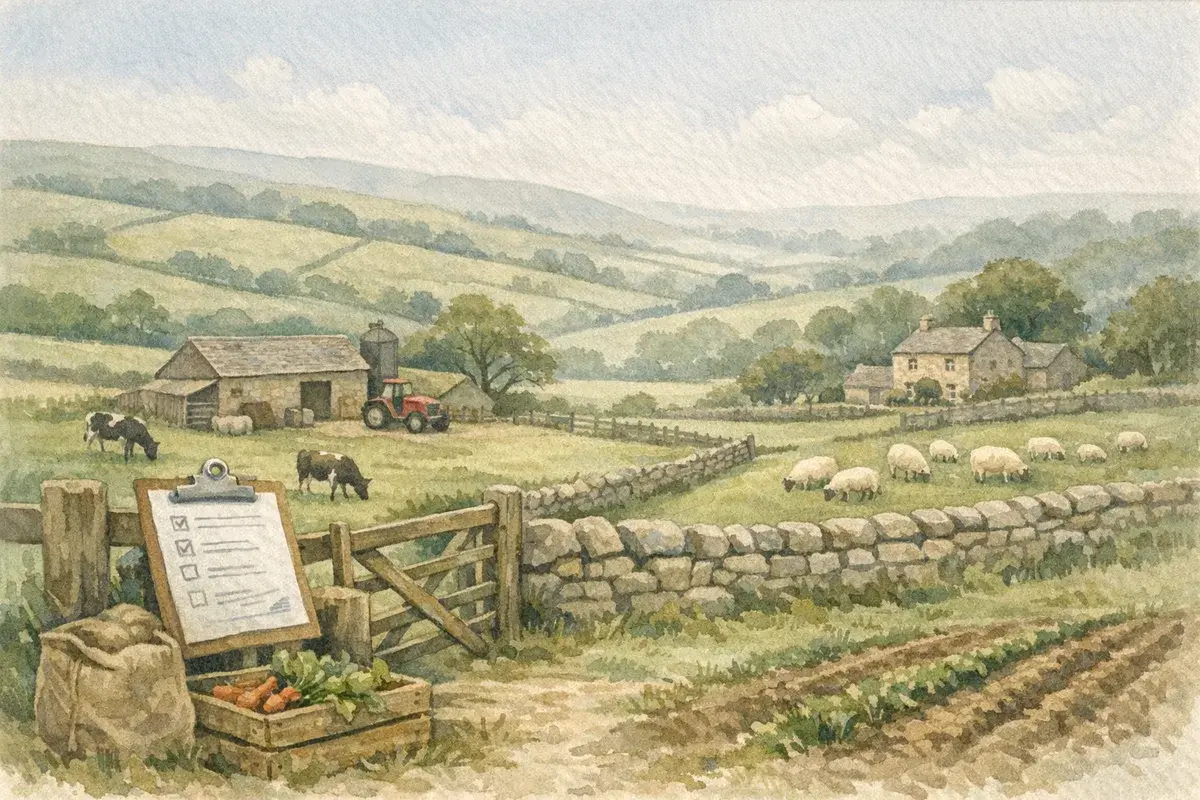
If you've never been through an organic inspection, it's easy to imagine it's all clipboards and gotcha questions. In reality, the organic farming inspection process in the UK is closer to a structured, evidence-led audit of how your farm operates day to day: what you buy in, what you apply, what you feed, how you store, and, crucially, how you can prove it.
The farms that breeze through aren't necessarily the fanciest. They're the ones with calm routines, clear separation between organic and non-organic (where relevant), and records that match what's happening on the ground. This guide walks you through what inspectors look for, how the timeline usually runs, and how to prepare without turning the week before a visit into a panic.
How Organic Certification And Inspections Work In Practice
Organic certification in the UK is built around a simple idea: you're allowed to market produce as organic only if your whole system meets the rules and you can demonstrate that it does, consistently.
That "demonstrate it" piece is where inspections come in. Think of an inspection as a verification of your management system (plans, procedures, purchasing, storage, animal health decisions) as much as a look around the yard.
Who Regulates Organic Standards In The UK
In the UK, organic production is governed by retained legislation and implemented through approved organic control bodies. Practically, you'll deal with a control body that's authorised to certify and inspect your operation.
Your inspector is there on behalf of that control body. They're not your agronomist and they're not there to redesign your business, although good inspectors will often flag risk areas and ask the sort of questions that help you tighten up your system.
If you're still getting your head around what sits behind the rulebook, it helps to read up on the core organic farming standards in the UK so you understand the logic inspectors are following.
What Inspectors Are Checking: Standards, Scope, And Risk
Inspections typically cover three overlapping layers:
- Standards compliance: Are you meeting the organic rules for your enterprise type (arable, mixed, livestock, horticulture, processing, storage)?
- Scope: What exactly is included in your certification, land parcels, livestock enterprises, buildings, storage sites, contractors, any processing or packing? If it's in scope, it's auditable.
- Risk: Where could organic integrity be compromised? Common UK risks include spray drift from neighbouring conventional land, shared machinery, bought-in feed or bedding, commingled storage, and unclear documentation when produce moves off farm.
Inspectors work methodically: they'll sample documents, cross-check field operations against purchases and sales, and look for weak links. The goal is traceability and credibility, not perfection. But if something is unclear or unmanaged, it will get attention, because unclear is where problems hide.
For a broader view of the steps, costs and typical compliance pinch-points, you may also find AgLand's guide to UK organic certification and how it's assessed useful.
Your Inspection Timeline: From Application To Ongoing Annual Visits
One reason inspections feel stressful is that people treat them as an event. In practice, they're the visible checkpoint in a year-round compliance cycle.
Pre-Application And Conversion Period Checks
Before you're certified, you'll apply to a control body and define your scope (land, enterprises, storage, any processing/packing). At this stage, you'll be thinking about inputs, rotations, stocking, and how you'll avoid contamination.
If you're converting, the conversion period is where many UK farms either build good habits, or accidentally create future headaches (for example, by not documenting seed sources or by using contractors without clarifying cleaning protocols). If you're planning that journey, it's worth grounding yourself in what the organic conversion period involves in practice, timelines affect cropping choices, livestock integration, and when you can market as organic.
A common misconception: "I'm not selling as organic yet, so the admin can wait." It can't, really. Inspectors will still expect controls and records to be in place during conversion, because conversion is part of the certification story.
Initial Inspection Versus Routine Annual Inspection
Your initial inspection is usually broader and slower. The inspector is building a baseline understanding of:
- your farm layout and boundaries
- enterprise scope
- planned rotations and input strategy
- housing, yards, stores, and handling areas
- record systems (paper, spreadsheets, software)
Routine annual inspections are still thorough, but they tend to focus on what's changed, where the risk sits this year, and whether last year's actions were completed. If you added rented blocks, brought in a new contractor, started finishing cattle, or began storing for a neighbour, those are inspection-worthy changes.
Risk-Based And Unannounced Inspections: When They Happen
Not every inspection is pre-arranged in a neat, diary-friendly way. Control bodies can carry out risk-based visits, including unannounced inspections.
Triggers vary, but typical reasons include:
- a higher-risk supply chain (for example, bought-in feed or trading)
- complex operations with multiple sites or storage locations
- previous non-compliances
- significant changes in the business (new land, new enterprise, new storage/packing)
- complaints or intelligence suggesting a risk to organic integrity
The best way to handle the possibility of an unannounced visit is boring-but-effective: keep records current and keep segregation systems obvious. If everything only makes sense when you explain it, you're relying on memory rather than controls, and inspections are designed to test controls.
What Inspectors Review On Farm: Typical Inspection Areas
Most UK organic inspections blend two things: a sit-down document review and a farm walk/drive. The order depends on the inspector and your setup, but the coverage tends to be consistent.
Land, Cropping Plans, Inputs, And Contamination Controls
Expect questions and checks around:
- Land parcels and history: what's in scope, what's in conversion, what's excluded (if anything), and why, cross-checked against your parcel data held by the Rural Payments Agency.
- Cropping and rotation plan: how fertility is maintained, how you're handling weeds, and how the plan matches field operations.
- Seed and planting material: organic seed use and justification/records where alternatives were used.
- Inputs: fertilisers, soil amendments, crop protection products (where permitted), cleaning products for stores/handling, plus purchase invoices and application records.
- Contamination controls: buffer zones, hedges, watercourses, sprayer drift risk, neighbour communication, and what you do if there's a known incident.
A detail that often trips people up: you might do the right thing operationally but fail to evidence it. If a neighbour sprays and you had a phone call, note it. If you left an unsprayed margin as a buffer, map it and record it.
Livestock, Feed, Veterinary Treatments, And Welfare
For livestock units, inspectors usually look at:
- Feed sourcing and rations: organic status, invoices, delivery notes, storage integrity.
- Livestock movement records: purchases, sales, births, deaths, and holding registers.
- Veterinary medicines: treatment records, withdrawal periods, and decision-making around animal health.
- Housing and welfare: bedding, stocking densities, access to outdoors (where relevant), and general welfare outcomes.
They're also looking for coherence: does your livestock plan match your land base and your forage/fertility strategy? Organic inspections often reward joined-up farming.
Storage, Handling, Labelling, And Organic/Non-Organic Segregation
Where your farm stores, handles, packs or sells product, expect scrutiny of:
- Segregation: clear physical separation and/or timed separation with effective cleaning when organic and non-organic are both present.
- Stores and bins: identification, cleaning regimes, pest control approaches aligned with organic requirements.
- Labelling and claims: what you put on tickets, invoices, farm shop labels, and whether you're using the correct markings.
If you sell boxed veg, meat, grain, or even hay/straw as organic, labelling becomes part of compliance. Many people only think about logos at the very end, better to understand the organic symbols used in the UK early so your sales and paperwork don't accidentally create a problem.
Records And Evidence: The Paper Trail That Makes Or Breaks An Audit
If you take one thing from this: the inspection is not a test of whether you remember what happened. It's a test of whether your system produces reliable evidence.
Good organic farms don't have perfect paperwork. They have repeatable routines: record at the point of action, file invoices as they arrive, and keep maps and plans version-controlled.
Mandatory Documents: Field, Livestock, Input, And Sales Records
Inspectors commonly ask for:
- Field records: cultivations, sowing dates, varieties, harvest, yields, manures/compost applications, grazing dates.
- Input records: what was used, where, how much, and why it's permitted (plus invoices and product specs).
- Livestock records: movement books, flock/herd registers, feed purchases and usage, bedding, medicines and vet notes.
- Sales records: invoices, delivery notes, batch/lot references, and any claims made.
A practical approach that works on busy UK farms: keep a single "inspection folder" (digital or physical) with the last 12 months of the above, plus a running list of changes (new land, new supplier, new storage). You're reducing the time spent rummaging while someone watches.
If you want a tighter framework, AgLand's overview of organic farming requirements in the UK pairs well with an annual record checklist, because it's usually the gaps between "requirements" and "what we wrote down" that cause findings.
Mass Balance, Traceability, And Supply Chain Checks
A key audit technique is mass balance, whether the volumes you say you produced and sold make sense against your land area, yields, stock numbers, and purchases.
Examples of what an inspector might do:
- Compare harvested tonnage to hectares cropped and typical yields (allowing for the season).
- Cross-check feed bought in against stock numbers and time housed.
- Track a batch from field or store through to sale paperwork.
You don't need to obsess over making everything look "high performing". You do need it to be believable and reconcilable. Where you have wastage, spoilage, or downgraded loads, record it. It's better to show reality than to leave a mystery.
Maps, Boundaries, Buffer Zones, And Neighbour Management
Maps are not glamorous, but they're one of the fastest ways to show control.
Inspectors often want to see:
- a clear holding map with field numbers/IDs
- boundaries (hedges, ditches, tracks) and any shared access
- buffer zones and excluded areas (if applicable)
- sensitive points: watercourses, spray drift risk edges, storage sites
Neighbour management in the UK context is a real-world necessity, not a theoretical best practice. A simple record of who you spoke to, when, and what was agreed (for example, notification before spraying a boundary) can de-risk a whole edge of the farm.
And don't forget shared access routes. If a track is used by contractors servicing conventional neighbours, that doesn't automatically make you non-compliant, but it does mean you should have a considered approach to contamination risk and documentation.
Preparing For Inspection: A Practical Checklist For UK Farms And Estates
Preparation isn't about staging the place. It's about making your normal system easy to audit.
Pre-Visit Self-Audit: Fixing Gaps Before The Inspector Arrives
A sensible self-audit a few weeks ahead usually pays for itself in reduced stress. Here's a practical checklist:
- Update your scope changes: new land, new enterprises, new storage locations, new contractors.
- Reconcile key numbers: cropped hectares vs harvest, livestock numbers vs feed use, sales volumes vs production.
- Check input approvals: keep product specs, labels, and invoices together.
- Review separation points: stores, trailers, augers, weighheads, livestock handling, anything that could mix organic/non-organic.
- Close old actions: if last year had corrective actions, ensure evidence is ready.
If you're already certified, think in terms of continuous compliance rather than annual firefighting. AgLand's guide on maintaining organic certification goes deeper on the habits that keep you out of trouble year-round.
Staff Briefing And Site Readiness On The Day
On the day, your job is to keep the inspection flowing.
- Brief staff so everyone gives consistent, factual answers (especially around cleaning, segregation, and where things are stored).
- Make sure keys are available for stores and chemical cupboards.
- Have a workspace ready: somewhere to lay out maps, invoices, and records.
- Keep a "parking bay" for questions: if the inspector asks something you can't answer instantly, note it and come back with evidence rather than guessing.
A small human reality: inspectors can tell when a farm is being "performed". Calm, ordinary transparency tends to build trust faster than over-polished explanations.
Working With Contractors, Hauliers, And Storage Providers
UK farms increasingly rely on third parties, combining, hauling, mobile grain cleaning, contract rearing, shared stores. That's fine, but inspectors will want to see that you've maintained control.
Good practice includes:
- written agreements or emails confirming cleaning and segregation procedures
- records of when shared kit was cleaned (and by whom)
- clear instructions on where organic loads go, how they're labelled, and what paperwork travels with them
- where off-site storage is used, a clear map/address and a description of segregation
If you're using a general-purpose store that also handles non-organic grain, be ready to show a robust cleaning regime and a system that prevents accidental tipping into the wrong bay. Most non-compliances in this area aren't bad intent, they're momentary confusion. Your job is to engineer confusion out of the system.
Non-Compliance, Corrective Actions, And Appeals
Non-compliance sounds dramatic. Often it's not. It's a formal way of saying: "This part of your system doesn't currently meet the rules, or you can't evidence that it does."
What matters is severity, speed of response, and whether the organic integrity of product has been compromised.
Minor Versus Major Non-Compliance And What It Means For Status
While terminology varies between control bodies, you can broadly expect:
- Minor non-compliance: an issue that doesn't necessarily compromise product integrity but needs correction (for example, incomplete records, a missing label on a store bin, a procedure that isn't written down).
- Major non-compliance: higher-risk issues, use of non-permitted inputs, clear segregation failures, repeated unresolved issues, or traceability breakdowns.
A minor finding is often a warning sign, not a punishment. But multiple "minor" issues can add up to a bigger picture: weak control.
Corrective Action Plans, Evidence Deadlines, And Follow-Up Visits
If you receive non-compliances, you'll typically be asked for a corrective action plan with deadlines and evidence.
To handle it well:
- Respond quickly and concretely, what you did, when, and how it prevents recurrence.
- Provide proof: photos of relabelled stores, updated maps, revised procedures, invoices, training notes.
- Don't over-promise. A modest fix delivered on time beats an ambitious overhaul that never lands.
Follow-up visits may occur where risk is higher or where evidence can't be adequately assessed remotely.
Suspension, Decertification, And How Appeals Typically Work
Where there's a serious breach, certification can be suspended or removed (decertification). This can affect your ability to market produce as organic and, in some cases, may require product to be downgraded.
If you believe a decision is incorrect, control bodies usually have an appeals process. Appeals are evidence-driven, so your best chance is detailed records, clear timelines, and professional support (for example, from an experienced consultant or adviser who understands organic controls).
One pragmatic note: if something has gone wrong, your tone matters. Inspectors and certification teams respond better to clear accountability and a prevention plan than to defensiveness. The system is designed to protect consumer trust: your job is to show you're protecting it too.
Buying, Renting, Or Selling Organic Land: Inspection Implications For Property Decisions
Organic status changes the property conversation. It affects value, marketability, management obligations, and the due diligence you should do before you sign.
If you're buying, you're not just acquiring soil and buildings, you're inheriting a compliance history and a set of operational constraints (some helpful, some inconvenient).
Due Diligence When Acquiring Organic Or In-Conversion Holdings
Before you buy or take on a farm advertised as organic or in conversion, you'll want to confirm:
- what is actually in the certified scope (fields, buildings, yards, stores)
- the status of each parcel (organic, in conversion, excluded)
- any outstanding non-compliances or corrective actions
- contamination risks from neighbours and how they've been managed
- whether key enterprises rely on third-party storage, contractors, or shared facilities
Ask for records that make the claim real: recent inspection reports (where available to you), maps, cropping history, input use history, and evidence of segregation where relevant.
From a market-insider perspective, we've seen transactions slow down because "organic" was treated as a label rather than a management system. The fastest deals are the ones where the vendor can produce a tidy pack of evidence early.
Tenancies, Contract Farming, And Shared Kit: Keeping Compliance Clear
Where land is rented, farmed under a contract farming agreement, or managed across multiple parties, clarity becomes a compliance tool.
Practical steps that help:
- define who is responsible for organic records (and where they're kept)
- agree who buys inputs and who approves them
- document cleaning/separation for shared machinery
- ensure cropping plans and stewardship obligations align with organic requirements
If you're a landowner with an operator in place, you should still understand the basics of the inspection process. If the operator falls short, it's your asset and reputation on the line too.
Infrastructure And Planning Considerations For Organic Units
Organic systems often shift infrastructure priorities: more covered storage for segregated produce, different livestock housing needs, composting areas, handling space for direct sales, or additional fencing for grazing management.
From a property perspective, consider:
- whether existing stores allow clear separation and easy cleaning
- yard flow (can you avoid cross-traffic that risks mixing?)
- water and drainage around manure/compost handling
- access and turning for haulage without contaminating handling areas
If you're developing or adapting a holding, it's wise to sense-check your plans with your control body early and bring in appropriate professional advice, especially where building work, change of use, or sensitive environmental designations are involved.
And if you're actively searching for a holding that suits an organic system, whether that's pasture-heavy, mixed, or horticulture-friendly, being specific about what you need matters. AgLand is built around rural and agricultural transactions: you register the practicalities you need (land type, buildings, access, rights and constraints) and hear the moment something matching is advertised, rather than trawling generic listings.
Conclusion
The organic farming inspection process in the UK is predictable once you stop viewing it as a once-a-year hurdle. Inspections reward the farms that run clear systems: controlled inputs, sensible contamination management, obvious segregation, and records that tell the same story as the yard and the fields.
If you're preparing for your first inspection, aim for "credible and consistent" rather than "perfect". Build a routine for records, map your risk points, and make sure everyone involved, family, staff, contractors, understands how organic integrity is protected on your holding.
Disclaimer: AgLand.co.uk is a UK agricultural land and rural property matching service, where buyers register what they are looking for and owners advertise directly to the buyers who match, and a rural resource hub. Nothing in this text is intended as legal, financial, or investment advice. You should carry out your own due diligence and seek guidance from appropriately qualified professionals (for example, organic certification bodies, agronomists, veterinarians, accountants, solicitors, and surveyors) before making decisions.