
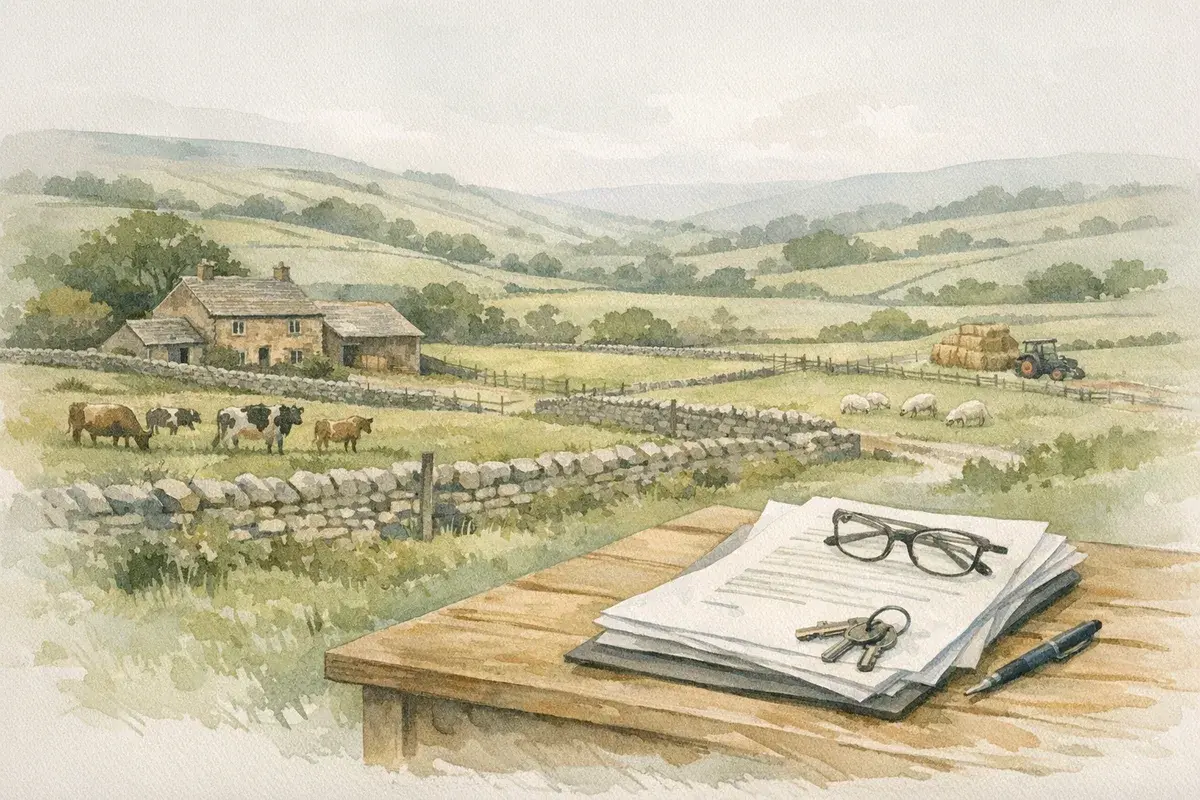
If you've ever searched for a "farm business tenancy agreement template", you've probably found plenty of documents that look convincing, right up until you try to apply them to a real holding with real gates, real tracks, real kit, and real money at stake.
An FBT is commercial. It's also personal in the way only rural property can be: a water trough that's always been "yours", a shared yard everyone quietly relies on, a right of way that's never been written down because "it's how it's always been". Templates can be a useful starting point, but only if you treat them as a framework to fill with the gritty, site-specific details that prevent arguments later.
This guide shows you what a UK farm business tenancy agreement template should include, what you need to gather before you draft, where the big legal and practical tripwires sit, and when it's sensible to stop tweaking clauses and pay for proper advice.
What A Farm Business Tenancy (FBT) Is And When It Applies
A Farm Business Tenancy (FBT) is the default form of agricultural letting in England and Wales for most new arrangements entered into on or after 1 September 1995, provided the agreement meets the statutory conditions. In plain terms: it's a tenancy of agricultural land (and often buildings) let for the purposes of a farming business, governed primarily by the Farm Business Tenancy regime.
If you're drafting from a template, your first job is classification. Get that wrong and you can accidentally create very different rights and obligations than you intended.
For a deeper run-through of core terms, practical realities, and how these agreements play out on the ground, see AgLand's guide to how farm business tenancies typically work in practice.
FBT Vs Agricultural Holdings Act (AHA) Tenancies: Why The Distinction Matters
In England and Wales, the big distinction is usually between:
- FBTs (Farm Business Tenancies) – generally more flexible on term length, rent review, and possession at the end of the term (assuming the agreement is drafted and operated correctly).
- AHA tenancies (Agricultural Holdings Act 1986) – typically older tenancies with stronger security of tenure and more complex statutory rules.
Why you should care: the wrong tenancy status can affect everything from your ability to recover possession, to compensation rules, to lender confidence, to the value/marketability of the asset.
If you're uncertain which framework you're dealing with, particularly where there's an existing occupier, historic paperwork, or you're varying an old arrangement, read up on the key differences between an agricultural tenancy and an FBT before you touch a template.
The Legal Basics: Agricultural Use, Business Purpose, And The 1995 Act Framework
To sit comfortably within the FBT regime, the letting generally needs to satisfy "agricultural" conditions (broadly, land used for agriculture) and be let for the purposes of a business.
Templates often wave a hand at this with a single line like "for agricultural purposes only". That's not enough if the reality is mixed use, contracting arrangements, grazing licences embedded inside, or a block of buildings that someone wants to use for storage that's not clearly agricultural.
When you're referencing statutory footing or you want to sense-check what the Act actually does (and doesn't) cover, it's worth reviewing the Farm Business Tenancy Act 1995 overview and then aligning your drafting accordingly.
Common Scenarios For Using An FBT Template
A template tends to be most useful when the commercial deal is clear and the holding is relatively straightforward. Typical examples include:
- A bare land letting (arable or grass) with limited fixed equipment.
- A short-to-medium term FBT while you decide on longer-term strategy (succession, sale, development, or scheme participation).
- A building-led letting (e.g., livestock unit + yard) where you can precisely list what's included.
- A stepping-stone arrangement for a new entrant, where both sides want clarity on improvements, scheme income, and exit.
Where templates struggle is with shared infrastructure, multiple occupiers, complex rights, environmental income streams, and any arrangement where "normal" farm practice isn't actually normal for that holding.
Before You Use A Template: The Information You Need To Gather
Most FBT disputes aren't born from wicked intent. They come from missing information.
A farm business tenancy agreement template can only be as good as the facts you pour into it. Before you draft a clause, assemble the "deal file" so you're not guessing later.
Parties, Capacity, And Authority To Grant The Tenancy
Start with who is actually doing what:
- Correct legal names of landlord and tenant (individuals, partnerships, companies).
- Capacity: is the landlord a trustee, executor, attorney, or company director? Do they have authority to grant the tenancy?
- Title: check the registered title(s) and whether the land is split across multiple titles.
- Consents: lender consent is a common overlooked requirement: so are co-owner consents and trustee powers.
If you're letting on behalf of a family trust or an estate, don't rely on "we've always done it this way." Get the paperwork lined up first.
The Holding: Plans, Boundaries, Access, Easements, And Rights Of Way
A surprising number of "template" tenancies fall over on the plan.
You'll want:
- A Land Registry-compliant plan (or as close as possible) with a clear edging.
- Internal boundaries that matter in practice: fences, ditches, hedges, gates, tracks, watercourses.
- Access routes (including across third-party land) and what happens if access is blocked.
- Any known easements, wayleaves, or rights of way, public and private.
Don't forget the unglamorous bits: turning areas for livestock wagons, passing places, and where the milk tanker (or grain lorry) actually goes. If it matters on a wet February morning, it belongs in your schedules.
What's Included: Buildings, Fixed Equipment, Water, Utilities, And Yard Areas
Your template should force you to list inclusions and exclusions. Make the list painfully specific:
- Buildings: which sheds, which bays, which pens, which lean-tos.
- Fixed equipment: feeders, handling systems, silage clamps, slurry channels.
- Water: supply points, troughs, private supplies, maintenance obligations.
- Utilities: electricity meters, sub-meters, who pays standing charges.
- Yard areas: exactly what's included, and what's shared (if anything).
This is also the right moment to agree practical rules: parking, muck storage, delivery times, and whether the landlord can keep using a corner of the yard "now and again". Put it in writing or expect it to become a grievance later.
Term, Start Date, And Contracting-Out Checks
Get the basics locked:
- Start date and term (including whether it's fixed-term or periodic).
- Any break options (and how they're triggered).
- Whether you're expecting renewal negotiations, and what you'll do if they fail.
Also sense-check whether any other regime could bite (for example, if buildings are used in a way that looks more commercial than agricultural). If there's any doubt, that's a "pause and ask" moment, templates aren't good at grey areas.
Finally: be realistic about timing. If you need the tenant in possession for cropping or grazing, you must allow enough time to draft, approve, sign, and complete any consents.
Core Clauses Every UK FBT Agreement Template Should Cover
Good FBT drafting is rarely about clever wording. It's about removing ambiguity.
Below are the clauses that do the heavy lifting in a UK farm business tenancy agreement template, and what you should look for when you're adapting one.
Rent, Review Mechanism, Payment Dates, VAT, And Interest
Rent clauses should answer five questions clearly:
- How much rent is payable, and when? (quarterly in advance is common, but not universal)
- How is it paid? (standing order helps avoid "lost invoice" arguments)
- Is VAT payable? (and is the landlord opted to tax any buildings?)
- What happens if it's late? (interest, admin costs, and how quickly default escalates)
- How does rent change over time? (review dates, method, evidence, and dispute route)
Rent review is one of those areas where templates can look fine but behave badly in real life, especially if the clause is vague on comparables, improvements, or disregards.
If you want the mechanism to be workable (and defensible) rather than theoretical, read AgLand's breakdown of how farm business tenancy rent review is typically structured and then align your clause to the commercial reality of your holding.
Permitted Use, Cropping, Stocking, And Management Standards
The use clause is where landlords try to protect the asset, and where tenants quietly worry about being boxed in.
A balanced approach usually:
- Defines permitted agricultural use clearly (including grazing, arable rotations, horticulture, etc. as relevant).
- Sets good husbandry and environmental maintenance standards that are measurable.
- Deals with cropping rules (e.g., restrictions on maize, potatoes, veg, or continuous arable) where soil risk is high.
- Addresses stocking limits if overgrazing or poaching is a known issue.
Be careful with one-size-fits-all "no diversification" clauses. They can make a tenancy unfinanceable for the tenant, and they can also inadvertently encourage non-compliance or quiet workarounds.
Repairing And Insuring: Who Does What And To What Standard
Repairs are where relationships go to die, unless you're explicit.
Your template should define:
- Landlord repairs vs tenant repairs (and to what standard)
- Who maintains fences, gates, tracks, ditches, hedges, water troughs, drains
- Timescales for responding to issues (especially where animal welfare or safety is involved)
- Insurance: what the landlord insures (buildings?) and what the tenant insures (contents, public liability, livestock)
This is an area where you'll benefit from a dedicated checklist of obligations. AgLand's guide to landlord responsibilities in a farm business tenancy is a useful reference point when you're splitting duties sensibly.
Alterations, Improvements, And Tenant's Right To Compensation
Tenants often need to improve: a new water line, better handling, extra concrete, upgraded electric.
A strong template will:
- Require written consent for specified improvements (but avoid making consent unreasonably hard).
- Define who owns what once installed (fixtures vs tenant's fittings).
- Set a route for compensation at the end of term (and what evidence is needed).
- Clarify reinstatement obligations (do you want that lean-to removed or left in place?)
If you don't address this, you'll end up with either (a) a tenant who won't invest, or (b) investment that becomes a dispute when you come to end the tenancy.
Assignment, Subletting, Contract Farming, And Sharing Occupation
Templates often ban everything by default. That might feel safe, but it can clash with modern farming reality.
You should decide, explicitly:
- Is assignment allowed (usually no, or only with consent)?
- Is subletting allowed (rarely, and usually controlled)?
- Can the tenant use contractors and contract-farming style arrangements without breaching the tenancy?
- Are there limits on sharing occupation (e.g., grazing another person's stock, machinery storage for a neighbour)?
This is also where you align with lender expectations and insurance. If a third party is regularly on the holding, you'll want to know who is responsible when something goes wrong.
Environmental Schemes, Public Access, And Third-Party Agreements
If you're using an FBT template written ten years ago, there's a fair chance it barely mentions environmental schemes, or treats them as a footnote.
In 2026, scheme income and natural capital obligations can be central to the commercial deal. If the agreement doesn't say who can enter schemes, who gets paid, and who carries risk, you're basically inviting conflict.
Stewardship And ELM-Style Agreements: Who Can Enter, Who Gets Paid, Who Carries Risk
Where one party wants to enter an environmental agreement (or continue an existing one), your template needs to address:
- Authority to apply: landlord, tenant, or joint?
- Payment flow: who receives scheme payments, and are any passed on?
- Obligations: who does the work (buffer strips, herbal leys, seed mixes, record-keeping)?
- Breach risk: who pays if there's a penalty or clawback?
- Exit and handover: what happens at tenancy end if the agreement continues beyond the term?
A practical tip we've seen work well: attach a schedule with the scheme options you've agreed are permitted, plus an approval process for anything new. That keeps the main tenancy readable while still making the rules enforceable.
BPS And Legacy Entitlements: If Relevant, How They're Dealt With
While BPS has been winding down (in England) and the landscape keeps shifting across the UK nations, you can still encounter "legacy" arrangements, whether that's historic entitlements, transitional payments, or informal expectations about who claims what.
If anything scheme-related is in play, don't assume the template's generic wording fits your situation. You'll want to specify:
- Whether any claim is intended at all
- Who is responsible for eligibility and compliance
- What evidence is required if claims are challenged
And if the holding spans borders or you operate in different UK administrations, treat it as a specialist advice area, rules and schemes aren't uniform.
Sporting Rights, Shooting, Fishing, And Access Arrangements
Sporting rights can be a quiet flashpoint.
Your template should say:
- Who holds sporting rights (shooting/fishing)
- Whether the tenant must allow access for shoot days (and what notice is required)
- Safety protocols: signage, safe routes, and responsibilities if a third party causes damage
Public access is similar. If there are footpaths, bridleways, permissive paths, or access obligations, define who maintains signage, gates, stiles, and surfaces.
Biodiversity Net Gain, Carbon, Nutrient Neutrality, And Natural Capital Clauses
Natural capital clauses are increasingly appearing in rural leases, sometimes copied in without both parties understanding the consequences.
If you include them, be specific about:
- Who can grant carbon/BNG/nutrient agreements
- Who receives income (and whether it affects rent)
- Term conflicts: many natural capital agreements run 30+ years: most FBTs don't
- Management obligations and monitoring access
- Land-use restrictions that could affect future farming or diversification
A template clause that says "tenant must not do anything that interferes with landlord's environmental projects" can be far too blunt. Better is a defined list of reserved rights, plus a process for agreeing new ones, plus compensation if it genuinely constrains the tenant's business.
Compliance, Biosecurity, And Practical Farm Risk Allocation
A decent template doesn't just state "comply with the law". It translates compliance into farm-specific responsibilities, because compliance failures rarely arrive as tidy legal problems. They arrive as enforcement visits, withheld payments, pollution incidents, animal health restrictions, or insurance disputes.
Statutory Compliance: Cross-Compliance Successors, NVZ, Slurry, And Waste
Even as agricultural support evolves, the compliance culture remains: regulators expect systems, records, and accountability.
Your FBT template should allocate responsibility for:
- NVZ (Nitrate Vulnerable Zone) rules where applicable
- SSAFO and slurry/manure storage responsibilities (who maintains stores, who bears upgrade costs?)
- Waste management (including chemical containers, silage wrap, scrap, tyres)
- Water pollution prevention: ditches, drains, and high-risk areas around yards
A simple, practical drafting technique: list "high-risk infrastructure" (slurry stores, silage clamps, fuel tanks, bunds, septic systems) and state who inspects, maintains, and pays.
Animal Health, Biosecurity, And Notifiable Disease Protocols
If livestock is involved, include a biosecurity schedule that covers:
- Movement controls and record-keeping expectations
- Isolation procedures for incoming stock
- Shared yard rules (if any)
- Who pays for cleansing/disinfection following a disease incident
You're not trying to rewrite DEFRA guidance in a lease. You're setting expectations so that, if the worst happens, you're not arguing about who was meant to do what.
Health And Safety, Employers' Liability, And Contractor Management
Templates often include a generic health and safety clause, but you'll want it to reflect actual working practices:
- Who controls access for contractors
- Who is responsible for maintaining safe surfaces, lighting, and yard hazards
- Minimum insurance requirements (public liability/employers' liability)
- Reporting of accidents and near misses (especially where the landlord retains access)
If the landlord reserves rights to enter, inspect, or carry out works, be explicit about notice, safety coordination, and who takes the lead on risk assessments.
Invasive Weeds, Pests, Hedgerows, Ditches, And Watercourses
This is where "good husbandry" needs teeth.
Your template should allocate tasks and costs for:
- Control of injurious weeds (ragwort is the classic battleground)
- Invasive species (e.g., Japanese knotweed, rare on farmland, but serious if present)
- Routine maintenance of hedges, ditches, grips, culverts, and outfalls
- Vermin/pest control, especially around grain stores and yards
Small wording choice, big consequence: if you say "tenant must maintain ditches" but don't define whether that includes de-silting, bank repairs, replacing culverts, or dealing with downstream blockages, you've written the seed of a dispute.
Ending The Tenancy Cleanly: Notices, Break Clauses, And Dilapidations
If you want a template to earn its keep, it should make the end of the tenancy boring.
Most of the cost and stress at termination comes from uncertainty: what condition should the holding be in, what notice is valid, what can be removed, and what compensation is due.
Termination Routes: Effluxion Of Time, Notice To Quit, And Forfeiture
In practice, FBTs usually end by:
- Effluxion of time: the fixed term expires.
- Notice to quit: where the agreement requires notice (often relevant if the tenancy has become periodic or the template includes notice provisions).
- Forfeiture: termination for breach (this is technical, and you need to be careful with process).
Notice mechanics are a frequent failure point, wrong dates, wrong service method, wrong party.
If you're building or checking your template's notice section, AgLand's guide on farm business tenancy notice periods is a strong starting point for understanding what's typical and what you should spell out.
Break Clauses And Conditions Precedent That Actually Work In Practice
Break clauses look simple until you try to use them.
If your template includes a break option, make sure it's clear on:
- Who can break (landlord, tenant, or either)
- When they can break (dates, windows, minimum notice)
- Conditions (rent paid up, vacant possession, compliance with repairing obligations)
Be cautious with overly strict conditions that can be accidentally tripped. A break clause that fails because of a minor, technical breach can be costly, and sometimes litigated.
Yielding Up: Waygo, Condition Reports, And Photographic Schedules
A "waygo" (walk-out inspection) is where your schedules either save you or sink you.
A good template should require:
- A start-of-term condition report
- A photographic schedule (date-stamped, organised by building/field)
- A process for the end-of-term inspection and agreeing dilapidations
If you don't do this, you'll end up arguing about whether a gate was broken before the tenant arrived, whether a roof was already leaking, or whether that heap of scrap was "always there". You won't remember. Photos will.
Fixtures, Crops, Manure, And Compensation At The End Of Term
This is where farm reality matters:
- Can the tenant remove fixed equipment they installed?
- What happens to crops in the ground at termination?
- Who owns or must remove manure, muck heaps, silage, bale stacks?
- Is there compensation for improvements, and how is it valued?
If you want an orderly exit, avoid vague lines like "tenant shall yield up in good condition". Define what "good" means, tie it to your starting schedule, and set a mechanism for agreeing remedial works and costs.
When you're planning the end-game from the beginning, it also helps to understand the usual routes and pitfalls in terminating a farm business tenancy, especially if you're drafting breaks or thinking ahead to a sale.
Common Template Pitfalls And How To Avoid Expensive Mistakes
Templates create a particular kind of confidence: "It's in writing, so it must be right." Unfortunately, rural property has a way of testing that.
Here are the mistakes we see most often when people rely on a farm business tenancy agreement template without adapting it properly.
Accidentally Creating A Different Tenancy Than You Intended
This happens when:
- The agreement doesn't properly reflect agricultural/business use.
- The reality on the ground drifts away from the written deal (e.g., non-agricultural storage becomes the main activity).
- You vary terms informally over years, creating uncertainty.
If the arrangement is unusual (shared occupation, multiple enterprises, significant non-agricultural elements), treat the template as a checklist, not a final document.
Vague Plans, Unclear Rights, And "Who Pays?" Grey Areas
If you only fix one thing after reading this guide, fix the schedules.
Common grey areas that turn into bills:
- Who maintains the main access track?
- Who pays for water leaks on private supplies?
- Who is responsible for clearing ditches after storms?
- Can the tenant use a shed that isn't shown on the plan but is "obviously part of the yard"?
If you can't answer it instantly, it isn't clear enough.
Rent Review And Repair Clauses That Trigger Disputes
Two classic triggers:
- Rent review wording that's too open-ended, making it hard to agree comparables and easy to become positional.
- Repairing clauses that allocate responsibility without defining standard or scope (especially for older buildings and fixed equipment).
Your goal is not to write the harshest clause. It's to write a clause that can be operated without a fight.
Overreaching Use Clauses That Block Diversification Or Breach Planning
Landlords often draft "agriculture only, nothing else, ever" use clauses. Tenants then either:
- Don't take the holding (reducing demand and potentially rent), or
- Take it and feel trapped, or
- Bend the rules quietly (which is where risk multiplies).
A better pattern is:
- Define the permitted agricultural uses.
- Specify what is prohibited.
- Include a consent process for anything else.
And remember: even if a lease permits something, planning control still applies. Don't write clauses that encourage someone to do something unlawful or unconsented, because enforcement pain has a habit of landing on whoever has the deepest pockets.
How To Use An FBT Template Properly: A Step-By-Step Drafting Workflow
If you treat a template like a form to fill in, you'll miss the point. The right approach is closer to a drafting workflow: agree the deal, build the schedules, then make the legal wording match what you actually agreed.
Start With Heads Of Terms And A Clear Commercial Deal
Before clauses, write heads of terms that cover:
- Parties and holding description
- Term, start date, and any break options
- Rent, payment dates, and review approach
- Repairs split (headline position)
- Permitted use and any known restrictions
- Scheme intentions (if any) and who benefits
Heads of terms reduce the chance you "negotiate in the margins" of the template and end up with inconsistencies.
Build The Schedules: Plan, Equipment List, Cropping Rules, And Scheme Terms
Most templates have schedules, use them properly.
At a minimum, build:
- Schedule 1: Plan (with clear edging and any excluded areas hatched)
- Schedule 2: Buildings and fixed equipment (itemised)
- Schedule 3: Repairing responsibilities (yes, a dedicated schedule)
- Schedule 4: Cropping/stocking rules (if required)
- Schedule 5: Schemes and third-party rights (who can do what, and on what terms)
If you're not willing to invest time in schedules, you're not really ready to rely on a template.
Get The Right Sign-Offs: Lender Consent, Trustees, And Co-Owners
This is where deals stall, so front-load it.
Make sure you have:
- Mortgagee/lender consent (where required)
- Trustee powers and approvals (where relevant)
- Co-owner signatures (and clarity on joint/several positions)
- Any necessary company approvals (board minutes, if needed)
It's also a good time to confirm insurance positions and whether any existing third-party agreements (wayleaves, shoot licences, access agreements) need to be disclosed and aligned.
Execution, Witnessing, And Storing Documents For Future Proof
Finally, treat completion like you might need to prove it in five years' time, because you might.
- Ensure correct execution formalities (witnessing where required).
- Serve any notices required by the template in the right way.
- Store a signed PDF plus originals securely.
- Keep the schedule photos and condition report in the same folder as the signed tenancy.
A practical suggestion: label the folder with the holding name, tenant name, term dates, and a "key dates" note (rent review, breaks, expiry). It sounds basic. It saves hours later.
Conclusion
A farm business tenancy agreement template can be a sensible starting point, but only if you treat it as a framework and do the unglamorous work: accurate plans, detailed schedules, clear allocation of repairs and compliance, and an end-of-term process that doesn't depend on anyone's memory.
If you're dealing with shared yards, scheme income, natural capital clauses, unusual rights, lender conditions, or anything that feels "not quite standard", that's your cue to get specialist input early. It's nearly always cheaper to fix a clause before signature than to argue about it during a rent review, a stewardship inspection, or a messy exit.
Disclaimer: AgLand.co.uk is a UK agricultural land and rural property matching service, where buyers register what they are looking for and owners advertise directly to the buyers who match, and a rural resource hub. Nothing in this text is intended as legal, financial, or investment advice. You should carry out your own due diligence and take advice from appropriately qualified professionals (such as agricultural solicitors, chartered surveyors, accountants/tax advisers, and planning consultants) before acting on any information.