
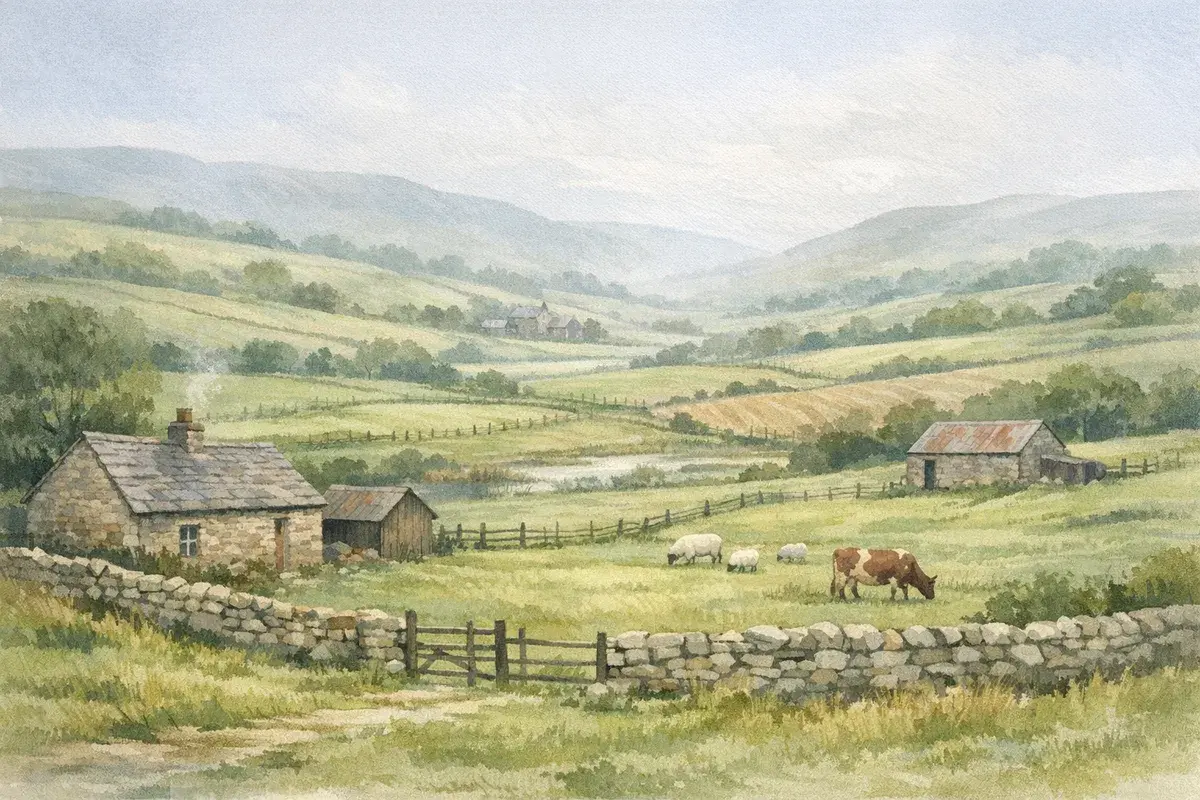
You can fall in love with a croft in about ten minutes. The view, the space, the idea of "a bit of land of your own" on the west coast or islands, it's a powerful pull.
But crofting land for sale in Scotland isn't just a rural property purchase with a romantic backstory. Crofting is its own legal and cultural system, with specific rights, duties, and local expectations. Get it right and you'll buy into a resilient way of living and working the land. Get it wrong and you can end up with unclear boundaries, misunderstandings over common grazings, planning disappointments, or a purchase that doesn't match how you want to use the place.
This guide cuts through the confusion. You'll learn what crofting land actually is, where it comes to market, what due diligence is croft-specific, how deals are structured, and how to make a croft work in practice, without tripping over compliance or neighbour relations.
What Counts As Crofting Land (And Why It Matters To Buyers)
Crofting land isn't simply "small farmland in the Highlands". In Scotland, a croft is a legally recognised unit, typically small, often in crofting counties and designated areas, where the land is governed by crofting law, principally the Crofters (Scotland) Act 1993, and overseen (in key respects) by the Crofting Commission.
Why it matters to you as a buyer is straightforward: the label changes what you can do, what you must do, and how the transaction works. It can affect lender appetite, planning prospects, the ease of selling later, and the day-to-day reality of how you use the land.
Crofts, Common Grazings, And Shares Explained
Most crofts have two "layers" to understand:
- The croft land (inbye/outbye): the core area you'll see fenced or worked directly.
- Common grazings: larger shared hill or rough grazing used by multiple crofters, managed under grazing regulations with a committee/clerk in many townships.
If a croft comes with a share in common grazings, that share can be economically and practically important (stocking, access to hill ground, potential for agri-environment measures). It's also a frequent source of confusion in purchases: the share may not be obvious from a viewing, and the paperwork needs careful checking.
Crofting Tenancy Vs Owner-Occupied Croft
Crofts can be:
- Tenanted crofts (you hold the tenancy: the landlord owns the land), or
- Owner-occupied crofts (you own and occupy the croft).
Both still sit within crofting law. The big difference for you is where the risks land:
- With tenancy, your transaction may involve an assignation of tenancy (and potentially separate arrangements for any house or improvements, depending on what's being transferred). You'll want to be crystal-clear on what's included.
- With owner-occupation, you'll typically buy via a more familiar purchase route, but you still need to confirm croft status, any common grazings rights, and whether the house site is croft land, decrofted land, or split by historic decisions.
If you're comparing crofting land for sale to other rural options, it's worth grounding yourself in the broader picture of Scottish rural land rules and value drivers. Our guide to how agricultural land values and constraints work in Scotland gives that context without assuming you already speak fluent "rural property".
The Crofting Register, Croft Maps, And Title Basics
Two separate-but-related concepts often get muddled:
- Crofting status: whether the land is a registered/recognised croft.
- Land title: who owns it, what burdens/servitudes exist, and how the boundaries are defined.
You'll hear about the Crofting Register, established by the Crofting Reform (Scotland) Act 2010, and croft maps because they're central to reducing boundary uncertainty. Some crofts have very clear mapped extents: others rely on older descriptions, local knowledge, or boundaries that have drifted over decades.
Practical tip: when you're looking at crofting land for sale in Scotland, treat "map clarity" like you would treat "proof of access" on any rural purchase, if it's fuzzy at first glance, it deserves proper professional attention before you commit.
Where Crofting Land Comes Up For Sale (Beyond The Usual Portals)
If you've been searching "crofting land for sale Scotland" for a while, you've probably noticed supply can feel… sporadic. That's normal. Crofting properties are often held for generations, and when they do change hands, the route to market isn't always the same as a standard residential listing.
On-Market Listings, Local Agents, And Specialist Rural Search Tools
You'll still find crofts openly marketed, but success comes from being systematic:
- Set a clear search area (island/peninsula travel times matter more than miles).
- Decide upfront whether you need a house, outbuildings, or just land.
- Be specific about what you'd actually accept: acreage bands, property type, and land use notes.
Looking for land like this? Tell AgLand what you're after - type, acreage, budget and area - and we'll alert you the moment a matching property is advertised. Registering is free, and there's no commission on either side. Tell us what you're looking for.
Also, don't underestimate good local agents. The best rural agents will tell you, quietly, what tends to come up, what buyers usually miss, and which townships have active grazings management (which is often a proxy for how smoothly things run).
Off-Market Routes: Community Networks, Estates, And Word-Of-Mouth
A lot of crofting opportunities never look like "a listing". They surface through:
- township conversations
- local contractors and fencers
- agricultural merchants
- solicitors and surveyors with rural caseloads
- estate management offices
If you're serious, you'll often do better by being known as a credible buyer rather than the person who sends a dozen speculative messages. In crofting communities, intent matters. People talk. If your plan is to occupy, work the croft, and fit in, say so.
There's also a practical route that bridges on-market and off-market: register what you're looking for so you hear the moment something suitable is advertised, then be ready to move quickly. For how that works across Scotland, see our overview on telling us what you're looking for.
Auctions And Tender: When They Work (And When They Don't)
Auctions and informal tenders can work for crofting land, but only in the right circumstances.
They tend to suit:
- more straightforward titles
- properties with clear access and services
- sellers prioritising speed and certainty
They can be risky when:
- croft status is unclear or mixed (part croft, part decrofted)
- there are unresolved boundary issues
- common grazings shares or rights are not properly evidenced
Your mindset should be: auction isn't "skip the due diligence", it's "do it faster". If you can't get enough answers before committing, you're gambling with a legal structure that really doesn't reward guesswork.
The Due Diligence Checklist Specific To Crofting
Crofting due diligence isn't about being cautious for the sake of it, it's about lining up the paperwork with the reality on the ground. Crofts are often in areas where historic arrangements, informal access, and "everyone knows where the boundary is" have worked fine… right up until a sale.
Below are the checks that repeatedly save buyers from expensive surprises.
Confirming Croft Status, Boundaries, Access, And Servitudes
Start with four fundamentals:
- Is it definitely a croft? Confirm what part of the holding is croft land and what part (if any) has been decrofted historically.
- Do the boundaries match the occupation? Fences, dykes and old posts can be misleading. You want map clarity.
- Is access legal, practical, and year-round? A track you can drive in summer isn't the same as a right of vehicular access in winter.
- Are there servitudes and wayleaves? Water pipes, electricity lines, shared tracks, and rights of access need to be understood, not assumed.
If you're coming from "standard" rural property buying, it's worth reading up on the Scotland-specific buying process and terminology (offers, missives, etc.) so you're not learning it mid-transaction. Our guide to buying farmland in Scotland covers the practical flow and the points where specialist advice matters.
Checking Common Grazings Rights, Share Records, And Management
If the croft includes a common grazings share, ask early:
- What is the share entitlement (and how is it evidenced)?
- Are there grazings regulations and an active committee/clerk?
- Are there any apportionments (exclusive use areas taken from the common grazings) associated with the croft?
- Are there current disputes, arrears, or management issues?
This is one of those topics where local knowledge and professional paperwork review both matter. A seller might honestly believe the share is "included" because it's always been used that way, your job is to ensure the legal position aligns.
Genuine Occupation And Use Expectations: What You're Signing Up To
Crofting comes with an expectation that you'll occupy and use the croft appropriately. In practice, that means you should go in with a realistic plan for:
- where you'll live (on the croft or suitably near)
- how you'll use the land (grazing, cropping, horticulture, small-scale enterprise)
- what "use" looks like in that location (rough grazing crofts won't resemble lowland smallholdings)
This isn't about perfection. It's about demonstrating genuine intent and avoiding a situation where you own or hold a croft but treat it as a static lifestyle asset with no meaningful land use.
Planning Constraints, House Sites, And Services In Remote Areas
Planning is often where croft dreams meet hard reality. A few recurring issues:
- House site history: Is the existing house on croft land? Was a house site decrofted? Are there conditions attached?
- Services: private water supplies, septic tanks, power upgrades, and broadband can be material costs, not minor admin.
- Designations: scenic/heritage constraints, access visibility standards, and infrastructure limits can shape what's feasible.
Treat any "potential" (additional house, holiday units, new track) as unproven until your solicitor and planning advisor are satisfied. If development value is part of your rationale, you'll also want to understand how clawback/overage is handled (more on that below).
Common Deal Structures And What They Mean For Price And Risk
Two crofts that look similar on a viewing can carry very different legal structures. And those structures tend to explain price differences that otherwise feel baffling.
Buying A Croft House With Land Vs Bare Land
A croft house with land can be more straightforward (you can live there immediately, services exist, boundaries may be clearer). But it can also bring complications:
- the house site may be decrofted while the rest remains croft land
- there may be historic planning conditions or occupancy expectations
- lenders can be more comfortable with a conventional dwelling than with bare croft land
Bare land or land with minimal buildings is often cheaper upfront, but your total cost can jump once you price in access improvements, water, power, and a realistic schedule for any building consents.
When you're comparing options, it helps to look at what's on offer in a consistent way, what's included, what's excluded, and what's simply described vaguely. Whatever reaches you, ask for the same things next: title notes, access statements, and maps.
Assignation Of Tenancy, Subletting, And Resumption Scenarios
If you're buying into a tenanted croft, the mechanics can involve:
- assignation (transfer of the croft tenancy)
- possible consents/notifications depending on circumstances
- careful separation of what you're paying for (tenancy value, improvements, fixed equipment, any house)
You may also hear about:
- subletting (not a casual decision, there are rules)
- resumption (where croft land is taken back for a reasonable purpose, typically linked to development or infrastructure, complex, fact-specific, and not something to assume will or won't happen)
These are areas where you really do want a solicitor who regularly handles crofting transactions, not someone "who also does rural sometimes".
Clawback, Overage, And Development Value: How To Keep It Clean
In rural Scotland, sellers sometimes seek overage/clawback: if you later secure planning permission or unlock development value, they receive an agreed uplift.
Overage can be fair. It can also be messy.
If it's proposed, you'll want clarity on:
- what triggers payment (planning consent? commencement? sale?)
- the time period (10 years? 25 years? longer?)
- what counts as development (new house, multiple units, change of use)
- how disputes are resolved and how the obligation is secured against title
A clean overage clause is one you can understand and explain back in plain English. If you can't, pause and get proper advice, because future-you (or your buyer) will have to live with it.
Money, Mortgages, And Tax: The Practical Reality
Crofting purchases are often less about "can you afford it?" and more about "can you fund it on sensible terms given the property type and location?" The answer can be yes, but you'll plan better if you understand why crofts sometimes sit outside a lender's comfort zone.
Funding Options And Why Some Lenders Treat Crofts Differently
Some lenders view crofts as non-standard because of:
- mixed title (croft land plus decrofted house site)
- remote location and resale market thinness
- reliance on private services (water, drainage)
- tenancy/occupancy structures
Practical ways to improve your position:
- have your solicitor clarify croft status and title early
- provide clear maps and access evidence
- be realistic about valuation (lenders focus on comparable sales and marketability)
- consider specialist mortgage advice if the property is unusual
Cash buyers have flexibility, but don't confuse flexibility with immunity: you still need the same due diligence, because the resale market will ask the same questions later.
LBTT, ADS, VAT, And Transaction Costs To Budget For
In Scotland you'll typically budget for:
- Land and Buildings Transaction Tax (LBTT) (rates and thresholds depend on price and whether it's residential, non-residential, or mixed)
- Additional Dwelling Supplement (ADS) if the purchase includes a dwelling and you already own another dwelling (rules and reliefs are situation-dependent)
- legal fees and registration costs
- survey/valuation by a RICS member (especially important with non-standard construction or remote services)
VAT can appear on certain professional fees and, in some cases, elements of property transactions (again, fact-specific). The key is not to guess: your solicitor and tax adviser should confirm the likely treatment for the specific property.
Grants, Schemes, And Support For Crofters And New Entrants
Support changes over time, and eligibility depends on location, land type, and what you're doing.
At a practical level, funding and support tend to fall into a few buckets:
- crofting-specific support (improvements, access, stock management, etc., where available)
- rural business support (small enterprises, diversification)
- environment and land management support (habitat, peatland, woodland, species work)
You'll make better decisions if you treat grants as a bonus, not the core business case. Use them to improve viability or speed up works you'd do anyway, rather than buying a croft on the assumption a scheme will cover gaps in your plan.
Making A Croft Work: Land Capability, Enterprises, And Compliance
Once you've bought (or taken on) a croft, the next question is the one that really matters: what's a realistic, compliant way to use it well?
The honest answer is that crofts vary wildly. Two acres of good inbye ground near a settlement is a different proposition from 20 acres of rough grazing with a share in hill ground and a long, exposed access track.
Matching Land Type To Enterprise: Grazing, Inbye, Peat, And Woodland
Before you pick an enterprise, look at:
- inbye quality (drainage, sward, shelter, ability to cut hay/silage)
- rough grazing (stocking rates can be very low: practicality matters)
- peat/very wet ground (high environmental sensitivity: limited "improvement" options)
- existing woodland/scrub (can be an asset or a constraint depending on management goals)
Common croft enterprises include:
- sheep and cattle grazing (often tied to common grazings)
- small-scale horticulture where soil/shelter allows
- native tree planting and shelter belts (where appropriate)
- diversification that fits the place (storage, workshops, produce, small tourism, subject to permissions)
A good test: could you explain your plan to a neighbouring crofter without them raising an eyebrow? If the plan makes sense locally, it usually has a better chance of working.
Stewardship, Biodiversity, And Carbon: Opportunity With Guardrails
There's real opportunity in nature restoration and carbon-aware land use in the Highlands and Islands, but you need guardrails:
- don't assume carbon projects are "easy money", they're technical and long-term
- check how any environmental scheme interacts with grazing rights and common grazings management
- be careful with peatland: inappropriate works can create compliance problems as well as ecological damage
The best outcomes we see are where buyers treat stewardship as part of a whole farm/croft system: better grazing management, improved habitat, sensible water management, and a plan that doesn't depend on one volatile income stream.
Neighbours, Common Grazings Etiquette, And Dispute Prevention
Crofting is communal in a way many rural buyers aren't used to. The fastest route to friction is arriving with assumptions.
Practical ways to keep things smooth:
- introduce yourself early and listen more than you talk
- learn how the grazings are managed (and who does the admin)
- be transparent about fencing, stock movements, dogs, and vehicle access
- document agreements in writing where appropriate (especially for shared tracks and maintenance)
If you're joining common grazings, treat it like joining any well-run cooperative: show up, do your part, and you'll usually find people are generous with knowledge and practical help.
A Step-By-Step Buying Timeline (From Search To Settlement)
Crofting purchases go best when you run them like a project: clear milestones, the right professionals, and no rushing the parts that create future legal headaches.
Shortlisting, Viewing, And Asking The Right Questions Early
Before you view, get the basics:
- what exactly is being sold (croft land, decrofted areas, house site status)
- whether common grazings shares are included
- what services exist (water, drainage, power, broadband reality)
- access: who owns the track, who maintains it, what rights exist
At viewing, look beyond the pretty bits:
- walk boundaries (or as close as practicable)
- check exposure, shelter, and drainage
- ask about stocking history and how the land has been used recently
- take notes on what you can't verify (those become due diligence tasks)
When you're ready to compare multiple options efficiently, it helps to have suitable places come to you rather than chasing each one down. Register what you're looking for and you'll be alerted when a matching croft or block of land is advertised - it's free, and there's no commission on either side.
Offer, Missives, And The Role Of Your Solicitor And Surveyor
In Scotland, the legal process is distinct and solicitor-led. Your solicitor will guide the offer and missives, but for crofts you'll often benefit from a team approach:
- solicitor with crofting experience (status, title, missives, conditions)
- surveyor/valuer familiar with rural property (condition, services, marketability)
- planning consultant where there's development intent or uncertainty
Build your offer around what you know and what you still need to prove. If access rights or croft boundaries are unclear, that should be reflected as conditions, not as a hopeful assumption.
Post-Completion: Registration, Notifications, And First-Year Priorities
After completion, your first year should prioritise the boring-but-important:
- ensure any necessary registrations/updates are completed properly
- organise a simple land-use plan (grazing, fencing, weed control, maintenance)
- get on top of water/drainage maintenance and winter access planning
- build relationships locally, because practical help in remote areas often comes from people who know your place and your intent
A croft rewards steady progress. The buyers who thrive tend to be the ones who treat year one as "set foundations", not "transform everything immediately".
Conclusion
Crofting land for sale in Scotland can be a brilliant route into a small, productive holding, if you go in with your eyes open. The win isn't just buying land: it's buying a workable set-up: clear status and boundaries, understood rights (especially common grazings), realistic funding, and a plan that fits local land capability.
If you approach your search like a professional, patient, organised, and properly advised, you'll spot the difference between a croft that's merely attractive on paper and one you can genuinely occupy, use and enjoy for the long haul.
Disclaimer: AgLand.co.uk is a UK agricultural land and rural property matching service, where buyers register what they are looking for and owners advertise directly to the buyers who match, and a rural resource hub. Nothing in this text is intended as legal, financial, or investment advice. You should carry out your own due diligence and seek advice from appropriately qualified professionals (for example, Scottish solicitors, chartered surveyors, tax advisers, and planning consultants) before making decisions or entering into any transaction.