
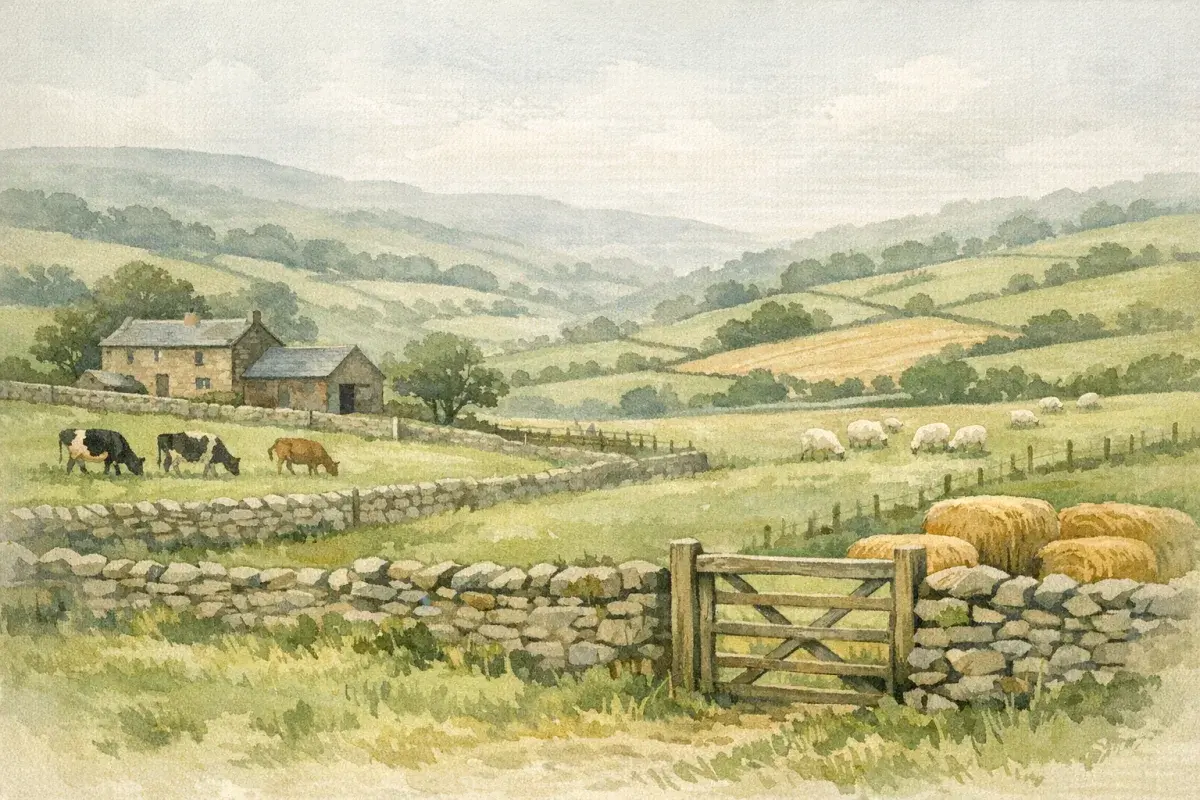
APR is one of those bits of UK inheritance tax planning that can look deceptively simple on paper, "it's farmland, hence it's relieved", right up until HMRC asks for the working.
If you're a farmer, landowner, or rural business owner, claiming agricultural property relief can be the difference between a manageable IHT position and a forced sale at the worst possible moment. But APR isn't a blanket exemption. It's a relief with definitions, time tests, valuation rules, and some very sharp edges (farmhouses, diversification, and development value being the usual culprits).
This guide is written to help you think like HMRC for an hour: what qualifies, what evidence you'll need, where claims commonly come unstuck, and how to structure your adviser team so a claim doesn't drift for months.
What Agricultural Property Relief Covers (And What It Doesn’t)
APR is an inheritance tax relief on the agricultural value of certain property in the UK. That phrase, agricultural value, does a lot of heavy lifting. It's not necessarily the same as market value, and it's often where disputes start.
At a high level, APR can apply to:
- Agricultural land and pasture
- Woodland (but only if it's ancillary to agricultural land and occupied with it)
- Farm buildings used for agriculture
- Farmhouses (but only if they pass extra tests)
- Some cottages and farmworkers' dwellings (again, fact-specific)
What it doesn't automatically cover is equally important: anything not used for agriculture, and anything that is "value above agriculture" (development/hope value, lifestyle/amenity value, and sometimes diversification value).
APR Basics: 50% Vs 100% Relief And When Each Applies
APR is generally available at 100% or 50%, but the rate depends on the facts, including the nature of the interest and historic tenancy position (see HMRC's guidance on Agricultural Relief for Inheritance Tax).
In broad terms:
- 100% APR commonly applies where you own and occupy the land for agriculture, or where it's let on certain tenancies that meet the conditions for full relief.
- 50% APR can crop up where the property is subject to particular pre-1995 tenancy arrangements, or where the nature of your interest doesn't meet the 100% conditions.
Because the "which rate applies?" question is so central to planning (and to the eventual IHT computation), it's worth checking the detail rather than relying on rules of thumb. If you want a deeper, UK-specific run-through of scenarios that point to full relief, see our guide to getting 100% APR in practice.
Qualifying Property: Land, Pasture, Buildings, Farmhouses, And Cottages
HMRC's starting point is practical: is the property agricultural property, and is it occupied for agriculture?
- Land and pasture: Typically straightforward when it's genuinely farmed, cropped, grazed, managed, and evidenced.
- Buildings: They must be used for agricultural purposes. A modern grain store used for your combinable crops is a very different proposition from a "former grain store" now used as a workshop for a non-farming trade.
- Farmhouses: Often the battleground. HMRC expects the farmhouse to be of a character appropriate to the farm (and occupied with it), a test worked through in the Inheritance Tax Manual. Size, layout, historic function, proximity, and the scale of the agricultural operation all matter.
- Cottages/farmworkers' dwellings: Can qualify where occupation is connected to the agricultural use of the land.
If you're unsure where your assets sit on the "clearly agricultural" to "probably not" spectrum, it helps to step through the recognised UK tests and definitions. Our explainer on APR in the UK and how it applies to different asset types is a useful companion piece.
Common Exclusions: Development Value, Let Property, And Non-Agricultural Use
The most common misunderstandings we see are:
- Development value isn't relieved by APR (in most cases). APR applies to agricultural value, not "what a developer might pay" or what the land could be worth with planning.
- Let property isn't automatically out, but the detail matters. Tenanted land can qualify, but tenancy type, dates, and who has control of the agricultural use can change the answer.
- Non-agricultural use can taint a claim. Holiday lets, storage, equine use, and solar can all be commercially sensible. But they can also reduce APR on the relevant parts of the property.
The practical takeaway: think in parcels. HMRC will happily accept that one part of a holding qualifies and another part doesn't, but only if you (and your valuer) have separated and evidenced it properly.
Who Can Claim APR And The Core Eligibility Tests
APR is claimed by the personal representatives on death, or can be relevant to lifetime planning. Either way, the claim depends on who owned what, who occupied it, and how it was used.
There are two big eligibility pillars:
- The property must qualify (type of asset and agricultural use)
- The ownership/occupation conditions must be met (including the two-year and seven-year tests)
If you're trying to sanity-check eligibility quickly before getting into the weeds, our checklist on whether you qualify for APR can help you spot obvious gaps.
Ownership And Occupation: Owner-Occupied, Let, Share-Farmed, And Contract-Farmed Land
How you run the land day-to-day has a direct impact on APR risk.
- Owner-occupied land: Often the cleanest APR profile, provided the land is genuinely farmed and you can show agricultural management.
- Let land: Can still qualify, but you'll need to map the tenancy type and show the land is agricultural property occupied for agriculture.
- Share farming: Usually involves shared risk and inputs. Documentation matters because HMRC will look at "who is really farming?"
- Contract farming: A common structure where you retain farming risk and receive the farming profits, while a contractor provides labour and machinery. Get this wrong and it can start to look like you've effectively let the land.
There's no prize for the most complicated structure. If your agreements are informal ("it's just a handshake with the neighbour"), that's where estates get delayed, because HMRC then has to infer the legal reality after the fact.
The Two-Year And Seven-Year Rules: Occupation, Letting, And Control
APR is tied to minimum periods of ownership and occupation:
- Two-year test: Commonly relevant where you (or a company/partnership you're in) have occupied the land for agriculture.
- Seven-year test: Often comes into play where the land has been let.
The nuance is in the definitions of occupation and the continuity of agricultural use. Breaks in farming, changes from grazing licence to tenancy, or a shift from active agriculture to "mown once a year to keep it tidy" can all create questions.
Timing also matters for planning. If you've bought land recently, taken land back in-hand, or restructured agreements, you'll want to track the relevant clock carefully. Our guide to the APR time limits and how the tests are applied is worth reading alongside your own timeline.
The "Character Appropriate" Farmhouse Test And How HMRC Challenges It
Farmhouses are where APR claims can become forensic.
HMRC typically focuses on:
- Is there a real agricultural unit? A few acres with hobby-level activity won't support a large farmhouse claim.
- Is the farmhouse occupied for the purposes of agriculture? Not just "on the farm", but functioning as the operational base.
- Is it of a character appropriate? Size, nature, and quality are assessed in the context of the agricultural land and buildings.
Common pressure points we see (especially in higher-value areas):
- A farmhouse that's materially larger or higher-spec than the working farm would justify
- Significant diversification income with agriculture becoming marginal
- Retired owner-occupiers where day-to-day management has clearly moved elsewhere
If the farmhouse is in play in your estate planning, don't leave it to chance. Read our detailed guide on APR and the farmhouse tests HMRC applies and then speak to a valuer who has defended these cases before. The difference is night and day.
Evidence And Record-Keeping HMRC Expects
APR claims don't usually fail because the law changed overnight. They fail because, when someone dies, nobody can quickly produce a coherent picture of how the land was owned, occupied, and used.
If you want to make life easier for your family (and your professional team), build the file now.
Documents To Keep: Tenancies, Grazing Licences, Accounts, And Cropping Records
A sensible "APR evidence pack" typically includes:
- Title and plan documents (what is owned, in what names)
- Tenancies and licences (AHA, FBTs, grazing licences, contract farming agreements)
- Maps showing parcels and uses (cropped, grazed, stewardship, woodland, yards)
- Farm accounts and management accounts (showing agricultural trading activity)
- Cropping records and field operations (sprays, fertiliser, cultivations)
- Livestock records (movement logs, stocking records, medicine records)
- Stewardship/ELM agreements (and evidence of compliance)
The goal isn't to drown in paperwork. It's to be able to answer HMRC's implied question: "Show us that this was an agricultural business using agricultural property."
Showing Agricultural Use In Practice: Stocking, Rotations, And Management Decisions
HMRC is persuaded by reality, not labels.
Good evidence of agricultural use looks like:
- Clear stocking policies (even if numbers flex with seasons and markets)
- Rotations that make agronomic sense (not token cropping)
- Decisions that show active management: reseeding, drainage, fencing, hedging, nutrient planning
- Records that explain why land was in temporary grass, fallow, or environmental options
One underappreciated point: environmental schemes and regenerative practices can still be part of genuine agriculture, but you need to document intent and outcomes. "We stopped cropping this block for soil health and moved to herbal leys" reads very differently from "we couldn't be bothered so we left it."
Valuations: Separating Agricultural Value From Hope Value And Amenity Value
APR applies to agricultural value, so valuations have to do some careful separating.
A competent rural valuer may need to split value between:
- Agricultural value: what the land/building is worth in agricultural use
- Hope value/development value: uplift based on planning potential (often not APR)
- Amenity value: the "lifestyle premium" (commonly seen with farmhouses and smallholdings)
This separation is not just theoretical. If your farmhouse sits in an area where residential values dwarf farm incomes, HMRC may argue that a chunk of the value is amenity-led and doesn't attract APR.
In practice, it helps if your valuer's report is:
- Parcel-by-parcel
- Assumption-led (what use is being valued and why)
- Backed by comparable evidence appropriate to agricultural vs residential markets
And yes, this is where specialist advice earns its keep. General practice valuations often aren't written with HMRC challenge in mind.
How APR Interacts With Business Property Relief (BPR) And Other Reliefs
APR is powerful, but it's not always sufficient, especially where you have diversification, development angles, or trading structures that muddy the picture.
This is where Business Property Relief (BPR) often comes into the conversation. The two reliefs can complement each other, but they're not interchangeable and the conditions differ.
When BPR Can Fill The Gaps APR Leaves
BPR can sometimes apply to assets used in a qualifying trading business where APR doesn't cover the full value, particularly where there's:
- Value in non-agricultural trading activities (certain diversified trades)
- Development/hope value not relieved by APR, but potentially within a trading business context (fact-specific and often contentious)
- Business structures where land/buildings are owned personally but used by a trading entity (watch the "excepted assets" and ownership rules)
The trap is assuming BPR will "just pick up the rest." HMRC scrutinises whether a business is mainly trading vs mainly investment, and many rural income streams (like certain lets) can push you towards "investment".
If you want the clearest side-by-side of how the tests differ, and when they can stack, read our guide on BPR vs APR and where each is strongest.
APR And BPR On Partnerships, Companies, And Trading Structures
Your trading structure can make APR/BPR simpler, or much harder.
Common rural setups include:
- Sole trade (often administratively simple, but succession can be harder)
- Partnerships (including family partnerships with partnership property and partnership accounts)
- Limited companies (useful for certain trades, but introduces share valuation and different relief mechanics)
Key questions advisers typically map:
- Who owns the land and buildings (personally, partnership, company)?
- Who occupies them and on what legal basis (tenancy, licence, partnership occupation)?
- Where do the profits and risks sit (who is exposed to market and cost swings)?
When these answers align, relief claims tend to be smoother. When they contradict each other, say, a "contract farm" that behaves like a let, or a partnership that doesn't actually operate as one, HMRC has more room to challenge.
Gifts, Trusts, And Lifetime Planning: Hold-Over Relief, Reservations, And Traps
APR often features in lifetime planning, but it's rarely a one-relief story.
Depending on what you're doing, you may also need to think about:
- Capital Gains Tax hold-over relief on gifts of qualifying business assets (complex, and not automatic)
- Gifts with reservation of benefit (the classic "I gave it away but still use it" problem)
- Trust planning and how trustees will maintain qualifying use and evidence
A practical rule: if the plan relies on you giving away land but still treating it as "yours" day-to-day, assume HMRC will examine it closely.
This is also where sequencing matters, what you do first (transfer, restructure, change occupation, change use) can determine which clocks start and whether relief is available at the key date.
Practical Scenarios And High-Risk Areas
Most APR problems aren't philosophical: they're operational. The way land is occupied, the way buildings are used, and the paperwork you didn't quite get round to are what create risk.
Farm Business Tenancies, AHA Tenancies, And Informal Occupations
Tenanted land can qualify for APR, but you need to know exactly what you have.
- AHA tenancies (pre-1995 regime): Often long-standing, with their own APR wrinkles and valuation impacts.
- Farm Business Tenancies (FBTs): Flexible, common, and usually easier to document cleanly.
- Grazing licences and "informal lets": This is where we see confusion, especially if the arrangement looks like a tenancy in practice.
The more informal the arrangement, the more time your advisers will spend reconstructing facts after the event.
If tenanted land is a key part of your estate, it's worth reading our dedicated guide on APR for tenanted farmland and how HMRC looks at occupation. It'll also help you ask better questions of your agent and solicitor.
Diversification: Storage, Solar, Holiday Lets, And Equine Use
Diversification is normal now. The question isn't "should you diversify?" It's "how does it change relief eligibility?"
A few common situations:
- Storage yards and buildings: If you rent out buildings for storage, HMRC may treat that as investment income (riskier for BPR) and non-agricultural use (reducing APR on that part).
- Solar: A solar lease can be commercially attractive, but it may remove APR on the leased area and introduce valuation complexity, plus long-term control issues.
- Holiday lets: Often look like a trade, but the facts matter and they can affect the farmhouse/amenity picture.
- Equine use: This is a big one. Horses are not automatically "agriculture" for APR purposes. Livery and equestrian activities can push land into non-agricultural territory.
None of these are deal-breakers by default. But you want clean plans, clear agreements, and a valuer who can properly apportion and defend their reasoning.
Development, Overage, Options, And Promotion Agreements
If your land has development potential, expect APR conversations to get more pointed.
Common arrangements include:
- Option agreements (a developer can buy if/when planning is achieved)
- Promotion agreements (a promoter markets the land and takes a fee on sale)
- Overage/clawback (you receive extra payments if future development value is realised)
Each can change:
- The valuation at the date of death (hope value can be substantial)
- The argument about what value is "agricultural" vs "development"
- Whether a business looks like it's moving from farming into dealing/development (with knock-on effects for reliefs)
A practical point we've seen repeatedly: if you're going down a development route, get your adviser team aligned early. Waiting until a claim is being assembled, when emotions are high and deadlines bite, makes it harder to shape the narrative and the evidence.
How To Make An APR Claim And Avoid Delays
APR is claimed through the inheritance tax process, and delays often come from avoidable gaps: unclear occupation, missing agreements, valuations that don't separate agricultural and non-agricultural elements, or a thin narrative that leaves HMRC to fill in the blanks.
What Goes On The IHT Return: Forms, Narratives, And Supporting Schedules
In practice, a strong APR claim usually includes:
- The relevant IHT forms completed accurately (your solicitor/accountant will handle this)
- A supporting narrative explaining:
- What assets are being claimed for
- How they were used (agricultural activity, who did what)
- How long the conditions were met (two-year/seven-year timelines)
- Any mixed-use areas and how they've been valued
- Schedules and exhibits: tenancy documents, maps, cropping records, accounts, stewardship documentation
Think of it as telling the story once, properly, so you don't have to tell it five times in HMRC correspondence.
Working With Your Adviser Team: Agent, Valuer, Accountant, And Solicitor
The smoothest claims we see are the ones where roles are clear:
- Land agent: occupation, agreements, on-the-ground reality, mapping parcels
- Valuer: defensible split of agricultural vs hope/amenity value, written for scrutiny
- Accountant: trading position, structure, evidence of farming activity and risk
- Solicitor: legal ownership, IHT forms, estate administration, and any trust issues
Thinking of selling? AgLand shows you how many registered buyers already match your land before you pay anything - no board at the gate, no commission, and your details stay private until a buyer asks to connect. Check your matches.
Common Reasons Claims Fail And How To Pre-Empt HMRC Queries
The recurring reasons APR claims get reduced or delayed include:
- Farmhouse doesn't pass the character appropriate test (often because the agricultural unit is too small or not genuinely managed from the house)
- Insufficient evidence of agricultural use, especially where land is "kept tidy" rather than farmed
- Informal occupation arrangements with unclear legal reality
- Valuation that lumps everything together, failing to separate agricultural value from development/amenity value
- Diversification not properly apportioned, leading to over-claiming
Pre-emption is mostly boring admin (sorry). But it works:
- Put agreements in writing and keep signed copies
- Maintain a simple annual "farm summary" note: what you farmed, what changed, why
- Keep maps updated when parcels change use
- Ask your valuer to write with HMRC challenge in mind, not just for the bank
APR is a relief you earn by being able to prove your position. If your file is strong, the claim often becomes routine rather than adversarial.
Conclusion
Claiming agricultural property relief is less about clever wording and more about getting the fundamentals right: genuine agricultural use, clear occupation arrangements, sensible structures, and valuations that separate agricultural value from everything else.
If you take one action after reading this, make it this: pick one high-risk area on your holding, farmhouse, a diversified building, a solar lease, an informal grazing arrangement, and tighten the evidence and paperwork around it. Those are the pressure points that tend to decide whether an APR claim flies through or drags into months of HMRC queries.
Disclaimer: AgLand.co.uk is a UK agricultural land and rural property matching service, where buyers register what they are looking for and owners advertise directly to the buyers who match, and a rural resource hub. Nothing in this text is intended as legal, financial, tax, or investment advice. You should carry out your own due diligence and seek guidance from appropriately qualified UK professionals (such as a solicitor, accountant, tax adviser, and RICS-accredited rural surveyor) before making decisions or submitting any claim.