
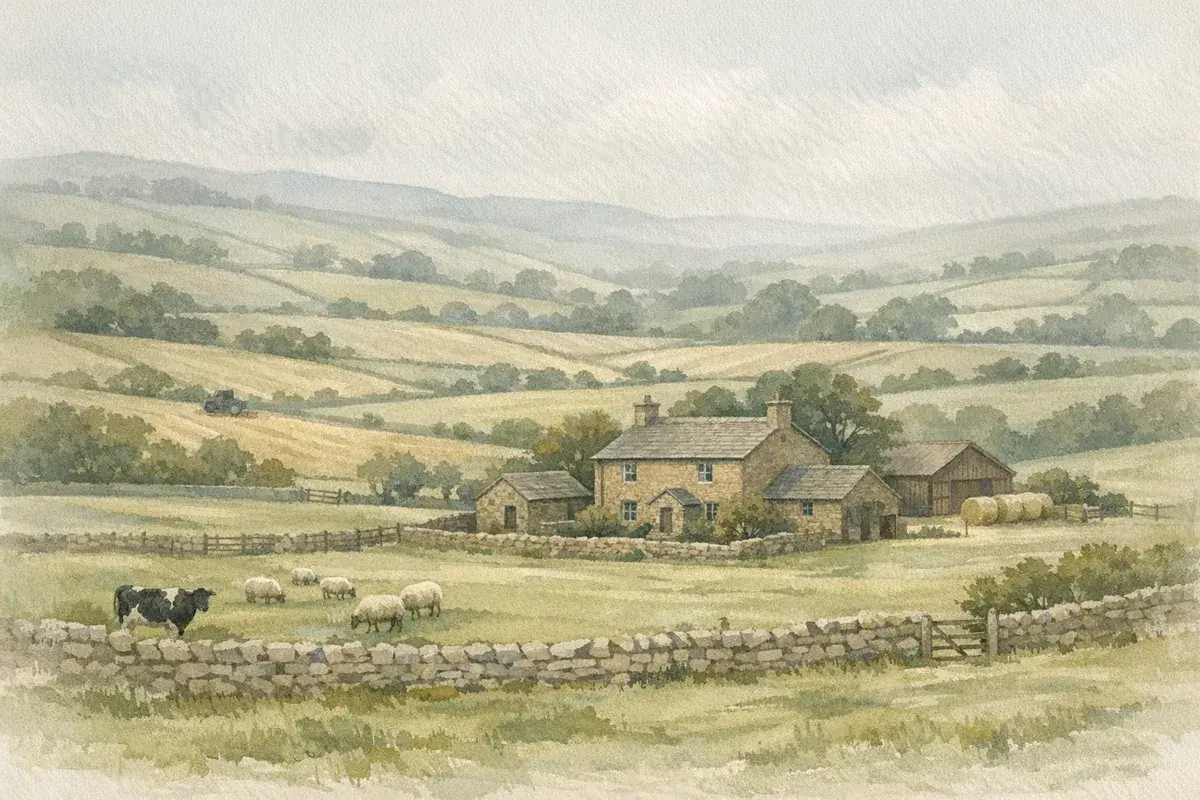
You can do everything "right" on the land, farm it well, keep decent accounts, plan succession sensibly, and still find the farmhouse becomes the awkward piece in the inheritance tax jigsaw.
That's because Agricultural Property Relief (APR) treats a farmhouse differently from fields, buildings, and bare agricultural value. HMRC will often accept that the land is agricultural property… then challenge whether the house is genuinely the farmhouse of that farm, and whether it's "character appropriate" for what's being run.
This guide cuts through the confusion in UK terms: what APR covers, the HMRC tests that bite hardest on farmhouses, and, crucially, what you can do now to build a defendable position long before a claim is ever made.
What Agricultural Property Relief Covers (And Why The Farmhouse Is Different)
APR is an inheritance tax (IHT) relief. It can reduce the IHT value of qualifying agricultural property by 50% or 100%, but only on the agricultural value, not the "hope value" or residential uplift that often sits in and around a desirable rural home.
Where people get caught out is assuming: "If the land qualifies, the farmhouse automatically qualifies." It doesn't work like that. The farmhouse has its own hurdles, and HMRC will look at it with a very different lens.
APR Basics: Eligible Property Types And Relief Rates
In broad terms, APR can apply to:
- Agricultural land or pasture in the UK
- Woodland that's occupied with agricultural land and is "ancillary" to it
- Farm buildings (and some fixed equipment) that are part of an agricultural unit
- The farmhouse, but only if it is genuinely the farmhouse of the agricultural unit and meets specific occupation and "character appropriate" tests
Relief rates are typically:
- 100% APR in common scenarios such as owner-occupied and farmed by you (or where land is let on certain tenancies that qualify for full relief)
- 50% APR in other scenarios, often where ownership and occupation are split, or where the underlying conditions for 100% aren't met
If you need a clear grounding on the UK rules, relief rates, and the key ownership/occupation tests, it's worth reading our fuller guide to how APR works in practice (including the typical pitfalls HMRC focuses on).
APR Vs Business Property Relief: Where Farmhouses Often Go Wrong
A lot of farmhouse headaches come from mixing up APR with Business Property Relief (BPR).
- APR is tied to agricultural property and its agricultural value.
- BPR is tied to a trading business (and whether it's mainly trading rather than mainly investment).
In real life, farms can be a blend: farming operations, diversified lets, renewable energy, storage, holiday accommodation, equestrian use… And the more "non-farm" activity you have, the more you need to be careful about which relief you're relying on for which asset.
Farmhouses go wrong when:
- the house looks like a standalone residence with only a light connection to the farm:
- the farming activity is modest, outsourced, or heavily let out: or
- you're expecting BPR to "save" the house when the facts don't support a trading business case.
A practical way to think about it: APR for the farmhouse is a proof exercise, not a tick-box. You're proving that the house is functionally and operationally part of an agricultural unit, and sensibly sized for it.
The HMRC “Character Appropriate” Test For Farmhouses
If there's one phrase that makes farmhouse owners wince, it's "character appropriate". It's not a single statutory definition you can point to and relax. It's HMRC's long-standing approach, set out in the Inheritance Tax Manual and backed by case law, to decide whether a dwelling really is a farmhouse for APR purposes.
In plain English: is this the sort of house you'd expect for the farm that's actually being carried on?
How HMRC Assesses Size, Nature, And Quality
HMRC will consider the house's:
- Size (number of bedrooms/reception rooms, floor area, outbuildings used as domestic space)
- Nature and quality (is it modest, functional, typical for the holding, or does it present as a high-end country residence?)
- Relationship to the holding (is it the operational centre or just "nearby"?)
Here's the catch: it's not about punishing success or saying a farmhouse can't be lovely. It's about proportionality. A sizeable, high-spec home can still qualify, but it needs to be anchored to a substantive farming operation with genuine day-to-day management needs.
The "character appropriate" point tends to become contentious when the farming footprint shrinks (or becomes more passive) but the farmhouse remains large and valuable.
How Location, Amenities, And Non-Farm Use Affect The Result
HMRC doesn't just look at the floorplan. They look at how the house is actually used and perceived.
Factors that can weaken your position include:
- The farmhouse is a long drive from the agricultural land, while other buildings on the holding look more like the farm's working hub
- Significant amenities that read as lifestyle-led (for example extensive leisure facilities), especially where there's limited evidence of active farm management
- A substantial portion of the house being used for non-farm purposes (commercial holiday letting, frequent short-term occupation patterns, or use that resembles a second home)
That doesn't mean any of these features automatically fail APR. It means you should expect more scrutiny, and you'll want stronger evidence of the working relationship between the dwelling and the farm.
If you're unsure whether your set-up meets the underlying tests, start with the core APR qualification criteria and then examine the farmhouse facts in that light. It's usually easier to fix "farm connection" issues early than to argue them under time pressure after a death.
The “Occupied For The Purposes Of Agriculture” Requirement
For a farmhouse to qualify for APR, HMRC will typically expect it to be occupied for the purposes of agriculture.
That sounds straightforward until you try to define "occupied" and "purposes of agriculture" in modern farming, where management might be shared, contracting is common, and diversification is often essential.
Who Must Occupy The Farmhouse And What "Occupation" Means In Practice
Occupation isn't just a name on a bill. HMRC looks at who actually lives there and whether their presence is connected to the agricultural unit.
In practice, occupation can work where:
- You, as the farmer/owner, live in the farmhouse and you're actively involved in running the farm
- A family member lives there and genuinely manages the farming operations (not just "helps out now and then")
- A farm manager occupies the farmhouse as part of their role (facts matter: duties, decision-making, and day-to-day oversight)
What becomes harder is where the person in the house is retired, mainly absent, or has only a light-touch relationship with the farming activity.
What Counts As "For The Purposes Of Agriculture" (And What Does Not)
The key idea is necessity and function. The occupation should be connected to:
- management decisions
- supervision of livestock/crops
- responding to day-to-day issues (animal welfare, security, weather-driven decisions)
- the practical running of the agricultural unit
It's not enough that the house is next to farmland, or that you have a sentimental connection to the place.
Common weak arguments (on their own) include:
- "We've always lived here."
- "The land's still in the family."
- "A contractor does the work but we keep an eye on it."
If you're trying to sense-check your position, our guide to whether you qualify for APR is a useful starting point, particularly for mixed arrangements where some activity is outsourced and some land is let.
One more practical note: this area is intensely fact-specific. Two farms can look similar on paper but land in very different places depending on who actually makes decisions, how often they're on-site, and what the farmhouse is used for day to day.
The Working Farm Connection: Land, Enterprise, And Day-To-Day Management
When HMRC challenges farmhouse APR, the subtext is usually: "Is there really a working farm here that needs this farmhouse?"
That's why the working farm connection, between the house, the land, and the enterprise, matters so much. The best claims don't just say "we farm": they show how the farmhouse is woven into the management and operation of the holding.
Minimum Land Or Scale: What Matters More Than Hectares
People often ask for a minimum acreage that guarantees APR on a farmhouse. There isn't one.
HMRC's approach is more nuanced:
- A small but intensive enterprise (for example, high-value horticulture, poultry, or specialist livestock) may justify a strong farmhouse connection.
- A larger area that's mostly let out or only lightly farmed may struggle if management is thin.
What tends to matter more than hectares is:
- the level of active decision-making
- the frequency of on-the-ground oversight
- the operational need to be based on the holding
- the coherence of the unit (house + buildings + land operating as one)
So, rather than trying to "hit a number", focus on whether your farming activity would still look like a farm, run from that farmhouse, if an outsider reviewed it.
Contract Farming, Share Farming, Grazing Licences, And Let Land
Modern arrangements can still support APR, but you must be careful about how they're structured and evidenced.
- Contract farming: You may retain strategic control while contractors handle operations. That can still look like active farming, if you can show real management and risk.
- Share farming: Often involves shared inputs/outputs and a closer operational connection, but paperwork and roles need to be crystal clear.
- Grazing licences / seasonal lets: Can be fine, but if they become the dominant "activity", HMRC may view the unit as more passive.
- Longer-term letting: Depending on tenancy type and dates, APR can still apply to land, but the farmhouse claim becomes more sensitive if you're no longer demonstrably running the farm from the house.
Timing also matters. APR often hinges on meeting the relevant occupation/ownership conditions over specific periods (for example, the typical two-year ownership and occupation test, or seven years in some letting scenarios). If you're checking your position against those timelines, see our explainer on the APR time limits and how they're applied.
In short: contracting and letting aren't the enemy. Vagueness is. If your reality is "we oversee it, but it all happens without us", you'll want to tighten the structure and the paper trail.
Evidence And Record-Keeping: How To Defend APR On A Farmhouse
If HMRC opens an IHT enquiry, you don't "argue" your way to APR on a farmhouse, you evidence your way there.
The strongest positions are built years in advance, almost accidentally, by people who run the farm properly and document decisions as they go. The weakest positions are built after the event, with reconstructed narratives and missing paperwork.
Documents HMRC Typically Expects You To Produce
You're aiming to demonstrate three things:
- there is a genuine agricultural unit:
- the farmhouse is the farmhouse of that unit (including being character appropriate):
- the farmhouse is occupied for the purposes of agriculture.
In practical terms, keep (and be able to find) items such as:
- Farm accounts showing agricultural income and costs (separating diversified income where possible)
- Cropping plans, livestock records, movement logs, and vet documentation
- Stewardship/land management agreements and correspondence
- Tenancy, licence, share farming, or contract farming agreements, with clear roles and responsibilities
- Management evidence: diaries, meeting notes, emails with agronomists/agents, risk decisions (fertiliser strategy, rotations, animal health)
- Maps and plans showing the farmhouse in context (access routes, yard, working buildings, land blocks)
- Employment records (if staff are managed from the farm office/house)
You're not trying to create a museum archive. You're trying to make it obvious that the farmhouse is where the farm is run from.
Common Weak Spots And How To Fix Them Before A Claim
The same weak spots come up again and again:
- Diversification blurs the picture. Fix: separate income lines and document how much time/management is genuinely agricultural versus investment/letting.
- The "retired but still here" problem. Fix: document who is the real decision-maker: consider whether occupation, roles, and even ownership need to reflect reality.
- Agreements don't match behaviour. Fix: update contracts so they reflect how the holding is actually operated.
- The farmhouse looks detached from operations. Fix: strengthen the operational centre, where meetings happen, where records are kept, where supervision is based.
And if you want to understand the practical process (and common mistakes) when the time comes to submit an IHT account, our guide to claiming APR properly is designed to walk you through what typically gets queried.
A small, honest aside: we've seen families spend more time debating "what HMRC might think" than simply putting good records in place. Record-keeping isn't glamorous, but it's often the cheapest form of tax planning you'll ever do.
High-Risk Scenarios And How To Mitigate Them
Certain life events and property arrangements reliably increase the risk of a farmhouse APR challenge. You can still navigate them, but you'll want to plan with your eyes open.
Retirement, Succession, And "Passive" Ownership After Stepping Back
Retirement is where many farmhouse claims wobble.
If you step back from active management, but continue living in the farmhouse while the farming is done by others (contractors, neighbours, even family), HMRC may argue the house is no longer occupied for the purposes of agriculture.
Mitigation options (very fact-dependent) can include:
- Formalising the successor's role if they are genuinely managing the farm (and ensuring that role is evidenced)
- Adjusting occupation patterns so the person running the farm is the one based at the farmhouse (where appropriate)
- Reviewing agreements so the farm doesn't drift into a passive investment profile
- Succession planning earlier than you'd like, because changing facts a few months before death rarely looks convincing
This is also where wider tax planning starts to overlap: even if APR is available, you may be looking at capital gains tax (CGT) implications on lifetime gifts or business restructuring.
Second Homes, Multiple Dwellings, And Farmhouses With Annexes
A farmhouse with an annexe, a second dwelling, or a layout that supports separate occupation can raise questions such as:
- Which part is the farmhouse used for farm management?
- Is any part effectively a separate residence?
- Is the overall property still "character appropriate" for the holding?
You don't necessarily lose APR because you've created additional accommodation. But you do need to be realistic: if the property reads like a cluster of desirable homes with a bit of farming attached, HMRC's instincts will be to challenge.
A practical tip: map the use of the buildings and keep the story consistent. If an annexe is genuinely linked to the agricultural operation (for example housing a working farm manager or supporting multi-generational day-to-day farm management), document that.
And remember: APR is IHT-focused, but property decisions can trigger other taxes. If you're changing ownership, carving out plots, or contemplating development value, you'll also want to understand the typical CGT pressure points around farmhouses and land. (We cover those in a separate AgLand resource, but the key message here is coordination: don't plan IHT in isolation.)
Practical Planning: Structuring Ownership, Occupation, And Wills
Good farmhouse APR planning usually looks boring on the surface: tidy structures, clear roles, consistent paperwork, and a will that matches reality.
The best time to do it is when nothing is "happening", not when the family is under pressure.
Partnerships, Companies, Trusts, And Family Occupation Patterns
Different structures can work, but they create different risk profiles.
- Partnerships: Often a natural fit for family farms. The key is that partnership arrangements and profit shares should reflect who actually runs the farm.
- Companies: Can make sense for some operations, but you must be careful about how the farmhouse is held and used. A farmhouse used privately can create complications.
- Trusts: Sometimes used for succession, control, and vulnerability planning, but they require careful advice on IHT, income tax, and CGT implications.
In all cases, HMRC will look through complicated paperwork if the day-to-day reality doesn't match. If the next generation runs the farm, it should be visible in roles, decision-making, and documents, not just family understanding.
You should also keep an eye on policy updates and fiscal context. APR is politically sensitive because it sits at the junction of land values, family wealth, and food production. For recent context and what changed (and what didn't) in the latest cycle, see our update on APR and the Budget 2024 discussion points.
Coordinating APR With IHT Planning, CGT, And Stamp Duty Land Tax Considerations
APR is powerful, but it's not the only moving part.
A few common coordination issues we see:
- Gifts and succession: You might improve IHT outcomes but create a CGT exposure if you transfer assets during life without the right reliefs.
- Buying/selling land or homes: SDLT can become relevant depending on what's being acquired and whether it's residential, mixed-use, or includes multiple dwellings.
- Development potential: APR generally focuses on agricultural value, so planning around "hope value" and uplift often needs a wider strategy.
A pragmatic approach is to run a short checklist with your professional team (agent/surveyor, accountant, solicitor, tax adviser):
- What assets are expected to qualify for 100% APR versus 50%?
- For the farmhouse, what is the clearest evidence of working farm occupation and character appropriateness?
- What changes are planned (retirement, contracting, diversification, building works) and how do they affect the farmhouse story?
- Does your will and ownership structure match how the farm is actually run?
If you're currently searching for land, a new holding, or a property with a house that you hope will qualify as a farmhouse, it's worth stress-testing the arrangement early. On AgLand, you can register exactly what you're after and be alerted when an owner or agricultural agent advertises something that matches, so you're dealing with people who understand how holdings operate in the real world, not just how they look in a brochure.
Conclusion
APR on land is often relatively straightforward. APR on a farmhouse is where HMRC expects you to prove the practical reality: that the house is the operational heart of a genuine agricultural unit, occupied for agricultural purposes, and proportionate to the farming being carried on.
If you take one action from this guide, make it this: line up the facts, the paperwork, and the lived reality now, especially if you're approaching retirement, changing how the land is farmed, or increasing non-farm use. Those are the moments when farmhouse APR becomes fragile.
Disclaimer: AgLand.co.uk is a UK agricultural land and rural property matching service, where buyers register what they are looking for and owners advertise directly to the buyers who match, and a rural resource hub. Nothing in this text is intended as legal, financial, tax, or investment advice. You should carry out your own due diligence and seek guidance from suitably qualified professionals (for example, a solicitor, accountant, and specialist rural surveyor/land agent) based on your circumstances.