
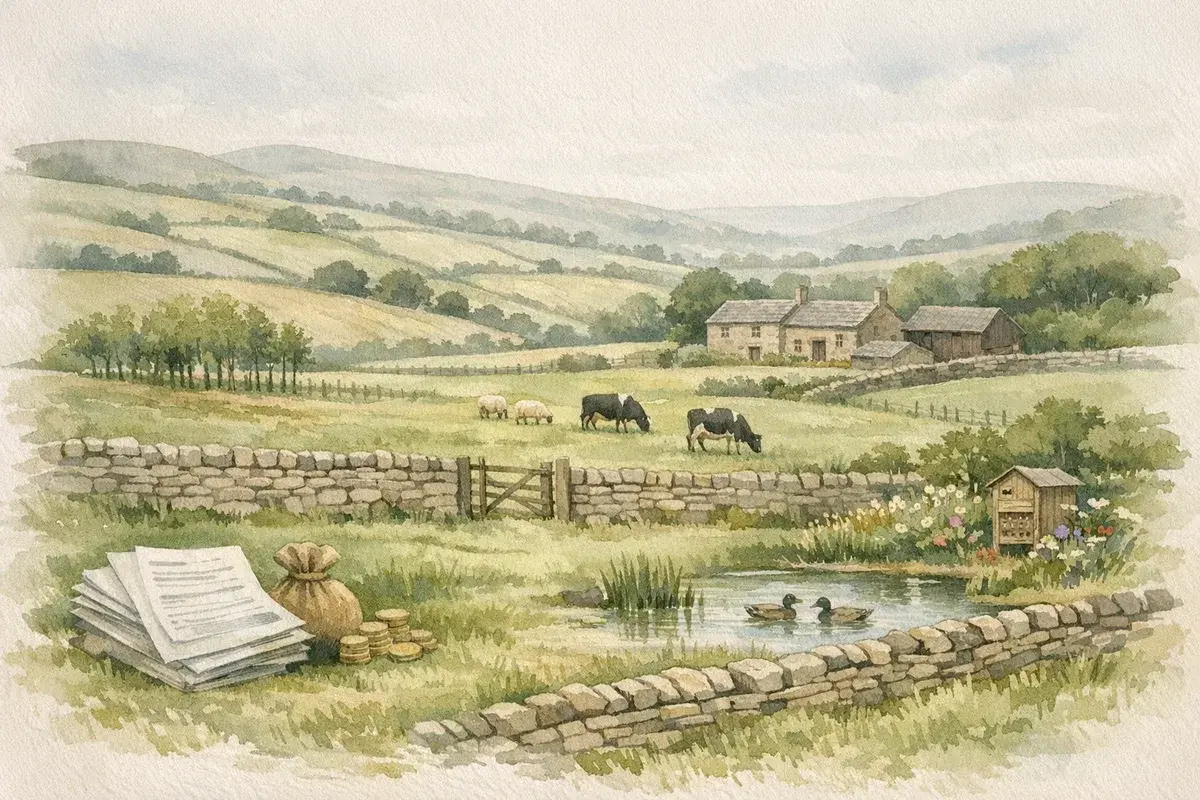
You don't take on a land management agreement because you fancy more paperwork. You do it because the numbers stack up, the land needs it, or because you've got compliance, biodiversity, water, or tenancy pressures nudging you in that direction.
Countryside Stewardship (CS) is still one of the most practical "do-able" schemes in England if you want paid options and capital items that reward good land management. But it's also a scheme that can trip you up: mapping errors, missed evidence, conflicts with sporting rights, and the classic cashflow pinch where you pay contractors long before you see a penny.
This guide cuts through the confusion for 2026. You'll get a clear view of what CS is for, the main grant types, how payments and inspections really work, and how to choose options that suit your farm, estate, or investment holding, without creating a future headache when you come to refinance, let, or sell.
What Countryside Stewardship Is (And Who It’s For)
Countryside Stewardship is an agri-environment scheme in England that pays you to manage land in ways that deliver public goods, think biodiversity, water quality, soil health, flood mitigation, and protection of historic features.
At its best, CS is a structured way to turn "the right thing to do" into a funded management plan. At its worst, it's a compliance minefield where a small admin mistake can reduce your payment.
Who it's for in practice:
- Owner-occupier farmers who can commit land for the agreement term.
- Landlords/estates who want consistent delivery across a holding (and to make stewardship part of the long-term land strategy).
- Tenanted farms where responsibilities are clear and the tenancy allows scheme participation.
- Rural investors holding land for long-term value, natural capital outcomes, or resilience, provided you can meet the "active management" reality of the scheme.
What it isn't: a "set and forget" income stream. You're paid for outcomes and actions, and you'll need a defensible paper trail.
How CS Fits Alongside ELM, SFI, And Other Schemes
If you've felt the policy landscape shifting under your boots since BPS started to reduce, you're not imagining it. The direction of travel in England is Environmental Land Management (ELM), and CS sits in the same ecosystem as:
- SFI (Sustainable Farming Incentive) for more standardised, whole-farm actions.
- CS for more targeted options and capital works, often suited to specific habitats/features.
- Other targeted grants and capital offers that come and go as priorities and budgets change.
In 2026, the key mindset is this: treat schemes like layers, but only where they're compatible. You can't be paid twice for the same action on the same land (double funding), and some combinations create timing and evidence headaches. Layering is the whole point now, because nothing arrived to replace BPS pound for pound and English support instead splits across SFI, CS and Landscape Recovery alongside capital and productivity grants, which a guide to what took over from the Basic Payment Scheme maps out nation by nation.
It's worth reading up on how CS sits within the broader grant landscape so you don't design an agreement in isolation. For a wider view of what's typically in play, see our overview of the wider funding picture in recent grant options and how they're being used on UK farms (link added here deliberately in the body, not the intro).
Eligibility Basics: Land Control, Management Responsibilities, And Farmer Types
Eligibility starts with a simple question: do you actually control the land and the management? In CS terms, that usually means:
- You have management control for the agreement length.
- You can carry out the required actions (or contract them out) and keep evidence.
- Any consents (landlord, common land rules, designated site permissions) are in place.
A few practical "gotchas" we see repeatedly:
- Tenancies and licences: If you're a tenant, check your tenancy terms on cropping, stocking, hedges, drainage, environmental schemes, and landlord consent.
- Shared management: If you've got graziers, keepers, a shoot tenant, or a contractor effectively controlling land use, you need everyone aligned before you commit.
- Land parcels and mapping: CS is only as good as your rural payments maps. A small boundary mismatch can snowball into reductions later.
The scheme can work for a wide range of businesses, but it only works smoothly when responsibilities are written down and day-to-day management lines up with what the agreement requires.
Key Countryside Stewardship Grant Types And What They Fund
Countryside Stewardship isn't one single pot. It's a family of offers that typically fall into two buckets:
- Revenue options (you get paid per hectare or per item for ongoing management each year).
- Capital items (you get paid for one-off works, often with a claim process and evidence requirements).
The art is selecting the right mix for your holding: enough revenue to justify the management change, plus capital works that remove bottlenecks (fencing, water infrastructure, hedgerow work, habitat creation).
Mid Tier, Higher Tier, And Capital Grants Explained
In plain English:
- Mid Tier is often where many farms start. It suits holdings with identifiable features and achievable management actions.
- Higher Tier is designed for more environmentally significant sites and more complex management, frequently involving bespoke input and, in many cases, specialist advice.
- Capital Grants focus on one-off items that improve the environment, heritage, or farm resilience.
Which one fits depends less on your "type" of farm and more on the land's sensitivities, features, and your appetite for management change.
A very practical example: if you're looking at field boundary improvements, species recovery, or water quality, the scheme may fund fencing, buffer strips, and habitat work, but the detail of what's allowed and what evidence is needed is where applications succeed or fail.
If hedges are central to your plan, it's worth also understanding the related options and typical evidence standards: our guide to hedge-focused funding and how farmers use it without falling foul of the rules goes deeper on what's usually expected.
Common Option Areas: Arable, Grassland, Woodland, Water, And Historic Features
Most CS agreements cluster around a few "workhorse" areas.
Arable options often target:
- Overwintered stubbles and cover crops
- Pollen and nectar mixes
- Beetle banks and margins
- Reduced inputs where appropriate
The upside is you can often design these around your rotation. The downside is timing, miss the window and you're into breach territory.
Grassland options commonly focus on:
- Species-rich swards and low-input grassland
- Managed grazing regimes
- Buffering watercourses and wet features
The key is matching the option to your realistic stocking policy. If your system needs flexibility (e.g., a hard spring for grass growth), lock-in can be painful.
Woodland and trees may include:
- Woodland creation and maintenance
- Tree planting and protection
- Management work that supports habitat networks
Woodland is a strategic decision because it changes future use, future value drivers, and sometimes tax/inheritance planning. If you're exploring that direction, our explainer on funding routes for creating new woodland in the UK countryside is a helpful companion.
Water and soil options often pay for actions that reduce diffuse pollution or runoff, buffer strips, riparian management, and sometimes infrastructure that stops poaching and sediment entering watercourses.
Historic and landscape features can be surprisingly relevant: stone walls, traditional boundaries, archaeological features, and scheduled/registered assets can open up (or restrict) what you're allowed to do. The best agreements protect those features without turning your day-to-day operations into a negotiation.
One note for rural investors: the most attractive CS agreements aren't always the ones with the highest headline payment, they're the ones that align with what the land wants to be, so you're not fighting agronomy, access, or existing rights for five years.
Payments, Agreement Lengths, And Budgeting For Cashflow
If you're making decisions based on the annual payment figure alone, you're taking on risk you can avoid.
The real question is: what's your net position after management change, compliance time, and capital outlay? And, crucially, can you carry the cashflow?
How Payment Rates Work And What Costs You'll Still Carry
CS payments are typically set rates for the option/item. That makes budgeting easier on paper, but it doesn't remove your costs.
You'll still commonly carry:
- Establishment costs (seed mixes, cultivation, contractor time)
- Opportunity cost (foregone cropping margin on land moved into margins/options)
- Ongoing management (mowing, grazing control, scrub management)
- Admin time (mapping, claims, evidence, diary notes)
A human reality we see: the option that looks profitable can become marginal if you're forced into extra passes, specialist contractors, or repeated establishment because the first sowing failed.
A useful way to budget is to split your CS plan into three columns:
- Guaranteed costs (you will pay these)
- Probable costs (likely in most seasons)
- Risk costs (only if weather, pests, or establishment go wrong)
Then stress-test it. If the plan only works in a perfect year, it's not a plan, it's a gamble.
Inspections, Evidence, And The Paper Trail That Protects Your Payment
Inspections aren't something to fear, but they are something to prepare for.
A strong "audit file" usually includes:
- Dated photos (before, during, after works)
- Seed and input invoices
- Contractor invoices and job sheets
- Maps marked with option locations
- A simple management diary (what you did and when)
The point isn't to create bureaucracy for its own sake, it's to make your compliance obvious to an inspector who wasn't there when you did the work.
Two tips that save grief:
- Document decisions as well as actions. If you delayed mowing due to ground conditions or wildlife, write it down.
- Keep evidence in one place. A folder per parcel/option beats searching emails the night before a visit.
And remember: reductions often come from small, avoidable errors, missing a date window, applying the wrong operation on the wrong parcel, or failing to keep proof you did what you said you did.
Choosing The Right Options For Your Farm, Estate, Or Investment Holding
The best CS agreement is one you can deliver without resenting it by year two.
That sounds flippant, but it's true. Stewardship has to fit your system, your people, your kit, and your longer-term property plan.
Start With Objectives: Profitability, Compliance, Biodiversity, Water, And Public Access
Start by deciding what you're actually optimising for. For most businesses, it's a blend of:
- Profitability and stability (income that smooths volatility)
- Compliance and risk management (less chance of causing water pollution or damaging protected features)
- Biodiversity outcomes (habitats that stack up across the holding)
- Water and soil resilience (less runoff, better infiltration, reduced erosion)
- Public access (only if it genuinely fits your location and appetite)
Once you pick your priorities, options get easier to judge.
Example: if water quality is the driver, you might focus on riparian buffers, fencing, and gateways/track work that stops sediment. If biodiversity is central, you may prioritise connected habitat patches and boundary features.
If your business is already organic (or you're considering conversion), you'll want to map CS choices alongside organic requirements and certification realities. We've set out the common funding angles in our guide to organic support and how it interacts with land management decisions, again, worth reading in the body of your planning, not as an afterthought.
How To Avoid Conflicts With Tenancies, Grazing Licences, And Sporting Rights
Most problems aren't ecological. They're human.
Before you lock anything in, pressure-test your plan against:
- Farm Business Tenancies (FBTs) and AHA tenancies: Who has the right to enter schemes? Who controls day-to-day operations? What happens at end of term?
- Grazing licences: If a grazier needs flexibility, a rigid option can cause friction. Write stocking and timing expectations down.
- Sporting rights and shoots: Cover crops, margins, and woodland edges can affect game management. Sometimes that's positive: sometimes it's a row waiting to happen.
- Contract farming agreements: Be crystal clear about who carries the risk if an option is breached.
A sensible approach is to treat CS like any other material land obligation:
- Put it in writing.
- Align incentives (who gets the payment vs who does the work).
- Build in a practical dispute process.
If you're an investor or landlord, you'll also want to think about "exit friendliness". An agreement can be a selling point, but only if it's deliverable by the next operator and clearly documented.
How To Apply: A Practical Step-By-Step For 2026
A strong application is mostly preparation. The scheme itself is structured: the chaos usually comes from rushed mapping, unclear responsibilities, or missing consents.
Here's a pragmatic, field-tested way to approach it.
Pre-Application Checks: Maps, Parcel Data, Designations, And Consents
Before you even think about options, get your foundations right:
- Confirm land control for the full agreement term (and get landlord consent where needed).
- Check mapping and parcel data are accurate, boundaries, ineligible areas, permanent features, watercourses.
- Identify designations and constraints (SSSIs, scheduled monuments, rights of way, protected habitats). These don't mean "no", but they do change what's permissible.
- Cross-check existing obligations: tenancies, easements, wayleaves, shoot leases, and any current scheme commitments.
- Build a delivery plan: who will do what, with what kit/contractors, at what time of year.
If you do nothing else: don't design options you can't physically deliver with your labour profile and seasonal pressures.
Working With Advisors: When A Land Agent Or Ecologist Earns Their Fee
Advisors can feel like an extra cost until you've watched a payment get reduced for a technicality.
In our experience, professional support tends to pay for itself when:
- You're going for Higher Tier or a complex package.
- Your holding includes sensitive habitats or historic features.
- You've got multiple parties (landlord/tenant/grazier/shoot) and need agreements aligned.
- You're planning capital works with multiple quotes, specifications, and evidence.
A good land agent brings scheme fluency and negotiation skills. A good ecologist brings credibility and avoids you creating habitat that looks right but fails on the scheme detail.
One more practical point: if you're applying with capital items, line up contractors early. Rural contractors get booked out fast, and delayed delivery can create compliance risk even when your intentions are sound.
Managing Your Agreement: Delivery, Variations, And Common Pitfalls
Once you're in, the work is mostly about consistency: do what you said you'd do, when you said you'd do it, and keep evidence.
But farms aren't spreadsheets. Weather happens, staff change, tenancies shift, and sometimes an option just doesn't establish properly.
Capital Works Delivery, Claims, And Record-Keeping That Stands Up To Audit
Capital works are where many agreements win (infrastructure you genuinely need) and where many get messy (specs, invoices, before/after evidence).
A simple delivery system that holds up:
- Specification file: what you're building, where, and to what standard.
- Quote and contractor file: quotes, acceptance, contractor details.
- Evidence file: dated photos, delivery notes, invoices.
- As-built notes: what changed on the ground (and why).
Treat it like a small construction project. Because, effectively, it is.
If something changes, route, length, materials, don't assume it's "close enough". Variations exist for a reason, and the admin is far less painful than a reduction later.
What Triggers Reductions: Timing Errors, Ineligible Items, And Double Funding
The most common reduction triggers are unglamorous:
- Timing errors: a cut, graze, cultivate, or spray at the wrong time.
- Ineligible items: claiming for work that doesn't meet the spec, or where the evidence is thin.
- Boundary issues: the option isn't where the map says it is.
- Double funding: being paid twice for the same thing via overlapping scheme actions.
A practical safeguard is a "two-minute check" routine:
- Before an operation: confirm parcel, option, and timing.
- After an operation: photo + diary note.
If staff or contractors rotate, make sure stewardship requirements are part of the handover. A lot of breaches come from someone doing a normal farm job on land that's no longer "normal" under the agreement.
How CS Affects Rural Property Decisions
Countryside Stewardship isn't just a farming decision. It's a property decision.
Whether you're buying, letting, refinancing, or restructuring, a live agreement changes what the land can do and how easy it is for someone else to step in.
Due Diligence When Buying Or Letting Land With A Live Agreement
If you're looking at a farm, block of land, or smallholding with CS in place, your due diligence should go beyond "what's the annual payment?"
Ask for:
- The full agreement documents and maps
- Option list by parcel
- Evidence and claims history (if available)
- Any known issues, correspondence, or variations
- Who is responsible for delivery (and whether that changes on completion)
You should also check the practical realities:
- Are options compatible with your system and kit?
- Are there public rights of way, access constraints, or neighbours who'll be affected by changes?
- Does the agreement clash with future plans (buildings, diversification, reversion to arable, drainage works)?
If you're a landlord letting land with stewardship obligations, it's worth making sure the tenancy documents and schedules clearly allocate:
- Who receives scheme income
- Who does the work
- What happens if there's a reduction
Clarity here prevents "it was your job" arguments later.
Valuation And Marketability: How Stewardship Can Help Or Hinder A Sale
Stewardship can support value, but only when it improves the land's story.
How it can help:
- Predictable income attached to practical management
- Better access, fencing, water infrastructure
- Improved habitat condition and presentation
- A clear plan that de-risks compliance for the next operator
How it can hinder:
- Overly restrictive options that reduce flexibility
- Poor records (a buyer fears inherited compliance problems)
- Agreements designed without thinking about exit or succession
When you come to market land, the buyer pool is wider if the agreement is understandable and transferable in practice.
From where we sit, land advertised with stewardship described in specifics does best: which parcels, which options, what obligations, and what's been delivered so far. Vague "stewardship in place" wording tends to create more questions than confidence.
If you're planning a sale or purchase around a live CS agreement, a specialist agent and a careful paperwork review are rarely money wasted, they're how you avoid buying a compliance problem disguised as a benefit.
Conclusion
Countryside Stewardship grants can be a genuinely useful tool in 2026, especially when you treat them as part of a long-term land strategy rather than a short-term cheque. The farms and estates that do best are the ones that pick options they can actually deliver, keep immaculate evidence, and make sure the agreement works with tenancies, sporting rights, and future plans.
If you're considering CS as part of a purchase, let, or restructure, be methodical: get the maps right, get responsibilities in writing, and sanity-check cashflow before you commit. Stewardship rewards good management, but it's unforgiving of casual admin.
Disclaimer: AgLand.co.uk is a UK agricultural land and rural property matching service, where buyers register what they are looking for and owners advertise directly to the buyers who match, and a rural resource hub. Nothing in this text is intended as legal, financial, or investment advice. You should carry out your own due diligence and take guidance from appropriately qualified professionals (for example, agricultural land agents, solicitors, accountants, tax advisers, and ecologists) before making decisions or entering into any scheme or transaction.