
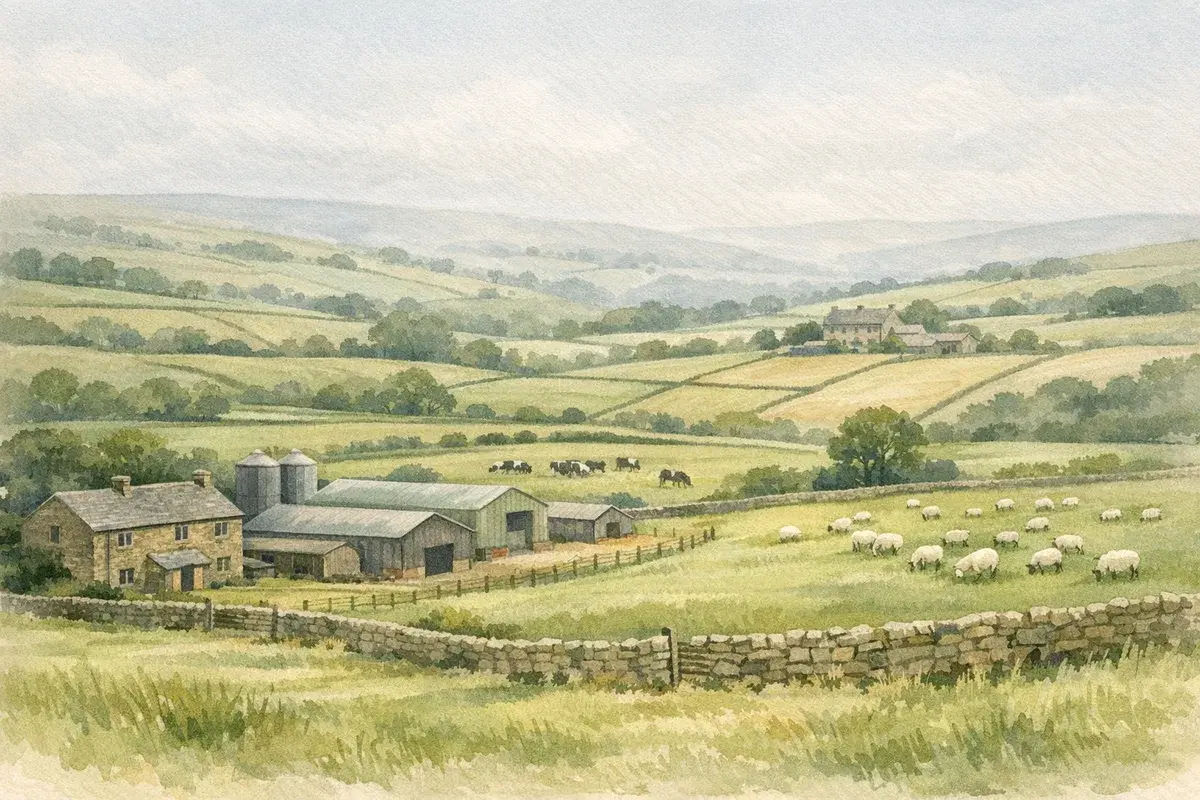
If you're looking at large commercial farms for sale, you're not shopping for a "nice bit of land". You're effectively buying (or buying into) a complex operating system: soils, buildings, staff, contracts, compliance, access, water, tenancies, and a planning history that can either unlock value, or quietly cap it.
At scale, the biggest risks aren't usually the ones that show up on the sales particulars. They're the awkward rights on a title plan, the tenancy clause that delays possession, the nutrient constraints that limit stocking, or the building that looks serviceable until you price up asbestos removal.
This guide is written for UK buyers who want to move decisively but carefully: how large farms come to market, what really drives value, and the diligence steps that help you avoid expensive surprises.
What Counts As A Large Commercial Farm In Today’s UK Market
There isn't one official UK definition of a "large commercial farm", because scale looks different in arable East Anglia versus upland livestock in Cumbria. In practice, buyers, lenders, and agents tend to use a mix of hectares, productive output, and operational complexity.
What matters is this: you're not just buying land, you're buying a business platform. The moment a unit needs full-time labour, significant compliance management, or has multiple income streams (cropping, livestock, contracting, renewables, storage, lets), it behaves like a large commercial farm even if the acreage isn't headline-grabbing.
Size, Output, And Infrastructure: Practical Benchmarks Buyers Use
In the real world, "large" is often shorthand for farms that:
- Require professional management (farm manager/foreman, office/admin, structured health & safety)
- Have meaningful fixed infrastructure (grain handling, slurry systems, parlours, poultry sheds, irrigation, staff housing)
- Carry material working capital needs (inputs bought in bulk, feed contracts, machinery replacement cycles)
- Create lender-grade cashflow (or have the potential to, with restructuring)
As a rough steer in the UK market:
- Arable-focused units often feel "large" once you're into several hundred acres with modern storage and drying, because logistics and timeliness drive margin.
- Dairy becomes "large" quickly due to capex and compliance, parlours, slurry storage, cubicle housing, water and nutrient planning.
- Upland livestock can be operationally large with less arable acreage, because scale may sit in forage area, common grazing rights, or dispersed blocks.
Typical Enterprise Types: Arable, Dairy, Mixed, Livestock, Horticulture, And Poultry
Most large commercial farms for sale in the UK fall into one (or a blend) of these enterprise types:
- Arable: cereals, oilseeds, pulses, specialist crops: value is often in soil, layout, and grain infrastructure.
- Dairy: a tight link between housing, parlour capacity, slurry, and nearby land for manures.
- Mixed: can be robust in volatile years, but management intensity is higher.
- Beef and sheep: often land-led value, with performance driven by handling systems, water, and access.
- Horticulture: irrigation, polytunnels/glass, packhouses, grid capacity, and labour availability can dominate value.
- Poultry: planning, environmental permitting, and biosecurity are central: the "farm" is as much a regulated site as it is land.
Ownership Structures You'll Encounter: Estates, Companies, Partnerships, And Trusts
At scale, the structure behind the sale can change the whole process.
Common set-ups include:
- Traditional estate ownership: sometimes cleaner titles, sometimes layered with rights, sporting, and historic arrangements.
- Limited companies: assets may sit in a company with trading history, employment, and contracts, sometimes leading to share-sale discussions.
- Partnerships: clarifying who owns what (and whether land is partnership property) is crucial early on.
- Trusts and family settlements: can add complexity on timing, confidentiality, and approvals.
None of these are "bad". But each affects how quickly you can move, what information is shared, and what a lender or solicitor will require before exchange.
Where Large Commercial Farms Come To Market (And Why Many Never Do)
If you're frustrated by the lack of choice, you're not imagining it. The best large units are often scarce, and many change hands quietly. Vendors may be sensitive about staff, neighbours, supply contracts, or simply not wanting 20 cars blocking the yard.
On-Market Versus Off-Market: How The Best Opportunities Are Sourced
On-market sales are the visible tip of the iceberg: marketed broadly, scheduled viewings, and a clear campaign timetable.
Off-market opportunities are common at scale. They're typically driven by:
- A vendor testing appetite before launching publicly
- A need for discretion (staff, family reasons, trading relationships)
- Portfolio or estate restructuring
- A buyer-led approach (you identify a target area and ask the right people)
How Specialist Agents Market Scale: Data Rooms, NDAs, And Managed Viewings
For large commercial farms, marketing often looks more like corporate M&A than a typical house sale.
Expect:
- NDAs before receiving sensitive documents (cropping records, supply contracts, compliance files)
- Data rooms containing title, plans, wayleaves, tenancy documents, scheme agreements, utilities, and building information
- Managed viewings (sometimes in stages) to avoid disruption and protect confidentiality
If the vendor is selling a going concern, particularly dairy, poultry, or horticulture, the "information pack" can be the difference between a clean deal and months of drift.
Building A Search Strategy: Registered Requirements, Target Areas, And Timing Your Approach
A good search strategy is less "scroll and hope" and more like running a pipeline.
- Choose two to four target areas based on agronomy, market access, and your operational strengths.
- Define your non-negotiables (soils, block size, water, grid, housing, biosecurity distance, access).
- Set up regular monitoring and keep notes, what looked expensive last quarter might look fair once you understand local comparables.
To keep your search organised, register your requirement somewhere built for farmland rather than general property. On AgLand you set out type, acreage, budget and area once, then hear the moment a matching farm is advertised.
Timing matters, too. Large farms often come forward when:
- Tenancies roll off (possession becomes achievable)
- Cropping seasons allow cleaner handover points
- Families plan around tax years or succession milestones
If you can align your funding, professional team, and decision-making so you're "ready-ready", you'll spot, and act on, opportunities others miss.
The Due Diligence Checklist For Buying At Scale
Due diligence on a large farm is rarely about finding a single fatal flaw. It's about uncovering a stack of small constraints that, together, change what the farm is worth to you.
Your aim is to turn "unknowns" into either (a) priced-in issues, (b) contractual protections, or (c) walk-away triggers.
Title And Rights: Boundaries, Easements, Wayleaves, And Ransom Strips
Start with the boring stuff. It's usually where the sharp edges are.
- Boundaries: Does the fence line match the title plan? Are there encroachments? Who maintains ditches and hedges?
- Easements and rights of way: Public footpaths are manageable: poorly-defined private rights can be disruptive (especially through yards).
- Wayleaves: Overhead lines, water mains, fibre routes, check payments, access rights, and repair obligations.
- Ransom strips: Small retained slivers can control access. If your only proper access crosses a third-party strip, your negotiating position changes fast.
At scale, ask your solicitor and land agent to treat access as a "stop/go" item early.
Land Quality And Capability: Soils, Drainage, Water, And Cropping History
A large commercial farm lives or dies on workability and timeliness.
Look for:
- Soil type and structure: heavy land can be brilliant, but only if drainage and working windows suit your kit and rotation.
- Drainage: confirm outfalls, maintenance, and whether systems are functional (and documented).
- Water availability: mains reliability, private supplies, boreholes, and any abstraction constraints.
- Cropping history: yields matter, but so do rotations, compaction risks, and grassland reseed cycles.
When you view, bring someone who'll actually dig holes and ask uncomfortable questions. A shiny brochure won't tell you where the wet corners are.
Infrastructure And Compliance: Buildings, Permits, NVZs, And Environmental Liabilities
Large farms usually come with a mix of old and new buildings. Condition isn't just capex, it can be compliance.
- Asbestos: common in older roofs: factor in management/removal.
- Silage clamps, slurry stores, and dirty water: capacity, integrity, and records.
- NVZ considerations (where applicable): storage requirements and spreading limitations can affect stocking and rotations.
- Environmental liabilities: fuel tanks, pesticide stores, historic dumps, ask what's been used and where.
If you're buying an intensive unit (poultry/dairy/horticulture), treat permitting, waste, and nutrient handling as "core business systems", not admin.
Access And Logistics: Road Networks, Yard Layout, And Proximity To Markets
On a big unit, access isn't a convenience, it's margin.
Check:
- Approach roads: width, weight restrictions, tight villages, winter resilience.
- Yard flow: can articulated lorries turn? Where do you store fertiliser and load grain without chaos?
- Distance to markets: feed mills, abattoirs, processors, grain intakes: time and diesel add up.
A farm that's 20 minutes closer to key outlets can outperform a "better" farm on paper.
Tenancies And Occupation: FBTs, AHA Agreements, Grazing Licences, And Possession
Occupation is often the single biggest timing risk.
- FBTs (Farm Business Tenancies): check term, break clauses, rent review, and who owns cropping, manures, and scheme entitlements.
- AHA tenancies: can significantly affect vacant possession and value: they're not "just a bit of paperwork".
- Grazing licences: confirm they're genuinely licences (and not tenancies in disguise).
- Employees and tied housing: understand who lives where, and under what basis.
Get clarity early: are you buying vacant possession, a reversion, or a going concern with occupiers? Each can be right, just not at the same price.
What Drives Value In Large Commercial Farms (Beyond £ Per Acre)
Price per acre is an easy headline, but it's a blunt instrument. On large commercial farms, value is usually driven by capacity, optionality, and risk.
Productive Capacity And Cost Base: Yields, Inputs, Labour, And Power
Two farms can be the same size and produce very different margins.
Look hard at:
- Yields over time, not just one good year
- Input strategy: fertiliser policy, crop protection approach, forage bought in versus produced
- Labour model: reliance on scarce skills, housing availability, contractor dependency
- Power and machinery: fleet age, replacement profile, and whether the system is over-capitalised
A useful test is to ask: If you took this farm over tomorrow, what's the first cost you'd have to commit to within 12 months? If the answer is "a combine, a slurry store upgrade, and a new roof", the headline price should reflect that.
Property Potential: Diversification, Overages, And Strategic Land Angles
At scale, "property potential" is where optimism can either pay off, or burn you.
- Diversification: storage lets, small industrial, farm shops, holiday lets, renewables. Some are cash-generative: others are management-heavy.
- Overages and clawbacks: if there's development hope value, check what the seller is reserving.
- Strategic land: edge-of-settlement land can carry a premium, but it also comes with planning uncertainty and long time horizons.
If you're banking on non-agricultural upside, your professional team should stress-test it. Assume delays. Assume conditions. Assume objections.
Natural Capital And Income Stacking: Woodland, Wetland, Peat, And Biodiversity Units
Natural capital has shifted from "nice to have" to a serious line in some business plans.
Depending on location and baseline, large farms may stack income from:
- Woodland creation/management
- Wetland projects and flood attenuation
- Peatland restoration (where relevant)
- Biodiversity units (Biodiversity Net Gain is a planning requirement in England, which has increased interest in habitat banks)
But beware the catch: these deals are documentation-heavy and can restrict future farming flexibility. Make sure obligations, durations, access, and maintenance are crystal clear.
Subsidies And Schemes: SFI, CS, And Devolved-Nation Differences
Support is now less about a single cheque and more about selecting the right agreements.
In England, buyers commonly ask how land is positioned for:
- SFI (Sustainable Farming Incentive) actions and compatibility with the system
- Countryside Stewardship (CS) agreements, options, and obligations
In Scotland, Wales, and Northern Ireland, schemes differ in structure and transition pace. The key due diligence question is: What agreements are in place now, and what flexibility do you inherit?
If you're assessing farms regularly, it helps to spend your time on the ones that genuinely fit rather than the ones that merely turn up. Registering your requirement with AgLand puts matching farms in front of you as they're advertised, so your effort goes into the documents and the view of value rather than the hunt.
Financing A Large Farm Purchase In The UK
Finance can make or break your ability to buy at scale. Even cash buyers usually want a structure that keeps working capital available for the first season, because the first season is where surprises like to hide.
Lending At Scale: Deposit Expectations, Covenants, And Valuation Approach
Lenders will typically focus on:
- Deposit and equity position: the larger the ticket, the more the bank cares about resilience.
- Security: what's being charged, what has strong resale value, and how liquid it is.
- Covenants: interest cover, loan-to-value, sometimes performance covenants on a trading business.
- Valuation: expect the valuer to separate agricultural value from any "hope" value and to scrutinise income streams.
Bring your banker into the conversation early, before you emotionally commit to a farm.
Sale Structures: Private Treaty, Informal Tender, Formal Tender, And Auction
Large farms are commonly sold by:
- Private treaty: negotiation-led, can suit complex deals.
- Informal tender: best bids by a deadline, often with a chance to improve.
- Formal tender: more rigid: you need your ducks in a row.
- Auction: less common for very large operating units, but sometimes used for land-only or where a clean, unconditional sale is preferred.
The structure affects your due diligence window. If you're heading toward tender, you'll want your solicitor and surveyor lined up before the pack lands.
Tax And Reliefs To Plan Early: SDLT, VAT, APR, BPR, And CGT
Tax can materially change your true purchase cost and your longer-term plan.
Areas that frequently matter in large farm transactions include:
- SDLT: different treatment for residential elements, mixed-use, and linked transactions.
- VAT: whether land/buildings are opted to tax, VAT on fixtures, and whether the deal is structured as a transfer of a going concern.
- APR/BPR: inheritance tax reliefs depend on facts, use, and structure.
- CGT planning: relevant if you're buying from a vendor with complex history or if you're structuring a longer-term exit.
This is where early advice pays for itself. The "cheap" way is often the expensive way, later.
Insurance And Risk Management: Biosecurity, Flood, And Business Interruption
Insurance at scale isn't just a tick-box.
Consider:
- Biosecurity exposure: livestock movements, visitor controls, and proximity to other intensive units.
- Flood risk: not just buildings, cropping risk and access roads matter.
- Business interruption: if one shed, one parlour, or one borehole fails, what's your contingency?
A good broker will ask uncomfortable operational questions. That's a feature, not a bug.
Planning, Regulation, And Operational Constraints You Must Not Miss
On a large farm, regulatory friction can quietly become your biggest cost centre. Planning and compliance aren't just paperwork, they shape what you can build, how you can expand, and what you can change.
Planning Status: Lawful Use, Conditions, And Agricultural Occupancy Restrictions
You'll want clarity on:
- Lawful use of existing buildings and yards
- Planning conditions that restrict hours, traffic, lighting, or specific uses
- Agricultural occupancy restrictions (ties) on dwellings (and what that means for staff housing and resale)
Don't assume historic arrangements are "fine because they've been like that for years". If you're changing use or intensifying, you may bring scrutiny.
Environmental Designations And Constraints: SSSI, AONB, SPA, And Habitats Rules
Designations don't make a farm un-buyable, but they do change what's straightforward.
Common UK constraints include:
- SSSI (Sites of Special Scientific Interest)
- AONB (Areas of Outstanding Natural Beauty)
- SPA/SAC and wider habitats protections
These can affect:
- New buildings and tracks
- Drainage work and watercourse management
- Woodland creation and habitat change
If a meaningful part of the holding is designated, ask early what consents are typically needed and how long they take.
Water And Nutrient Rules: Abstraction, Slurry Storage, And Diffuse Pollution
Water can be a hidden limiter, especially for dairy, horticulture, or any enterprise dependent on irrigation.
Check:
- Abstraction licensing position and reliability
- Private water supplies and compliance responsibilities
- Nutrient management: slurry storage capacity, spreading windows, and diffuse pollution risk
If you're buying intensity, get a practical view from someone who's actually run a system under these rules. Paper compliance and operational compliance aren't always the same.
Labour, Health And Safety, And Assurance: Red Tractor, Dairy, And Poultry Implications
Large farms rely on people and processes.
- H&S: machinery safety, grain store risks, working at height, lone working, contractor management.
- Assurance schemes (where applicable): what standards are required, and what upgrades might be needed to stay compliant.
- Labour availability: housing, local competition for staff, and seasonal peaks.
If you're inheriting staff, treat this as both a legal and a cultural handover. A messy transition can cost more than a roof repair.
How To Compare Farms And Shortlist The Right One Efficiently
When you're reviewing multiple large commercial farms for sale, you need a repeatable way to compare apples with apples. Otherwise the biggest yard or the prettiest farmhouse wins, until the spreadsheet arrives.
A Practical Scoring Framework: Land, Buildings, Location, And Headline Risks
A simple scoring framework helps you stay rational.
Score each category 1–5:
- Land (block size, soils, drainage, water, shape)
- Buildings (fitness for purpose, compliance risk, replacement cost)
- Location (access, market proximity, labour availability)
- Housing (staff accommodation, condition, restrictions)
- Operational risk (tenancies, designations, neighbours, biosecurity)
- Upside (diversification, natural capital, strategic angles, only if realistic)
Then force yourself to write one line: "If I buy this, the biggest thing I'm taking on is…" If you can't answer, you don't know the farm yet.
Looking for land like this? Tell AgLand what you're after - type, acreage, budget and area - and we'll alert you the moment a matching property is advertised. Registering is free, and there's no commission on either side. Tell us what you're looking for.
Documents To Request Early: Plans, EIA Screens, Nutrient Plans, And Utility Data
Ask early for documents that de-risk the deal:
- Title plan, Land Registry extracts, and any supplemental plans
- Building plans and schedules (including age/condition where known)
- EIA screening history (if there's been major work or land-use change)
- Nutrient management records (where relevant)
- Utility info: electric capacity, water supply details, telecoms
The goal isn't to create paperwork. It's to prevent you discovering, late in the day, that the grid can't support your intended enterprise.
Viewing A Large Unit Properly: What To Inspect In One Day Versus Two
A proper viewing of a large farm is rarely "one and done".
Day one should focus on go/no-go:
- Access and yard flow
- Condition of core buildings (grain, slurry, parlour, sheds)
- Land blocks and the awkward corners (wet patches, steep fields, pinch points)
- Neighbour proximity, rights of way, and biosecurity pinch points
Day two (if you're serious) is for detail:
- Meter locations and utility routes
- Store measurements and capacity checks
- Staff housing and any occupancy restrictions
- A longer drive round boundaries, especially where the title plan is complex
Take photos, but also take notes. Six farms later, your brain will blur them together.
Putting The Right Professional Team Around You
Buying at scale is a team sport. You can be an excellent farmer and still lose money if your adviser bench is thin, or if they're not used to agricultural property complexity.
Who You Need And When: Land Agent, Solicitor, Surveyor, Banker, And Tax Adviser
A solid team typically includes:
- Land agent: negotiation, local comparables, deal strategy, and market access
- Solicitor (with agricultural expertise): title, rights, tenancies, contracts, and completion mechanics
- Surveyor: buildings, condition, and capex forecasting (plus valuation support)
- Banker/lender: structure, speed, and covenant reality
- Tax adviser: SDLT/VAT and longer-term structuring
If you want a quick sense of how UK agricultural property transactions are typically approached, the resources and guides across AgLand's knowledge sections can help you ask better questions of each professional, before fees start clocking.
Negotiating With Confidence: Heads Of Terms, Timetables, And Conditionality
At scale, negotiation isn't just the price.
Focus on:
- Heads of terms that reflect what you believe you're buying (vacant possession, inclusions, handover dates)
- Timetable discipline: who provides what, by when
- Conditionality: where you need consents, finance approval, or tenancy clarifications
Be clear and calm. Sellers of large farms usually respect buyers who are decisive and properly advised.
Post-Completion Priorities: Handover, Staff, Contractors, And First-Season Decisions
Completion is when the real work starts.
Prioritise:
- A practical handover list: keys, meters, alarm codes, service records, chemical store inventory
- Staff conversations (if applicable): roles, expectations, and immediate risks
- Contractor continuity: who knows the land and kit, and who's reliable under pressure
- First-season decisions: rotations, stocking, infrastructure fixes, and scheme choices
And give yourself permission to stage change. The best operators don't try to rebuild everything in month one, they stabilise, learn the farm, then optimise.
Conclusion
Large commercial farms for sale can be rare, and the buying process can feel like a sprint followed by a marathon. The buyers who do well aren't necessarily the boldest, they're the ones who stay systematic: tighten the search area, get the right documents early, pressure-test access and occupation, and treat compliance as part of the commercial engine.
If you approach a large farm like a business acquisition (not a romantic purchase), you'll make better decisions on value, risk, and timing. And when the right unit appears, on-market or quietly, you'll be ready to move without gambling.
Disclaimer: AgLand.co.uk is a UK agricultural land and rural property matching service, where buyers register what they are looking for and owners advertise directly to the buyers who match, and a rural resource hub. Nothing in this text is intended as legal, financial, or investment advice. You should carry out your own due diligence and seek guidance from appropriately qualified professionals (for example, a solicitor, chartered surveyor, accountant/tax adviser, and specialist rural land agent) before making decisions or entering into any transaction.