
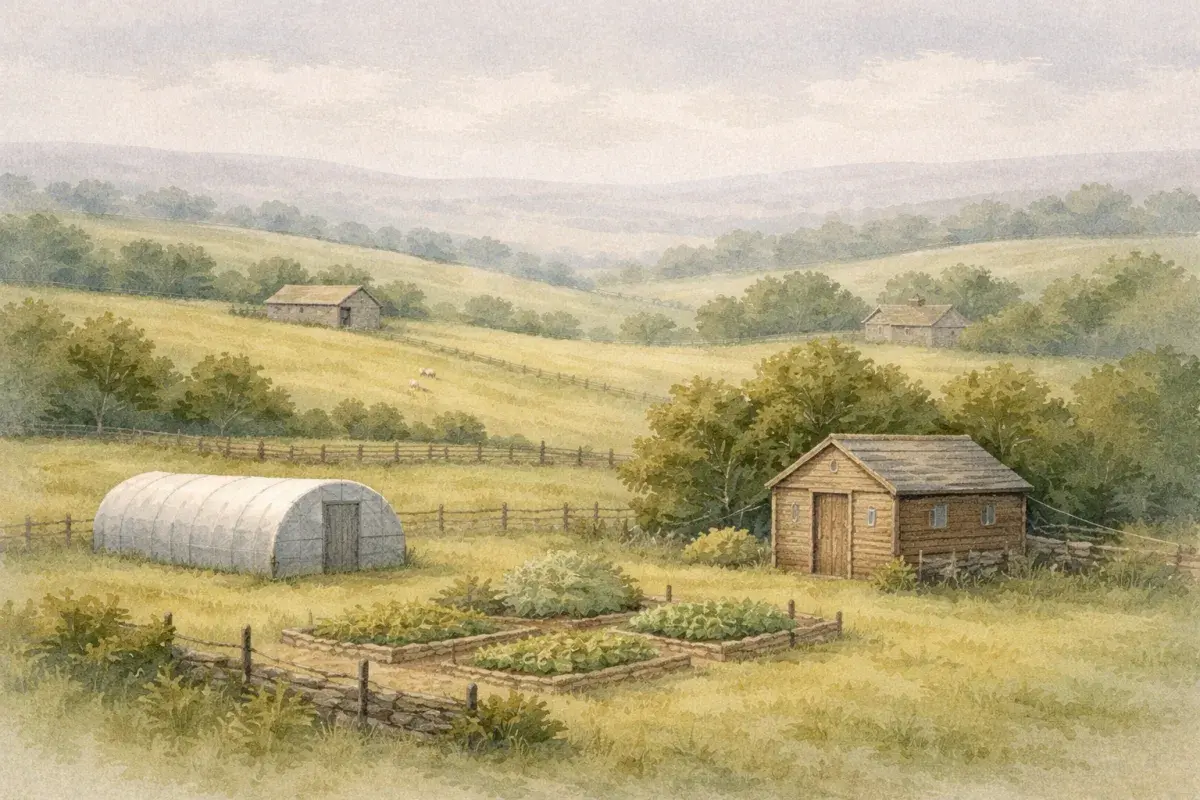
Planning permission can be a nightmare. The applications take months, cost thousands, and there's no guarantee of approval. If you own agricultural land in the UK, you're probably wondering what you can actually build without jumping through those bureaucratic hoops.
The good news? Agricultural landowners enjoy some of the most generous permitted development rights in the UK. You can construct various buildings and structures without formal planning permission - provided you follow specific rules and size restrictions.
But here's the catch: get it wrong, and you could face enforcement action, fines, or be forced to demolish what you've built. The regulations differ across England, Scotland, and Wales, and what counts as "agricultural" use isn't always straightforward.
This guide cuts through the confusion. We'll show you exactly what you can build, the size limits that apply, and the critical conditions you must meet to stay on the right side of planning law.
Quick Overview: What You Can Build Without Permission
Agricultural land benefits from permitted development rights under the Town and Country Planning (General Permitted Development) (England) Order 2015 (with equivalents in Scotland and Wales). These rights allow you to construct certain buildings without applying for planning permission.
Here's what's typically allowed:
- Agricultural buildings up to 465 square metres (if you meet specific conditions)
- Mobile structures like polytunnels and temporary animal shelters
- Fencing, gates, and access tracks for agricultural purposes
- Livestock shelters and feed stores within size limits
- Small structures for essential agricultural operations
The key phrase is "reasonably necessary for agriculture." Your building must serve a genuine agricultural purpose, not provide additional living space or commercial operations unrelated to farming.
Understanding Permitted Development Rights for Agriculture
Permitted development rights exist to help working farms operate efficiently without bureaucratic delays. They recognise that farmers need to respond quickly to operational demands - whether that's storing equipment, housing livestock, or protecting crops.
Class A of Part 6 of the General Permitted Development Order covers most agricultural buildings. But these rights come with strict conditions.
Your land must be used for agricultural purposes for at least one year before you can claim these rights. You can't buy a field and immediately start construction. The building must be "reasonably necessary" for your agricultural operations, which means it should serve a clear farming purpose.
Estate agents we work with often see buyers caught out here. They purchase agricultural land with grand building plans, only to discover their intended use doesn't qualify. Use, not size, is the deciding factor throughout, and what can lawfully go up on land without consent narrows considerably on amenity paddocks and smallholdings that are not in genuine agricultural use.
The Agricultural Definition
For planning purposes, agriculture includes:
- Horticulture, fruit growing, and seed growing
- Dairy farming and livestock breeding
- Use of land as grazing, meadow, or pasture
- Woodland activities related to farm operations
- Market gardens and allotments (in some contexts)
It doesn't include equestrian activities (unless part of a working farm), commercial dog kennels, or land used purely for private recreation.
Agricultural Buildings Under 465 Square Metres
This is where most landowners find their sweet spot. You can construct agricultural buildings up to 465 square metres without planning permission, provided you meet the conditions.
The building must be:
- Single-storey only (no mezzanines or upper floors)
- At least 12 metres from any trunk or classified road
- More than 25 metres from a protected building (listed buildings or residential properties not in your ownership)
- Not used for livestock accommodation within 400 metres of a protected building
Size Limits by Land Area
Your permitted building size depends on your total agricultural land holding:
| Land Area | Maximum Building Size | Conditions |
|---|---|---|
| Less than 5 hectares | Not permitted | Must apply for planning permission |
| 5 hectares or more | Up to 465 sq metres | Must follow distance and use restrictions |
| Less than 1 hectare | Prior notification required | Even for smaller structures |
Source: Town and Country Planning (General Permitted Development) Order 2015, as of October 2025
If your agricultural unit is less than 5 hectares (about 12.4 acres), you don't have automatic permitted development rights for agricultural buildings. You'll need to apply for full planning permission or consider mobile structures instead.
Ground-Based Buildings Only
Your structure must be directly on the ground - no raised platforms or buildings on stilts. The 12-metre height restriction applies to the highest part of the roof.
Most barn-style agricultural buildings comfortably fall within these parameters. A typical 30m x 15m machinery store (450 sq metres) with a 5-metre ridge height is perfectly acceptable. Footprint is still only half the picture, though, because height and siting decide as much as the size of an agricultural building, and a low shed set well back from the road clears tests that a taller one on the same base would fail.
Buildings Between 465 and 1,000 Square Metres
You can actually build larger structures up to 1,000 square metres, but these require prior notification to your local planning authority.
Prior notification isn't full planning permission, but it's not automatic either. You submit details of your proposal, and the council has 28 days to decide whether they need more information or want to impose conditions.
They'll assess:
- Siting and appearance of the building
- Design and external materials
- Impact on surrounding landscape and properties
- Whether the agricultural need is genuine
The application fee is significantly lower than full planning permission (typically £96 as of 2025, versus £462+ for full applications). Processing time is also much quicker - 28 days versus months.
We've seen agricultural property specialists successfully navigate prior notification for large equipment stores, grain silos, and covered livestock housing. The key is demonstrating genuine agricultural need and choosing appropriate materials that blend with the rural landscape.
Mobile Structures and Temporary Buildings
Here's where things get interesting. Mobile structures offer flexibility without the permanence that triggers planning scrutiny.
Polytunnels are the classic example. These lightweight, removable structures are generally considered permitted development for horticultural purposes. There's no specific size limit, but they must be:
- Genuinely mobile (not permanently fixed with concrete foundations)
- Used for agricultural purposes only
- Not causing significant landscape harm
- Removed when no longer needed
Temporary Structures for Seasonal Needs
You can erect temporary buildings for seasonal agricultural work:
- Mobile field shelters for livestock (often on skids rather than foundations)
- Temporary harvest structures during crop collection periods
- Seasonal storage containers during busy periods
- Covered work areas for short-term agricultural processing
The crucial word is "temporary." If your "temporary" structure remains in place year after year, the council may argue it is permanent and requires permission.
Shipping Containers: The Grey Area
Shipping containers have become popular for agricultural storage. Their planning status is contested.
A single container used for genuine agricultural storage, not permanently affixed to the ground, typically falls under permitted development. But stack multiple containers, add windows or doors, connect them to utilities, or use them for anything beyond pure storage, and you're likely to need permission.
Some councils take a stricter view than others. If you're considering containers, check with your local planning department first.
Fencing, Gates, and Access Roads
Agricultural fencing generally doesn't require planning permission, with some important exceptions.
You can erect:
- Stock-proof fencing of any reasonable height for containing livestock
- Post-and-rail fencing for field boundaries
- Agricultural gates for field access
- Internal tracks within your land for farm vehicle access
Height Restrictions Near Highways
If your fence adjoins a highway (public road or right of way), it must not exceed 1 metre in height. Away from highways, agricultural fencing can be taller, but must remain "reasonably necessary" for agricultural purposes.
A 2-metre deer fence to protect forestry plantations? Perfectly acceptable. A 3-metre solid wall around a field for privacy? That's going to raise questions.
New Access Points
Creating a new vehicle access onto a classified road (A or B road) always requires planning permission, even for agricultural purposes. This is for highway safety reasons.
You can improve existing access points - widening gates, resurfacing entrances, improving visibility - without permission. But cutting a new access through a hedge onto a public road triggers both planning and highway authority involvement.
What You Cannot Build Without Permission
Let's be clear about what's off-limits under permitted development, because this trips up many landowners.
Residential Dwellings
You cannot build a house, caravan, mobile home, or any structure intended for human habitation without full planning permission. This includes:
- Agricultural workers' cottages or "shepherd's huts" used as dwellings
- Converting agricultural buildings to residential use
- Siting a caravan or mobile home as a residence
- "Temporary" structures that are actually lived in
The agricultural appraisal and "essential worker" test for farm dwellings is incredibly strict. You'll need to demonstrate a full-time essential agricultural need that cannot be met by existing dwellings in the area.
Commercial Non-Agricultural Uses
Your permitted development rights are for agriculture, not:
- Farm shops selling predominantly non-farm produce
- Wedding venues, holiday lets, or commercial accommodation
- Cafes, restaurants, or food processing beyond farm-scale
- Industrial units or commercial storage for non-agricultural goods
- Equestrian centres or riding schools (unless incidental to livestock farming)
Even if the building itself would qualify for permitted development, the use determines whether permission is needed. A building used 80% for agriculture and 20% for a farm shop may breach your permitted rights.
Developments in Protected Areas
Permitted development rights are significantly restricted in:
- Sites of Special Scientific Interest (SSSIs) (prior notification required for most buildings)
- National Parks and Areas of Outstanding Natural Beauty (stricter size limits and prior notification thresholds)
- Conservation Areas (additional restrictions on materials and appearance)
- Within 3km of an aerodrome (height and location restrictions apply)
If your agricultural land sits within any designated area, always check the specific restrictions before assuming you have permitted development rights.
Regional Variations: England, Scotland, and Wales
Planning law differs across the UK nations, so location matters.
England
The rules outlined above apply to England under the 2015 General Permitted Development Order (as amended). England has the most expansive permitted development rights for agriculture.
Recent changes (effective April 2024) slightly relaxed some restrictions on barn conversions, though these still require prior approval rather than being fully permitted.
Scotland
Scottish planning law operates under the Town and Country Planning (General Permitted Development) (Scotland) Order 1992.
Key differences:
- Similar size thresholds but more restrictive height limits (12 metres maximum to eaves, not ridge)
- Stricter controls in National Scenic Areas
- Different rules around agricultural intensification and livestock units
- Stronger emphasis on landscape impact assessments
The Scottish Government has signalled potential changes to agricultural permitted development in 2025-26, potentially relaxing some restrictions while tightening environmental protections.
Wales
Wales follows the Town and Country Planning (General Permitted Development) Order 1995 (as amended).
Notable differences include:
- More restrictive approach in areas covered by Tir Gofal environmental schemes
- Additional scrutiny for buildings in Welsh-language communities
- Stricter interpretation of "reasonably necessary" for agriculture
- Enhanced landscape protections across much of rural Wales
The Welsh Government has indicated forthcoming changes to align agricultural permitted development with climate and environmental objectives, likely effective from mid-2026.
Expert Insight: Common Mistakes to Avoid
Agricultural property specialists across our network consistently see the same costly errors:
"The biggest mistake is assuming 'agricultural land' automatically gives you building rights," explains a rural chartered surveyor with over 25 years' experience. "We regularly encounter buyers who've purchased land specifically to erect buildings, only to discover they don't meet the 5-hectare threshold or the land hasn't been in agricultural use long enough."
Key pitfalls to avoid:
-
**Starting construction before the land has been agricultural for a full year. **Your clock starts from when agricultural use genuinely began, not when you bought it
-
Exceeding size limits incrementally. Building a 400 sq metre barn, then adding a 100 sq metre extension later doesn't work; it's the total that counts
-
Mixing agricultural and non-agricultural uses. Once you use part of an agricultural building for non-permitted purposes, you may lose permitted development rights for the entire structure
-
Assuming removal of a building creates "fresh" rights. If you demolish an old barn and rebuild, authorities may count it as a replacement, carrying forward previous permissions or restrictions
Agents we work with report that agricultural land with established permitted development rights and no restrictive conditions can command a 15-25% premium over comparable land where planning permission would be required for similar buildings (market data as of September 2025).
Step-by-Step: Before You Build
Follow this process to ensure you're building legally:
1. Verify Your Land Qualifications
- Confirm your land area exceeds 5 hectares (if building under Class A)
- Document that agricultural use has been established for at least 12 months
- Check for any restrictive covenants in your deeds
2. Review Planning Designations
- Contact your local planning authority to confirm any designations (AONB, conservation area, etc.)
- Check if your land falls within a SSSI or other protected designation
- Verify distance from protected buildings and highways
3. Calculate Size and Positioning
- Measure your intended building footprint accurately
- Ensure minimum 12-metre distance from classified roads
- Confirm 25-metre+ distance from neighbouring properties
- Stay under the 12-metre height limit
4. Determine If Prior Notification Is Needed
- Buildings over 465 sq metres require prior notification
- Some designated areas require notification even for smaller structures
- Allow 28 days for the council's response
5. Document Everything
- Keep records of your agricultural activities
- Photograph the site before construction
- Retain all correspondence with planning authorities
- Document the genuine agricultural need for the building
6. Use Appropriate Materials
- Choose materials typical of agricultural buildings in your area
- Avoid domestic-style windows or non-agricultural cladding
- Consider landscape screening if visually prominent
7. Maintain Agricultural Use
- Ensure the building is used solely for permitted agricultural purposes
- Don't convert to residential or non-agricultural commercial use
- Keep the building in reasonable repair and maintain its agricultural character
When Professional Advice Is Essential
While permitted development rights offer valuable flexibility, agricultural property law is complex. Consider professional advice when:
- Your land is close to the 5-hectare threshold
- You're planning to build near protected buildings or designated areas
- Your intended use sits at the boundary of what's considered "agricultural"
- You're planning structures over 465 square metres
- Your land has unusual covenants or restrictions
Agricultural property valuers, rural surveyors, and specialist planning consultants can provide crucial guidance. The cost of expert advice (typically £500-£1,500 for initial consultation and assessment) is minimal compared to the expense of an unauthorised development, which can include enforcement action, legal costs, and even demolition.
If you're looking for advice in this area, contact AgLand. We can connect landowners with experienced agricultural property professionals who understand the nuances of permitted development across different regions and land types.
Summary: Building With Confidence
Agricultural land owners in the UK enjoy substantial freedom to erect necessary farm buildings without the time and expense of full planning permission. Buildings up to 465 square metres, mobile structures, and essential agricultural infrastructure can typically proceed without formal approval - provided you meet the specific conditions.
The critical factors are:
- Land area of 5 hectares or more
- Genuine agricultural use for at least one year
- Appropriate sizing (under 465 sq metres for automatic rights)
- Correct positioning (meeting distance requirements)
- Purely agricultural purpose (not residential or commercial)
Get these right, and you can develop your agricultural enterprise efficiently. Get them wrong, and you risk costly enforcement action.
Whichever side you're on. Buyers tell AgLand what they're looking for and hear the moment something fits. Owners advertise straight to the buyers who already match, for one flat fee and no commission. Register as a buyer or check your matches.
Disclaimer
This information is provided for educational purposes and does not constitute professional advice. Planning regulations are complex, frequently updated, and vary by location and specific circumstances. Agricultural permitted development rights depend on multiple factors specific to your land and intended use. Always consult with qualified planning professionals, rural surveyors, and agricultural property specialists before commencing any building work.