
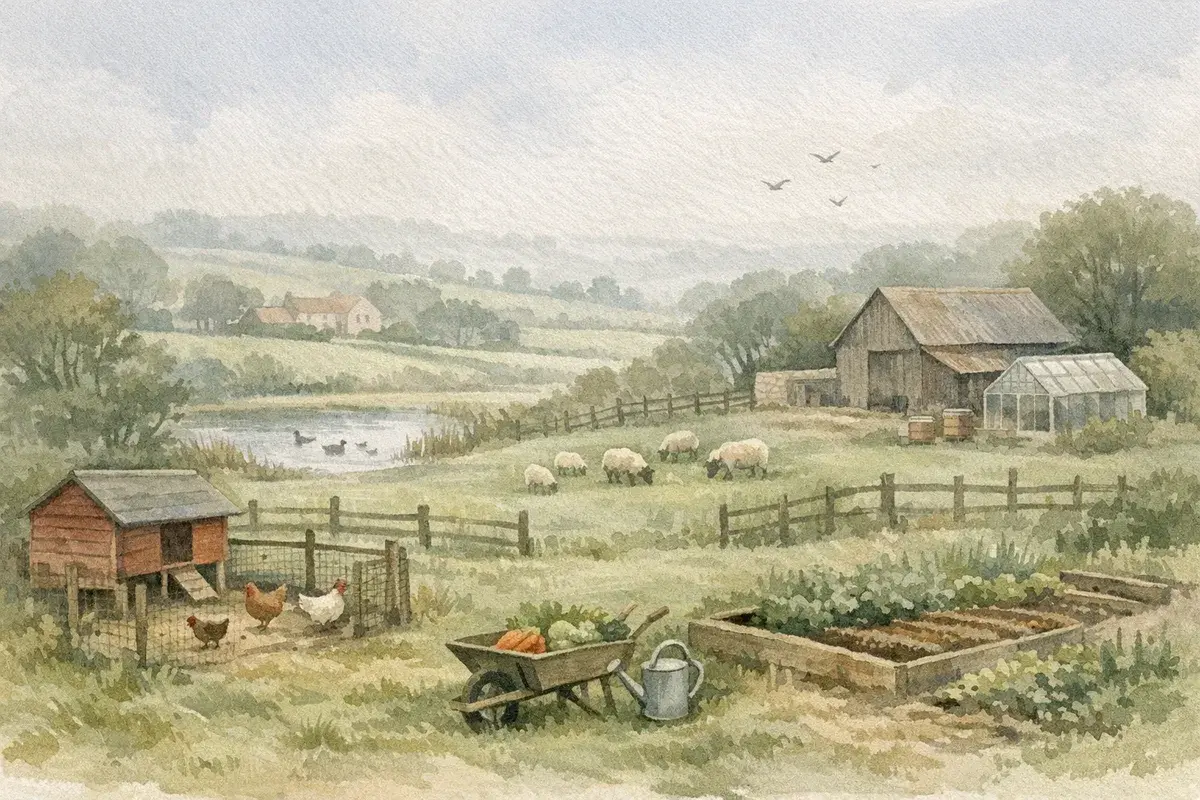
Running a smallholding is part business, part lifestyle, and part daily graft. If you're wondering how to run a smallholding properly, the short answer is this: start with a clear plan, match your land to realistic enterprises, and keep a tight grip on cash, labour, and compliance.
The people who do best aren't usually the ones with the fanciest kit. They're the ones who know their soils, count their hours, and choose enterprises that suit the ground, the local market, and the weather. That might mean sheep, pigs, poultry, market gardening, fruit, conservation grazing, or a mix of all five.
It's also worth saying up front that a smallholding isn't a charming side project once the gates close. There's fencing to repair, feed to order, movement records to keep, and the odd emergency at 6am on a wet Sunday. Still, done well, it can be resilient, profitable, and deeply satisfying.
Start With A Realistic Smallholding Plan
The first decision is whether you want a productive unit, a self-sufficient holding, or a mixture of the two. Those are different businesses, even if they share the same field boundaries and a battered pickup. If you want income, you need output. If you want food security and a rural lifestyle, you still need a plan.
We'd argue this is where many new owners go wrong. They buy a few rare-breed sheep, a couple of chickens, and a polytunnel, then wonder why the place eats money faster than it produces it. A smallholding only works when every acre, pen, bed, and shed has a purpose.
Choose Enterprises That Suit Your Land
Start with what the holding can actually support. Free-draining land in Norfolk or Lincolnshire may suit vegetables, poultry, and arable-inspired fruit production, while heavier ground in Lancashire, Cumbria, or Somerset often suits grazing livestock and winter forage better. South-facing slopes in Devon or Herefordshire can be excellent for orchards or market gardening, but only if water supply and access are sorted.
Soils matter. Clay soils hold nutrients but can be slow in spring. Sandy soils warm quickly but may need more irrigation and organic matter. If you don't know your soil type, you're steering blind.
- Light land: better for early vegetables, soft fruit, and rotational grazing.
- Heavy land: often better for sheep, cattle, and permanent pasture.
- Poor access: limits direct sales, machinery use, and livestock handling.
- Reliable water: can make the difference between profit and a costly hobby.
Set Goals You Can Measure
Decide what success looks like in year one, year three, and year five. Is the aim to cover costs, replace a full-time wage, feed the household, or build a diversified rural enterprise that could one day support staff? Without that target, it's too easy to work all hours and still fall short.
Keep the first year simple. One or two income streams is usually enough. For many first-time smallholders, a sensible combination might be grazing sheep, hens for eggs, and a small kitchen-garden or veg box scheme. In parts of Kent, Sussex, and Wiltshire, proximity to towns can support direct sales. In more remote parts of Northumberland or the Highlands, you may need to think harder about outlet routes and logistics.
Understand Land, Buildings, And Infrastructure
A smallholding is only as strong as its infrastructure. Good fencing, a dependable water system, secure buildings, and practical access are worth far more than ornamental features. If the water trough freezes, the gate won't shut, or the track turns into a bog, daily routines become complicated fast.
Before buying or expanding, walk the land in dry weather and after heavy rain. Check where stock would gather, where machinery can turn, and where you'd place handling pens, compost bays, cold storage, or a packhouse. A well-set-up holding saves labour every single day, which is exactly what you need.
Fencing, Water, And Tracks
Fencing is not glamorous, but it is absolutely central. Cattle need stronger boundaries than poultry, and sheep require excellent netting or close attention to boundary gaps. Water supply should be frost-proof where possible, with enough pressure and storage to handle summer demand.
Tracks and gateways deserve proper thought. A narrow, rutted entrance can make deliveries miserable and emergency access difficult. On Devon and Cornwall smallholdings, steep or wet access can affect almost every decision. In the Scottish Borders or parts of Yorkshire, long internal runs mean stock handling and vehicle movement need even more planning.
Buildings And Storage
You do not need everything on day one, but you do need secure storage for feed, tools, fertiliser, spare parts, and veterinary supplies. If you're processing produce, you may also need a clean preparation area, handwashing points, and chilled storage. For livestock, shelters, lambing pens, and raceways can make busy seasons far easier.
Think like a livestock farmer and a warehouse manager at the same time. That sounds dull, but it pays. A leaky barn or poorly ventilated shed costs money in lost stock condition, damaged feed, and avoidable disease pressure.
| Typical Smallholding Cost Area | What It Covers | As Of March/2025 | Planning Note |
|---|---|---|---|
| Boundary Repairs | Posts, wire, gates, netting | Variable by site | Often one of the first ongoing capital costs |
| Water Infrastructure | Pipework, troughs, pumps, tanks | Variable by site | Critical for livestock and summer production |
| Small Machinery | Ride-on mower, trailer, compact tractor | Higher upfront outlay | Buy only when the work justifies it |
| Storage And Sheds | Feed bins, dry stores, pack areas | Project-specific | Security and weather protection matter |
Set Up Livestock And Cropping Systems That Actually Work
Once the land and buildings make sense, build systems around them. Smallholdings do best when stock, soil, and labour are matched carefully. A holding in Gloucestershire with good pasture and decent handling facilities may suit a flock of ewes. A holding near Bristol or Reading, by contrast, might do better from intensive veg, eggs, flowers, or a farm shop-style outlet.
Do not overstock. That is one of the quickest ways to ruin both ground and morale. Stocking rate, which simply means how many animals the land can carry, must reflect rainfall, forage supply, and the length of the grazing season.
Livestock Choices For Beginnings
Sheep are often the easiest entry point because they can utilise grass well, but they are not low-effort. They need parasite control, lambing knowledge, foot care, and reliable fencing. Chickens can generate cash more quickly, but disease control, laying performance, and predator management become daily concerns.
Pigs suit some smallholdings brilliantly, especially where there is woodland edge, spare feed access, or a strong direct-sales channel. But pigs can be destructive and need proper fencing and welfare management. Dairy goats, cattle, and rare breeds can also work, though each demands its own level of handling skill, licensing awareness, and husbandry.
- Sheep: good for grazing land and lamb sales, but parasite control matters.
- Hens: useful for quick turnover through egg sales.
- Pigs: strong for direct sales if fencing and hygiene are solid.
- Goats: suited to niche markets, though they are escape artists.
Market Gardening And Low Acreage Crops
If your land is limited, market gardening can be a strong option. Salad crops, courgettes, beans, cut flowers, and soft fruit can produce high value from small areas, especially near towns in Surrey, Oxfordshire, and the East Midlands. But intensive cropping needs water, labour, and regular sales.
Growing food is one thing. Selling it is another. A bed of salad leaves has no value until a customer pays for it, and that means consistency, presentation, and a dependable outlet. Weekly veg bags, local markets, box schemes, and farm-gate sales can all work, but only if you can supply them regularly.
Know Your Costs, Income, And Compliance
Smallholdings often fail on cash flow rather than production. Feed bills arrive before the lamb cheque. Seeds are paid for in spring. Machinery breaks at the worst possible moment. So, if you're asking how to run a smallholding well, the answer includes book-keeping, pricing, and a close eye on regulation.
As of March/2025, many smallholders are feeling tighter margins because input costs remain high relative to modest sale prices in several farm-gate sectors. That does not mean the model is broken. It means you need to know your numbers before you commit.
Common Income Streams
Most smallholdings do best with several modest revenue lines rather than one big bet. Eggs, lamb, meat boxes, rare-breed breeding stock, vegetables, fruit, compost, wool, and educational visits can each play a part. The key is to match the workload to the return.
Some of the strongest opportunities are in areas with nearby population centres. North Yorkshire, Cheshire, and the Home Counties can support direct sales. More rural parts of Wales or the Scottish Borders may favour wholesale, breeding stock, or agri-tourism if access and planning allow it.
| Enterprise | Typical Strength | Risk Level | Best Fit |
|---|---|---|---|
| Eggs | Regular cashflow | Medium | Small, accessible holdings near customers |
| Lamb | Pasture conversion | Medium | Grass-based holdings with handling kit |
| Vegetables | High value per acre | High | Labour-rich sites with water and local demand |
| Meat Boxes | Direct margin potential | Medium | Holders who can manage fulfilment and sales |
Compliance Matters More Than You Think
Even a small holding can trigger serious obligations. Livestock movements, welfare standards, identification, food hygiene, environmental controls, and waste handling all matter. If you keep animals, you may need to register them correctly with Defra and maintain movement records. If you process food, hygiene rules become more exacting.
Planning permission, or a permitted development right under the General Permitted Development Order 2015, can also matter for buildings, conversion, parking, signage, cold storage, or visitor use. Rural enterprises in areas such as Cornwall, the Cotswolds, or Pembrokeshire may face additional sensitivity around landscape impact and access. It pays to sort the paperwork early, not after a problem lands on your lap.
Build A Routine That Protects Time And Profit
The final piece is daily management. A successful smallholding runs on routine, not inspiration. Good routines protect animal health, soil condition, and your own sanity, which is no small thing when lambing, harvesting, and market days collide.
Use a simple rhythm. Check stock first, then water, then boundaries, then feed, then crops. Keep records as you go. It takes minutes a day and can save hours later, especially if you need to trace a problem or justify a claim.
Daily, Weekly, And Seasonal Tasks
Daily tasks might include feeding, watering, welfare checks, egg collection, and quick repairs. Weekly jobs could include pasture rotation, ordering feed, updating records, and checking sales. Seasonal work is bigger: lambing, haymaking, planting, weaning, fencing, muck spreading, and winter protection all come in waves.
The best smallholders think ahead by season. In spring, they prep grazing and plant crops. In summer, they manage growth and sales. In autumn, they preserve value, store feed, and prepare for wet weather. In winter, they fix, budget, and plan.
- Daily checks: water, feed, health, gates, and security.
- Weekly planning: sales, ordering, grazing moves, and cash flow.
- Seasonal work: breeding, planting, harvesting, and infrastructure repairs.
- Record keeping: movements, treatments, yields, and costs.
Labour, Family, And Burnout
Smallholdings can swallow every spare hour if you let them. That's why build-in rest matters. If you're relying on family labour, agree who does what before the season begins. If you may need relief help, know where to find it before lambing week arrives.
In practical terms, the most profitable smallholdings are often the ones that say no to unnecessary complexity. A holding in Herefordshire that grows excellent vegetables and keeps a manageable flock may outperform a bigger, messier place with too many half-hearted ventures. Less can be more.
How to Run a Smallholding Well for the Long Term
The long-term answer to how to run a smallholding is to keep it simple, efficient, and suited to the land. Start with realistic enterprises, invest in the basics, and keep a close eye on cash, compliance, and labour. If the holding fits the ground and your goals, it can become a sturdy rural business rather than an expensive distraction.
In the UK, conditions vary sharply from county to county, so there is no one perfect model. What works on a free-draining Somerset site may fail on a wet Welsh hillside or a compact Sussex plot. The right system is the one that fits your place, your customers, and your time.
Get those three things aligned, and the rest becomes much easier. Miss them, and the place will tell you quickly.
Disclaimer: AgLand.co.uk is a UK agricultural land and rural property matching service, where buyers register what they are looking for and owners advertise directly to the buyers who match, and a rural resource hub. Nothing in this text is intended as legal, financial, or investment advice. You should carry out your own due diligence and seek guidance from appropriately qualified professionals (for example, solicitors, land agents, surveyors, and financial advisors) for your specific circumstances.