
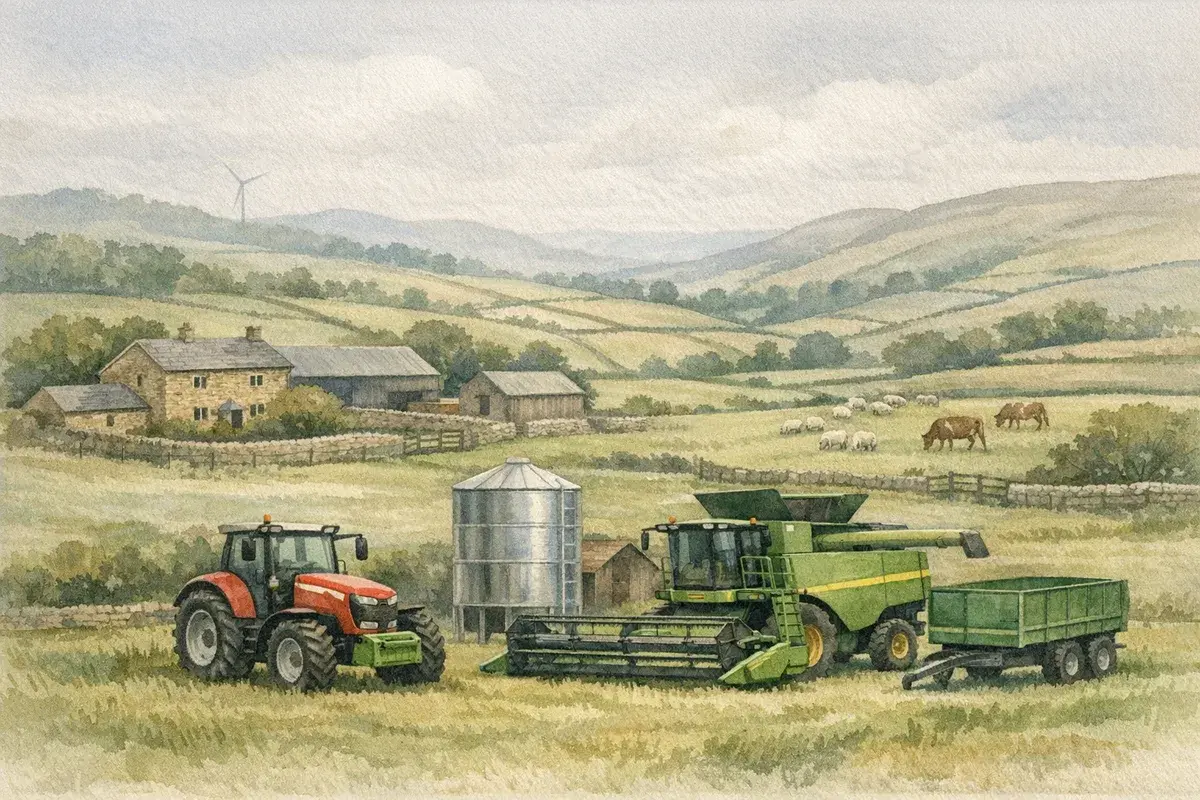
If you've ever priced up a slurry separator, a set of cattle handling kit, or even something as "simple" as yard drainage, you'll know the same truth hits every farm business sooner or later: good equipment isn't cheap, and waiting rarely makes it cheaper.
Capital grants can take some of the sting out of those big purchases, but only if you treat them like a compliance exercise as much as a funding opportunity. The details matter: what counts as "capital", what evidence you need, when you're allowed to place orders, and how to avoid accidentally falling foul of double funding rules.
This guide focuses on capital grants for farming equipment in the UK, with a practical, 2026-focused lens. You'll come away knowing what typically gets funded, what commonly doesn't, how the schemes differ across the UK nations, and the step-by-step process that gives you the best chance of getting approved and paid.
What Capital Grants Are And How They Differ From Subsidies And Tax Reliefs
A capital grant is (usually) a contribution towards the cost of buying or installing a tangible asset that lasts for years: equipment, infrastructure, fixed items, and sometimes technology. In grant language, you're improving the holding's capability, productivity, animal welfare, nutrient management, water quality, or environmental outcomes.
That's different from:
- Income-style support/subsidies (where the payment is for doing something or delivering an outcome over time), and
- Tax reliefs (where you reduce your taxable profit by claiming allowances or reliefs).
The trap is assuming they're interchangeable. They aren't, and mixing them up can create clawback risk or tax headaches.
Capital Vs Revenue Funding: Why The Distinction Matters
Capital and revenue funding sound like accountant-speak until you hit a scheme rule that says "not eligible" because you picked the wrong category.
Capital funding typically supports:
- One-off purchases (e.g., cattle crush, weigh crate, slurry store covers, rainwater harvesting tanks)
- Installed items with a useful life beyond a single season
- Works that create a lasting improvement (e.g., concrete yard renewal tied to pollution control)
Revenue funding (or ongoing payments) typically supports:
- Management actions and operational changes (e.g., certain habitat management, record-keeping, advisory support)
- Payments over time for maintaining standards or delivering outcomes
Why it matters:
- Different evidence: Capital claims often require invoices, photos, serial numbers, and installation proof.
- Different timings: You commonly must not start work or place orders until you have a grant offer from the scheme administrator, which in England is usually the Rural Payments Agency.
- Different compliance: Capital items usually have a "retain and use" period. Sell early and you may repay.
If you're also mapping out wider options for your business this year, it's worth cross-checking how capital schemes sit alongside broader funding routes covered in our guide to what's available under farming grants in 2024, many of the principles (evidence, timings, inspections) carry over even as scheme names and windows evolve.
Grants Vs Capital Allowances: Avoiding Double Funding
A common misunderstanding is thinking you can claim a grant and claim full tax relief on the same cost with no adjustments.
In practice:
- A grant reduces your net cost of an asset.
- Capital allowances (e.g., plant and machinery allowances) are calculated on the qualifying expenditure you've incurred.
If you receive grant funding towards an item, your accountant will typically adjust the capital allowance claim to reflect the subsidised spend (or treat the grant as taxable income depending on circumstances and the scheme's treatment). The exact treatment depends on the scheme, how the payment is structured, and your business structure.
Two practical rules keep you safe:
- Tell your accountant early what you're applying for and what you expect to claim.
- Keep grant and tax records aligned: invoices, payment dates, asset register entries, and grant correspondence should all match.
Done properly, grants and allowances can still work together, you just don't want "double funding" accusations or a messy correction later.
Which Schemes Fund Farming Equipment In 2026
By 2026, the UK grant landscape is still a patchwork: different nations, different agencies, different objectives, and different application windows. The upside is there are usually multiple routes to fund equipment, if you're prepared to match your project to the scheme's purpose.
Below is a practical overview of where capital grants for farming equipment typically sit across the UK. Always check the live guidance for current rounds, item lists, scoring, and deadlines.
England: Countryside Stewardship Capital Grants And Equipment Options
In England, equipment funding often shows up through:
- Countryside Stewardship (CS) capital items (where you apply for specific items with defined specifications and payment rates)
- Targeted capital offers tied to water quality, air quality, or boundary/habitat outcomes
- Periodic productivity-style competitions (where available) that support farm improvement and resilience
What this tends to mean in the real world:
- If your kit purchase clearly reduces diffuse pollution, improves nutrient management, or upgrades handling and welfare, you're usually in a stronger position.
- "Nice to have" upgrades that don't map to scheme outcomes can struggle.
If your equipment plans relate to run-off control, yard works, or storage improvements, our dedicated overview of water quality grant options for farming is a useful companion, many equipment items are only fundable when they can be tied to measurable pollution prevention.
Wales: Capital Items And Farm Investment Support Routes
In Wales, funding routes tend to include:
- Capital item lists linked to environmental outcomes and land management
- Investment support that prioritises resilience, resource efficiency, and (in some cases) animal health and welfare
Practical pointers:
- Wales often places strong emphasis on environmental compliance and outcomes. If your equipment prevents pollution or improves nutrient use efficiency, that's a cleaner story.
- Be ready for mapping and evidence requirements, especially if items are installed or tied to specific fields/yards.
Scotland And Northern Ireland: Typical Capital Grant Pathways For Equipment
Scotland and Northern Ireland have their own structures and priorities, but the typical "shape" of equipment grant pathways looks familiar:
- Capital support linked to environmental improvement (water, soil, biodiversity)
- Support for business efficiency and resilience where aligned to programme rules
- Requirements around permissions, procurement, and ongoing compliance
Two universal truths apply across these nations:
- The item list/specification is king. If your chosen kit doesn't match the published spec, you can lose the claim even if the item is sensible.
- Evidence wins. A neat, complete file (quotes, maps, photos, permissions) beats a brilliant idea with gaps.
If you're operating an organic system (or transitioning) your options can look a bit different again, especially where equipment supports certification, rotation viability, or reduced inputs. See our guide to organic grant support in the UK for a sector-specific view.
What Farming Equipment Is Commonly Eligible (And What Usually Isn’t)
Capital grant rules are rarely written to fund "equipment" in a broad sense. They fund outcomes, and equipment is the means.
So while every scheme has its own list, the items that most commonly pass eligibility checks fall into three buckets: productivity/handling, pollution prevention and resource management, and precision/monitoring.
Productivity And Handling: Livestock, Dairy, And Yard Equipment
Commonly eligible (scheme-dependent, specification-dependent):
- Livestock handling: races, crushes, forcing pens, drafting gates, weigh systems (especially where welfare, safety, and efficiency outcomes are explicit)
- Dairy and youngstock management: upgrades that improve hygiene, welfare, or efficiency (often more likely where tied to compliance or resource efficiency rather than pure expansion)
- Yard infrastructure linked to pollution control: channels, kerbs, and hardstanding improvements where the purpose is to prevent dirty water entering clean systems
What usually isn't funded (or is harder to justify):
- Like-for-like replacements with no improvement
- Second-hand equipment (many schemes require new items)
- General-purpose vehicles/tractors/telehandlers (often excluded unless a very specific exception exists)
A useful test: if you can't explain the measurable benefit beyond "it'll make life easier", it may not survive eligibility checks.
Water, Nutrients, And Pollution Controls: Storage, Spreading, And Run-Off Mitigation
This is one of the strongest areas for capital funding because it aligns with regulatory pressure and catchment outcomes.
Commonly eligible examples include:
- Run-off management: roofing/covering, gutters, clean/dirty water separation, yard drainage improvements
- Nutrient storage and handling: certain slurry store improvements, covers, reception areas, and equipment that reduces losses
- Application efficiency: kit that demonstrably reduces nutrient losses or improves targeting (again, only where the scheme explicitly supports it)
What's commonly excluded or restricted:
- Capacity increases that look like straightforward business expansion rather than compliance/improvement
- Works started before approval
- Items without the required consents (a surprisingly frequent reason for claim failure)
Technology And Precision: Measuring, Monitoring, And Application Equipment
Grant-makers like technology when it's clearly tied to better decisions and reduced waste.
Commonly eligible (where schemes support it):
- Measuring and monitoring: soil testing and mapping equipment, nutrient monitoring tools, flow meters, telemetry linked to water management
- Precision application: equipment or components that support accurate placement and reduce over-application
- Record-backed systems: tools that improve traceability of inputs/outputs (especially where linked to environmental outcomes)
What tends to fail:
- Tech that's primarily convenience, with no clear outcome
- Subscription-only services without an eligible capital element
- "Bundled" packages where the eligible component isn't separately evidenced on invoices
If you're unsure, get the specification in front of you early and build your purchase around it, not the other way round.
Eligibility Rules That Catch People Out
Most rejections (and clawbacks) aren't because a farm doesn't "deserve" a grant. They happen because the application didn't line up with the rules, or the applicant couldn't prove they were compliant.
Here are the big three problem areas we see most often.
Business And Land Control: Tenancies, Licences, And Landlord Consent
You generally need to show you have sufficient control of the land and the business to:
- Install the item
- Keep it for the required retention period
- Deliver the intended outcomes
If you're a tenant:
- Check your tenancy terms before you apply. Some improvements need written consent.
- Get landlord consent in writing where required, verbal agreements have a habit of evaporating when paperwork turns up.
- Match the retention period to your remaining term. If you may lose the holding before the scheme's minimum period ends, you're taking a risk.
If you're buying a farm or taking on new land, grant planning is also a property strategy issue. The timing of completion, the condition of fixed equipment, and the ability to carry out improvements can affect both value and viability, this is the sort of context we see regularly through AgLand when buyers are lining up land, buildings, and long-term plans.
Planning, Permitted Development, And Consents For Installed Equipment
Capital grants don't override planning law. If an item needs planning permission, building control, environmental permits, landlord consent, or other approvals, you're expected to have them in place.
Common examples where consents matter:
- Fixed installations and buildings (even where "equipment" is part of it)
- Significant yard works and drainage
- Works near watercourses, protected habitats, or designated sites
The painful bit is that some schemes require permissions before you claim, and some expect them before you even apply.
Practical approach:
- Identify which items are purely "plug-and-play" and which are effectively construction/engineering.
- Speak to your agent or planning consultant early if anything is borderline.
Procurement, Quotes, And Value For Money Requirements
Procurement rules are where good applications go to die.
Depending on the scheme, you might need:
- A minimum number of quotes (often comparable like-for-like)
- Evidence you didn't artificially split purchases to dodge thresholds
- Itemised invoices showing the eligible components
- Proof of payment (bank statements) at claim stage
Two tips that save time:
- Write a spec first. If your spec is clear, quotes are comparable.
- Keep a procurement log. A simple table with supplier, date requested, date received, price, and why you chose it can prevent a lot of back-and-forth.
And yes, ordering early "to beat the lead time" can be fatal if the scheme prohibits starting work before approval. Always check that rule before you pay a deposit.
The Application Process: A Practical Step-By-Step
A strong application is rarely complicated. It's just methodical. If you treat it like you're building an audit file from day one, you'll be ahead of most applicants.
Scoping The Right Items And Building A Compliant Specification
Start with outcomes, then work backwards to the kit.
- Define the problem (e.g., dirty water entering a clean drain: inefficient cattle handling causing welfare and safety risk: inaccurate nutrient application).
- Match it to scheme objectives (water quality, welfare, productivity, boundary management, etc.).
- Select items from the official list (or confirm eligibility if the scheme isn't list-based).
- Write a short specification you can hand to suppliers:
- exact dimensions/capacity
- materials
- installation requirements
- any scheme-specific performance criteria
This is also the stage to sense-check whether the equipment is part of a bigger environmental package. For example, if your wider plan includes boundary improvements alongside yard works, you may find it useful to align timelines with options discussed in support available for hedgerow works (it's a different category of capital spend, but bundling your planning and evidence gathering can save you time).
Evidence, Mapping, And Baselines: What You'll Need To Submit
Typical evidence requirements include:
- Business details: SBI/business identifiers, registration details, sometimes accounts or business plans depending on the scheme
- Land evidence: maps marking locations (often with field parcel references), tenancy/ownership proof where relevant
- Baseline information: photos of the current situation, notes on existing risks/problems, sometimes nutrient plans or manure management evidence
- Quotes: as required by scheme rules, comparable and itemised
- Permissions: planning/building control/landlord consent/environmental consents where applicable
A small but important point: take baseline photos before anything changes. A surprising number of claims get delayed because the "before" evidence is missing.
Timescales, Grant Offers, Claims, And Inspections
Most schemes follow the same rhythm:
- Application window opens
- Assessment/scoring period (weeks to months)
- Grant offer issued with conditions and deadlines
- Delivery period: you buy/install within set dates
- Claim submission with invoices, photos, proof of payment, and any completion evidence
- Inspection/audit risk period (sometimes pre-payment, sometimes post-payment)
Three realities to plan for:
- Lead times: equipment supply can be unpredictable: build slack into your delivery period.
- Cashflow: many grants reimburse after you've paid, so you may need bridging finance.
- Inspection readiness: assume you'll be inspected and keep records tidy enough that someone unfamiliar with your farm can follow them.
How To Strengthen Your Case And Reduce The Risk Of Rejection
If you want to be cynical, you could say grant success is 50% farming and 50% paperwork. But there's a better way to put it: the best applications make it easy for an assessor to say "yes" quickly.
Linking Equipment To Outcomes: Productivity, Welfare, And Compliance
Don't describe the item, describe the outcome.
Instead of:
- "We want a new handling system."
Try:
- "We'll reduce handling time and improve animal welfare by enabling calm flow, accurate weighing, and safer restraint, with fewer staff hours and fewer injury risks."
Instead of:
- "We need yard works."
Try:
- "We'll separate clean and dirty water to prevent run-off to the watercourse, reduce slurry dilution, and improve compliance with pollution control expectations."
Assessors are usually looking for:
- A clear problem
- A sensible solution
- Evidence that the solution is deliverable and compliant
Common Errors: Ineligible Items, Missing Permissions, And Poor Records
The same mistakes crop up repeatedly:
- Buying before approval (including paying deposits)
- Wrong spec: item doesn't match the scheme's required dimensions/materials
- Missing permissions: planning/landlord/consents not evidenced
- Bundled invoices: eligible and ineligible items lumped together with no clear breakdown
- Weak maps/photos: locations unclear, no "before" images, or photos that don't show what they're meant to show
A good habit: create a single folder (digital and/or paper) from day one with subfolders for quotes, permissions, maps, photos, invoices, payment evidence, and correspondence.
Working With Agents We Trust: When Specialist Help Pays For Itself
There's a point where DIY becomes a false economy, particularly if:
- Your project involves planning risk or environmental sensitivity
- You're combining multiple capital items across locations
- The sums are large enough that a rejection would materially hurt the business
A good land agent, rural surveyor, or specialist consultant can:
- sanity-check eligibility before you spend time and money
- tighten your specification and procurement approach
- coordinate consents and timelines
- prepare you for inspections
And if your grant plan is tied to a property move, buying additional land, securing a better yard layout, or looking for buildings suitable for upgrades, you can tell AgLand what you're after - type, acreage, budget and area - and hear the moment a matching property is advertised. Registering is free, and there's no commission on either side.
Buying, Installing, And Keeping The Grant: Post-Award Compliance
Getting the offer letter feels like the win. In reality, it's the halfway mark.
Post-award compliance is where you protect the payment you've been promised, and avoid the stress of clawback later.
Asset Registers, Photographic Evidence, And Record-Keeping Standards
Expect to prove three things:
- You bought what you said you'd buy (correct item, correct spec)
- You installed it where you said you would (location evidence)
- You retained and used it as required (retention period)
Best practice record-keeping:
- Asset register entry: item description, serial number (if applicable), purchase date, supplier, cost, grant reference, location
- Photo set: before/during/after, plus close-ups of identification plates where relevant
- Invoices and proof of payment: itemised invoices, bank statements showing the payments
- Operation/maintenance documents: manuals, service logs (especially for environmental equipment)
If you run multiple enterprises (contracting, diversification, joint ventures), keep a clear note of who owns the asset and where it sits in the business structure.
Change Requests, Disposals, And What To Do If Plans Shift
Farms change. Weather happens. Contractors cancel. A building you planned to use becomes unavailable.
What you shouldn't do is quietly "swap" items or relocate them without permission if the scheme requires approval.
If your plan shifts:
- Read the offer conditions first, some changes need formal approval.
- Ask before you act: a quick written clarification can save you from a later penalty.
- Keep an audit trail of why the change was needed and what you did instead.
On disposals:
- Selling or trading in funded kit inside the retention period can trigger clawback.
- If the equipment is damaged or written off, you'll usually need to evidence what happened and how you'll remain compliant.
VAT, Cashflow, And Financing The Gap Until Reimbursement
Many capital grants reimburse after you've paid suppliers. That creates a cashflow gap.
Think through:
- VAT treatment: whether you can reclaim VAT depends on your VAT registration and partial exemption position. Some schemes pay on net costs, some specify treatment, get your accountant to confirm.
- Staged payments: if your supplier offers staged invoices, ensure the scheme allows it and that your claim evidence will still meet the rules.
- Bridging finance: for larger projects, discuss funding options early (bank, asset finance, or other facilities) so you're not scrambling when the delivery deadline is looming.
The calm approach is to assume payment might take longer than you'd like, and build that into your cashflow forecast from the start.
Conclusion
Capital grants for farming equipment can be genuinely transformative, but only when you plan like an assessor is going to read every line (because they might). Start with outcomes, choose items that clearly deliver those outcomes, lock down permissions and procurement rules early, and keep your evidence as if you're preparing for an inspection from day one.
If you're also making property decisions, whether that's expanding, consolidating, or looking for a holding with buildings that actually suit the kit you want to install, treat grants as part of your wider strategy, not a last-minute discount.
Disclaimer: AgLand.co.uk is a UK agricultural land and rural property matching service, where buyers register what they are looking for and owners advertise directly to the buyers who match, and a rural resource hub. Nothing in this text is intended as legal, financial, tax, or investment advice. Grant schemes and rules change, and eligibility depends on your circumstances. You should do your own due diligence and seek advice from appropriately qualified professionals (for example, your accountant, land agent, surveyor, solicitor, or planning/environmental consultant) before acting.