
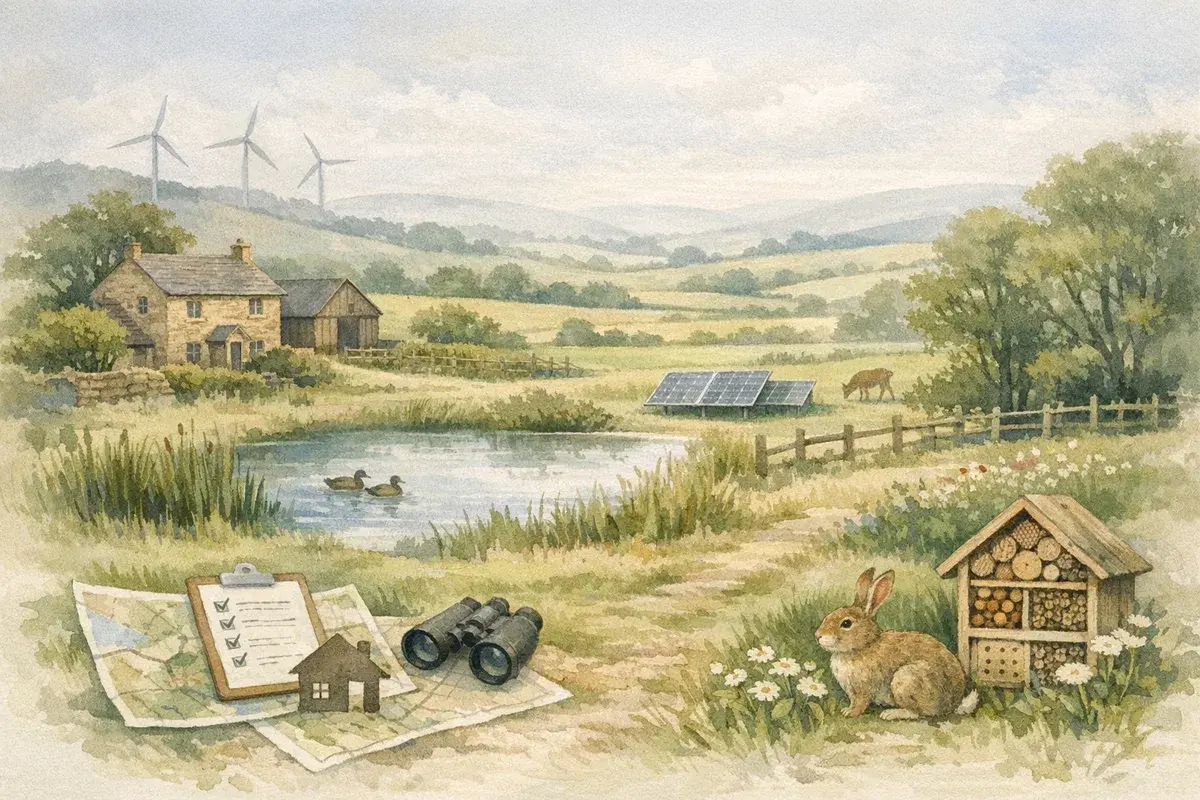
Environmental land listings are becoming a bigger part of the rural property market, and for good reason. They can offer habitat creation, carbon income, biodiversity gains and, in some cases, sensible long-term capital growth.
If you're scanning the market as a farmer, investor or estate agent, the detail matters. Location, scheme status, soil quality, access, water and legal restrictions can all change value fast.
The smartest approach is simple: treat these parcels as working assets, not just green space. A block of marginal pasture in Northumberland will play out very differently from a wet lowland parcel in Somerset or a chalk field margin in Cambridgeshire.
That's why environmental land listings need a closer read than standard arable or pasture ads. The headline acreage is only the start; the real story sits in consent, stewardship potential, yield trade-offs and the strength of local demand.
What Environmental Land Listings Include
At their simplest, environmental land listings are parcels marketed for environmental value as much as productive output. That might mean land suitable for habitat creation, peat restoration, woodland planting, wetland schemes, rewilding, biodiversity net gain uses or carbon-focused management.
We'd argue the term covers a wide spectrum, from small field corners and shelter belts to larger blocks of marginal grassland and former opencast land. Some listings come with existing scheme income, while others are blank canvases with strong potential but no guaranteed revenue. Those categories price on quite different logic, since stewardship land, peat, woodland, wetland and riparian strips each pull in their own buyer pool, so it pays to understand what you are really buying when environmental land comes up for sale before comparing two parcels on acreage alone.
Typical Land Types On The Market
You'll most often see low-input pasture, rough grazing, floodplain land, former arable on lighter soils, woodland creation sites and parcels with existing biodiversity value. In some parts of Devon and Cumbria, upland grazing fields are marketed for carbon and habitat outcomes as much as farming returns.
- Marginal pasture: Often lower rental value, but attractive for habitat or tree planting.
- Wetland or floodplain land: Suits water retention, peat and nature recovery projects.
- Former arable land: Useful for buffer strips, regenerative farming and biodiversity schemes.
- Woodland creation sites: Common where planting conditions and access are workable.
- Mixed amenity blocks: Sometimes sold with sporting or leisure rights alongside environmental use.
Not every listing is obvious from the headline. A grass field may look ordinary, yet carry excellent access, strong drainage potential or proximity to an existing habitat network. That can make it much more valuable to a buyer focused on environmental outcomes.
Why The Wording Matters
Agents often use broad phrases like 'natural capital opportunity' or 'suitable for environmental enhancement'. Those words are worth a closer look. They can signal everything from firm income potential to speculative suitability with no scheme in place.
As a buyer, ask what is actually meant by the description. Has the land got planning constraints, protected species records, moorland commons rights, mineral interests or agricultural occupancy implications? Those details can shape both price and end use.
How The Market Is Pricing Environmental Land
Pricing is still highly local, but environmental land listings now attract a clear premium where income potential is credible and the land is well connected to existing habitat or farm infrastructure. Land with flexible use, good access and workable topography tends to trade faster than isolated or heavily constrained parcels.
As of May 2026, buyers are still seeing a wide price spread across England and Wales. Broadly speaking, lower-grade grazing and restoration land can sit well below productive arable values, while land with consented habitat or strong natural capital attributes can rival or exceed nearby agricultural comparables.
| Land Type | Typical Market Position | Buyer Appeal | Date Reference |
|---|---|---|---|
| Rough grazing or marginal pasture | Lower to mid-range, depending on access and quality | Tree planting, biodiversity, carbon and low-input grazing | As of May 2026 |
| Former arable with environmental potential | Mid-range, often tied to soil and drainage | Buffer zones, habitat creation and regenerative farming | As of May 2026 |
| Land with scheme income or strong consent | Upper end of local market interest | Immediate cashflow and lower delivery risk | As of May 2026 |
| Wetland, peat or floodplain parcels | Highly variable, but can command strong interest | Water-backed restoration, carbon and biodiversity gains | As of May 2026 |
In practical terms, Norfolk and Lincolnshire buyers often focus on drainable land that can be turned into buffers or mixed-use environmental blocks. By contrast, in Somerset or parts of Yorkshire, wetter ground may be more attractive because it supports habitat or water management schemes without fighting the landscape.
The biggest pricing trap? Assuming environmental value automatically means higher value. Sometimes it does. Sometimes a restrictive designation, poor access or a weak local market means the land is worth less than a similar farm parcel nearby.
Income Streams Buyers Are Looking For
Today's buyers often want more than capital appreciation. They want a blend of income, tax efficiency and resilience, especially when agricultural margins are tight.
- Tiered land management payments: Useful where land can enter stewardship-style agreements.
- Carbon revenue: More relevant on woodland, peat and some soil-based schemes, though delivery risk remains.
- Biodiversity net gain: Important where units can be created and sold, subject to rules and verification.
- Leisure or sporting value: Can sit alongside environmental use on certain estates.
- Long-term capital growth: Often the main attraction for patient investors.
How To Assess A Listing Properly
The best environmental land listings are the ones where the paperwork matches the map. Before you fall in love with the idea, check the legal, physical and commercial fundamentals.
Start with access. Is there a proper right of way or legal access from the highway? Then look at drainage, boundary condition, existing tenancies, restrictive covenants and any ecological designations that could limit what you can do.
Planning, Designations And Consents
Protected habitats, Sites of Special Scientific Interest, common land, inward investment constraints and local planning policy can all affect delivery. In some counties, especially where land sits close to National Landscapes or flood-risk areas, those constraints are not minor footnotes. They're central to value.
Ask whether any works need consent, whether there are species surveys on record and whether public access obligations apply. If the land is meant for environmental enhancement, you still need to know what can legally happen there, not just what sounds appealing.
Physical Checks That Change The Numbers
Soil type matters. So does water. A parcel of clay land in Essex may suit wetland creation, while free-draining hill ground in Shropshire may be better for woodland establishment or low-intensity grazing.
It's also worth checking whether the site has hardstanding, tracks, mains water, fencing and shelter. Those features can improve operational practicality, which in turn supports value and marketability.
- Access: Legal and physical entry for machinery, fencing and maintenance.
- Water regime: Flooding, drainage, wet spots and seasonal saturation.
- Utilities: Power, water and drainage connections where relevant.
- Tenure: Vacant possession, grazing licence or farm business tenancy.
- Ecology: Survey status, habitat quality and protected species risk.
Where Demand Is Strongest Across The UK
Demand is strongest where environmental land can be turned into something measurable and saleable, with low friction and clear local need. That includes areas near large habitats, river catchments, upland restoration zones and counties with active farm diversification.
In the East of England, particularly Norfolk, Suffolk and parts of Lincolnshire, buyers often want land that can support nature recovery without compromising farm logistics too much. In South West England, including Devon, Somerset and Cornwall, there is keen interest in biodiversity, woodland and mixed grazing parcels.
Meanwhile, in Scotland, especially the central belt fringes and parts of the southern uplands, buyers may focus on peat, forestry transition and larger restoration blocks. In Wales, upland and valley-edge land can attract strong interest where it supports habitat, water quality and long-term stewardship.
County-level variation is still crucial. A small parcel in Cambridgeshire may command a different buyer audience from a similar acreage in Herefordshire, because one is viewed through arable transition and the other through mixed-farm diversification.
Estate agents should read demand carefully. Where there is active natural capital competition, the best listings are often those with clean titles, good road access and a clear delivery route. Without that, the pool narrows quickly.
How To Present Environmental Land To The Market
Good presentation makes a real difference. Buyers of environmental land listings want clarity, not poetry. The strongest listings set out the acreage, land grade, access, designations, current use and realistic future options in plain English.
It also helps to show the land in context. A parcel that looks ordinary on its own may be highly attractive if it sits next to a river corridor, existing woodland or an established stewardship block. That is the sort of detail serious buyers want early.
What Sellers Should Include
Landowners who want a serious response should be ready with maps, tenure details, boundary notes, planning history and any environmental reports already completed. If the land sits within a farmed holding, explain how it connects to the wider business and whether it is being sold with vacant possession.
For agents, the best listings separate speculation from fact. Say what the land currently is, what it can reasonably become and what evidence supports that view. That builds trust, and trust gets viewings.
- Title clarity: Avoids delay and buyer uncertainty.
- Location context: Helps buyers understand neighbouring habitat or farm use.
- Scheme history: Shows whether income has been established before.
- Constraints summary: Saves time for both sides.
- Practical photos: Show access, boundaries, water and topography.
A well-presented environmental parcel in Gloucestershire or Wiltshire can draw a broader audience than a vague listing with weak particulars. That matters, because environmental buyers often move quickly when the fit is right.
Conclusion
Environmental land listings are no longer a niche sideline. They now sit at the intersection of farming, ecology, investment and policy, which makes them more complex and often more interesting than standard land sales.
The key is to separate genuine opportunity from attractive wording. If you understand the land's physical traits, legal position, county-level demand and realistic income prospects, you'll make better decisions. In short, the strongest environmental land listings are the ones where the story, the site and the numbers all line up.
Disclaimer: AgLand.co.uk is a UK agricultural land and rural property matching service, where buyers register what they are looking for and owners advertise directly to the buyers who match, and a rural resource hub. Nothing in this text is intended as legal, financial, or investment advice. You should carry out your own due diligence and seek guidance from appropriately qualified professionals (for example, solicitors, land agents, surveyors, and financial advisors) for your specific circumstances.