
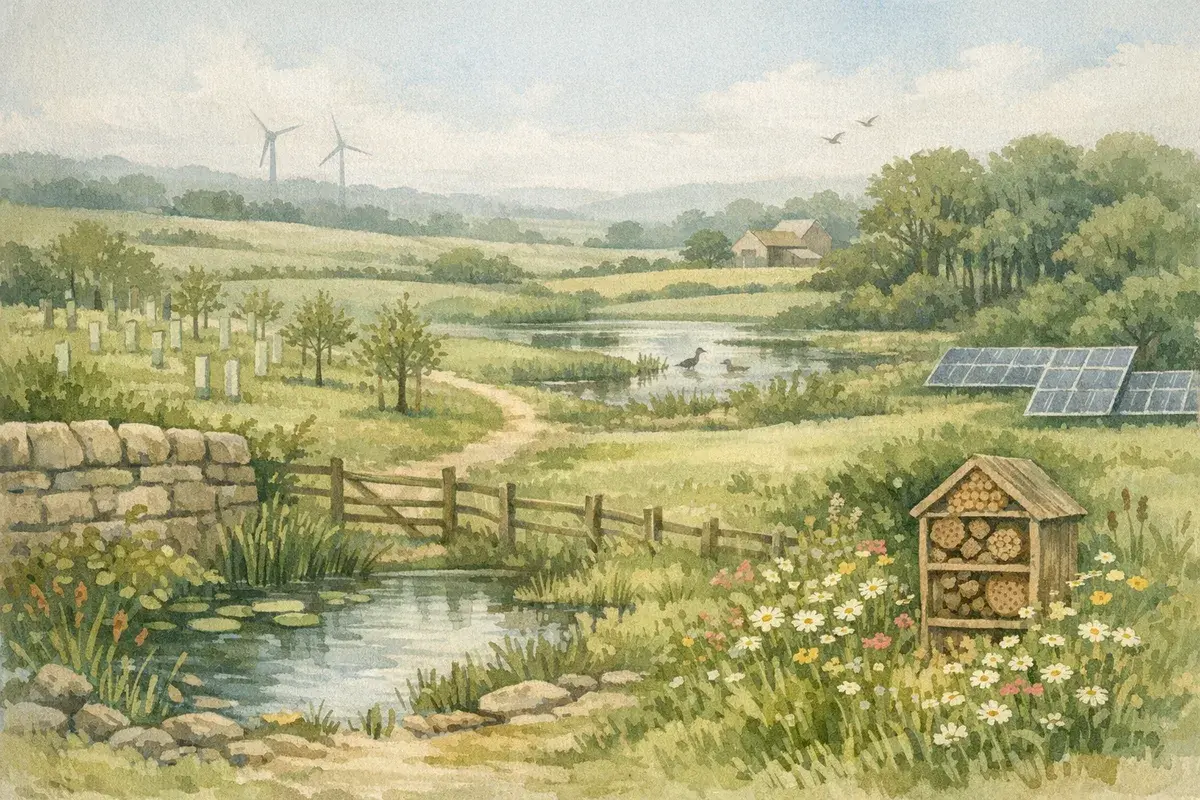
Environmental land for sale can mean anything from land in an agri-environment scheme to biodiversity-rich ground, peatland, margins, woodland, or parcels with carbon and natural capital potential. The right plot can offer income, stewardship payments, and long-term resilience, but the wrong one can tie up cash with limited flexibility.
If you're asking whether environmental land for sale is worth buying, the answer is usually 'it depends on the land, the scheme, and the restrictions'. Some parcels are attractive because they sit alongside productive grassland or arable blocks, while others appeal more to investors seeking stable, lower-intensity returns and strong environmental credentials.
We'd argue the key is to assess it like a farmer first and an investor second. What are you really buying: productive acres, habitat, payments, or optionality? That question matters in Cumbria, Norfolk, Devon, Northumberland, and the Welsh borders just as much as it does in the south east, because local land values, rainfall, soils, and access to schemes can change the case completely.
What Environmental Land For Sale Actually Means
Environmental land for sale is not a single asset class. It can include land already entered into Environmental Land Management schemes, former set-aside, hill ground, wet grassland, lowland heath, riparian strips, and parcels with woodland or peat restoration potential. Each has a different income profile, a different level of management input, and a different buyer pool.
For farmers, the appeal is often practical. A block of boundary habitat, wet corners, or rough grazing can support a wider holding without needing the same fertiliser, reseeding, or machinery spend as improved land. For investors, the attraction is the growing recognition that soil health, carbon storage, water quality, flood mitigation, and biodiversity all have value, even if that value is less straightforward than an outright crop margin. Investors who want land exposure without holding any title sometimes look at listed vehicles instead, though a farmland REIT trades control for liquidity and distributes rent that rarely looks generous on arable ground alone.
Common Types Of Environmental Land
In the market, the term usually covers a fairly broad mix of land uses. Some parcels are deep in countryside stewardship, others are private nature recovery projects, and some are simply marginal acres that could be reworked for environmental outputs.
- Stewardship land: land already delivering habitat or species protection under agreement.
- Margin land: field edges, buffer strips, and awkward corners offering lower-intensity value.
- Woodland and shelter belts: useful for timber, carbon, biodiversity, and amenity.
- Wetland or peatland: often bought for restoration, water management, or habitat gains.
- Riparian land: river-adjacent acreage that can aid nutrient reduction and flood resilience.
That mix matters because the valuation basis changes with it. A hectare of productive arable in Lincolnshire will not price the same way as a hectare of peat in the Pennines, even if both are technically 'land'.
How The Market Is Pricing Environmental Land
Pricing is still highly local, but there are clear patterns. As of May 2026, lower-grade environmental land often trades well below prime arable and dairy ground, while well-positioned parcels with amenity, development hope, or strong habitat value can command surprising premiums. In simple terms, the market pays for either income, scarcity, or opportunity. If a parcel delivers all three, bidders rise quickly.
Across England and Wales, investors and farmers are paying closer attention to net return rather than headline acreage price alone. That means a cheaper field can still be expensive if the obligations are fiddly, the access is poor, or the payment profile is weak. Conversely, a more expensive parcel can make sense if it sits in a strong landscape recovery area with reliable scheme income and low upkeep.
| Land Type | Typical Buyer Interest | Market Consideration | As Of |
|---|---|---|---|
| Stewardship grassland | Farmers, amenity buyers | Scheme income and grazing value | May 2026 |
| Peatland restoration land | Environmental investors, estates | Long-term restoration costs and carbon potential | May 2026 |
| Woodland parcels | Mixed buyers | Timber, carbon, recreation, and low management | May 2026 |
| Floodplain and wet grassland | Farmers, charities, institutional buyers | Water management, habitat, and grazing constraints | May 2026 |
There are regional differences too. In East Anglia, buyers often weigh environmental land against the opportunity cost of taking acreage out of strong arable rotations. In Wales and the South West, hill and rough grazing land can look more attractive because stewardship and habitat creation may align neatly with existing land use. In Yorkshire and Northumberland, upland land with moorland or sheep-grazing characteristics can have different income potential again, especially where access to conservation funding is plausible.
What Drives Value Up Or Down
A few factors consistently move prices. None of them is exotic, but together they tell you whether you're looking at a deal or a headache.
- Scheme income: the reliability, duration, and transferability of payments.
- Access: can machinery, stock, or contractors reach the land easily?
- Restrictions: covenants, grazing limits, water controls, or management plans.
- Location: proximity to watercourses, habitats, estates, or settlement edges.
- Long-term potential: woodland creation, wetland enhancement, or natural capital.
Due Diligence Before You Buy
Buying environmental land is not the same as buying a clean block of pasture. You need to read the title, the scheme paperwork, the maps, and the physical ground condition. A site can look straightforward on paper but still hide drainage issues, public access rights, conservation constraints, or a history of mismanagement that will cost time and money. Read the advert itself with the same scepticism, because a phrase like 'natural capital opportunity' can cover anything from an agreement already paying income to bare suitability with no scheme in place, a gap we unpick in what to look for in environmental land listings.
Start with the basics. Check who controls the land, what rights come with it, and whether there are any obligations that survive the sale. If the land is under an agri-environment agreement, find out what happens on completion, whether the agreement can be transferred, and who carries the risk if a payment claim is challenged later.
Documents And Checks That Matter
This is the point where careful buyers save themselves significant pain. The paperwork should tell you whether the land is a genuine asset or an expensive promise.
- Title deeds: confirm boundaries, access, easements, and any restrictive covenants.
- Scheme agreements: check payment terms, end dates, management obligations, and transfer rules.
- Environmental designations: note SSSI, SAC, SPA, or local wildlife site status.
- Soil and drainage reports: especially important on wet ground or restoration sites.
- Water rights and abstraction: crucial where wetland management or irrigation interacts with the parcel.
Also think about your end use. A farmer in Somerset might want low-input sheep grazing with occasional conservation payment, while a buyer in Essex may want a long-hold biodiversity asset with minimal operational burden. The same parcel won't suit both, which sounds obvious until you're in a competitive bidding process and emotion takes over.
Income Streams And Business Models
Environmental land for sale can support several income models, but the cashflow profile is usually less immediate than conventional farming. The strongest cases often blend payments, grazing, woodland value, and long-term natural capital growth rather than relying on one income line.
For agricultural buyers, this can work well as part of a wider holding. For example, rough ground in the Lake District may be modestly productive as sheep pasture but stronger as a mixed habitat parcel with stewardship support. In Norfolk or Lincolnshire, buffer strips and wetlands can help with compliance and water management, while still keeping the core arable business productive.
Potential Revenue Sources
Not every parcel will qualify for every stream, and that's the point. Good advice is about matching the land to the right model, not forcing a model onto the land.
- Agri-environment payments: recurring income for habitat, soil, and water actions.
- Grazing: low-input stock grazing on rough or seasonal land.
- Woodland products: timber, firewood, shelter, and amenity uses.
- Carbon and biodiversity potential: sometimes attractive, but terms vary widely.
- Water management value: flood storage, runoff reduction, and nutrient mitigation.
We'd be cautious about assuming carbon income will rescue a weak acquisition case. Some projects are real and robust, but others depend on long time horizons, verification costs, and contracts that can be harder to understand than a standard land sale. If the deal only works on the most optimistic assumptions, it probably doesn't work.
Regional Hotspots And Buyer Profiles Across The UK
Buyer behaviour changes a lot by county and landscape. In Devon and Cumbria, buyers often value environmental land because it sits naturally alongside existing livestock systems, commons, river corridors, or upland margins. In Cambridgeshire, Norfolk, and Lincolnshire, the conversation is more likely to centre on taking marginal land out of production, water quality, and scheme income replacing lost cropping margin.
Institutional buyers, family offices, charities, and estate buyers are increasingly active in parts of Scotland, North Wales, and the West Country, especially where land can support habitat networks or estate-wide environmental strategies. Farmers remain the most practical buyers, though, because they understand stocking, seasonal access, and the realities of keeping a holding operational.
Who Buys What, And Why
The buyer profile often tells you more than the asking price. A grazier will underwrite the land differently from a conservation-led investor, and that changes the bidding ceiling.
- Livestock farmers: want flexibility, grazing, and low disturbance management.
- Arable farmers: look for buffer land, nutrient planning, and wet corners.
- Estate owners: may want landscape coherence and long-term capital preservation.
- Environmental investors: focus on habitat, carbon, and measurable outcomes.
- Charities and trusts: often prioritise public benefit and ecosystem restoration.
That variety keeps demand healthy, but it also means competition can be uneven. A parcel of reedbed in East Yorkshire may attract a niche set of bidders, while a mixed grassland block in Hampshire could appeal to several buyer groups at once. More bidders usually means firmer pricing, especially if the land has clean access and clear scheme status.
Conclusion
Environmental land for sale can be a smart acquisition when the land, the obligations, and the income model all line up. The best purchases tend to sit at the intersection of agriculture, ecology, and long-term asset management, not in one camp alone.
Before you buy, judge the parcel on its real return, not just its story. If the scheme terms are clear, the land suits your holding, and the long-term use is realistic, environmental land can be a solid addition to a farm, estate, or rural investment portfolio.
Disclaimer: AgLand.co.uk is a UK agricultural land and rural property matching service, where buyers register what they are looking for and owners advertise directly to the buyers who match, and a rural resource hub. Nothing in this text is intended as legal, financial, or investment advice. You should carry out your own due diligence and seek guidance from appropriately qualified professionals (for example, solicitors, land agents, surveyors, and financial advisors) for your specific circumstances.